
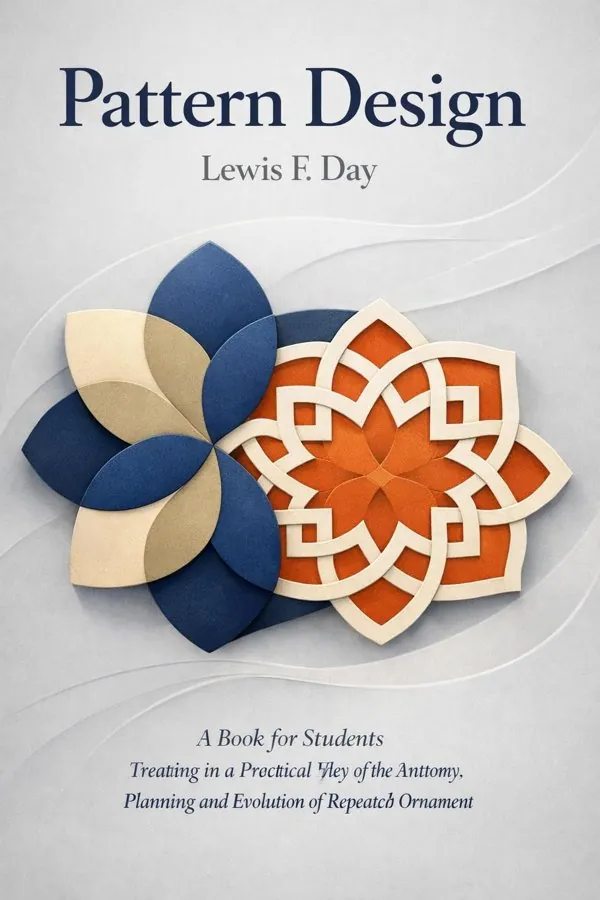
Pattern Design: A Book for Students Treating in a Practical Way of the Anatomy, Planning and Evolution of Repeated Ornament: Summary & Key Insights
by Lewis F. Day
 10 min9 chaptersAudio available
Key Takeaways from Pattern Design: A Book for Students Treating in a Practical Way of the Anatomy, Planning and Evolution of Repeated Ornament
A pattern only begins to make sense when you stop seeing it as a finished surface and start seeing it as a system.
The power of pattern lies in repetition, but repetition is never merely duplication.
Beautiful ornament often looks effortless, but Day insists that it is the result of careful planning.
No pattern tradition appears fully formed; ornament evolves by adaptation.
Nature is one of ornament’s richest sources, but Day warns that the designer who copies nature literally often misunderstands decorative art.
What Is Pattern Design: A Book for Students Treating in a Practical Way of the Anatomy, Planning and Evolution of Repeated Ornament About?
Pattern Design: A Book for Students Treating in a Practical Way of the Anatomy, Planning and Evolution of Repeated Ornament by Lewis F. Day is a design book spanning 9 pages. Lewis F. Day’s Pattern Design is a classic manual on how ornament works, why repeated forms create beauty, and how designers can build patterns with intelligence rather than instinct alone. Written for students and working designers, the book breaks pattern down into its essential parts: the motif, the repeat, the spacing, the underlying structure, and the visual rhythm that turns decoration into design. Day does not treat ornament as superficial embellishment. Instead, he shows that good pattern is planned, disciplined, and deeply connected to craft, culture, and the logic of surfaces. What makes this book enduring is its practical clarity. Drawing on examples from Japanese, Persian, Arabian, historic European, and contemporary decorative traditions, Day explains how patterns grow from geometry, nature, and artistic adaptation. He is less interested in copying old ornament than in teaching readers to understand its principles and apply them creatively. As a leading British designer, critic, and Arts and Crafts thinker, Day wrote with both technical knowledge and visual sensitivity. The result is a foundational guide for anyone interested in textiles, wallpaper, ceramics, interiors, illustration, or surface design—and a reminder that repetition, when thoughtfully handled, becomes art.
This FizzRead summary covers all 9 key chapters of Pattern Design: A Book for Students Treating in a Practical Way of the Anatomy, Planning and Evolution of Repeated Ornament in approximately 10 minutes, distilling the most important ideas, arguments, and takeaways from Lewis F. Day's work. Also available as an audio summary and Key Quotes Podcast.
Pattern Design: A Book for Students Treating in a Practical Way of the Anatomy, Planning and Evolution of Repeated Ornament
Lewis F. Day’s Pattern Design is a classic manual on how ornament works, why repeated forms create beauty, and how designers can build patterns with intelligence rather than instinct alone. Written for students and working designers, the book breaks pattern down into its essential parts: the motif, the repeat, the spacing, the underlying structure, and the visual rhythm that turns decoration into design. Day does not treat ornament as superficial embellishment. Instead, he shows that good pattern is planned, disciplined, and deeply connected to craft, culture, and the logic of surfaces.
What makes this book enduring is its practical clarity. Drawing on examples from Japanese, Persian, Arabian, historic European, and contemporary decorative traditions, Day explains how patterns grow from geometry, nature, and artistic adaptation. He is less interested in copying old ornament than in teaching readers to understand its principles and apply them creatively. As a leading British designer, critic, and Arts and Crafts thinker, Day wrote with both technical knowledge and visual sensitivity. The result is a foundational guide for anyone interested in textiles, wallpaper, ceramics, interiors, illustration, or surface design—and a reminder that repetition, when thoughtfully handled, becomes art.
Who Should Read Pattern Design: A Book for Students Treating in a Practical Way of the Anatomy, Planning and Evolution of Repeated Ornament?
This book is perfect for anyone interested in design and looking to gain actionable insights in a short read. Whether you're a student, professional, or lifelong learner, the key ideas from Pattern Design: A Book for Students Treating in a Practical Way of the Anatomy, Planning and Evolution of Repeated Ornament by Lewis F. Day will help you think differently.
- ✓Readers who enjoy design and want practical takeaways
- ✓Professionals looking to apply new ideas to their work and life
- ✓Anyone who wants the core insights of Pattern Design: A Book for Students Treating in a Practical Way of the Anatomy, Planning and Evolution of Repeated Ornament in just 10 minutes
Want the full summary?
Get instant access to this book summary and 100K+ more with Fizz Moment.
Get Free SummaryAvailable on App Store • Free to download
Key Chapters
A pattern only begins to make sense when you stop seeing it as a finished surface and start seeing it as a system. That is Day’s first and most important lesson. Every ornament, no matter how dense or luxurious it appears, can be understood by examining its basic components: the unit, the motif, the interval, and the method of connection. A student who learns to dissect a pattern gains control over it. Instead of being dazzled by complexity, the designer begins to understand how complexity is built.
Day treats ornament almost like a living structure. The motif is the visible form, but it is not enough on its own. It must be related to neighboring forms, fitted to a surface, and ordered according to some governing principle. A leaf, flower, scroll, star, or abstract shape becomes ornament only when it is organized into recurrence. That organization may be obvious, as in a regular diaper pattern, or subtle, as in a flowing textile repeat where the eye senses order before it fully sees it.
This way of thinking has immediate practical value. A wallpaper designer, for instance, should not simply sketch a bouquet and repeat it blindly. They should ask: what is the repeating unit, where does it lock, what spaces are left between forms, and what kind of movement does the repeat create across a wall? The same applies to fabric, tile, digital backgrounds, and branding systems.
Day’s deeper point is that ornament must be built, not improvised. To study pattern is to study relations, not isolated forms. Actionable takeaway: take any pattern you admire and redraw it as a structural diagram, identifying its motif, repeat unit, spacing, and linking lines before attempting to design your own.
The power of pattern lies in repetition, but repetition is never merely duplication. Day argues that the secret of ornament is rhythm: a recurring order that gives life to a surface without making it mechanical. Repetition provides unity, but variation prevents deadness. The designer’s challenge is to make forms recur in a way that feels inevitable yet alive.
If every element is exactly identical and equally spaced, a pattern may become stiff. If there is too much variation, however, the design dissolves into scattered decoration. Day points to the need for controlled recurrence. In good ornament, the eye recognizes a stable order while also enjoying shifts of emphasis, direction, scale, or detailing. This is why many successful historical patterns repeat a structure while modifying the internal drawing of leaves, flowers, or abstract elements. The framework remains coherent even as the details breathe.
Consider printed fabric. A rigid grid of identical blossoms may look flat and predictable. But if the blossoms are arranged in a repeating structure with alternating directions, supporting leaves, and carefully adjusted gaps, the pattern gains movement. Similarly, in digital interface backgrounds or packaging design, repeating elements can create brand consistency while subtle changes in size or color keep the design engaging.
Day’s insight is especially relevant today, when software makes endless duplication easy. The tool can repeat; the designer must create rhythm. Pattern succeeds when it balances order and vitality. Actionable takeaway: when designing a repeat, establish one stable system first, then introduce one controlled kind of variation—such as rotation, scale, or secondary detail—to keep the pattern from becoming monotonous.
Beautiful ornament often looks effortless, but Day insists that it is the result of careful planning. Before a designer refines motifs or adds decorative richness, they must solve the problem of arrangement. How will the repeat tile? What is the governing grid? What kind of spacing will support the design? What visual weight will the elements carry across the surface? Planning is not an obstacle to creativity; it is what allows creativity to function.
Day sees planning as the stage where ornament becomes suited to its purpose. A textile pattern, for example, must consider drape, scale, and viewing distance. A wallpaper must read well over a broad surface without exhausting the eye. A tile design must respect physical joints and edges. These practical conditions shape the pattern from the beginning. The student who starts with a pretty sketch and only later worries about the repeat often discovers awkward seams, empty zones, or crowded intersections.
This is why Day encourages constructing pattern from a scheme. A designer may begin with a square, diamond, stripe, ogee, or lattice arrangement and then adapt motifs to it. The structure gives direction to invention. In practice, this might mean sketching a half-drop repeat before drawing floral elements, or setting a radial geometry for a ceramic motif before adding ornamented detail. Even a contemporary social media template or website background benefits from the same logic: define the system before embellishing the surface.
Day’s broader lesson is disciplined foresight. Decorative success depends less on spontaneous flourish than on premeditated fit. Actionable takeaway: before drawing any final motif, map the repeat structure and test it as a plain scaffold so you can solve alignment, spacing, and balance before adding visual complexity.
No pattern tradition appears fully formed; ornament evolves by adaptation. Day presents decorative history not as a museum of fixed styles but as a record of forms changing under the pressure of materials, techniques, taste, and cultural exchange. A motif migrates from architecture to textile, from weaving to print, from natural image to stylized sign. Understanding this process helps students see design as development rather than imitation.
A flower in ornament is rarely just a flower. Over time, repeated use, technical limitations, and artistic intention simplify it, abstract it, and reshape it into a pattern element. A realistic blossom may become a symmetrical emblem, then a scrolling arabesque component, then a geometric rosette. The same principle applies to leaves, vines, waves, stars, and animals. Day wants students to understand not only what forms look like, but how they became what they are.
This historical view matters because it frees the designer from passive copying. A Persian motif, a Japanese wave, or a Gothic foliate form should not be reproduced merely because it is attractive. It should be studied for its logic of transformation. How was it adapted to a repeat? How did craft technique influence its shape? How did one culture reinterpret another’s visual language?
In modern practice, this insight encourages designers to evolve references responsibly. A heritage motif might be translated into contemporary wallpaper, packaging, or motion graphics by preserving its structural intelligence while adjusting scale, contrast, or drawing style for new uses. Actionable takeaway: when using historical inspiration, trace one motif through at least two stages of simplification or transformation so your design grows from understanding rather than direct borrowing.
Nature is one of ornament’s richest sources, but Day warns that the designer who copies nature literally often misunderstands decorative art. A plant in the field and a plant in pattern serve different purposes. The first belongs to natural growth; the second belongs to the ordering of a surface. Ornament therefore begins not with imitation, but with selection, simplification, and adaptation.
Day does not reject natural study. On the contrary, he values close observation of leaves, flowers, stems, shells, and organic movement. What he rejects is raw transcription. In pattern, the designer must choose the essential line, mass, or rhythm that can be repeated convincingly. A flower may need to be flattened, a stem redirected, or a cluster made symmetrical so it works within a repeat. This is not a betrayal of nature but a translation into decorative language.
The principle is easy to see in textile design. A realistic rose with every petal rendered may be impressive in illustration, yet cumbersome in repeat. A stylized rose reduced to a few bold shapes can create stronger pattern rhythm, reproduce more clearly, and maintain coherence across a large surface. In logo systems, icon sets, and packaging, the same truth applies: natural references must often be distilled to their most memorable structure.
Day’s lesson is especially helpful for beginners, who often think good design means drawing more detail. Decorative success usually depends on drawing less, but more decisively. Nature offers material, not finished ornament. Actionable takeaway: choose a natural form, sketch it from life, then create three increasingly simplified versions until you arrive at one that preserves character while functioning clearly in repetition.
Even the most flowing ornament often rests on invisible geometry. Day repeatedly shows that behind floral sprays, arabesques, interlacing bands, and abstract repeats lies a structural order of lines, axes, and intervals. Geometry is not the enemy of beauty; it is the hidden framework that allows beauty to extend across a surface with coherence. When students overlook this, their patterns may look attractive in fragments but fail as repeats.
Day values geometry because it creates consistency. Grids, diagonals, circles, diamonds, and tessellating frameworks help distribute motifs evenly, control spacing, and maintain balance. This does not mean all pattern must look rigid. The underlying geometry can be concealed beneath organic drawing. In fact, some of the most graceful designs depend on firm geometric planning that the viewer barely notices.
Consider Islamic ornament, where geometric intelligence is often explicit, or Arts and Crafts wallpaper, where botanical forms may be arranged on an implicit lattice. In both cases, the geometry keeps the design from collapsing into visual clutter. Contemporary designers rely on the same principle when building seamless repeats in software, designing modular icon systems, or creating brand patterns for packaging and environments. Without a framework, there is no reliable repeat; without flexibility, there is no life.
Day’s contribution here is methodological. He teaches students to see ornament as ordered extension over space. Once the structural net is established, creativity can move freely within it. Geometry is the discipline that makes invention sustainable. Actionable takeaway: build your next pattern on a clear geometric base—square grid, diagonal lattice, stripe, or circular repeat—and test the scaffold alone before layering motifs over it.
Pattern is never purely formal; it is also cultural memory organized on a surface. Day draws from Japanese, Persian, Arabian, and European examples to show that different traditions solve decorative problems in distinct ways. One culture may emphasize flatness and asymmetry, another luxuriant interlace, another stylized botany, another geometric rigor. To study these traditions is to expand one’s design vocabulary and learn that there is no single formula for ornament.
What interests Day is not exotic novelty but the intelligence embedded in each style. Japanese design may reveal economy, spacing, and the expressive use of emptiness. Persian ornament may demonstrate how floral richness can remain controlled within an overall system. Arabian pattern shows extraordinary mastery of repetition, abstraction, and surface unity. European historic traditions offer lessons in adaptation to architecture, textiles, and craftsmanship. Each tradition embodies choices about line, rhythm, symbolism, and structure.
For designers, this comparative perspective is invaluable. It encourages looking beyond local habits and recognizing that visual order can be achieved through many means. At the same time, it invites respect. Cultural forms should be studied carefully, not stripped of meaning and used carelessly. The goal is not to mix motifs indiscriminately but to understand the principles that make each tradition effective.
In practice, a modern designer might learn asymmetrical balance from Japanese prints, all-over repeat control from Islamic geometry, and stylized botanical simplification from Persian textiles—then apply those lessons to original work rather than direct quotation. Actionable takeaway: study one pattern tradition outside your usual reference set and identify three structural principles you can adapt without copying its motifs verbatim.
A pattern is not made by line alone. Day understands that color and texture profoundly affect how ornament is perceived, repeated, and emotionally received. The same design can feel delicate, opulent, restful, or overpowering depending on its palette and material expression. For that reason, color should not be treated as an afterthought applied to a completed drawing. It is part of the pattern’s architecture.
Color influences emphasis, separation, and rhythm. Contrasting colors can clarify the repeat and make the pattern structure explicit. Related tones can soften edges and create atmospheric continuity. A limited palette often strengthens design by reducing confusion and directing attention to form. Excessive contrast, by contrast, may flatten complexity into noise. Day’s practical concern is always suitability: color must support the purpose of the ornament and the surface on which it appears.
Texture matters in a similar way. Printed cotton, woven damask, glazed tile, carved wood, and digital screens all interpret pattern differently. Fine detail that succeeds in engraving may disappear in weave. A texture-rich material may need simpler motifs. A smooth printed surface can support sharper contrasts. These material conditions shape design decisions from the outset.
This remains highly relevant for modern creators working across media. A pattern meant for phone cases, upholstery, web headers, and gift wrap cannot simply be transferred unchanged from one format to another. Day reminds us that surface is physical, and ornament must respond to it. Actionable takeaway: test your pattern in at least two color palettes and two output contexts before finalizing it, checking whether the repeat remains clear and appropriate in each.
Good pattern design is not the product of inspiration alone; it is a discipline learned through repeated seeing, analyzing, and making. Day writes for students, and one of the strongest themes in the book is that ability grows through exercises. By copying excellent examples, reducing them to schemes, redrawing motifs, and constructing original repeats, the learner develops judgment. The trained eye does not emerge suddenly. It is built through practice.
Day values exercises because they sharpen perception. A beginner often notices only the obvious motif—the flower, leaf, or star. A more advanced student sees proportion, interval, directional flow, and surface balance. Those qualities become visible only when one studies patterns actively rather than passively admiring them. Redrawing a historic border or reconstructing a repeat from observation reveals decisions that casual looking misses.
Practical application is central. A student might begin by tracing the geometric basis of a traditional tile pattern, then invent a new motif to fit the same structure. Or they might simplify a natural form into a repeat unit, test different spacings, and compare the results. In professional settings, the same habits remain useful: building swatches, testing scale, revising repeats, and comparing alternate colorways are all forms of disciplined experimentation.
Day’s deeper message is encouraging. Design talent matters, but method matters more than many beginners assume. The student becomes capable by working systematically. Pattern knowledge is embodied through doing. Actionable takeaway: create a weekly exercise routine in which you analyze one existing pattern, reconstruct its repeat, and then design one original variation using the same underlying structure.
All Chapters in Pattern Design: A Book for Students Treating in a Practical Way of the Anatomy, Planning and Evolution of Repeated Ornament
About the Author
Lewis Foreman Day (1845–1910) was a British designer, writer, and critic whose work helped shape late nineteenth-century thinking on ornament and the decorative arts. Associated with the Arts and Crafts movement, he worked across stained glass, textiles, wallpaper, and interior design, combining practical craft knowledge with a strong interest in design theory. Day became especially influential through his books and lectures, in which he explained the principles of pattern, ornament, and applied art for students and working designers. Unlike purely academic commentators, he wrote from the perspective of someone deeply involved in making and visual problem-solving. His clear, analytical approach made complex ideas about design accessible and useful. Today, he is remembered as one of the period’s most important interpreters of decorative design and as a lasting authority on pattern and ornament.
Get This Summary in Your Preferred Format
Read or listen to the Pattern Design: A Book for Students Treating in a Practical Way of the Anatomy, Planning and Evolution of Repeated Ornament summary by Lewis F. Day anytime, anywhere. FizzRead offers multiple formats so you can learn on your terms — all free.
Available formats: App · Audio · PDF · EPUB — All included free with FizzRead
Download Pattern Design: A Book for Students Treating in a Practical Way of the Anatomy, Planning and Evolution of Repeated Ornament PDF and EPUB Summary
Key Quotes from Pattern Design: A Book for Students Treating in a Practical Way of the Anatomy, Planning and Evolution of Repeated Ornament
“A pattern only begins to make sense when you stop seeing it as a finished surface and start seeing it as a system.”
“The power of pattern lies in repetition, but repetition is never merely duplication.”
“Beautiful ornament often looks effortless, but Day insists that it is the result of careful planning.”
“No pattern tradition appears fully formed; ornament evolves by adaptation.”
“Nature is one of ornament’s richest sources, but Day warns that the designer who copies nature literally often misunderstands decorative art.”
Frequently Asked Questions about Pattern Design: A Book for Students Treating in a Practical Way of the Anatomy, Planning and Evolution of Repeated Ornament
Pattern Design: A Book for Students Treating in a Practical Way of the Anatomy, Planning and Evolution of Repeated Ornament by Lewis F. Day is a design book that explores key ideas across 9 chapters. Lewis F. Day’s Pattern Design is a classic manual on how ornament works, why repeated forms create beauty, and how designers can build patterns with intelligence rather than instinct alone. Written for students and working designers, the book breaks pattern down into its essential parts: the motif, the repeat, the spacing, the underlying structure, and the visual rhythm that turns decoration into design. Day does not treat ornament as superficial embellishment. Instead, he shows that good pattern is planned, disciplined, and deeply connected to craft, culture, and the logic of surfaces. What makes this book enduring is its practical clarity. Drawing on examples from Japanese, Persian, Arabian, historic European, and contemporary decorative traditions, Day explains how patterns grow from geometry, nature, and artistic adaptation. He is less interested in copying old ornament than in teaching readers to understand its principles and apply them creatively. As a leading British designer, critic, and Arts and Crafts thinker, Day wrote with both technical knowledge and visual sensitivity. The result is a foundational guide for anyone interested in textiles, wallpaper, ceramics, interiors, illustration, or surface design—and a reminder that repetition, when thoughtfully handled, becomes art.
You Might Also Like
The Design of Everyday Things
Don Norman
10 min
The Better Angels of Our Nature
Steven Pinker
10 min
A Designer's Art
Paul Rand
10 min
Architects' Sketchbooks
Various Editors
10 min
Architectural Graphic Standards
The American Institute of Architects
10 min
Design Is Storytelling
Ellen Lupton
10 minBrowse by Category
Ready to read Pattern Design: A Book for Students Treating in a Practical Way of the Anatomy, Planning and Evolution of Repeated Ornament?
Get the full summary and 100K+ more books with Fizz Moment.