
Lewis F. Day Books
Lewis Foreman Day (1845–1910) was a British designer, writer, and critic associated with the Arts and Crafts movement. He was known for his work in stained glass, textiles, and wallpaper design, as well as for his influential writings on design theory and ornamentation.
Known for: Pattern Design: A Book for Students Treating in a Practical Way of the Anatomy, Planning and Evolution of Repeated Ornament
Books by Lewis F. Day
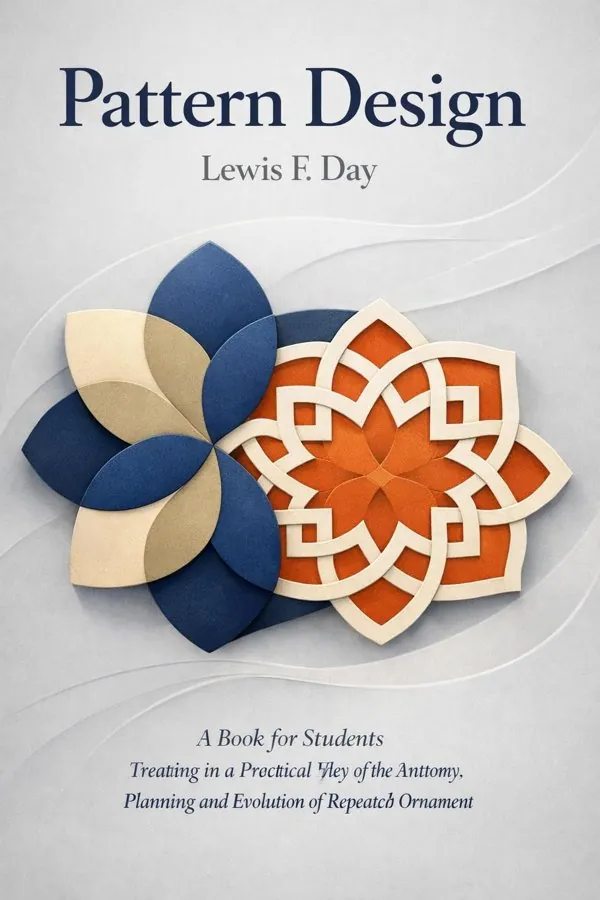
Pattern Design: A Book for Students Treating in a Practical Way of the Anatomy, Planning and Evolution of Repeated Ornament
Lewis F. Day’s Pattern Design is a classic manual on how ornament works, why repeated forms create beauty, and how designers can build patterns with intelligence rather than instinct alone. Written for students and working designers, the book breaks pattern down into its essential parts: the motif, the repeat, the spacing, the underlying structure, and the visual rhythm that turns decoration into design. Day does not treat ornament as superficial embellishment. Instead, he shows that good pattern is planned, disciplined, and deeply connected to craft, culture, and the logic of surfaces. What makes this book enduring is its practical clarity. Drawing on examples from Japanese, Persian, Arabian, historic European, and contemporary decorative traditions, Day explains how patterns grow from geometry, nature, and artistic adaptation. He is less interested in copying old ornament than in teaching readers to understand its principles and apply them creatively. As a leading British designer, critic, and Arts and Crafts thinker, Day wrote with both technical knowledge and visual sensitivity. The result is a foundational guide for anyone interested in textiles, wallpaper, ceramics, interiors, illustration, or surface design—and a reminder that repetition, when thoughtfully handled, becomes art.
Read SummaryKey Insights from Lewis F. Day
The Anatomy of Ornament
A pattern only begins to make sense when you stop seeing it as a finished surface and start seeing it as a system. That is Day’s first and most important lesson. Every ornament, no matter how dense or luxurious it appears, can be understood by examining its basic components: the unit, the motif, the...
From Pattern Design: A Book for Students Treating in a Practical Way of the Anatomy, Planning and Evolution of Repeated Ornament
Repetition Creates Rhythm, Not Sameness
The power of pattern lies in repetition, but repetition is never merely duplication. Day argues that the secret of ornament is rhythm: a recurring order that gives life to a surface without making it mechanical. Repetition provides unity, but variation prevents deadness. The designer’s challenge is ...
From Pattern Design: A Book for Students Treating in a Practical Way of the Anatomy, Planning and Evolution of Repeated Ornament
Planning Comes Before Decoration
Beautiful ornament often looks effortless, but Day insists that it is the result of careful planning. Before a designer refines motifs or adds decorative richness, they must solve the problem of arrangement. How will the repeat tile? What is the governing grid? What kind of spacing will support the ...
From Pattern Design: A Book for Students Treating in a Practical Way of the Anatomy, Planning and Evolution of Repeated Ornament
Ornament Evolves Through Adaptation
No pattern tradition appears fully formed; ornament evolves by adaptation. Day presents decorative history not as a museum of fixed styles but as a record of forms changing under the pressure of materials, techniques, taste, and cultural exchange. A motif migrates from architecture to textile, from ...
From Pattern Design: A Book for Students Treating in a Practical Way of the Anatomy, Planning and Evolution of Repeated Ornament
Nature Must Be Interpreted, Not Copied
Nature is one of ornament’s richest sources, but Day warns that the designer who copies nature literally often misunderstands decorative art. A plant in the field and a plant in pattern serve different purposes. The first belongs to natural growth; the second belongs to the ordering of a surface. Or...
From Pattern Design: A Book for Students Treating in a Practical Way of the Anatomy, Planning and Evolution of Repeated Ornament
Geometry Gives Pattern Its Backbone
Even the most flowing ornament often rests on invisible geometry. Day repeatedly shows that behind floral sprays, arabesques, interlacing bands, and abstract repeats lies a structural order of lines, axes, and intervals. Geometry is not the enemy of beauty; it is the hidden framework that allows bea...
From Pattern Design: A Book for Students Treating in a Practical Way of the Anatomy, Planning and Evolution of Repeated Ornament
About Lewis F. Day
Lewis Foreman Day (1845–1910) was a British designer, writer, and critic associated with the Arts and Crafts movement. He was known for his work in stained glass, textiles, and wallpaper design, as well as for his influential writings on design theory and ornamentation.

Frequently Asked Questions
Lewis Foreman Day (1845–1910) was a British designer, writer, and critic associated with the Arts and Crafts movement. He was known for his work in stained glass, textiles, and wallpaper design, as well as for his influential writings on design theory and ornamentation.
Read Lewis F. Day's books in 15 minutes
Get AI-powered summaries with key insights from 1 book by Lewis F. Day.