
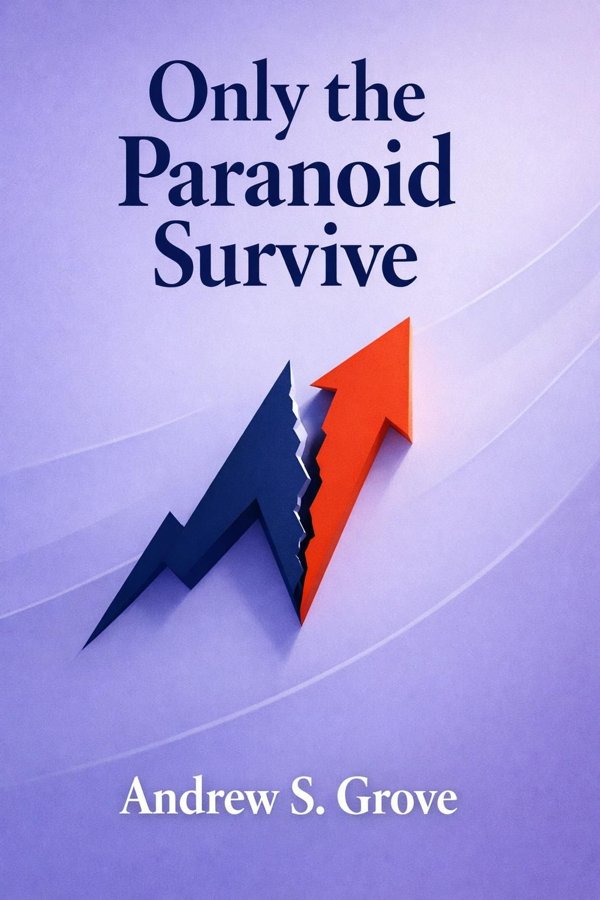
Only the Paranoid Survive: Summary & Key Insights
by Andrew Grove
 10 min5 chaptersAudio available
What Is Only the Paranoid Survive About?
Only the Paranoid Survive by Andrew Grove is a business book published in 1996 spanning 5 pages. In this influential business book, Intel co-founder and former CEO Andrew S. Grove shares his insights on how companies and leaders can navigate strategic inflection points—moments when massive change transforms industries. Drawing from his experience leading Intel through technological and competitive upheavals, Grove explains how paranoia, vigilance, and adaptability are essential for survival and success in a rapidly changing world.
This FizzRead summary covers all 5 key chapters of Only the Paranoid Survive in approximately 10 minutes, distilling the most important ideas, arguments, and takeaways from Andrew Grove's work. Also available as an audio summary and Key Quotes Podcast.
Only the Paranoid Survive: How to Exploit the Crisis Points That Challenge Every Company and Career
In this influential business book, Intel co-founder and former CEO Andrew S. Grove shares his insights on how companies and leaders can navigate strategic inflection points—moments when massive change transforms industries. Drawing from his experience leading Intel through technological and competitive upheavals, Grove explains how paranoia, vigilance, and adaptability are essential for survival and success in a rapidly changing world.
Who Should Read Only the Paranoid Survive?
This book is perfect for anyone interested in business and looking to gain actionable insights in a short read. Whether you're a student, professional, or lifelong learner, the key ideas from Only the Paranoid Survive by Andrew Grove will help you think differently.
- ✓Readers who enjoy business and want practical takeaways
- ✓Professionals looking to apply new ideas to their work and life
- ✓Anyone who wants the core insights of Only the Paranoid Survive in just 10 minutes
Want the full summary?
Get instant access to this book summary and 100K+ more with Fizz Moment.
Get Free SummaryAvailable on App Store • Free to download
Key Chapters
Every business, regardless of size or industry, eventually encounters a strategic inflection point—a moment when fundamental forces in the environment shift so dramatically that the old rules no longer apply. From my experience at Intel, a strategic inflection point is not merely a fluctuation in market trends; it is a complete change in the structure of how your business operates, competes, and delivers value.
When we were in the memory chip business, Intel’s world seemed stable. We had built expertise, infrastructure, and relationships around producing DRAMs. But then came Japanese competitors, armed with superior manufacturing efficiency and quality control. The effect wasn’t immediate; it was insidious. Prices fell, demand declined, and quality expectations rose beyond our ability to match them. At first, we didn’t see this as an inflection point. We thought it was a temporary slump. Only later did we realize that the underlying dynamics—the technology, the competition, the customer expectations—had changed permanently.
That realization was the turning point. A strategic inflection point forces you to decide whether your current strategy aligns with a new reality. Most leaders fail not because they miss the answer, but because they fail to ask the right questions soon enough. They cling to what worked yesterday, unaware that yesterday’s wisdom has expired.
Technological changes are often the triggers. Think of how digital photography disrupted film, or how online retail transformed physical stores. But the force can also be competitive or regulatory, even cultural. What matters is your capacity to perceive the shift early and its implication on your core assumptions. The uncomfortable truth is that you rarely recognize an inflection point as it happens—it looks like noise, or temporary turbulence. The challenge for every manager is to distinguish noise from signal.
My advice: listen widely, especially to those closest to execution—your front-line engineers, your salespeople, your customers. They often experience the tremors first. In the same way seismologists detect small quakes long before major ones, your team can alert you to subtle dissonances between the market’s behavior and your current strategy. The leader’s task is to take those tremors seriously, to remain paranoid enough to investigate whether they might herald a seismic shift.
When you learn to see these inflection points clearly, you unlock strategic freedom. You are no longer trapped by inertia; you can pivot intelligently, redefine your business identity, and seize opportunities others fear to confront.
At Intel, our decision to leave memory chips and focus on microprocessors was one of the most painful—and most pivotal—choices of our history. I remember the tension vividly. For years, DRAMs had been our pride and symbol of technological mastery. To abandon that was to abandon part of our identity. Yet the numbers told a stark story. Japanese manufacturers were dominating memory production, while the rising personal computer market needed advanced microprocessors. The strategic inflection point was unavoidable.
The shift did not happen in a single boardroom meeting. It emerged from countless small observations, frustrations, and failed recoveries. At first, we resisted. Intel had world-class engineers who were convinced that perseverance would win. But it became increasingly clear that we were fighting a war no longer ours to win. The core forces had changed—manufacturing scale, quality systems, and global cost efficiencies mattered far more than innovation alone.
When Gordon Moore and I finally articulated the reality—that our future lay in microprocessors—we felt both liberation and fear. Liberation because we could see a path forward, fear because the path required shedding our comfort zone. Implementing the transition was not just a strategic act; it was a cultural transformation. We had to redefine ourselves from a memory company into the engine of computing power.
Mobilizing the organization took intense communication and participation. I learned that even rational arguments are not enough; people need emotional alignment. We had to bring employees to a shared understanding that survival required change. Many left, unable to reconcile the departure from the past. Those who stayed became the backbone of Intel’s next era. The experience taught me that the essence of leadership during transformation lies not only in decision-making but in sustaining the collective energy to move through uncertainty.
In hindsight, the decision transformed Intel into a global leader in computing technology. But at the time, we were merely acting on instinct sharpened by paranoia. The lesson is simple: when you hit a strategic inflection point, indecision is the enemy. You cannot wait until all data are clear—by then, it’s too late. You must act amidst ambiguity, guided by informed judgment and courage.
+ 3 more chapters — available in the FizzRead app
All Chapters in Only the Paranoid Survive
About the Author
Andrew S. Grove (1936–2016) was a Hungarian-American engineer, businessman, and author. As one of the founders and the third CEO of Intel Corporation, he played a pivotal role in shaping the modern semiconductor industry. Grove was known for his rigorous management style and his influential writings on leadership and strategy.
Get This Summary in Your Preferred Format
Read or listen to the Only the Paranoid Survive summary by Andrew Grove anytime, anywhere. FizzRead offers multiple formats so you can learn on your terms — all free.
Available formats: App · Audio · PDF · EPUB — All included free with FizzRead
Download Only the Paranoid Survive PDF and EPUB Summary
Key Quotes from Only the Paranoid Survive
“At Intel, our decision to leave memory chips and focus on microprocessors was one of the most painful—and most pivotal—choices of our history.”
Frequently Asked Questions about Only the Paranoid Survive
Only the Paranoid Survive by Andrew Grove is a business book that explores key ideas across 5 chapters. In this influential business book, Intel co-founder and former CEO Andrew S. Grove shares his insights on how companies and leaders can navigate strategic inflection points—moments when massive change transforms industries. Drawing from his experience leading Intel through technological and competitive upheavals, Grove explains how paranoia, vigilance, and adaptability are essential for survival and success in a rapidly changing world.
You Might Also Like





Browse by Category
Ready to read Only the Paranoid Survive?
Get the full summary and 100K+ more books with Fizz Moment.