
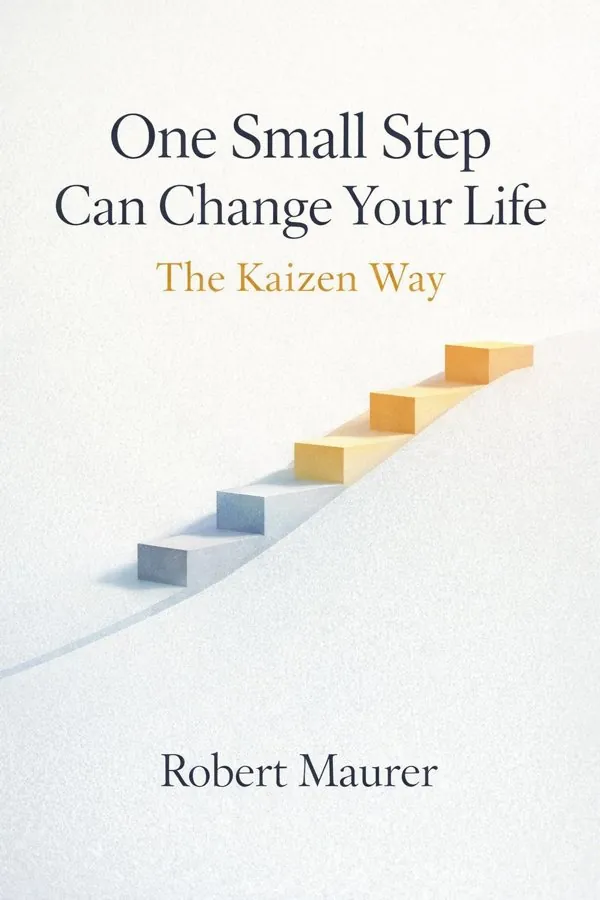
One Small Step Can Change Your Life: The Kaizen Way: Summary & Key Insights
 10 min7 chaptersAudio available
What Is One Small Step Can Change Your Life: The Kaizen Way About?
One Small Step Can Change Your Life: The Kaizen Way by Robert Maurer is a habits book spanning 7 pages. This book introduces the Japanese philosophy of Kaizen—making small, continuous improvements to achieve lasting change. Robert Maurer, a psychologist at UCLA, explains how taking small, manageable steps can help overcome fear, build new habits, and achieve personal and professional goals. The book provides practical strategies for applying Kaizen to health, relationships, work, and creativity.
This FizzRead summary covers all 7 key chapters of One Small Step Can Change Your Life: The Kaizen Way in approximately 10 minutes, distilling the most important ideas, arguments, and takeaways from Robert Maurer's work. Also available as an audio summary and Key Quotes Podcast.
One Small Step Can Change Your Life: The Kaizen Way
This book introduces the Japanese philosophy of Kaizen—making small, continuous improvements to achieve lasting change. Robert Maurer, a psychologist at UCLA, explains how taking small, manageable steps can help overcome fear, build new habits, and achieve personal and professional goals. The book provides practical strategies for applying Kaizen to health, relationships, work, and creativity.
Who Should Read One Small Step Can Change Your Life: The Kaizen Way?
This book is perfect for anyone interested in habits and looking to gain actionable insights in a short read. Whether you're a student, professional, or lifelong learner, the key ideas from One Small Step Can Change Your Life: The Kaizen Way by Robert Maurer will help you think differently.
- ✓Readers who enjoy habits and want practical takeaways
- ✓Professionals looking to apply new ideas to their work and life
- ✓Anyone who wants the core insights of One Small Step Can Change Your Life: The Kaizen Way in just 10 minutes
Want the full summary?
Get instant access to this book summary and 100K+ more with Fizz Moment.
Get Free SummaryAvailable on App Store • Free to download
Key Chapters
Kaizen grew out of postwar Japan, when businesses faced the monumental challenge of rebuilding an economy from ruins. Rather than compete through gigantic shifts, Japanese managers emphasized small, consistent refinements—tiny corrections done repeatedly. From production lines at Toyota to office workflows across industries, Kaizen became synonymous with excellence through accumulation: countless little adjustments summing into world-class systems.
When I studied this model through the lens of psychology, I discovered its deeper human truth. Kaizen isn’t simply a management technique—it’s a philosophy of human evolution. Every meaningful change, whether you’re improving a relationship or learning a skill, happens through gradual adaptation. The Japanese understood this intuitively: a single, consistent improvement today may seem trivial, but it invites continuity, resilience, and mastery tomorrow.
This mindset rescues us from a trap I see often in modern life—the obsession with rapid transformation. People want to lose weight in a month, learn a language overnight, change a career within a week. When those grand gestures fail, they interpret the setback as personal weakness. But in reality, their brains were never given a chance to integrate the change. Kaizen teaches us to think differently: transformation does not require revolution; it requires evolution.
Once you internalize this idea, you begin treating each moment as an opportunity to progress marginally. You discover that success is less about dramatic breakthroughs, and more about removing unnecessary resistance. That is how Japan turned small, continuous improvements into global competitiveness—and how you can turn them into personal fulfillment.
When I teach the Kaizen method in seminars or clinical settings, I start with an unavoidable truth: fear is the enemy of change. The minute you demand too much from yourself, your brain’s primitive centers seize control. The amygdala interprets dramatic change as danger. It’s an instinct designed to protect you, but now it sabotages your growth.
The brilliance of Kaizen lies in its ability to circumvent this reaction. Small steps slip under the radar of fear. They don’t alarm the brain because they don’t threaten survival. When you focus on a single, simple action—choosing one healthier meal or cleaning one corner of your desk—the brain stays calm and receptive.
As a psychologist, I’ve watched patients paralyzed by fear of failure begin to move forward when we scaled their goals down to nearly invisible increments. A woman terrified of exercise started by simply standing in her gym clothes for five minutes. A man struggling with public speaking began by rehearsing in front of his mirror. Slowly, these micro-steps built comfort. Fear diminished, confidence grew, and change began.
Kaizen isn’t about cunningly tricking the brain—it’s about respecting its design. We stop forcing transformation through sheer willpower and instead build safety into the process. Change becomes gentle, livable, and sustainable. In time, your mind learns that progress feels good, not dangerous. That’s how small steps overcome resistance where grand intentions fail.
+ 5 more chapters — available in the FizzRead app
All Chapters in One Small Step Can Change Your Life: The Kaizen Way
About the Author
Robert Maurer, Ph.D., is a clinical psychologist and faculty member at the UCLA and University of Washington Schools of Medicine. He is known for his work on creativity, success, and the application of the Kaizen method to personal development and organizational change.
Get This Summary in Your Preferred Format
Read or listen to the One Small Step Can Change Your Life: The Kaizen Way summary by Robert Maurer anytime, anywhere. FizzRead offers multiple formats so you can learn on your terms — all free.
Available formats: App · Audio · PDF · EPUB — All included free with FizzRead
Download One Small Step Can Change Your Life: The Kaizen Way PDF and EPUB Summary
Key Quotes from One Small Step Can Change Your Life: The Kaizen Way
“Kaizen grew out of postwar Japan, when businesses faced the monumental challenge of rebuilding an economy from ruins.”
“When I teach the Kaizen method in seminars or clinical settings, I start with an unavoidable truth: fear is the enemy of change.”
Frequently Asked Questions about One Small Step Can Change Your Life: The Kaizen Way
One Small Step Can Change Your Life: The Kaizen Way by Robert Maurer is a habits book that explores key ideas across 7 chapters. This book introduces the Japanese philosophy of Kaizen—making small, continuous improvements to achieve lasting change. Robert Maurer, a psychologist at UCLA, explains how taking small, manageable steps can help overcome fear, build new habits, and achieve personal and professional goals. The book provides practical strategies for applying Kaizen to health, relationships, work, and creativity.
You Might Also Like

Atomic Habits: An Easy & Proven Way to Build Good Habits and Break Bad Ones
James Clear
10 min
A Complaint Free World: How to Stop Complaining and Start Enjoying the Life You Always Wanted
Will Bowen
10 minBadass Habits: Cultivate the Awareness, Boundaries, and Daily Upgrades You Need to Make Them Stick
Jen Sincero
10 min
Better Than Before: Mastering The Habits Of Our Everyday Lives
Gretchen Rubin
10 min
Change Anything: The New Science of Personal Success
Kerry Patterson
10 min
Discipline Equals Freedom: Field Manual
Jocko Willink
10 minBrowse by Category
Ready to read One Small Step Can Change Your Life: The Kaizen Way?
Get the full summary and 100K+ more books with Fizz Moment.