
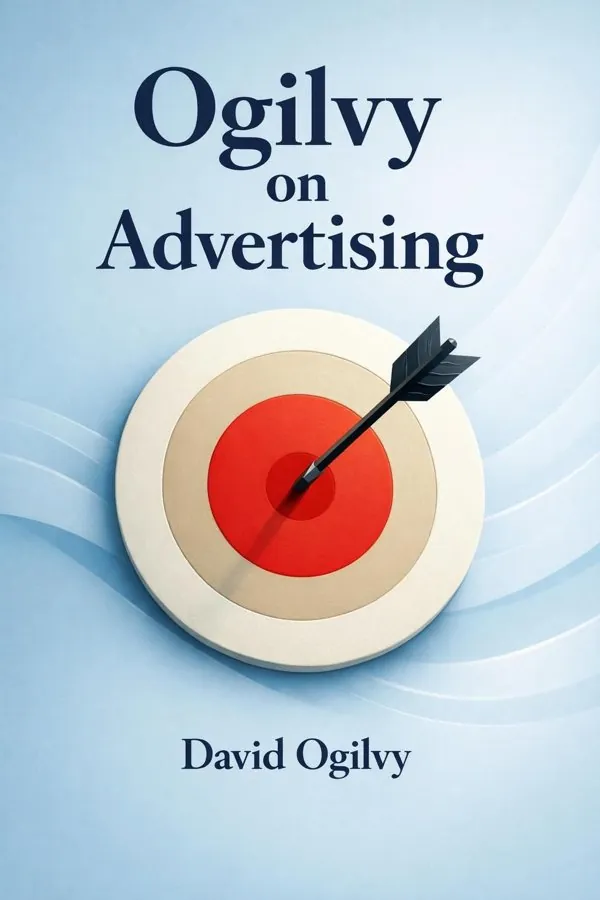
Ogilvy on Advertising: Summary & Key Insights
by David Ogilvy
 10 min9 chaptersAudio available
Key Takeaways from Ogilvy on Advertising
The most dangerous illusion in advertising is believing that attention alone equals success.
A successful advertisement is rarely the result of mystery.
Many marketers underestimate how much selling still happens through words.
Brilliant advertising often begins not with inspiration, but with curiosity.
Consumers do not experience a brand as a collection of isolated advertisements.
What Is Ogilvy on Advertising About?
Ogilvy on Advertising by David Ogilvy is a marketing book spanning 12 pages. Few advertising books have remained as influential, quotable, and useful as Ogilvy on Advertising. Written by David Ogilvy, the legendary founder of Ogilvy & Mather, this book is both a practical manual and a statement of philosophy from a man who helped define modern marketing. Ogilvy does not treat advertising as vague creativity or clever showmanship. He treats it as disciplined persuasion: a business tool designed to attract attention, build trust, and, above all, sell. What makes the book endure is its unusual combination of hard-headed practicality and creative insight. Ogilvy draws on decades of experience creating campaigns, writing copy, managing clients, studying research, and building brands across markets. He explains why headlines matter, how consumers actually respond to ads, why research should guide ideas, and how agencies can produce work that is both memorable and effective. For marketers, founders, copywriters, brand managers, and anyone interested in influence, Ogilvy on Advertising remains essential reading. Even in a digital world of social media, performance marketing, and AI-generated content, Ogilvy’s core principles still hold: respect the consumer, value clarity, test what works, and never forget that advertising exists to produce results.
This FizzRead summary covers all 9 key chapters of Ogilvy on Advertising in approximately 10 minutes, distilling the most important ideas, arguments, and takeaways from David Ogilvy's work. Also available as an audio summary and Key Quotes Podcast.
Ogilvy on Advertising
Few advertising books have remained as influential, quotable, and useful as Ogilvy on Advertising. Written by David Ogilvy, the legendary founder of Ogilvy & Mather, this book is both a practical manual and a statement of philosophy from a man who helped define modern marketing. Ogilvy does not treat advertising as vague creativity or clever showmanship. He treats it as disciplined persuasion: a business tool designed to attract attention, build trust, and, above all, sell.
What makes the book endure is its unusual combination of hard-headed practicality and creative insight. Ogilvy draws on decades of experience creating campaigns, writing copy, managing clients, studying research, and building brands across markets. He explains why headlines matter, how consumers actually respond to ads, why research should guide ideas, and how agencies can produce work that is both memorable and effective.
For marketers, founders, copywriters, brand managers, and anyone interested in influence, Ogilvy on Advertising remains essential reading. Even in a digital world of social media, performance marketing, and AI-generated content, Ogilvy’s core principles still hold: respect the consumer, value clarity, test what works, and never forget that advertising exists to produce results.
Who Should Read Ogilvy on Advertising?
This book is perfect for anyone interested in marketing and looking to gain actionable insights in a short read. Whether you're a student, professional, or lifelong learner, the key ideas from Ogilvy on Advertising by David Ogilvy will help you think differently.
- ✓Readers who enjoy marketing and want practical takeaways
- ✓Professionals looking to apply new ideas to their work and life
- ✓Anyone who wants the core insights of Ogilvy on Advertising in just 10 minutes
Want the full summary?
Get instant access to this book summary and 100K+ more with Fizz Moment.
Get Free SummaryAvailable on App Store • Free to download
Key Chapters
The most dangerous illusion in advertising is believing that attention alone equals success. David Ogilvy repeatedly insists that advertising is not created to amuse agencies, impress peers, or win awards. Its first duty is to sell. That idea sounds obvious, yet many campaigns fail because they confuse originality with effectiveness. A beautiful ad that no one remembers, or a funny ad that people recall but cannot connect to the product, has missed the point.
Ogilvy argues that the purpose of advertising is to move consumers toward action. Sometimes that means making an immediate sale. Sometimes it means building familiarity, preference, or trust that later converts into sales. In either case, the ad must serve a commercial objective. This focus forces discipline. It changes how you write headlines, choose visuals, present benefits, and measure success. Instead of asking, “Is this clever?” Ogilvy asks, “Will this persuade the right customer?”
This principle applies far beyond print ads. A startup homepage, a paid social campaign, a product video, or an email sequence can all be judged by the same standard. Are they clear about what is being offered? Do they communicate value? Do they reduce doubt? Do they motivate a next step? If not, they may be creative, but they are not doing the full job of advertising.
Ogilvy does not reject creativity. He values it deeply. But he sees creativity as useful only when it is harnessed to strategy and selling. The best ads are both interesting and productive. They capture attention, deliver a promise, support it with facts, and lead the consumer closer to purchase.
Actionable takeaway: Before approving any ad, define the exact business result it should produce and judge every creative decision against that goal.
A successful advertisement is rarely the result of mystery. More often, it comes from getting a few key elements right. Ogilvy highlights the headline, visual, body copy, layout, and offer as the structural components that determine whether an ad performs. When these elements work together, an ad becomes persuasive. When they clash or weaken one another, even a strong product can be overlooked.
The headline is especially important because it determines whether the rest of the ad gets read at all. Ogilvy believed that many readers only scan headlines, so the headline must communicate a clear benefit or compelling promise immediately. The visual should reinforce the message, not distract from it. A relevant photograph can stop a reader, create curiosity, and increase recall. Then the copy must continue the sale by explaining advantages, answering objections, and making the case in plain language.
Layout matters because readers need a clear path through the message. A cluttered page signals confusion. A clean hierarchy helps the eye move naturally from headline to image to text to call to action. Even typography influences perception. Legibility is not a cosmetic concern; it affects whether the message gets absorbed.
These ideas remain highly relevant in digital media. A landing page needs a promise-driven headline, supportive imagery, persuasive copy, and a frictionless design. An ecommerce product page needs the same logic. Even a short paid ad works best when each element contributes to the central claim.
Ogilvy’s point is that good advertising can be built. It is not random inspiration. It is a craft made of parts, each of which can be improved with judgment and testing.
Actionable takeaway: Audit every campaign by checking whether the headline, image, copy, layout, and call to action each strengthen the same core message.
Many marketers underestimate how much selling still happens through words. Ogilvy never did. He viewed copywriting as salesmanship on the page, and he believed that strong writing could outperform flashy presentation when it communicated real value. Great copy does not sound literary for its own sake. It speaks clearly, confidently, and persuasively to the reader’s interests.
Ogilvy’s approach to copy is rooted in clarity and relevance. He advises writers to know the product thoroughly, understand the consumer, and make a specific promise. Vague claims like “high quality” or “innovative solution” are weak because they say little. Concrete benefits work better: save time, reduce cost, improve comfort, last longer, taste better, look sharper. Specificity builds credibility. Facts, demonstrations, testimonials, and comparisons can all strengthen the case.
He also respected the intelligence of the consumer. Rather than writing down to people, he urged advertisers to provide useful information. Long copy can work if it remains interesting and relevant, especially when consumers are making considered purchases. A reader interested in skincare, financial services, software, or a car may welcome detailed explanation if it helps reduce uncertainty.
This principle remains vital for websites, product descriptions, emails, video scripts, and social captions. Strong copy identifies the problem, names the benefit, supports the claim, and prompts action. Weak copy relies on hype, jargon, and generic brand language.
Ogilvy also believed that editing is part of persuasion. Every unnecessary word creates friction. Every ambiguous sentence loses momentum. The best copy feels easy to read because the writer has worked hard to make it so.
Actionable takeaway: Rewrite your marketing copy to replace vague adjectives with specific benefits, evidence, and language your customer would naturally use.
Brilliant advertising often begins not with inspiration, but with curiosity. One of Ogilvy’s defining beliefs is that research is not the enemy of creativity; it is the source of more effective creativity. Marketers who ignore research end up projecting their own assumptions onto consumers. Marketers who study real behavior discover what people actually want, fear, believe, and remember.
Ogilvy used research to shape positioning, messaging, targeting, and testing. He wanted to know which promises mattered most, which headlines pulled best, which visuals attracted attention, and which claims increased purchase intent. Research could reveal surprising truths: a feature the company considered minor might be the customer’s main reason to buy; a phrase that feels elegant internally might confuse the market.
Importantly, research should not be treated as a bureaucratic ritual. For Ogilvy, it was a practical tool for improving performance. Product research helps uncover genuine advantages. Consumer research reveals motivations and objections. Market research clarifies segments and competitors. Post-campaign testing shows what worked and what did not. Over time, this builds institutional wisdom.
In the digital era, research is even more accessible. Search data, customer reviews, support tickets, heat maps, A/B tests, retention metrics, and audience interviews can all sharpen advertising. But Ogilvy’s warning still applies: data becomes useful only when it leads to better judgment. Numbers do not replace strategy; they inform it.
The deeper lesson is humility. Effective advertisers do not assume they know the consumer better than the consumer knows themselves. They observe, test, and learn. This creates ads that feel less imposed and more aligned with real needs.
Actionable takeaway: Before launching your next campaign, gather direct evidence from customers and use it to shape one clear promise grounded in actual demand.
Consumers do not experience a brand as a collection of isolated advertisements. They experience it as a cumulative impression formed over time. Ogilvy understood this deeply and argued that every advertisement contributes to brand image. The words, tone, design, claims, and even the choice of media all shape what people come to believe about a company.
For that reason, he opposed erratic advertising that changes personality from campaign to campaign. If one ad is luxurious, another playful, another aggressive, and another generic, the brand becomes difficult to place in memory. Strong brands project a recognizable character. They stand for something coherent. This does not mean every ad looks identical. It means they all reinforce the same underlying identity.
Ogilvy’s brand-building approach combines immediate persuasion with long-term consistency. A campaign should aim to sell today without damaging the qualities that attract buyers over years. Premium brands should not sound cheap. Trusted brands should not become gimmicky. Serious products should not rely on hollow theatrics. The manner of selling must suit the brand being built.
This insight is especially valuable today, when brands operate across websites, social platforms, packaging, retail environments, podcasts, and email. Each touchpoint can either strengthen the brand’s identity or fragment it. Consistent messaging, visual systems, and tone increase recognition and trust.
Ogilvy also knew that brand image carries economic value. A clear, respected brand can command higher prices, reduce resistance to new products, and improve customer loyalty. Advertising is therefore not just a short-term sales expense; it is an investment in market position.
Actionable takeaway: Define your brand’s core personality and promise, then ensure every campaign expresses those traits consistently across channels.
An excellent message can underperform if it appears in the wrong place, at the wrong time, or before the wrong audience. Ogilvy therefore treats media selection as a strategic decision, not a logistical afterthought. The effectiveness of an advertisement depends not only on what it says, but also on where and how it appears.
Different media create different reading conditions, levels of attention, and opportunities for persuasion. A magazine ad may allow for detailed copy and careful visuals. Television can dramatize product benefits and create emotion. Direct mail can target narrowly and drive measurable response. In every case, the advertiser must understand the habits and mindset of the audience in that medium.
Ogilvy favored matching medium to objective. If the product requires explanation, choose a format that supports information. If the goal is broad awareness, favor reach with enough repetition to build memory. If the audience is specialized, media should be precise rather than merely large. He also recognized the importance of placement within media environments. Context influences how people receive a message.
This logic remains vital in digital marketing. Search ads capture intent, social media can generate discovery, email nurtures interest, podcasts build intimacy, and landing pages convert. Treating every platform the same is wasteful. Each has its own strengths, limitations, and user expectations.
Media planning also reflects economics. A cheaper impression is not truly cheaper if it reaches the wrong audience or produces no action. Smart advertisers think in terms of effectiveness, not vanity metrics. They ask where the intended customer is most receptive, and what message format best fits that moment.
Actionable takeaway: Choose channels based on audience behavior and buying stage, then tailor the message format to the level of attention each medium naturally provides.
In advertising, originality is powerful only when it is attached to a meaningful promise. Ogilvy admired big ideas, but he did not romanticize creativity as a mysterious force beyond discipline. He believed creative breakthroughs usually come from immersion in the product, the market, and the consumer. The better you understand the problem, the more likely you are to find an idea that is both fresh and useful.
Ogilvy encourages advertisers to work hard before waiting for inspiration. Gather facts, study the product, identify the strongest benefit, and clarify the audience. Then think deeply, often away from noise and committee pressure. He knew that good ideas can appear unexpectedly, but he also knew they usually favor prepared minds.
A strong creative idea simplifies and dramatizes the selling proposition. It gives the campaign a memorable shape. It may come through a distinctive visual treatment, a compelling demonstration, a striking headline, or a clear brand character. But whatever form it takes, it must make the product more interesting and more believable.
This is where many campaigns go wrong. They chase novelty without strategic fit. The result may earn attention but fail to transfer value to the brand. Ogilvy’s standard is tougher: the idea should make the promise easier to understand, harder to forget, and more desirable to act on.
His advice is highly relevant in content-heavy digital environments. A creative social campaign, influencer concept, or video series should not merely entertain. It should strengthen positioning and increase persuasion. Creativity is not decoration added after strategy; it is strategy made vivid.
Actionable takeaway: When evaluating a creative idea, ask whether it makes the product benefit clearer, more memorable, and more believable—not just more noticeable.
An ad that works brilliantly in one market can fail completely in another. Ogilvy understood that international advertising demands more than translation. It requires sensitivity to culture, language, habits, humor, status signals, and consumer priorities. Brands that assume one universal message can simply be exported often discover that meaning changes across borders.
At the same time, Ogilvy did not argue for total fragmentation. He believed a brand could preserve a coherent identity globally while adapting execution locally. The central promise may remain consistent, but the expression of that promise should reflect the audience’s context. What counts as persuasive proof, aspirational imagery, or appropriate tone varies by country and region.
This balance between global consistency and local relevance is one of the book’s most forward-looking ideas. International campaigns are strongest when they identify what is essential and what is adaptable. Product truth, brand character, and key benefits may travel well. Taglines, humor, visuals, spokespersons, and media habits often require adjustment.
In today’s global digital environment, this principle extends beyond countries to subcultures and communities. A campaign seen across markets on social media can be interpreted through very different local lenses. Cultural missteps spread quickly, while culturally informed campaigns can build affinity and trust.
Ogilvy’s broader point is respectful realism. Consumers are not abstract demographics. They live inside cultural systems that shape meaning. Effective advertising pays attention to those systems rather than imposing a one-size-fits-all message.
Actionable takeaway: For any campaign entering a new market, preserve the brand’s core promise but validate language, imagery, tone, and proof points with local insight before launch.
Advertising is powerful because it shapes attention, belief, and behavior. That power creates responsibility. Ogilvy believed that dishonest advertising is not only morally wrong but strategically foolish. Misleading claims may produce short-term gains, but they destroy trust, weaken brands, and damage the reputation of agencies and clients alike. In his view, good business and ethical conduct are aligned more often than cynical marketers assume.
This belief extends to the management of agencies. Ogilvy writes not only as a copywriter but as a builder of organizations. He values high standards, strong talent, respect for clients, and a culture where people are expected to think clearly and work hard. Great campaigns do not emerge from chaos alone. They require leadership, judgment, and an environment where research, creativity, and professionalism reinforce one another.
He also understood that agencies must balance service and courage. They exist to help clients succeed, but they should not become passive order-takers. The best agency leaders defend good work, challenge weak assumptions, and maintain integrity under pressure. This creates long-term partnerships rather than transactional output.
The same lessons apply to in-house teams and modern marketing organizations. If teams reward vanity metrics, tolerate exaggeration, or chase trends without principle, quality declines. If they value truth, craft, accountability, and customer respect, they create stronger brands over time.
Ogilvy’s view of the future of advertising is therefore not centered on technology alone. Tools will change, media will evolve, and formats will multiply. But trust, competence, and disciplined persuasion will remain decisive.
Actionable takeaway: Build marketing systems that reward truthful claims, measurable results, and thoughtful leadership rather than short-term hype or internal applause.
All Chapters in Ogilvy on Advertising
About the Author
David Ogilvy (1911–1999) was a British advertising executive, copywriter, and founder of Ogilvy & Mather, one of the world’s most influential advertising agencies. Often called the “Father of Advertising,” he helped transform modern marketing by combining bold creative ideas with research, discipline, and a relentless focus on results. Before entering advertising, Ogilvy held a variety of jobs, experiences that sharpened his understanding of people and persuasion. He became famous for campaigns that balanced memorable brand image with strong selling power, and for his belief that the consumer should be treated with intelligence and respect. Through his agency work and books, including Ogilvy on Advertising, he left a lasting legacy on copywriting, branding, agency culture, and the broader practice of persuasive communication.
Get This Summary in Your Preferred Format
Read or listen to the Ogilvy on Advertising summary by David Ogilvy anytime, anywhere. FizzRead offers multiple formats so you can learn on your terms — all free.
Available formats: App · Audio · PDF · EPUB — All included free with FizzRead
Download Ogilvy on Advertising PDF and EPUB Summary
Key Quotes from Ogilvy on Advertising
“The most dangerous illusion in advertising is believing that attention alone equals success.”
“A successful advertisement is rarely the result of mystery.”
“Many marketers underestimate how much selling still happens through words.”
“Brilliant advertising often begins not with inspiration, but with curiosity.”
“Consumers do not experience a brand as a collection of isolated advertisements.”
Frequently Asked Questions about Ogilvy on Advertising
Ogilvy on Advertising by David Ogilvy is a marketing book that explores key ideas across 9 chapters. Few advertising books have remained as influential, quotable, and useful as Ogilvy on Advertising. Written by David Ogilvy, the legendary founder of Ogilvy & Mather, this book is both a practical manual and a statement of philosophy from a man who helped define modern marketing. Ogilvy does not treat advertising as vague creativity or clever showmanship. He treats it as disciplined persuasion: a business tool designed to attract attention, build trust, and, above all, sell. What makes the book endure is its unusual combination of hard-headed practicality and creative insight. Ogilvy draws on decades of experience creating campaigns, writing copy, managing clients, studying research, and building brands across markets. He explains why headlines matter, how consumers actually respond to ads, why research should guide ideas, and how agencies can produce work that is both memorable and effective. For marketers, founders, copywriters, brand managers, and anyone interested in influence, Ogilvy on Advertising remains essential reading. Even in a digital world of social media, performance marketing, and AI-generated content, Ogilvy’s core principles still hold: respect the consumer, value clarity, test what works, and never forget that advertising exists to produce results.
You Might Also Like
Captivology: The Science of Capturing People's Attention
Ben Parr
10 min
Marketing 5.0: Technology for Humanity
Philip Kotler, Hermawan Kartajaya, Iwan Setiawan
10 min
Marketing Strategy
Paul Fifield
10 min
UnMarketing: Stop Marketing. Start Engaging.
Scott Stratten
10 min
$100M Leads: How to Get Strangers to Want to Buy Your Stuff
Alex Hormozi
10 min
80/20 Sales and Marketing: The Definitive Guide to Working Less and Making More
Perry Marshall
10 minBrowse by Category
Ready to read Ogilvy on Advertising?
Get the full summary and 100K+ more books with Fizz Moment.