
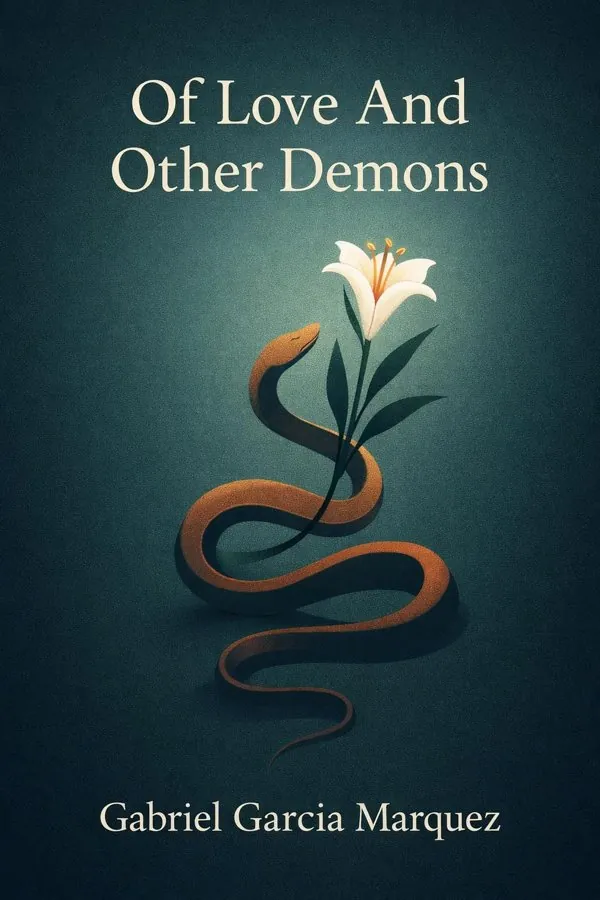
Of Love And Other Demons: Summary & Key Insights
 10 min9 chaptersAudio available
Key Takeaways from Of Love And Other Demons
Sometimes the dead survive more vividly in stories than the living do in their own time.
The most dangerous passions are often the ones that begin under the guise of duty.
Some loves endure not because they triumph, but because they are denied any ordinary life.
Fear rarely stays empty for long; if knowledge does not fill the gap, superstition will.
A society can be refined in manners and brutal in spirit at the same time.
What Is Of Love And Other Demons About?
Of Love And Other Demons by Gabriel Garcia Marquez is a classics book spanning 3 pages. Set in 18th-century colonial Cartagena, Of Love And Other Demons is a haunting novel about fear, desire, and the stories societies tell to explain what they cannot understand. At its center is Sierva María de Todos los Ángeles, the neglected daughter of a marquis, who is bitten by a dog and gradually becomes the object of panic, superstition, and religious obsession. When Father Cayetano Delaura is assigned to evaluate whether she is possessed, what begins as spiritual inquiry turns into a dangerous and transformative love. Through their tragic bond, Gabriel Garcia Marquez examines how institutions—family, church, medicine, and empire—can distort human experience when they are ruled by prejudice and certainty rather than compassion. The novel matters because it speaks far beyond its historical setting: it asks how often difference is mistaken for madness, how often love is condemned by power, and how often fear masquerades as faith. Marquez, the Nobel Prize-winning Colombian master of lyrical prose and magical realism, brings extraordinary authority to this story, blending historical texture, emotional intensity, and symbolic richness into one of his most piercing short novels.
This FizzRead summary covers all 9 key chapters of Of Love And Other Demons in approximately 10 minutes, distilling the most important ideas, arguments, and takeaways from Gabriel Garcia Marquez's work. Also available as an audio summary and Key Quotes Podcast.
Of Love And Other Demons
Set in 18th-century colonial Cartagena, Of Love And Other Demons is a haunting novel about fear, desire, and the stories societies tell to explain what they cannot understand. At its center is Sierva María de Todos los Ángeles, the neglected daughter of a marquis, who is bitten by a dog and gradually becomes the object of panic, superstition, and religious obsession. When Father Cayetano Delaura is assigned to evaluate whether she is possessed, what begins as spiritual inquiry turns into a dangerous and transformative love. Through their tragic bond, Gabriel Garcia Marquez examines how institutions—family, church, medicine, and empire—can distort human experience when they are ruled by prejudice and certainty rather than compassion. The novel matters because it speaks far beyond its historical setting: it asks how often difference is mistaken for madness, how often love is condemned by power, and how often fear masquerades as faith. Marquez, the Nobel Prize-winning Colombian master of lyrical prose and magical realism, brings extraordinary authority to this story, blending historical texture, emotional intensity, and symbolic richness into one of his most piercing short novels.
Who Should Read Of Love And Other Demons?
This book is perfect for anyone interested in classics and looking to gain actionable insights in a short read. Whether you're a student, professional, or lifelong learner, the key ideas from Of Love And Other Demons by Gabriel Garcia Marquez will help you think differently.
- ✓Readers who enjoy classics and want practical takeaways
- ✓Professionals looking to apply new ideas to their work and life
- ✓Anyone who wants the core insights of Of Love And Other Demons in just 10 minutes
Want the full summary?
Get instant access to this book summary and 100K+ more with Fizz Moment.
Get Free SummaryAvailable on App Store • Free to download
Key Chapters
Sometimes the dead survive more vividly in stories than the living do in their own time. Of Love And Other Demons begins with an image of excavation: the unearthing of a colonial convent and the discovery of a girl’s long copper-colored hair flowing from a grave. That startling image frames the entire novel as an act of recovery. Sierva María is not introduced simply as a character in motion but as someone history has already buried, misunderstood, and nearly erased. The novel then moves backward to reconstruct how this happened. In doing so, Marquez transforms what seems like a gothic mystery into a critique of the forces that produce social forgetting.
Sierva María is “lost” in more than one sense. She is neglected by her aristocratic parents, emotionally abandoned within her own home, and culturally displaced between colonial nobility and the enslaved African world that truly raises her. Because she does not fit cleanly into any approved category, the adults around her project meanings onto her rather than seeing her clearly. Her unusual habits, languages, and self-possession become signs of danger in the eyes of others. The convent, later meant to confine and “cure” her, becomes the perfect symbol of this dynamic: a place claiming to save souls while participating in their disappearance.
In modern life, people are often “buried” in similar ways—not literally, but through labels, assumptions, and institutional decisions. A child marked as difficult, a patient dismissed as irrational, or a minority voice treated as threatening can be pushed outside the bounds of empathy. Marquez asks us to notice how that process begins: with not listening.
Actionable takeaway: when someone seems strange, difficult, or incomprehensible, resist the urge to classify them too quickly; begin by asking what story has been ignored.
The most dangerous passions are often the ones that begin under the guise of duty. Father Cayetano Delaura enters the novel as a learned priest entrusted with Sierva María’s case. He is expected to diagnose, guide, and perhaps exorcise her. Instead, he becomes emotionally and spiritually entangled with her. What makes this relationship so compelling is not merely that it is forbidden, but that it reveals how fragile the boundaries are between religious devotion, imagination, and erotic longing.
Delaura initially approaches Sierva María through inherited concepts. He reads her through theology, through books, through his own cultivated sensibility. Yet the more he encounters her as a living presence rather than a problem to solve, the more his certainty collapses. Marquez shows that desire does not arrive as a crude interruption to faith; it can emerge from the same intensity, tenderness, and longing for transcendence that animate faith itself. Delaura’s tragedy lies in his inability to integrate these dimensions honestly. He moves from priestly interpretation to romantic idealization, but in both cases he risks turning Sierva María into an object of meaning rather than a person with her own interiority.
This tension remains relevant. In many professions and relationships, people are trained to maintain roles—teacher and student, healer and patient, spiritual guide and follower. Problems begin when emotional needs are disguised as service, or when admiration becomes possession. The novel does not merely condemn forbidden love; it asks us to examine whether our strongest attachments are rooted in care, fantasy, loneliness, or power.
Actionable takeaway: whenever responsibility and intimacy intersect, pause to examine your motives honestly—especially if your feelings seem noble, elevated, or spiritually justified.
Some loves endure not because they triumph, but because they are denied any ordinary life. The final movement of Of Love And Other Demons is steeped in death, but it is not death alone that gives the novel its lasting force. What remains after Sierva María’s destruction is memory—the charged afterlife of a story that refuses to disappear. Marquez suggests that love can persist as wound, legend, and haunting presence even when institutions succeed in crushing the people who embodied it.
The novel’s opening grave scene already tells us that this story will be remembered through fragments. We know from the start that Sierva María will not receive a conventional happy ending; what matters is how and why she becomes a figure history cannot fully absorb. Her hair, growing mythically from the tomb, symbolizes more than magical wonder. It stands for what exceeds official accounts: desire, innocence, suffering, and mystery surviving the systems that sought to control them. Delaura, too, becomes part of that residual memory, not as a heroic lover who conquers fate, but as a witness to how love and catastrophe become inseparable.
In our own lives, memory often preserves emotional truth better than public narratives do. Families rewrite painful histories. Institutions sanitize harm. Communities romanticize tragedies without facing their causes. Marquez pushes us to remember with complexity. Love is not redeemed simply because it is intense. Tragedy is not meaningful simply because it is beautiful. What deserves preservation is not myth alone but the recognition of injustice.
Actionable takeaway: when reflecting on painful relationships or historical wrongs, resist sentimental simplification; ask what must be remembered clearly so that beauty does not erase harm.
Fear rarely stays empty for long; if knowledge does not fill the gap, superstition will. The plot of the novel turns on a dog bite and the suspicion of rabies, but what truly drives events is not medical diagnosis alone. It is the social terror attached to uncertainty. Sierva María’s behavior, appearance, and cultural difference become raw material for projections of possession. The possibility of illness becomes entangled with folklore, rumor, colonial anxiety, and religious paranoia until facts no longer matter.
Marquez is careful not to create a simple opposition between enlightened science and irrational religion. The physicians in the novel are themselves limited, vain, or constrained by the knowledge of their era. Still, the book shows how destructive it is when fear hardens into certainty. Once authorities decide that Sierva María is possessed, every gesture becomes evidence. Silence looks demonic. Resistance looks demonic. Difference itself looks demonic. This is one of the novel’s sharpest insights: under conditions of panic, interpretation becomes self-confirming.
The pattern remains strikingly modern. Public scares about disease, morality, crime, or identity often produce the same logic. A person or group is marked as suspicious; every action then reinforces the accusation. Social media rumors, workplace gossip, and ideological echo chambers all work this way. We do not just fear the unknown—we invent stories that make our fear feel justified.
Marquez invites us to see superstition broadly: not only as belief in spirits, but as any rigid explanatory system that converts uncertainty into punishment. The cost is usually borne by those already vulnerable.
Actionable takeaway: when a crisis produces confident accusations before careful evidence, slow down and ask who benefits from fear—and who is being sacrificed to it.
A society can be refined in manners and brutal in spirit at the same time. One of the great achievements of Of Love And Other Demons is its portrait of colonial Cartagena as a world of ceremony, hierarchy, decay, and violence. Marquez fills the novel with marquises, bishops, convents, servants, slaves, and scholars, but beneath this elaborate social order lies rot: racism, neglect, vanity, and spiritual emptiness. The elegance of the setting does not soften its cruelty; it makes the cruelty more chilling.
Sierva María’s life exposes the contradictions of the colonial elite. Though born into nobility, she is emotionally discarded by her parents and effectively raised among enslaved Africans. She learns their languages, customs, and songs, developing an identity that unsettles the rigid classifications on which colonial power depends. Her difference becomes threatening not because it is evil, but because it blurs boundaries of race, class, religion, and belonging. The adults around her respond by trying to force her back into a legible category—child, daughter, patient, penitent, possessed body.
This social world is not incidental background. It is the mechanism of tragedy. The Church’s authority, the father’s title, the mother’s instability, the servants’ knowledge, and the stigma attached to African practices all intersect to make Sierva María vulnerable. Marquez shows how institutions often preserve themselves by naming mixed identities as disorder.
Today, this insight applies to any environment where appearance, status, or tradition conceal deeper injustices. A polished workplace may normalize exploitation. A cultured family may perpetuate silence and shame. A prestigious institution may punish what it cannot categorize.
Actionable takeaway: look beyond the elegance of institutions and ask a harder question—who is protected by this order, and who is diminished by it?
People do not become monstrous only through evil; often they become destructive through loneliness, repression, and emotional hunger. Nearly every major figure in Of Love And Other Demons is isolated in a different way. Sierva María is abandoned within privilege. Her mother withdraws into addiction, bitterness, and emotional instability. Her father hides behind title and passivity. Delaura lives within the intellectual and celibate structures of the Church, rich in imagination but starved of ordinary intimacy. Even the convent is a crowded place organized around inward exile.
This emotional isolation matters because it shapes how characters perceive one another. Instead of meeting as full human beings, they approach each other through need, fear, guilt, or projection. Sierva María becomes a vessel for everyone else’s unresolved conflict. To some she is a scandal, to others a curiosity, to others a soul to save, and to Delaura a revelation. Yet very few ask what her experience actually feels like. Marquez suggests that loneliness can make people cling more tightly to roles and fantasies, because genuine mutual recognition is harder and riskier.
The novel therefore works not only as a tragedy of love, but as a study of failed connection. Its emotional force comes from a world where tenderness appears too late or in compromised form. This is why even acts that seem loving can become dangerous: they emerge from damaged people in damaged institutions.
Readers can apply this insight directly. Miscommunication in families, workplaces, and communities often worsens when people interpret others only through their own deprivation. The more isolated we are, the more likely we are to confuse being seen with being saved.
Actionable takeaway: before reacting to someone intensely, ask whether you are responding to who they are—or to the loneliness they awaken in you.
Belief becomes dangerous when certainty matters more than compassion. Marquez’s portrayal of religion in Of Love And Other Demons is layered and unsparing. He does not depict faith itself as foolish; instead, he exposes what happens when religious institutions confuse control with salvation. The Church in the novel includes sincere devotion, learning, and ritual beauty, but it also includes pride, bureaucracy, fear of disorder, and a willingness to interpret suffering through predetermined doctrine.
The bishop and other authorities are less interested in understanding Sierva María than in fitting her into an accepted theological frame. Exorcism offers a dramatic answer to an ambiguous problem. It grants the institution relevance, authority, and narrative coherence. Yet the result is devastating. What might have required patience, medical uncertainty, psychological care, or simple mercy becomes spiritual theater. The tragedy is not only that religion fails her; it is that religion is used to legitimize that failure.
At the same time, Delaura embodies another side of faith: one capable of poetry, interior struggle, and genuine reverence. His downfall does not cancel the spiritual dimension of the novel. Rather, it shows how difficult it is to remain humane within structures that reward certainty over humility. Marquez’s critique is therefore profoundly relevant. In any ideological system—religious, political, therapeutic, even academic—people can become more attached to being right than to relieving suffering.
The practical lesson is not to reject belief, but to test whether belief produces mercy. Any worldview that cannot tolerate ambiguity may end up harming the people it claims to help.
Actionable takeaway: judge institutions less by the purity of their principles and more by how they treat vulnerable people when answers are unclear.
What societies cannot classify, they often try to discipline. Sierva María is one of Marquez’s most striking figures because she resists easy interpretation. She is aristocratic by birth, culturally shaped by enslaved women, emotionally self-contained, physically vivid, and linguistically plural. Her identity does not match the expectations of her class or the moral categories of her world. That very indeterminacy becomes central to the novel’s tension. She is not simply misunderstood by accident; she is misunderstood because social systems are threatened by what exceeds their definitions.
Marquez gives Sierva María an aura that invites symbolic reading—saint, witch, victim, muse, demonized child—yet the brilliance of the novel lies in showing how these labels accumulate around her without exhausting her reality. Her long hair, her poise, her estrangement, and her opacity make others believe they have encountered something extraordinary. But extraordinariness here is inseparable from social projection. She becomes a screen onto which colonial fear, religious fantasy, and male desire are cast.
This dynamic has many contemporary echoes. People who embody mixed identities, unconventional behavior, neurodivergence, cultural hybridity, or simply a refusal to perform expected roles are often burdened with exaggerated meanings. They are romanticized, pathologized, exoticized, or policed. The issue is not only prejudice, but interpretive violence—the insistence that a person must be legible according to dominant norms.
Sierva María’s tragedy reminds us that dignity begins with allowing complexity. Not every silence is sickness. Not every difference needs correction. Not every mystery is a threat.
Actionable takeaway: when encountering someone whose identity or behavior resists your categories, replace interpretation with curiosity and let complexity remain unresolved.
Even the most intimate feelings unfold inside structures of power. It is tempting to read Of Love And Other Demons as a pure story of doomed love between Sierva María and Delaura, but Marquez complicates that reading at every turn. Their relationship is emotionally intense, spiritually charged, and deeply moving, yet it is not free from asymmetry. He is a priest, older, educated, and institutionally empowered. She is a confined adolescent girl under suspicion, deprived of autonomy, and subject to others’ interpretations. Their bond may be sincere, but sincerity does not erase unequal conditions.
This is one reason the novel remains so unsettling. Marquez invites readers into the lyrical beauty of their connection while also exposing the tragic context that makes such beauty impossible to separate from danger. Love appears as refuge from oppressive authority, yet it is also shaped by that authority. Delaura encounters Sierva María first as an assigned case. His language, dreams, and self-understanding are formed by religious and literary traditions she did not choose. What feels to him like revelation may also reflect the power to narrate her life.
This tension enriches rather than diminishes the novel. It pushes readers to think more honestly about romance. In real life, people often defend relationships by appealing to strong feeling alone. But feeling is never the whole story. Workplace romances, mentor-student attachments, age-imbalanced relationships, and dynamics formed in crisis all require attention to context, not just emotion.
Marquez’s final lesson is painful: love may be real and still not be innocent. To honor love fully, one must also examine the conditions under which it appears.
Actionable takeaway: when evaluating a relationship, ask not only whether the feelings are genuine, but also whether the surrounding power dynamics allow true freedom and care.
All Chapters in Of Love And Other Demons
About the Author
Gabriel Garcia Marquez (1927-2014) was a Colombian novelist, journalist, screenwriter, and Nobel laureate whose work reshaped modern literature. Born in Aracataca, Colombia, he drew deeply on the oral storytelling traditions, political tensions, and cultural richness of Latin America. He became internationally famous with One Hundred Years of Solitude, a landmark novel that helped define magical realism for global readers. His fiction often blends history, myth, memory, love, and violence with luminous, dreamlike precision. Other major works include Love in the Time of Cholera, Chronicle of a Death Foretold, The Autumn of the Patriarch, and Of Love And Other Demons. Awarded the Nobel Prize in Literature in 1982, Garcia Marquez remains one of the most influential and widely read writers of the 20th century.
Get This Summary in Your Preferred Format
Read or listen to the Of Love And Other Demons summary by Gabriel Garcia Marquez anytime, anywhere. FizzRead offers multiple formats so you can learn on your terms — all free.
Available formats: App · Audio · PDF · EPUB — All included free with FizzRead
Download Of Love And Other Demons PDF and EPUB Summary
Key Quotes from Of Love And Other Demons
“Sometimes the dead survive more vividly in stories than the living do in their own time.”
“The most dangerous passions are often the ones that begin under the guise of duty.”
“Some loves endure not because they triumph, but because they are denied any ordinary life.”
“Fear rarely stays empty for long; if knowledge does not fill the gap, superstition will.”
“A society can be refined in manners and brutal in spirit at the same time.”
Frequently Asked Questions about Of Love And Other Demons
Of Love And Other Demons by Gabriel Garcia Marquez is a classics book that explores key ideas across 9 chapters. Set in 18th-century colonial Cartagena, Of Love And Other Demons is a haunting novel about fear, desire, and the stories societies tell to explain what they cannot understand. At its center is Sierva María de Todos los Ángeles, the neglected daughter of a marquis, who is bitten by a dog and gradually becomes the object of panic, superstition, and religious obsession. When Father Cayetano Delaura is assigned to evaluate whether she is possessed, what begins as spiritual inquiry turns into a dangerous and transformative love. Through their tragic bond, Gabriel Garcia Marquez examines how institutions—family, church, medicine, and empire—can distort human experience when they are ruled by prejudice and certainty rather than compassion. The novel matters because it speaks far beyond its historical setting: it asks how often difference is mistaken for madness, how often love is condemned by power, and how often fear masquerades as faith. Marquez, the Nobel Prize-winning Colombian master of lyrical prose and magical realism, brings extraordinary authority to this story, blending historical texture, emotional intensity, and symbolic richness into one of his most piercing short novels.
You Might Also Like






Browse by Category
Ready to read Of Love And Other Demons?
Get the full summary and 100K+ more books with Fizz Moment.