
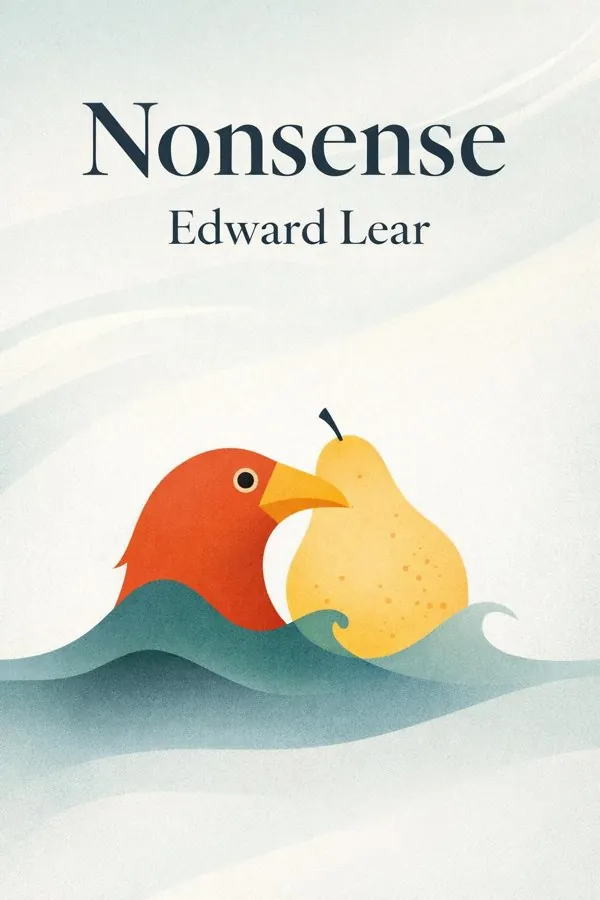
Nonsense: Summary & Key Insights
by Edward Lear
 10 min10 chaptersAudio available
Key Takeaways from Nonsense
The first surprise of Lear’s work is that nonsense depends on discipline.
People laugh more readily at absurdity when it arrives in the shape of a character.
Some truths about imagination can only be expressed through words that do not yet exist.
When animals behave like people and impossible beings enter the scene, imagination becomes emotionally safer and more expansive.
Travel in Nonsense is rarely practical, but it is always liberating.
What Is Nonsense About?
Nonsense by Edward Lear is a classics book spanning 10 pages. Edward Lear��s Nonsense is a landmark collection of comic verse, playful songs, absurd miniatures, and unforgettable limericks that transformed silliness into an art form. At first glance, the book seems to offer light amusement: odd old people, improbable animals, made-up words, and gleefully irrational events. But Lear’s achievement runs deeper than simple humor. He created a literary space where logic loosens, language becomes musical, and imagination is allowed to roam without apology. In doing so, he helped establish literary nonsense as a serious mode of creativity, one that would influence writers from Lewis Carroll onward and continue to shape children’s literature, comic poetry, and surreal art. What makes Nonsense endure is its combination of strict form and wild invention. Lear’s limericks obey rhythm and structure even as they celebrate absurdity, and his illustrations amplify the joke by making impossible scenes feel oddly believable. The result is a body of work that delights children, rewards adults, and invites readers of any age to rediscover the freedom of playful thought. Lear’s authority comes not from solemn instruction but from mastery: he understood sound, image, and timing so well that he could make nonsense feel inevitable, graceful, and strangely wise.
This FizzRead summary covers all 10 key chapters of Nonsense in approximately 10 minutes, distilling the most important ideas, arguments, and takeaways from Edward Lear's work. Also available as an audio summary and Key Quotes Podcast.
Nonsense
Edward Lear��s Nonsense is a landmark collection of comic verse, playful songs, absurd miniatures, and unforgettable limericks that transformed silliness into an art form. At first glance, the book seems to offer light amusement: odd old people, improbable animals, made-up words, and gleefully irrational events. But Lear’s achievement runs deeper than simple humor. He created a literary space where logic loosens, language becomes musical, and imagination is allowed to roam without apology. In doing so, he helped establish literary nonsense as a serious mode of creativity, one that would influence writers from Lewis Carroll onward and continue to shape children’s literature, comic poetry, and surreal art.
What makes Nonsense endure is its combination of strict form and wild invention. Lear’s limericks obey rhythm and structure even as they celebrate absurdity, and his illustrations amplify the joke by making impossible scenes feel oddly believable. The result is a body of work that delights children, rewards adults, and invites readers of any age to rediscover the freedom of playful thought. Lear’s authority comes not from solemn instruction but from mastery: he understood sound, image, and timing so well that he could make nonsense feel inevitable, graceful, and strangely wise.
Who Should Read Nonsense?
This book is perfect for anyone interested in classics and looking to gain actionable insights in a short read. Whether you're a student, professional, or lifelong learner, the key ideas from Nonsense by Edward Lear will help you think differently.
- ✓Readers who enjoy classics and want practical takeaways
- ✓Professionals looking to apply new ideas to their work and life
- ✓Anyone who wants the core insights of Nonsense in just 10 minutes
Want the full summary?
Get instant access to this book summary and 100K+ more with Fizz Moment.
Get Free SummaryAvailable on App Store • Free to download
Key Chapters
The first surprise of Lear’s work is that nonsense depends on discipline. His best-known poems are limericks, a form so compact that every sound, pause, and turn matters. The five-line structure creates a rhythmic expectation, then rewards it with a comic twist. Because the pattern is familiar and tightly controlled, even the most ridiculous content feels satisfying rather than random. A person from a strange town, a bizarre habit, a social scandal, and a silly conclusion can all fit into a handful of lines, provided the beat lands properly.
This is why the limerick sits at the heart of Nonsense. Lear understood that absurdity becomes funnier when it is framed. The form gives readers a railing to hold while the poem swerves into illogic. The opening line introduces a character and place, the middle lines stretch the premise, and the final line snaps back with a repeated phrase, altered emphasis, or comic exaggeration. The effect is musical as much as verbal. We laugh not only at what happens but at how neatly it lands.
In practical terms, Lear shows that creativity often flourishes under constraint. A writer facing a blank page can learn from this by choosing a form first: five lines, a fixed rhythm, or a recurring phrase. A teacher can use limericks to help students play with language while learning meter and rhyme. Even outside poetry, the lesson applies to presentation, storytelling, and humor: structure helps bold ideas become memorable.
Actionable takeaway: choose a tiny creative form today—a limerick, a six-word story, or a four-panel sketch—and use its limits to generate freer, funnier ideas.
People laugh more readily at absurdity when it arrives in the shape of a character. Lear fills his poems with figures who are defined by one outsized trait: an enormous beard, a troubling habit, a remarkable nose, a strange appetite, or a socially inconvenient obsession. These people are not realistic portraits. They are comic essences. By exaggerating a single quality until it becomes absurd, Lear creates instant recognition. We do not need a full biography to understand them; their peculiarity is their identity.
What makes these characters memorable is that they are never merely mocked. Lear’s tone is teasing, but rarely cruel. His odd people inhabit a world where strangeness is normal enough to be reported in rhyme. This gives the book a generous spirit. Difference is not explained away; it is displayed, enjoyed, and carried to impossible extremes. That lightness is part of the enduring charm. The poems suggest that the world is full of eccentricity and that delight, not correction, is often the best response.
This idea has practical value in storytelling and communication. Whether you are writing fiction, crafting a speech, or developing a brand voice, a single vivid trait can make a character or message unforgettable. A children’s author might create a hero who always whispers to clouds. A manager might remember that quirks, when harmless, can become part of team culture rather than problems to erase. Lear reminds us that distinctiveness creates energy.
Actionable takeaway: when inventing a character or presenting yourself, identify one unusual, specific trait and amplify it until it becomes memorable rather than merely descriptive.
Some truths about imagination can only be expressed through words that do not yet exist. Lear’s nonsense vocabulary, unusual names, sound-driven phrasing, and delight in verbal invention reveal a central principle of the book: language is not just a tool for labeling reality, but a playground for expanding it. When Lear introduces improbable names or creates sounds that feel meaningful without being strictly definable, he reminds us that words carry music, texture, and emotion in addition to literal sense.
This matters because nonsense is not the absence of meaning. It is meaning loosened from ordinary logic. A made-up word may not fit a dictionary definition, yet it can still communicate mood, shape, and comic force. Children grasp this instinctively. Adults often forget it. Lear restores that instinct by allowing readers to enjoy language physically—with the ear, tongue, and imagination—rather than only analytically. His phrasing often charms before it can be paraphrased, which is part of its power.
In everyday life, this insight can be surprisingly useful. Writers can invent terms to capture feelings standard language flattens. Parents and teachers can use playful naming to make reading feel less intimidating. Teams can create light internal vocabulary that strengthens culture and memory. Even journalers can invent labels for recurring moods or habits, making self-reflection more vivid and personal.
Lear also models confidence: not every phrase must justify itself with perfect logic. Sometimes delight is enough reason to say something.
Actionable takeaway: invent one new word or name for a feeling, object, or experience today, and notice how creative naming changes the way you think about it.
When animals behave like people and impossible beings enter the scene, imagination becomes emotionally safer and more expansive. Lear’s world is populated by owls, pussycats, and extraordinary creatures whose behavior blends innocence, tenderness, oddity, and comedy. These beings are not decorative additions; they allow Lear to dramatize human longing, affection, vanity, adventure, and vulnerability at a slight remove. By shifting emotion into the realm of the whimsical, he makes it easier for readers to feel deeply without defensiveness.
The classic example is the union of unlikely companions or the appearance of a creature whose physical oddness symbolizes inner uniqueness. Such images are funny, but they are also gentle ways of talking about acceptance and desire. A fantastical creature can carry emotional truth more lightly than a realistic one. Readers are invited to empathize before they begin analyzing. This is one reason Lear’s nonsense can feel unexpectedly moving beneath its comic surface.
Practically, anthropomorphism and whimsy remain powerful tools. A teacher explaining social emotions to children might use animals to discuss friendship, exclusion, or courage. A creator designing illustrations, ads, or stories can use animal characters to make sensitive ideas more approachable. Even adults can borrow this strategy in journaling or therapy by describing fears and hopes as imaginary creatures, which can make abstract emotions easier to face.
Lear’s creatures teach that imagination is not escapism alone. It is also a method for seeing ourselves from a kinder distance.
Actionable takeaway: translate one human feeling into an animal or invented creature, then describe how it moves, sounds, or dresses to better understand that emotion.
Travel in Nonsense is rarely practical, but it is always liberating. Lear repeatedly sends his characters across seas, into improbable landscapes, or toward destinations that seem chosen for musical delight as much as narrative purpose. These journeys matter because nonsense thrives on movement. Once a poem leaves the ordinary world behind, the impossible becomes easier to accept. Travel opens the door to strangeness and gives absurd events a sense of progression.
At a deeper level, these voyages dramatize the human urge to leave the known behind. Lear was himself a traveler and illustrator of landscapes, and his nonsense reflects both wanderlust and dislocation. But instead of presenting travel as self-improvement in a moral or practical sense, he frames it as imaginative release. Adventure here means permission: permission to pair unlikely companions, encounter surreal places, and suspend the rules of realism.
This has modern relevance. Many readers feel trapped by routine, efficiency, and predictability. Lear reminds us that novelty can be restorative even when it is playful or symbolic rather than useful. A creative retreat, a change of walking route, a themed writing exercise, or a spontaneous museum visit can function like miniature nonsense journeys. The point is not productivity. It is perceptual refreshment.
Writers and artists can especially learn from Lear’s method of treating place as an imaginative catalyst. An unusual destination, real or invented, instantly alters tone and possibility.
Actionable takeaway: plan one small imaginative journey this week—visit an unfamiliar place, write a story set somewhere impossible, or take a routine activity and give it a fantastical destination.
Before nonsense is understood, it is heard. Lear’s poems often linger in memory because of their pulse, repetition, and musical wording. The ear accepts what the mind might resist. Recurrent sounds, echoed phrases, and singable cadences create pleasure independent of strict meaning, which allows absurdity to enter gracefully. This is one of Lear’s great technical achievements: he makes nonsense feel inevitable by giving it strong acoustic design.
Repetition performs several functions. It creates expectation, which can then be fulfilled or disrupted for comic effect. It also invites participation. Children especially love lines they can anticipate and repeat, but adults respond to the same mechanism in songs, slogans, and jokes. Rhythm, meanwhile, organizes surprise. A strange image delivered at the right beat lands far better than a clever line with awkward timing.
The practical lesson extends far beyond poetry. Teachers can use repetition to make content memorable. Public speakers can build emphasis with recurring phrases. Songwriters, marketers, and storytellers can learn that sound often drives recall more powerfully than explanation. Even in everyday conversation, a playful repeated phrase can turn an ordinary moment into a shared joke.
Lear’s work shows that style is not decoration added after meaning. In many cases, style creates meaning by shaping emotional response. We remember nonsense because it sings to us.
Actionable takeaway: revise a piece of writing or speech by adding one repeated phrase and reading it aloud; if it sounds better, it will likely be remembered better too.
Lear was not only a writer of nonsense but also an illustrator, and that dual talent is central to the book’s effect. His drawings do more than accompany the text. They confirm, complicate, and intensify it. A strange figure rendered with calm visual certainty becomes funnier because the image treats absurdity as visible fact. The reader is no longer imagining chaos alone; the nonsense has a face, posture, hat, or beak. Illustration gives the impossible just enough solidity to feel real for a moment.
This visual dimension is especially important in literary nonsense because images help bridge the gap between sound and sense. A bizarre phrase might seem abstract on its own, but once paired with a sketch, it acquires comic specificity. Lear understood timing across media: the text sets up the absurd premise, and the drawing seals it with deadpan conviction. That combination broadens the audience too, making the work accessible to children, emerging readers, and anyone drawn first to pictures.
In contemporary creative work, Lear’s example highlights the power of multimodal storytelling. A simple illustration can deepen a poem, a presentation slide can sharpen a joke, and a doodle in a classroom can make a concept memorable. Visual thinking is not secondary to verbal thinking; often it carries a different kind of intelligence.
For readers, this also encourages slower engagement. Looking carefully at the image can reveal another layer of the joke, especially when the visual detail subtly exaggerates what the poem states.
Actionable takeaway: pair one piece of writing with a sketch, symbol, or simple image and ask how the visual changes the tone, clarity, or humor of the words.
One of the most quietly radical things about Lear’s work is that it refuses to apologize for delight. Nonsense gives readers a realm where wonder is not naïve and play is not wasted. In a culture that often pressures language to be useful, factual, and efficient, Lear preserves verbal innocence—the freedom to say something because it is funny, beautiful, or surprising. That is not emptiness; it is imaginative health.
This is why Nonsense continues to matter for both children and adults. For children, it validates curiosity before logic hardens into rule-bound thinking. For adults, it can reopen a mode of attention that modern life suppresses. To read Lear well, one must surrender the need to extract a tidy moral from every line. The reward is a refreshed mind, more capable of metaphor, humor, and flexible thinking.
There is also a social dimension here. Nonsense creates a low-stakes space for shared joy. Reciting absurd poems together, laughing at impossible creatures, and enjoying playful language can build connection without controversy or pressure. In education and family life, that matters. Playful reading cultivates intimacy and lowers fear around language.
Lear suggests that innocence is not ignorance. It is the willingness to encounter the world without immediately shrinking it to utility. Wonder is a practice, and nonsense is one way to keep that practice alive.
Actionable takeaway: set aside five minutes to read or recite something purely for delight, with no goal beyond enjoyment, and treat that time as nourishment rather than indulgence.
Nonsense appears chaotic, yet its secret is balance. Lear repeatedly shows that the wildest inventions are most effective when held within formal order. Meter, rhyme, symmetry, and recurring structures keep the poems from collapsing into randomness. This tension between stability and absurdity is one of the book’s deepest artistic lessons. Chaos becomes enjoyable when a pattern contains it.
This harmonious contradiction explains why Lear’s work feels playful rather than incoherent. The reader senses trustworthy craftsmanship beneath the foolishness. Form says, in effect, “You are safe here; the nonsense has been arranged.” Because of that safety, language can behave outrageously without losing the audience. Lear therefore demonstrates a broader truth about art and life: freedom often depends on a framework.
This insight has immediate applications. Creative professionals frequently assume that structure limits originality, but Lear shows the opposite. A designer may create bolder work after setting constraints. A team may brainstorm more freely once clear parameters are defined. Parents and teachers may find that children play more imaginatively when rituals and boundaries are secure. Even personal habits work this way: a regular routine can support spontaneous thought.
Nonsense, then, is not anti-order. It is order used generously enough to host surprise. That is why the poems still feel fresh. Their frames endure while their contents continue to dance.
Actionable takeaway: when facing a creative problem, impose one useful constraint—a length limit, a pattern, a theme—and see whether that structure makes experimentation easier rather than harder.
The lasting power of Nonsense lies in its permission. Lear invites readers to think, speak, and imagine beyond the fear of being wrong. Absurdity, in his hands, is not meaningless rebellion but creative liberation. By making room for impossible combinations, irrational events, and verbal play, he loosens the inner censor that often blocks original thought. Many people generate dull ideas not because they lack imagination, but because they reject unusual ideas too early. Lear offers an antidote: entertain the ridiculous first, then discover what it reveals.
This matters in all creative fields. Writers can use nonsense to break cliché by pairing unrelated images. Artists can sketch impossible objects to expand visual vocabulary. Educators can start lessons with silly prompts to reduce performance anxiety. Teams solving practical problems can benefit from a “bad ideas first” session, where absurd suggestions open paths to innovative ones. Nonsense is useful precisely because it suspends immediate judgment.
There is emotional liberation here as well. To laugh at illogic is to loosen perfectionism. To invent freely is to remember that not every act of making must justify itself with seriousness. Lear’s work models a mature playfulness: disciplined enough to be art, free enough to remain joyful.
For modern readers surrounded by optimization and self-improvement rhetoric, this may be the book’s most refreshing contribution. Creativity grows when permission arrives before evaluation.
Actionable takeaway: spend ten minutes generating deliberately absurd ideas around a problem or project, without editing them, and only afterward look for the one surprising idea worth developing.
All Chapters in Nonsense
About the Author
Edward Lear (1812–1888) was an English poet, illustrator, painter, and travel writer whose name became inseparable from literary nonsense. He began his career as a gifted natural history artist, producing detailed drawings of birds and animals, but achieved lasting fame through his limericks, comic poems, and whimsical illustrated books. Lear’s work blended musical language, absurd imagery, and gentle satire, helping to establish nonsense verse as a respected literary form rather than a trivial amusement. He traveled widely throughout Europe and the Mediterranean, also creating admired landscape art and travel writings. Best remembered for works such as The Owl and the Pussycat and his nonsense collections, Lear influenced generations of writers, including Lewis Carroll, and remains a foundational figure in children’s literature, comic poetry, and imaginative art.
Get This Summary in Your Preferred Format
Read or listen to the Nonsense summary by Edward Lear anytime, anywhere. FizzRead offers multiple formats so you can learn on your terms — all free.
Available formats: App · Audio · PDF · EPUB — All included free with FizzRead
Download Nonsense PDF and EPUB Summary
Key Quotes from Nonsense
“The first surprise of Lear’s work is that nonsense depends on discipline.”
“People laugh more readily at absurdity when it arrives in the shape of a character.”
“Some truths about imagination can only be expressed through words that do not yet exist.”
“When animals behave like people and impossible beings enter the scene, imagination becomes emotionally safer and more expansive.”
“Travel in Nonsense is rarely practical, but it is always liberating.”
Frequently Asked Questions about Nonsense
Nonsense by Edward Lear is a classics book that explores key ideas across 10 chapters. Edward Lear��s Nonsense is a landmark collection of comic verse, playful songs, absurd miniatures, and unforgettable limericks that transformed silliness into an art form. At first glance, the book seems to offer light amusement: odd old people, improbable animals, made-up words, and gleefully irrational events. But Lear’s achievement runs deeper than simple humor. He created a literary space where logic loosens, language becomes musical, and imagination is allowed to roam without apology. In doing so, he helped establish literary nonsense as a serious mode of creativity, one that would influence writers from Lewis Carroll onward and continue to shape children’s literature, comic poetry, and surreal art. What makes Nonsense endure is its combination of strict form and wild invention. Lear’s limericks obey rhythm and structure even as they celebrate absurdity, and his illustrations amplify the joke by making impossible scenes feel oddly believable. The result is a body of work that delights children, rewards adults, and invites readers of any age to rediscover the freedom of playful thought. Lear’s authority comes not from solemn instruction but from mastery: he understood sound, image, and timing so well that he could make nonsense feel inevitable, graceful, and strangely wise.
You Might Also Like

Browse by Category
Ready to read Nonsense?
Get the full summary and 100K+ more books with Fizz Moment.