
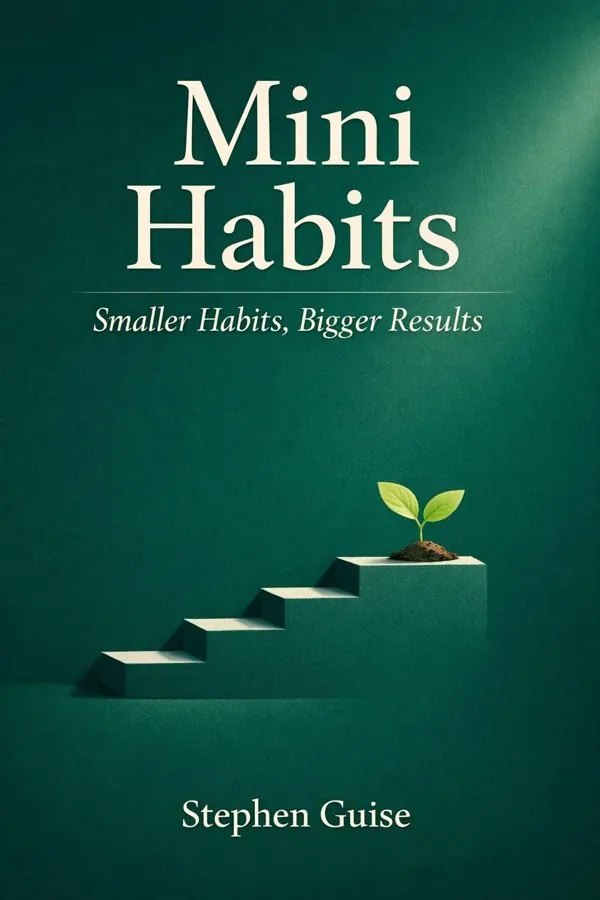
Mini Habits: Smaller Habits, Bigger Results: Summary & Key Insights
 10 min9 chaptersAudio available
Key Takeaways from Mini Habits: Smaller Habits, Bigger Results
Most people treat self-improvement like a test of character, but Stephen Guise argues that this is exactly why so many efforts fail.
The power of a mini habit lies in its absurd smallness.
The brain is not always opposed to improvement, but it is highly sensitive to perceived difficulty.
Many people believe results come from intensity, but Guise makes a more nuanced argument: consistency begins with starting, and starting is a skill in itself.
The most memorable part of Mini Habits is Guise’s own experiment with one push-up a day.
What Is Mini Habits: Smaller Habits, Bigger Results About?
Mini Habits: Smaller Habits, Bigger Results by Stephen Guise is a habits book spanning 9 pages. Big goals are exciting, but they often collapse under the weight of their own ambition. In Mini Habits, Stephen Guise offers a deceptively simple alternative: shrink the behavior until it becomes too easy to avoid. Instead of relying on motivation, mood, or bursts of discipline, Guise shows how tiny daily actions—one push-up, one sentence, one page—can build consistency, confidence, and eventually meaningful transformation. The core insight is that the biggest obstacle to change is not laziness or lack of desire, but the brain’s resistance to effort and uncertainty. By making the starting point ridiculously small, you bypass that resistance and create a reliable path to action. What makes this book so powerful is that it combines practical psychology with lived experience. Guise did not arrive at this method from theory alone; he developed it after repeatedly failing with traditional self-improvement systems. His one-push-up experiment became proof that small wins can rewire behavior and identity over time. For anyone who has started and stopped too many times, Mini Habits offers a realistic, low-friction approach to change that feels sustainable rather than exhausting.
This FizzRead summary covers all 9 key chapters of Mini Habits: Smaller Habits, Bigger Results in approximately 10 minutes, distilling the most important ideas, arguments, and takeaways from Stephen Guise's work. Also available as an audio summary and Key Quotes Podcast.
Mini Habits: Smaller Habits, Bigger Results
Big goals are exciting, but they often collapse under the weight of their own ambition. In Mini Habits, Stephen Guise offers a deceptively simple alternative: shrink the behavior until it becomes too easy to avoid. Instead of relying on motivation, mood, or bursts of discipline, Guise shows how tiny daily actions—one push-up, one sentence, one page—can build consistency, confidence, and eventually meaningful transformation. The core insight is that the biggest obstacle to change is not laziness or lack of desire, but the brain’s resistance to effort and uncertainty. By making the starting point ridiculously small, you bypass that resistance and create a reliable path to action.
What makes this book so powerful is that it combines practical psychology with lived experience. Guise did not arrive at this method from theory alone; he developed it after repeatedly failing with traditional self-improvement systems. His one-push-up experiment became proof that small wins can rewire behavior and identity over time. For anyone who has started and stopped too many times, Mini Habits offers a realistic, low-friction approach to change that feels sustainable rather than exhausting.
Who Should Read Mini Habits: Smaller Habits, Bigger Results?
This book is perfect for anyone interested in habits and looking to gain actionable insights in a short read. Whether you're a student, professional, or lifelong learner, the key ideas from Mini Habits: Smaller Habits, Bigger Results by Stephen Guise will help you think differently.
- ✓Readers who enjoy habits and want practical takeaways
- ✓Professionals looking to apply new ideas to their work and life
- ✓Anyone who wants the core insights of Mini Habits: Smaller Habits, Bigger Results in just 10 minutes
Want the full summary?
Get instant access to this book summary and 100K+ more with Fizz Moment.
Get Free SummaryAvailable on App Store • Free to download
Key Chapters
Most people treat self-improvement like a test of character, but Stephen Guise argues that this is exactly why so many efforts fail. We assume that if we care enough, we will keep going. Yet willpower is not a constant force. It changes with stress, sleep, emotions, hunger, decision fatigue, and the countless demands of daily life. You may feel highly disciplined on Monday morning and completely depleted by Thursday night. If your system depends on being strong all the time, it is built on unstable ground.
Guise explains that habits succeed where willpower fails because they reduce the need for repeated internal battles. A habit is not just a repeated action; it is a behavior that becomes easier to perform because it requires less mental negotiation. The problem is that many people try to build habits by starting too big. They set exercise goals that feel demanding, writing goals that feel intimidating, or diet plans that feel restrictive. This forces willpower to carry too much weight in the early stages, when consistency matters most.
Imagine two people trying to build a reading habit. One commits to reading 30 pages every night. The other commits to reading one page. The first plan sounds more impressive, but it creates more resistance. The second plan feels almost trivial, which is precisely the point. It can survive busy days, low-energy days, and emotionally difficult days. Over time, that reliability matters more than intensity.
The practical lesson is simple: stop designing goals for your best day. Design them for your worst realistic day. If a behavior still feels doable when you are tired, distracted, or unmotivated, it has a much better chance of becoming automatic. Build your habits around consistency, not heroic effort.
The power of a mini habit lies in its absurd smallness. Guise defines a mini habit as a positive behavior reduced to the smallest possible version that you can complete every day without internal resistance. The target should be so easy that saying no feels unreasonable. His famous example is one push-up a day. Not a workout. Not a fitness routine. Just one push-up. That tiny commitment becomes the doorway to a larger pattern.
This idea can feel counterintuitive because we are taught to think bigger is better. Bigger goals seem more serious, more ambitious, and more worthy of praise. But the problem with large goals is that they create pressure before action. They ask the brain to evaluate time, effort, and discomfort before you even begin. A mini habit avoids that trap. It lowers the threshold for starting, and starting is often the hardest part.
Mini habits work across many areas of life. If you want to write, commit to 50 words. If you want to meditate, sit for one minute. If you want to study, open the book and read one paragraph. If you want to build a tidying habit, put away one item. These actions may seem too small to matter, but they matter because they happen. Repeatedly. They create continuity, and continuity is the foundation of change.
The goal is not to stay tiny forever. The goal is to make action inevitable. Once you begin, you may often do more. But the genius of the system is that you still succeed even if you only meet the minimum. That protects momentum and confidence.
Actionable takeaway: choose one area you want to improve and shrink the behavior until it feels almost laughably easy. If it still feels challenging, shrink it again.
The brain is not always opposed to improvement, but it is highly sensitive to perceived difficulty. This is why even valuable behaviors can trigger procrastination. When a task looks large, vague, or tiring, the mind treats it like a threat to comfort and conservation of energy. Guise’s insight is that mini habits sidestep this resistance by making the task too small to alarm the brain.
A large goal like “exercise for an hour” invites excuses immediately: I do not have time, I am tired, I need the right clothes, I will start tomorrow. A mini habit like “put on my shoes and do one push-up” creates almost no friction. There is little to fear, little to delay, and little to negotiate. The mind relaxes because the demand is tiny. This is why mini habits can succeed even when motivation is low.
Guise also highlights the importance of success experiences. Every time you complete a mini habit, you reinforce a positive feedback loop. You prove that you are someone who follows through. That matters psychologically. People often quit because they repeatedly experience failure, and failure shapes identity. A person who constantly breaks ambitious commitments starts to believe they are inconsistent. Mini habits reverse that pattern by making success frequent and dependable.
For example, someone trying to build a journaling practice may avoid writing because they imagine a deep, reflective, 20-minute session. But if the commitment becomes “write one sentence,” the emotional barrier disappears. Some days they stop after one sentence; other days they write a full page. Either outcome counts as success.
Actionable takeaway: when you notice resistance, do not push harder first. Reduce the task. Ask, “What is the smallest version of this I can do right now?” Then complete that version immediately.
Many people believe results come from intensity, but Guise makes a more nuanced argument: consistency begins with starting, and starting is a skill in itself. We often underestimate how much energy is spent simply crossing the line between intention and action. Once that line is crossed, behavior becomes easier. This is why mini habits focus so much on initiation rather than volume.
Think about how often productive days begin with a tiny act. You open a document just to type a sentence, and suddenly you write for 30 minutes. You plan to walk to the corner, and end up taking a full loop around the neighborhood. This is not an accident. Beginning creates momentum. Psychologically, it shifts you from avoidance into engagement. Physically, it gets the body moving. Cognitively, it reduces uncertainty because you are no longer imagining the task—you are doing it.
Guise’s method turns this truth into a system. Instead of demanding a full, ideal behavior every day, it secures the start. This dramatically improves follow-through because the start is the most important threshold. On some days, the mini habit remains mini. On other days, it expands naturally. Both outcomes are useful. The first protects consistency; the second produces extra progress.
A student who wants to study might commit to reviewing one flashcard. That seems negligible, but it makes avoidance harder. A person wanting to declutter may decide to throw away one piece of junk mail. That often leads to clearing a whole surface. By reducing the starting cost, mini habits increase the odds of real work happening.
Actionable takeaway: identify a goal you have been postponing and define the easiest possible starting action. Focus on crossing into action today, not on finishing everything at once.
The most memorable part of Mini Habits is Guise’s own experiment with one push-up a day. At the time, he had grown frustrated with repeated failures to maintain an exercise routine. Like many people, he had aimed for ambitious workouts fueled by temporary motivation. Those plans worked briefly, then collapsed. So he tried the opposite approach: he committed to doing just one push-up each day.
At first glance, the idea seems almost meaningless. One push-up will not transform your body. But Guise’s point is not that a tiny action creates dramatic physical results by itself. The real result is behavioral consistency. One push-up was small enough to do no matter how he felt. It eliminated excuses. More importantly, once he got on the floor, he often did more. The tiny target got him started, and starting changed what felt possible in the moment.
This story illustrates several principles at once. First, tiny goals are psychologically strategic, not weak. Second, success should be measured by adherence to the habit, not by the size of any one day’s output. Third, repeated wins rebuild trust in yourself. Over time, Guise’s tiny commitment helped him become someone who exercised regularly. That identity shift matters more than any single workout.
You can apply the same logic in other domains. A person who wants to write a book can commit to one sentence. A person learning a language can study one word. A person building a gratitude practice can write one thing they appreciate. The point is not to impress yourself; it is to create a pattern that survives real life.
Actionable takeaway: choose a “one push-up equivalent” for one important goal—a tiny daily action that is impossible to rationally reject—and do it for the next week.
We often think identity comes first and behavior follows. We imagine that disciplined people act consistently because they already see themselves as disciplined. Guise flips this assumption. In his view, identity is often built from evidence, and mini habits supply that evidence in small but powerful doses. Each completed action becomes a vote for the type of person you are becoming.
This matters because many people are trapped by old self-descriptions: “I am bad at routines,” “I never finish what I start,” “I am not an exercise person,” or “I am too scattered to meditate.” These beliefs are not always consciously chosen, but they influence behavior. Large goals make the problem worse because frequent failure confirms the old identity. Mini habits interrupt that cycle by making success common.
Suppose someone believes they are not a reader. Committing to 20 pages a night may trigger failure within a week, reinforcing the belief. But committing to one page a night creates a stream of successful repetitions. After a month, that person has proof: I read every day. The identity begins to shift from aspiration to reality. The same process works for fitness, creativity, language learning, organization, and emotional practices.
Guise also emphasizes that self-respect grows when your promises are realistic. Every time you keep a promise to yourself, even a tiny one, you strengthen internal trust. That trust is easy to underestimate, but it is essential for long-term change. People who trust themselves to act need less drama, less guilt, and less motivational hype.
Actionable takeaway: stop asking, “How can I become more motivated?” Instead ask, “What tiny action can I repeat daily to gather evidence for the identity I want?” Then let repetition shape belief.
One reason people abandon habits is that they interpret inconsistency as personal failure. Miss a few workouts, skip a writing session, break a diet plan, and the mind quickly moves from “I slipped” to “I always ruin things.” Guise’s mini habit framework softens this all-or-nothing thinking. Because the required action is so small, missing it becomes less frequent, and when setbacks do happen, they are easier to understand without self-condemnation.
This is crucial for resilience. Traditional self-improvement plans often create high expectations and sharp emotional crashes. If your daily goal is demanding, any interruption feels significant. Travel, illness, stress, deadlines, family responsibilities, or emotional exhaustion can knock you off course. Then shame enters, and shame often leads to avoidance. Mini habits reduce the emotional stakes while preserving the behavioral thread.
Guise encourages readers to view setbacks with curiosity. If you missed your mini habit, why? Was the cue unclear? Was the habit attached to a fragile time of day? Was the target still too large? Did you depend on memory instead of an environmental reminder? This turns a lapse into useful feedback. The system is not accusing you; it is teaching you how to adjust.
For example, if your mini habit is to read one page before bed but you repeatedly forget, the solution may be to place the book on your pillow. If your one-minute meditation keeps getting skipped in the morning rush, move it to lunch break. If “one paragraph” of writing still feels heavy, reduce it to one sentence.
Actionable takeaway: when you miss a day, do not judge yourself. Diagnose the friction. Ask what made the action harder than it should have been, and redesign the habit so success becomes easier tomorrow.
A common criticism of mini habits is that they seem too small to produce meaningful results. Guise addresses this by distinguishing between the minimum requirement and the typical outcome. The minimum is tiny by design, but once you begin, you often do more than required. This expansion is not forced; it arises from momentum, reduced resistance, and a sense of progress.
The beauty of this model is that extra effort becomes a bonus rather than an obligation. Traditional goals create pressure to hit a specific number every day, which can make even good progress feel inadequate. Mini habits reverse the emotional structure. If you complete the minimum, you win. If you continue beyond it, you experience an unpressured surplus. This makes the process psychologically rewarding instead of draining.
Guise also discusses habit stacking and growth. Once one mini habit feels stable, you can add another. A person who successfully builds a one-page reading habit might later add one sentence of journaling. Someone doing one push-up may add one squat. Growth should happen from a base of success, not from impatience. The system works best when each added behavior remains easy enough to protect consistency.
This principle is useful in professional settings too. A manager wanting to improve communication could start by sending one thoughtful check-in message a day. An entrepreneur wanting to market consistently could publish one short social post each morning. These mini actions often expand into deeper engagement once the person is in motion.
Actionable takeaway: keep your minimum tiny, but allow yourself to exceed it whenever it feels natural. Track both streaks and bonus effort, and only add new habits after your current one feels stable.
Real transformation rarely looks dramatic in the moment. It looks repetitive, ordinary, and sometimes unimpressive. This is the quiet truth at the heart of Mini Habits: lasting change is built through daily repetition of behaviors simple enough to survive real life. Guise argues that we overvalue intensity and undervalue persistence. We want breakthroughs, but most positive change comes from accumulation.
Mini habits fit this reality because they are designed for longevity. A behavior that requires little effort can be repeated under a wide range of conditions. That makes it more robust than routines that only work when life is calm and motivation is high. Over months and years, those repetitions do more than produce outcomes; they reshape lifestyle. Someone who reads one page a day may become a regular reader. Someone who writes one sentence a day may finish articles, essays, or eventually a book. Someone who meditates for one minute a day may become more emotionally aware and eventually deepen the practice.
The long-term value also comes from compounding confidence. Every successful repetition says, “I can rely on myself.” That sense of self-trust encourages people to take on bigger goals without returning to self-defeating extremes. In this way, mini habits are not merely a tactic for beginners. They are a sustainable philosophy of behavior change.
This approach is especially powerful for people recovering from burnout, inconsistency, perfectionism, or repeated stop-start cycles. It gives them a way to move forward without needing to feel inspired first.
Actionable takeaway: pick one habit you want to sustain for the next year, not just the next week. Make the daily version so small that you can realistically continue it through stressful, messy, imperfect seasons of life.
All Chapters in Mini Habits: Smaller Habits, Bigger Results
About the Author
Stephen Guise is an American author and blogger best known for his work on habit formation, behavior change, and practical self-improvement. He gained broad attention through his concept of “mini habits,” a method built on taking very small daily actions to create lasting results. His ideas are shaped by both personal experimentation and behavioral psychology, which gives his writing a grounded, accessible quality. Rather than promoting extreme discipline or motivational hype, Guise focuses on sustainable systems that ordinary people can actually maintain. In addition to writing books, he has contributed articles and insights featured in publications such as Forbes, Business Insider, and Time. His work continues to resonate with readers who want realistic strategies for overcoming procrastination, inconsistency, and the frustration of repeated failed goals.
Get This Summary in Your Preferred Format
Read or listen to the Mini Habits: Smaller Habits, Bigger Results summary by Stephen Guise anytime, anywhere. FizzRead offers multiple formats so you can learn on your terms — all free.
Available formats: App · Audio · PDF · EPUB — All included free with FizzRead
Download Mini Habits: Smaller Habits, Bigger Results PDF and EPUB Summary
Key Quotes from Mini Habits: Smaller Habits, Bigger Results
“Most people treat self-improvement like a test of character, but Stephen Guise argues that this is exactly why so many efforts fail.”
“The power of a mini habit lies in its absurd smallness.”
“The brain is not always opposed to improvement, but it is highly sensitive to perceived difficulty.”
“Many people believe results come from intensity, but Guise makes a more nuanced argument: consistency begins with starting, and starting is a skill in itself.”
“The most memorable part of Mini Habits is Guise’s own experiment with one push-up a day.”
Frequently Asked Questions about Mini Habits: Smaller Habits, Bigger Results
Mini Habits: Smaller Habits, Bigger Results by Stephen Guise is a habits book that explores key ideas across 9 chapters. Big goals are exciting, but they often collapse under the weight of their own ambition. In Mini Habits, Stephen Guise offers a deceptively simple alternative: shrink the behavior until it becomes too easy to avoid. Instead of relying on motivation, mood, or bursts of discipline, Guise shows how tiny daily actions—one push-up, one sentence, one page—can build consistency, confidence, and eventually meaningful transformation. The core insight is that the biggest obstacle to change is not laziness or lack of desire, but the brain’s resistance to effort and uncertainty. By making the starting point ridiculously small, you bypass that resistance and create a reliable path to action. What makes this book so powerful is that it combines practical psychology with lived experience. Guise did not arrive at this method from theory alone; he developed it after repeatedly failing with traditional self-improvement systems. His one-push-up experiment became proof that small wins can rewire behavior and identity over time. For anyone who has started and stopped too many times, Mini Habits offers a realistic, low-friction approach to change that feels sustainable rather than exhausting.
You Might Also Like

Atomic Habits: An Easy & Proven Way to Build Good Habits and Break Bad Ones
James Clear
10 min
A Complaint Free World: How to Stop Complaining and Start Enjoying the Life You Always Wanted
Will Bowen
10 minBadass Habits: Cultivate the Awareness, Boundaries, and Daily Upgrades You Need to Make Them Stick
Jen Sincero
10 min
Better Than Before: Mastering The Habits Of Our Everyday Lives
Gretchen Rubin
10 min
Change Anything: The New Science of Personal Success
Kerry Patterson
10 min
Discipline Equals Freedom: Field Manual
Jocko Willink
10 minBrowse by Category
Ready to read Mini Habits: Smaller Habits, Bigger Results?
Get the full summary and 100K+ more books with Fizz Moment.