
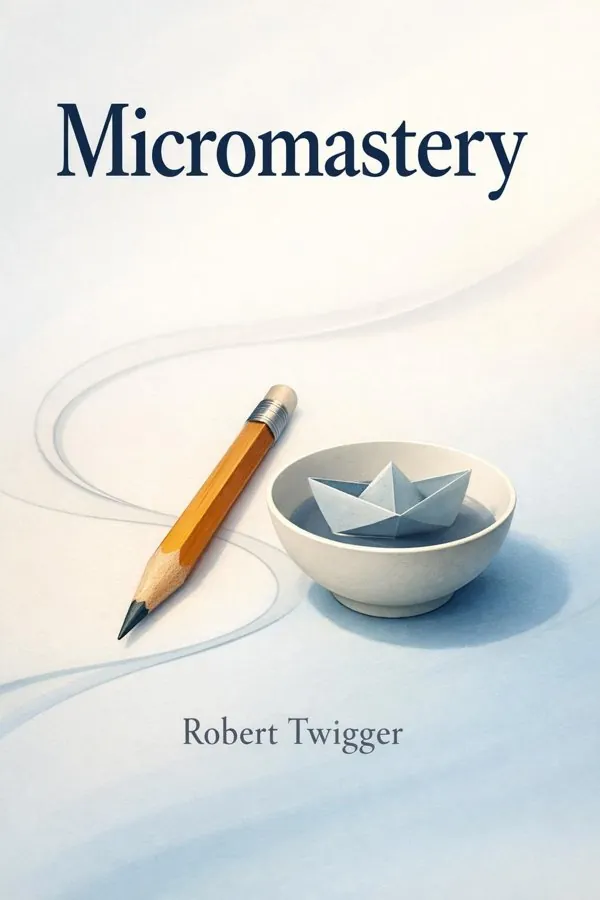
Micromastery: Learn Small, Learn Fast, and Unlock Your Potential to Achieve Anything: Summary & Key Insights
 10 min9 chaptersAudio available
Key Takeaways from Micromastery: Learn Small, Learn Fast, and Unlock Your Potential to Achieve Anything
The biggest barrier to learning is often not difficulty but mythology.
Confidence is rarely built through grand visions; it grows through proof.
A good beginning matters because the first learning experience shapes whether you continue.
Fast learning is rarely accidental; it is designed.
One of Twigger’s most liberating ideas is that worthy skills are hiding in plain sight.
What Is Micromastery: Learn Small, Learn Fast, and Unlock Your Potential to Achieve Anything About?
Micromastery: Learn Small, Learn Fast, and Unlock Your Potential to Achieve Anything by Robert Twigger is a self_awareness book spanning 9 pages. Most people don’t fail to learn because they lack talent. They fail because the idea of mastery has been made to feel too large, too slow, and too intimidating to begin. In Micromastery, Robert Twigger offers a refreshing alternative: instead of trying to conquer an entire field, start by mastering one small, self-contained skill with complete attention. That might mean making one excellent omelet, learning to juggle three balls, sketching a face, or tuning a bike properly. The point is not triviality. It is momentum. Twigger argues that these focused micro-skills change how we relate to learning itself. They create quick feedback, visible progress, and a sense of agency that large ambitions often destroy. Once you experience competence in one small area, you begin to trust your ability to grow in others. The result is confidence without ego, curiosity without pressure, and discipline that feels playful rather than punishing. Drawing on personal experience, observation, and a wide-ranging intellectual style, Twigger presents a practical philosophy for lifelong learning. This book matters because it turns mastery from a distant fantasy into a repeatable method anyone can use.
This FizzRead summary covers all 9 key chapters of Micromastery: Learn Small, Learn Fast, and Unlock Your Potential to Achieve Anything in approximately 10 minutes, distilling the most important ideas, arguments, and takeaways from Robert Twigger's work. Also available as an audio summary and Key Quotes Podcast.
Micromastery: Learn Small, Learn Fast, and Unlock Your Potential to Achieve Anything
Most people don’t fail to learn because they lack talent. They fail because the idea of mastery has been made to feel too large, too slow, and too intimidating to begin. In Micromastery, Robert Twigger offers a refreshing alternative: instead of trying to conquer an entire field, start by mastering one small, self-contained skill with complete attention. That might mean making one excellent omelet, learning to juggle three balls, sketching a face, or tuning a bike properly. The point is not triviality. It is momentum.
Twigger argues that these focused micro-skills change how we relate to learning itself. They create quick feedback, visible progress, and a sense of agency that large ambitions often destroy. Once you experience competence in one small area, you begin to trust your ability to grow in others. The result is confidence without ego, curiosity without pressure, and discipline that feels playful rather than punishing.
Drawing on personal experience, observation, and a wide-ranging intellectual style, Twigger presents a practical philosophy for lifelong learning. This book matters because it turns mastery from a distant fantasy into a repeatable method anyone can use.
Who Should Read Micromastery: Learn Small, Learn Fast, and Unlock Your Potential to Achieve Anything?
This book is perfect for anyone interested in self_awareness and looking to gain actionable insights in a short read. Whether you're a student, professional, or lifelong learner, the key ideas from Micromastery: Learn Small, Learn Fast, and Unlock Your Potential to Achieve Anything by Robert Twigger will help you think differently.
- ✓Readers who enjoy self_awareness and want practical takeaways
- ✓Professionals looking to apply new ideas to their work and life
- ✓Anyone who wants the core insights of Micromastery: Learn Small, Learn Fast, and Unlock Your Potential to Achieve Anything in just 10 minutes
Want the full summary?
Get instant access to this book summary and 100K+ more with Fizz Moment.
Get Free SummaryAvailable on App Store • Free to download
Key Chapters
The biggest barrier to learning is often not difficulty but mythology. We are surrounded by a dramatic image of mastery: years of sacrifice, obsessive dedication, expert teachers, and a near-superhuman level of commitment. That image can inspire, but it also frightens people away. If becoming good at something appears to require rebuilding your entire life around a single pursuit, most people will never begin. Twigger challenges this narrative by arguing that mastery has been packaged as a monumental project when it can also be approached as a series of small, achievable victories.
Traditional mastery tends to assume that a learner should commit to a broad domain like music, painting, or martial arts. But broad domains are messy. They contain too many sub-skills, too much ambiguity, and too many opportunities to feel inadequate. A micromastery shrinks the target. Instead of “learn guitar,” you might learn to play one clean blues shuffle. Instead of “become a cook,” you might learn to make one consistently excellent soup. This smaller frame makes progress visible and emotionally rewarding.
Twigger is not dismissing deep expertise. He is questioning the intimidating gateway that often prevents people from taking the first step. By removing the heroic aura around mastery, he makes learning democratic. You do not need permission, status, or a ten-year plan. You need a manageable challenge and the willingness to pay attention.
Actionable takeaway: Stop defining your goal as mastery of a whole field. Choose one narrow, concrete skill you can practice repeatedly and complete within weeks, not years.
Confidence is rarely built through grand visions; it grows through proof. Twigger emphasizes that the psychology of learning depends on feedback, and feedback is easiest to get when the task is small enough to measure. Large ambitions often remain emotionally empty because progress is too slow and too vague. When someone says, “I want to get fit,” “learn Italian,” or “become creative,” the brain has nothing immediate to latch onto. But if the goal is “hold a plank for two minutes,” “order a meal in Italian,” or “draw one accurate eye,” improvement becomes visible, and visible improvement fuels motivation.
This is why micromastery feels energizing rather than draining. Each practice session can produce evidence of movement. You see the omelet fold better, the juggling rhythm last longer, the bike gears shift more smoothly. These small wins are not superficial. They strengthen self-efficacy, the belief that effort leads to improvement. Once that belief grows, people become more resilient and more willing to attempt difficult things.
Small wins also reduce the emotional cost of failure. If you struggle with one tiny skill, your identity is not threatened. You simply adjust and try again. Compare that with a broad goal like “I’m learning to paint,” where every weak attempt can feel like proof that you lack talent. Micromastery creates a safer environment for repetition, and repetition is what learning requires.
Actionable takeaway: Redesign any overwhelming goal into a version that produces visible progress within days. If you cannot tell whether you are improving, the target is still too big.
A good beginning matters because the first learning experience shapes whether you continue. Twigger advises that your first micromastery should be small enough to finish, rich enough to stay interesting, and specific enough to practice. The ideal challenge sits between trivial and impossible. It should stretch you, but not crush you.
A strong micromastery has clear boundaries. “Learn photography” is too broad. “Take one striking black-and-white portrait using natural window light” is much better. “Get into woodworking” is vague. “Cut a precise dovetail joint” is concrete. A bounded skill allows you to know what success looks like. It also makes it easier to gather tools, design practice, and notice mistakes.
Twigger also suggests choosing something with sensory immediacy and built-in satisfaction. Skills that create a visible, audible, or physical result are especially motivating: baking bread, sharpening a knife, sketching a hand, juggling clubs, tying a proper knot. The learner can compare attempts and feel improvement in real time. This keeps curiosity alive.
Another crucial point is emotional resonance. The best micromastery is not just efficient; it is personally meaningful. You are more likely to persist when the skill carries some fascination, usefulness, or aesthetic pull. Maybe you want to make the perfect espresso because you love coffee, or identify birds because you enjoy walking outdoors. Relevance deepens attention.
Actionable takeaway: Pick a first micro-skill that is narrow, measurable, and intrinsically appealing. If you can describe success in one sentence, you probably have a workable target.
Fast learning is rarely accidental; it is designed. Twigger describes micromastery as built from several core elements that turn a small skill into an ideal learning unit. While the wording may vary, the underlying logic is consistent: the skill should have a clear endpoint, a manageable entry point, useful constraints, repeatable practice, immediate feedback, and room for personal experimentation.
First, the endpoint must be precise. You need to know what “done well” looks like. Second, the entry point should be accessible. A learner must be able to start without needing years of background knowledge. Third, constraints are valuable. They reduce complexity and force attention. Making one dish with five ingredients, drawing only with pen, or practicing one tennis serve variation can sharpen learning more than endless options.
Fourth, the skill needs repeatability. If you cannot practice it often, progress will be slow and hard to perceive. Fifth, feedback should arrive quickly, either through the result itself or through an informed comparison. The omelet tears, the note squeaks, the line goes off angle. Finally, experimentation keeps practice alive. Once the basics are stable, variation prevents boredom and helps the learner develop ownership.
These elements make micromastery powerful because they combine structure with play. The learner is not drowning in complexity, but neither is the process sterile. It becomes a compact laboratory for skill development.
Actionable takeaway: Before beginning a micro-skill, define its endpoint, constraints, and feedback loop. If those three pieces are clear, the rest of your practice becomes dramatically easier.
One of Twigger’s most liberating ideas is that worthy skills are hiding in plain sight. We tend to reserve the word “mastery” for prestigious activities such as music, writing, or athletics, but everyday acts can be just as rich for learning. Making an omelet, juggling, repairing a puncture, sketching a portrait, sharpening a pencil with a knife, or folding a shirt neatly all contain technique, standards, and opportunities for refinement. Once you begin to see this, the world fills with possible apprenticeships.
This matters because ordinary skills are accessible. They do not require large investments, special institutions, or dramatic identity changes. A kitchen, a notebook, a deck of cards, or a bicycle can become a site of disciplined growth. Everyday micromasteries also integrate more easily into life. You can practice them in short bursts, revisit them often, and enjoy practical benefits almost immediately.
Twigger’s examples show that learning does not need to be grand to be transformative. Mastering one useful thing changes posture. You become more observant, more patient, and more confident in your ability to improve. The object of study may seem humble, but the process reshapes the learner.
There is also a deeper philosophical point here: when you train yourself to notice quality in ordinary actions, life itself becomes more textured. Routine stops being dead time and starts becoming material for craft.
Actionable takeaway: Look at your daily life and identify three recurring tasks that could be upgraded into mini-disciplines. Choose one and decide what “excellent” would look like.
People learn fastest when they are alert, engaged, and slightly amused. Twigger resists the grim, punitive model of self-improvement in which progress is supposed to come only through drudgery. Micromastery works partly because it reactivates curiosity and play. A small skill invites experimentation. You can ask: What happens if I change my grip? Can I flip the omelet higher? How does the portrait change if I start with shadow instead of outline? This spirit of inquiry makes practice lively.
Play is not the opposite of seriousness. It is often the most effective route into seriousness because it sustains attention. When learners are curious, they naturally notice patterns, test variations, and recover more easily from mistakes. A child learns many physical and social skills through playful repetition; adults often forget that this mechanism still applies. If practice feels dead, brittle, or overburdened by performance anxiety, learning slows down.
Twigger’s method therefore invites a more adventurous stance. Rather than demanding instant competence, it encourages exploration within a constrained space. That balance matters. Pure randomness is not learning, but rigid repetition without interest is equally weak. Micromastery creates a sandbox with rules, where exploration remains productive.
This approach also helps adults who feel embarrassed to be beginners. Play lowers ego pressure. It allows experimentation without making each error feel like a verdict on ability.
Actionable takeaway: In your next practice session, add one playful variation on purpose. Change speed, angle, sequence, or setting, and treat the result as information rather than success or failure.
A single micromastery is useful; a chain of them can transform a life. Twigger argues that small skills are not isolated tricks but building blocks. Once you master one compact area, you gain not only that skill but also a transferable process: how to define a target, practice deliberately, seek feedback, and persist through awkwardness. This process can then be applied again and again.
For example, someone who begins by learning to make one excellent omelet may then move to knife skills, sauces, bread, and timing a full meal. A beginner cyclist might start with fixing a flat tire, then learn gear adjustment, brake tuning, wheel truing, and route planning. A writer might first master vivid scene description, then dialogue, then openings, then editing for rhythm. The point is not to perfect everything before moving on. It is to create a sequence where each success supports the next.
This chaining effect solves a major problem in self-development: inconsistency. Many people have bursts of enthusiasm followed by collapse because they rely on emotion alone. Micromastery builds continuity through structure. Each completed unit becomes evidence that further learning is possible. Over time, a person develops a portfolio of competence and a habit of tackling unfamiliar things without panic.
Twigger also shows that chains can stay flexible. You do not need a rigid grand plan. Follow interest, usefulness, or adjacent challenge. Let one micro-skill suggest the next.
Actionable takeaway: After choosing one micromastery, map two logical follow-up skills that build on it. Think in sequences of three, not fantasies of total expertise.
Identity is often the hidden force behind learning. People say, “I’m not musical,” “I’m bad with my hands,” or “I’m just not disciplined.” These statements appear descriptive, but they often become self-fulfilling limits. Twigger’s micromastery framework weakens those limits by giving learners repeated experiences of successful change. When you master one small thing, you gather evidence that identity is more flexible than you thought.
This is important because broad identity labels can be psychologically crushing. If you decide whether you are “a creative person” based on one failed attempt at painting, the conclusion is absurdly large compared with the evidence. Micromastery narrows the frame. You are not asking whether you are inherently talented. You are asking whether you can improve at this one specific operation through practice. Usually, the answer is yes.
Repeated across different areas, this creates a quieter but stronger form of confidence. It is not boastful. It is procedural. You start to think, “I know how to learn things,” which is more durable than “I am naturally gifted.” This shift matters at work, in hobbies, and in personal growth. A person with process confidence is more likely to take on new challenges, adapt, and recover from setbacks.
Twigger ultimately suggests that micromastery is not just a learning technique but an antidote to fixed identity. It helps people become more experimental versions of themselves.
Actionable takeaway: Replace one limiting self-label with a skill-specific experiment. Instead of saying “I’m bad at drawing,” try “I’m practicing how to shade a sphere accurately for ten days.”
Professional growth often stalls for the same reason personal growth does: the target is too broad. Twigger’s ideas extend naturally into work, where people are told to become better leaders, better communicators, better analysts, or more strategic thinkers. Those goals sound useful but are too vague to generate action. Micromastery translates them into trainable components.
A manager might focus on one micro-skill such as opening meetings with a clear objective and closing them with defined next steps. A salesperson could practice asking one stronger follow-up question. A writer at work might learn to produce cleaner email subject lines or more persuasive first paragraphs. A public speaker could work specifically on pausing after key points rather than trying to “be charismatic.” By reducing performance to small units, improvement becomes practical and trackable.
The same principle applies to personal life. Relationships can benefit from micro-skills like remembering names, asking better questions, or listening without interrupting for two full minutes. Health can improve through learning one reliable breakfast, one mobility routine, or one breath control technique. Home life can improve through tiny domestic competencies that lower friction and increase calm.
What makes this powerful is accumulation. Work and life are shaped less by dramatic reinventions than by repeated competent actions. Micromastery gives people a way to improve those actions without waiting for ideal conditions or massive motivation.
Actionable takeaway: Pick one recurring friction point in your work or home life and define the smallest skill that would improve it. Practice that skill daily until it becomes automatic.
All Chapters in Micromastery: Learn Small, Learn Fast, and Unlock Your Potential to Achieve Anything
About the Author
Robert Twigger is a British author, poet, and explorer whose nonfiction often blends memoir, philosophy, travel, and practical insight. He is known for his wide-ranging curiosity and his willingness to immerse himself in demanding experiences as a way of understanding learning, identity, and human potential. Twigger gained major recognition with Angry White Pyjamas, his account of intense martial arts training in Japan, which won the Somerset Maugham Award. Over the years, he has written on subjects including adventure, creativity, skill-building, and personal transformation. In Micromastery, he brings together his fascination with learning and experimentation to argue for a more approachable, playful path to competence. His work stands out for making serious ideas feel vivid, unconventional, and usable in everyday life.
Get This Summary in Your Preferred Format
Read or listen to the Micromastery: Learn Small, Learn Fast, and Unlock Your Potential to Achieve Anything summary by Robert Twigger anytime, anywhere. FizzRead offers multiple formats so you can learn on your terms — all free.
Available formats: App · Audio · PDF · EPUB — All included free with FizzRead
Download Micromastery: Learn Small, Learn Fast, and Unlock Your Potential to Achieve Anything PDF and EPUB Summary
Key Quotes from Micromastery: Learn Small, Learn Fast, and Unlock Your Potential to Achieve Anything
“The biggest barrier to learning is often not difficulty but mythology.”
“Confidence is rarely built through grand visions; it grows through proof.”
“A good beginning matters because the first learning experience shapes whether you continue.”
“Fast learning is rarely accidental; it is designed.”
“One of Twigger’s most liberating ideas is that worthy skills are hiding in plain sight.”
Frequently Asked Questions about Micromastery: Learn Small, Learn Fast, and Unlock Your Potential to Achieve Anything
Micromastery: Learn Small, Learn Fast, and Unlock Your Potential to Achieve Anything by Robert Twigger is a self_awareness book that explores key ideas across 9 chapters. Most people don’t fail to learn because they lack talent. They fail because the idea of mastery has been made to feel too large, too slow, and too intimidating to begin. In Micromastery, Robert Twigger offers a refreshing alternative: instead of trying to conquer an entire field, start by mastering one small, self-contained skill with complete attention. That might mean making one excellent omelet, learning to juggle three balls, sketching a face, or tuning a bike properly. The point is not triviality. It is momentum. Twigger argues that these focused micro-skills change how we relate to learning itself. They create quick feedback, visible progress, and a sense of agency that large ambitions often destroy. Once you experience competence in one small area, you begin to trust your ability to grow in others. The result is confidence without ego, curiosity without pressure, and discipline that feels playful rather than punishing. Drawing on personal experience, observation, and a wide-ranging intellectual style, Twigger presents a practical philosophy for lifelong learning. This book matters because it turns mastery from a distant fantasy into a repeatable method anyone can use.
You Might Also Like

Rising Strong
Brené Brown
10 min
You Do You
Sarah Knight
10 min
Master Your Emotions: A Practical Guide to Overcome Negativity and Better Manage Your Feelings
Thibaut Meurisse
10 min
The Mountain Is You: Transforming Self-Sabotage Into Self-Mastery
Brianna Wiest
10 min
101 Essays That Will Change The Way You Think
Brianna Wiest
10 min
A Radical Awakening: Turn Pain into Power, Embrace Your Truth, Live Free
Shefali Tsabary
10 minBrowse by Category
Ready to read Micromastery: Learn Small, Learn Fast, and Unlock Your Potential to Achieve Anything?
Get the full summary and 100K+ more books with Fizz Moment.