
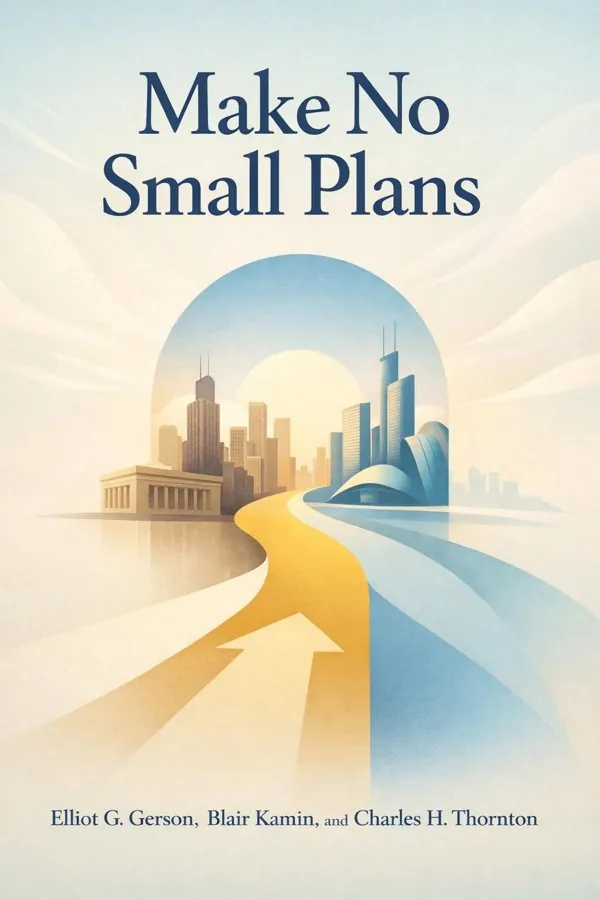
Make No Small Plans: Summary & Key Insights
by Elliot G. Gerson, Blair Kamin, and Charles H. Thornton
 10 min9 chaptersAudio available
Key Takeaways from Make No Small Plans
A city becomes more meaningful when we stop treating it as background and start seeing it as a story in progress.
Great cities rarely emerge from small ambitions.
Disaster can expose weakness, but it can also open the door to reinvention.
Tall buildings are not just feats of vanity; they are arguments about what technology can make possible.
Cities are built by coalitions, not by lone geniuses.
What Is Make No Small Plans About?
Make No Small Plans by Elliot G. Gerson, Blair Kamin, and Charles H. Thornton is a design book spanning 8 pages. Make No Small Plans is an unusual and memorable book: part graphic novel, part civic history, and part invitation to imagine a better city. Commissioned by the Chicago Architecture Foundation, it follows three teenagers as they move through Chicago’s past, present, and possible futures, discovering how architecture, infrastructure, politics, and public vision shaped one of the world’s great urban laboratories. Inspired by Daniel Burnham’s 1909 Plan of Chicago and his famous challenge to “make no little plans,” the book turns urban design into a living story rather than a distant subject reserved for experts. What makes the book matter is its central claim: cities are not accidental. They are designed, contested, rebuilt, and reimagined by people with values, courage, and ambition. That means ordinary citizens, especially young people, have a role in shaping what comes next. The authors bring rare authority to that message. Blair Kamin offers the eye of a Pulitzer Prize–winning architecture critic, Charles H. Thornton brings the mind of a leading structural engineer, and Elliot G. Gerson contributes a deep commitment to civic leadership and education. Together, they create a book that makes urban history vivid, accessible, and urgently relevant.
This FizzRead summary covers all 9 key chapters of Make No Small Plans in approximately 10 minutes, distilling the most important ideas, arguments, and takeaways from Elliot G. Gerson, Blair Kamin, and Charles H. Thornton's work. Also available as an audio summary and Key Quotes Podcast.
Make No Small Plans
Make No Small Plans is an unusual and memorable book: part graphic novel, part civic history, and part invitation to imagine a better city. Commissioned by the Chicago Architecture Foundation, it follows three teenagers as they move through Chicago’s past, present, and possible futures, discovering how architecture, infrastructure, politics, and public vision shaped one of the world’s great urban laboratories. Inspired by Daniel Burnham’s 1909 Plan of Chicago and his famous challenge to “make no little plans,” the book turns urban design into a living story rather than a distant subject reserved for experts.
What makes the book matter is its central claim: cities are not accidental. They are designed, contested, rebuilt, and reimagined by people with values, courage, and ambition. That means ordinary citizens, especially young people, have a role in shaping what comes next. The authors bring rare authority to that message. Blair Kamin offers the eye of a Pulitzer Prize–winning architecture critic, Charles H. Thornton brings the mind of a leading structural engineer, and Elliot G. Gerson contributes a deep commitment to civic leadership and education. Together, they create a book that makes urban history vivid, accessible, and urgently relevant.
Who Should Read Make No Small Plans?
This book is perfect for anyone interested in design and looking to gain actionable insights in a short read. Whether you're a student, professional, or lifelong learner, the key ideas from Make No Small Plans by Elliot G. Gerson, Blair Kamin, and Charles H. Thornton will help you think differently.
- ✓Readers who enjoy design and want practical takeaways
- ✓Professionals looking to apply new ideas to their work and life
- ✓Anyone who wants the core insights of Make No Small Plans in just 10 minutes
Want the full summary?
Get instant access to this book summary and 100K+ more with Fizz Moment.
Get Free SummaryAvailable on App Store • Free to download
Key Chapters
A city becomes more meaningful when we stop treating it as background and start seeing it as a story in progress. Make No Small Plans begins with three teenagers who represent curiosity, skepticism, and possibility. They are not experts, and that is precisely the point. Through their eyes, readers encounter Chicago not as a fixed collection of buildings, but as a living environment shaped by decisions, disasters, ideals, and conflicts over time.
This framing matters because urban design can often seem abstract. Plans, zoning, parks, boulevards, transit lines, and waterfront access may sound technical, but they influence everyday life: how long commutes take, where children play, who feels welcome in public space, and which neighborhoods thrive or decline. By placing young people at the center of the narrative, the book makes civic design personal. The teenagers ask the kinds of questions many readers ask: Why does the city look this way? Who decided where roads go? Why do some spaces inspire pride while others feel neglected?
The result is an accessible lesson in civic literacy. The city itself becomes a classroom, with streets, bridges, parks, and skylines serving as evidence of earlier choices. Readers are encouraged to notice design all around them, from the width of sidewalks to the presence of trees and train stations. The message is empowering: you do not need professional credentials to care about architecture or public life. Attention is the first step toward participation.
Actionable takeaway: Walk through your own city or neighborhood and identify three design choices you normally ignore, such as transit access, green space, or building scale, then ask how each affects daily life.
Great cities rarely emerge from small ambitions. One of the book’s central episodes introduces Daniel Burnham and Edward Bennett’s 1909 Plan of Chicago, a landmark in American urban planning. Burnham’s famous declaration to “make no little plans” was not merely rhetorical flair. It reflected a philosophy that cities require bold, coordinated thinking rather than piecemeal fixes.
The Plan of Chicago proposed an integrated vision for parks, roads, lakefront access, civic spaces, rail improvements, and regional development. Instead of seeing transportation, beauty, public health, and economic growth as separate issues, Burnham treated them as interconnected. That insight still feels modern. A waterfront is not just scenery; it affects recreation, tourism, environmental resilience, and public identity. A boulevard is not just a road; it influences commerce, mobility, and neighborhood cohesion.
What the book does well is show that visionary planning is not fantasy. Some parts of Burnham’s plan were realized, others were modified, and some never happened. But even unrealized plans can shape public debate by expanding what people believe is possible. In practical terms, this teaches readers that long-range thinking matters even when politics, budgets, and competing interests complicate execution.
Today, cities confront housing shortages, climate risks, congestion, and inequity. Burnham’s example suggests that fragmented responses are rarely enough. Communities need comprehensive frameworks that align infrastructure, design, and civic values. Vision, in other words, is not a luxury; it is a form of responsibility.
Actionable takeaway: When evaluating a local issue such as traffic, parks, or housing, ask not only “What is the quick fix?” but also “What larger citywide vision would solve this more intelligently over the next twenty years?”
Disaster can expose weakness, but it can also open the door to reinvention. The Great Chicago Fire of 1871 is one of the book’s defining historical moments. Rather than presenting it only as tragedy, Make No Small Plans shows how the fire became a turning point that pushed Chicago to rebuild at a new scale and with new imagination.
The fire destroyed vast portions of the city, displacing residents and forcing hard questions about materials, street design, safety, and urban resilience. In its aftermath, Chicago became a proving ground for new construction methods and architectural experimentation. Reconstruction was not simply about replacing what had been lost. It was about deciding what the city should become.
This is an important civic lesson. Crises often reveal structural problems that existed long before the emergency itself. Whether the issue is fire, flooding, economic decline, or social unrest, moments of disruption can prompt communities to rethink systems rather than patch surfaces. Chicago’s recovery shows that rebuilding is always a moral and political act. Who gets rebuilt for? What kinds of spaces are prioritized? How can safety and beauty reinforce each other?
The book invites readers to connect this history to contemporary challenges. Cities today face climate shocks, aging infrastructure, and public health pressures. The lesson from Chicago is not that suffering automatically produces progress. It is that progress depends on whether leaders and citizens use crisis as a chance to design better institutions and places.
Actionable takeaway: The next time your community faces a setback, ask what underlying design or policy failure it reveals, and advocate for a solution that improves the system rather than merely restoring the old version.
Tall buildings are not just feats of vanity; they are arguments about what technology can make possible. In tracing Chicago’s architectural rise, the book highlights the development of skyscrapers and the engineering breakthroughs that supported them. This is where design meets physics, and where civic identity meets structural innovation.
Chicago became famous for pioneering modern building methods after the fire, as architects and engineers sought ways to build higher, stronger, and more efficiently. Steel-frame construction, improved foundations, and elevator technology transformed what a downtown could be. But the book also makes a subtler point: engineering is not separate from public life. Structural systems shape skylines, economic density, and how people experience urban space.
Charles H. Thornton’s influence is especially visible in this theme. He helps readers appreciate that buildings stand because of rigorous thinking, not just visual flair. A graceful tower depends on load paths, materials, wind resistance, and coordination across disciplines. In that sense, engineering is a hidden form of civic trust. People work, gather, and live inside structures because they rely on unseen expertise.
For readers, the practical takeaway is that good cities are collaborative achievements. Architects imagine form, engineers ensure performance, planners organize systems, and citizens define priorities. When any one of these elements dominates without the others, cities suffer.
Actionable takeaway: The next time you admire a landmark building, look beyond its appearance and ask what engineering, materials, and coordination made it possible, then apply that same respect for invisible systems to other public works like bridges, transit, and water infrastructure.
Cities are built by coalitions, not by lone geniuses. While Burnham is the most famous voice in the book, Make No Small Plans broadens the narrative to include reformers, planners, engineers, architects, public officials, and community actors who helped transform Chicago into a metropolis. This wider lens matters because it challenges the myth that urban greatness is produced by a single heroic planner.
The book shows that civic change requires institutions, advocacy, and persistence. Parks do not appear because someone once had a good idea. They require funding, land decisions, political support, and long-term maintenance. Transit systems require planning, coordination, and public buy-in. Lakefront access must be defended over time against private interests and changing pressures.
This perspective is especially helpful for readers who care about civic improvement but feel overwhelmed. The making of a city is cumulative. Small efforts, sustained over years, can reshape public life. A neighborhood group preserving a local landmark, a nonprofit promoting design education, or residents pushing for safer streets are participating in the same tradition of civic stewardship.
The deeper message is that urban design is inseparable from citizenship. To inhabit a city responsibly is to understand that streets, public spaces, and civic institutions are inherited goods that require renewal. Beauty and functionality do not maintain themselves.
Actionable takeaway: Identify one local institution, neighborhood group, or public initiative that influences the built environment in your area, and find a concrete way to support it, whether by attending a meeting, volunteering, or simply becoming informed about its work.
A well-designed city is not only efficient; it is democratic. One of the book’s strongest contemporary themes is that urban planning should not be imposed from above without public participation. While grand visions matter, they must be connected to the lived experiences of residents whose daily lives are shaped by planning decisions.
Make No Small Plans moves from historical master planning to a more current understanding of cities as places requiring dialogue, inclusion, and responsiveness. That shift is crucial. Earlier eras often celebrated top-down expertise while overlooking whose voices were missing. Today, planners and citizens increasingly recognize that transportation routes, school locations, public spaces, and redevelopment projects affect communities unevenly. If residents are excluded, even elegant plans can produce mistrust or harm.
The book encourages readers, especially younger ones, to see civic engagement as part of design itself. Public hearings, neighborhood forums, student projects, and community design workshops may not sound as dramatic as skyscrapers, but they shape how places function and whom they serve. Participation also improves outcomes. People who use a street, park, or transit stop every day often notice details experts miss.
In practical terms, this idea can be applied anywhere. A school courtyard redesign should involve students and teachers. A neighborhood traffic-calming plan should include cyclists, pedestrians, parents, and business owners. Better cities emerge when planning is both visionary and grounded.
Actionable takeaway: The next time a local development or public-space proposal appears, read the plan, attend one public meeting if possible, and write down one informed question or suggestion instead of staying passive.
The most exciting city is not the one that grows fastest, but the one that learns how to endure. In its future-facing sections, the book links civic imagination with sustainability, urging readers to think beyond iconic buildings toward environmental resilience, public health, and long-term livability.
This is a natural extension of Burnham’s big-picture mindset. A modern city must consider green space, clean air, water systems, walkability, transit, energy use, and climate adaptation. Sustainability here is not a decorative extra. It is a design principle that determines whether cities can remain humane under pressure from heat, storms, population shifts, and resource constraints.
The book’s visual storytelling helps younger readers grasp that the future is not predetermined. Different design choices lead to different outcomes. A city that invests in parks and tree cover can reduce heat stress. A city that supports transit and mixed-use neighborhoods can reduce car dependence. A city that protects its waterfronts and updates infrastructure can better withstand environmental shocks.
Importantly, sustainability is framed not as sacrifice but as intelligent design. Cleaner, greener, more connected cities are often healthier and more enjoyable cities. The challenge is to align immediate political decisions with long-term civic well-being.
For readers, this means sustainability should be part of everyday urban thinking. It applies to building design, school campuses, street layouts, and housing policy. The future is built incrementally, one project at a time.
Actionable takeaway: Look at one place you use regularly, such as a school, street, or park, and identify one realistic improvement that would make it more sustainable, such as more shade, safer walking access, better drainage, or less energy waste.
To imagine a better city is also to accept some responsibility for helping build it. By the end of Make No Small Plans, the teenagers’ journey comes full circle. They have not simply learned facts about Chicago. They have come to understand that cities are collective creations, and that every generation inherits both the achievements and unfinished work of those who came before.
This is the book’s emotional core. Architecture is not only about monuments, and planning is not only about maps. Both are expressions of what a society values. When a city preserves public access to a lakefront, invests in schools and transit, or creates welcoming public spaces, it reveals a belief in shared civic life. When it neglects these things, that too sends a message.
The teenagers’ evolving perspective mirrors what the book wants from readers: not passive admiration, but active imagination. To care about one’s city is to notice what is missing as well as what is admirable. It is to ask how beauty, equity, memory, and function can coexist. It is also to see oneself as part of the answer, even in modest ways.
This idea has practical force for students, educators, professionals, and ordinary residents. You may not draft a citywide master plan, but you can learn local history, support good design, speak up about public space, and help cultivate civic ambition in others. Big plans begin with enlarged expectations.
Actionable takeaway: Write a short “future letter” to your city or neighborhood describing one change you hope to see in ten years and one step you can personally take now to support that vision.
When people learn to read a city, they become harder to ignore. An understated but important contribution of Make No Small Plans is its belief that design education is civic education. By combining illustration, narrative, history, and urban ideas, the book demonstrates that architecture and planning can be taught in a way that is engaging rather than intimidating.
This matters because many people grow up surrounded by design decisions they never learn to interpret. They know whether a place feels safe, beautiful, confusing, or isolating, but they may lack the vocabulary to explain why. The book fills that gap. It introduces concepts like planning, infrastructure, engineering, and public space through story, helping readers connect emotional experience with structural understanding.
The practical implications are wide-reaching. Students who learn how cities function may become more informed voters, more observant residents, and more creative professionals whether or not they enter design fields. Teachers can use urban history to connect art, science, politics, and geography. Families can explore neighborhoods with fresh curiosity. Community groups can use visual storytelling to make local planning debates more accessible.
In an era of polarization and short attention spans, this approach is especially valuable. It reminds us that civic knowledge does not have to be dry. It can be visual, local, and imaginative. A more design-literate public is better equipped to demand quality, fairness, and foresight from leaders.
Actionable takeaway: Choose one public place in your area and discuss it with a friend, student, or family member using simple design questions: Who is this space for, what works well, what feels missing, and how could it be improved?
All Chapters in Make No Small Plans
About the Authors
Elliot G. Gerson, Blair Kamin, and Charles H. Thornton brought together civic leadership, architectural criticism, and structural engineering to create Make No Small Plans. Gerson is a prominent educational and nonprofit leader associated with the Aspen Institute and the Rhodes Trust, with a long record of supporting public-minded learning. Kamin is a Pulitzer Prize–winning architecture critic best known for his influential work at the Chicago Tribune, where he interpreted buildings and urban issues for a broad readership. Thornton was a celebrated structural engineer and co-founder of Thornton Tomasetti, a major engineering firm behind complex projects around the world. Their collaboration, developed with the Chicago Architecture Foundation, gives the book unusual authority and balance, combining historical insight, design literacy, technical understanding, and a strong belief in civic imagination.
Get This Summary in Your Preferred Format
Read or listen to the Make No Small Plans summary by Elliot G. Gerson, Blair Kamin, and Charles H. Thornton anytime, anywhere. FizzRead offers multiple formats so you can learn on your terms — all free.
Available formats: App · Audio · PDF · EPUB — All included free with FizzRead
Download Make No Small Plans PDF and EPUB Summary
Key Quotes from Make No Small Plans
“A city becomes more meaningful when we stop treating it as background and start seeing it as a story in progress.”
“Great cities rarely emerge from small ambitions.”
“Disaster can expose weakness, but it can also open the door to reinvention.”
“Tall buildings are not just feats of vanity; they are arguments about what technology can make possible.”
“Cities are built by coalitions, not by lone geniuses.”
Frequently Asked Questions about Make No Small Plans
Make No Small Plans by Elliot G. Gerson, Blair Kamin, and Charles H. Thornton is a design book that explores key ideas across 9 chapters. Make No Small Plans is an unusual and memorable book: part graphic novel, part civic history, and part invitation to imagine a better city. Commissioned by the Chicago Architecture Foundation, it follows three teenagers as they move through Chicago’s past, present, and possible futures, discovering how architecture, infrastructure, politics, and public vision shaped one of the world’s great urban laboratories. Inspired by Daniel Burnham’s 1909 Plan of Chicago and his famous challenge to “make no little plans,” the book turns urban design into a living story rather than a distant subject reserved for experts. What makes the book matter is its central claim: cities are not accidental. They are designed, contested, rebuilt, and reimagined by people with values, courage, and ambition. That means ordinary citizens, especially young people, have a role in shaping what comes next. The authors bring rare authority to that message. Blair Kamin offers the eye of a Pulitzer Prize–winning architecture critic, Charles H. Thornton brings the mind of a leading structural engineer, and Elliot G. Gerson contributes a deep commitment to civic leadership and education. Together, they create a book that makes urban history vivid, accessible, and urgently relevant.
You Might Also Like

The Design of Everyday Things
Don Norman
10 min
The Better Angels of Our Nature
Steven Pinker
10 min
A Designer's Art
Paul Rand
10 min
Architects' Sketchbooks
Various Editors
10 min
Architectural Graphic Standards
The American Institute of Architects
10 min
Design Is Storytelling
Ellen Lupton
10 minBrowse by Category
Ready to read Make No Small Plans?
Get the full summary and 100K+ more books with Fizz Moment.