
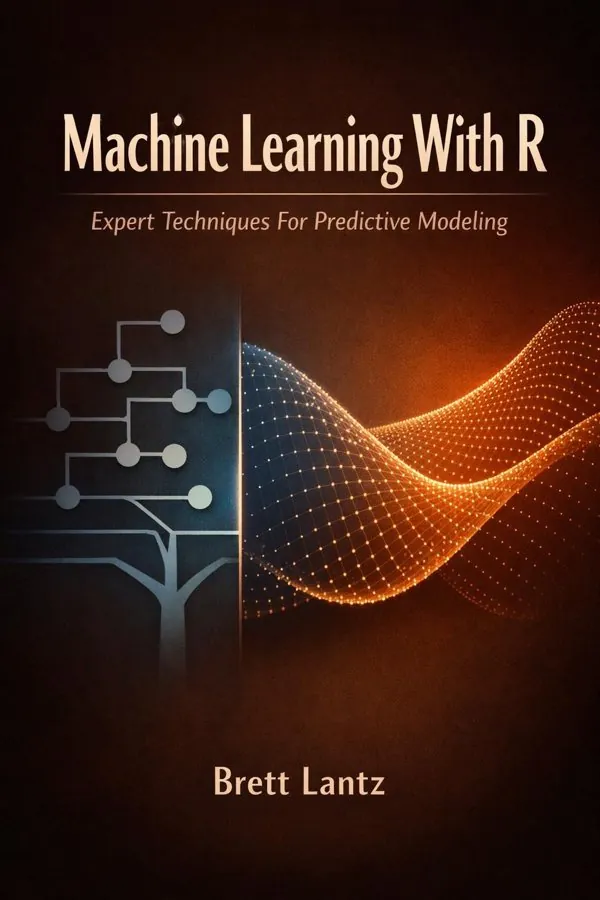
Machine Learning With R: Expert Techniques For Predictive Modeling: Summary & Key Insights
by Brett Lantz
 10 min8 chaptersAudio available
What Is Machine Learning With R: Expert Techniques For Predictive Modeling About?
Machine Learning With R: Expert Techniques For Predictive Modeling by Brett Lantz is a data_science book spanning 8 pages. Machine Learning with R by Brett Lantz provides a comprehensive introduction to machine learning using the R programming language. It covers key algorithms and techniques for predictive modeling, including decision trees, random forests, support vector machines, and neural networks. The book emphasizes practical implementation, data preprocessing, model evaluation, and real-world applications, making it suitable for both beginners and experienced data scientists seeking to enhance their R-based machine learning skills.
This FizzRead summary covers all 8 key chapters of Machine Learning With R: Expert Techniques For Predictive Modeling in approximately 10 minutes, distilling the most important ideas, arguments, and takeaways from Brett Lantz's work. Also available as an audio summary and Key Quotes Podcast.
Machine Learning With R: Expert Techniques For Predictive Modeling
Machine Learning with R by Brett Lantz provides a comprehensive introduction to machine learning using the R programming language. It covers key algorithms and techniques for predictive modeling, including decision trees, random forests, support vector machines, and neural networks. The book emphasizes practical implementation, data preprocessing, model evaluation, and real-world applications, making it suitable for both beginners and experienced data scientists seeking to enhance their R-based machine learning skills.
Who Should Read Machine Learning With R: Expert Techniques For Predictive Modeling?
This book is perfect for anyone interested in data_science and looking to gain actionable insights in a short read. Whether you're a student, professional, or lifelong learner, the key ideas from Machine Learning With R: Expert Techniques For Predictive Modeling by Brett Lantz will help you think differently.
- ✓Readers who enjoy data_science and want practical takeaways
- ✓Professionals looking to apply new ideas to their work and life
- ✓Anyone who wants the core insights of Machine Learning With R: Expert Techniques For Predictive Modeling in just 10 minutes
Want the full summary?
Get instant access to this book summary and 100K+ more with Fizz Moment.
Get Free SummaryAvailable on App Store • Free to download
Key Chapters
Every successful model begins with an act of discipline: preparing your data. Before we ever train a classifier or tune a network, we need to understand what our data truly represents. In R, this is a craft in itself—reading data from different sources, inspecting distributions, handling missing values, and transforming features into model-ready form.
In practice, this means not only using tools like *dplyr* or *tidyr* to clean data, but also questioning each variable’s meaning and influence. Outliers, for example, may represent rare but critical patterns, or they may be errors waiting to distort your predictions. Data normalization, scaling, and encoding categorical variables ensure that machine learning algorithms don’t mistake differences in measurement for differences in meaning.
Throughout the book, I stress that data preparation isn’t glamorous, but it is indispensable. The better you understand your data’s origins, context, and biases, the smarter your models become. R rewards this careful attention with a vast ecosystem of packages designed for transformation and visualization, making the process both efficient and intellectually rewarding. Clean, well-structured data doesn’t just feed the model—it tells its story truthfully.
Supervised learning is the foundation of most predictive systems, and in R, it’s the doorway into genuine data-driven intelligence. The defining feature of supervised learning is that we work with labeled data: examples for which the correct outcome is already known. This makes it possible to train models that can predict similar outcomes on unseen data.
We begin with the simplest forms of classification—logistic regression and k-nearest neighbors—before building toward more advanced algorithms like decision trees, random forests, and support vector machines. Regression methods cover the prediction of continuous outcomes; classification methods deal with discrete labels. The magic of R lies in how directly its syntax connects with the underlying statistical logic. Fitting a model is as simple as specifying relationships, yet beneath that simplicity lies a wealth of mathematical rigor.
In these chapters, I take the reader by the hand through practical examples—credit scoring, email filtering, and medical diagnosis—all to show that while algorithmic detail matters, clarity of problem definition matters even more. The model is only as good as the question asked of it. Supervised learning teaches us to ask questions that data can genuinely answer.
+ 6 more chapters — available in the FizzRead app
All Chapters in Machine Learning With R: Expert Techniques For Predictive Modeling
About the Author
Brett Lantz is a data scientist and author known for his expertise in R programming and machine learning. He has extensive experience applying statistical and computational methods to social science and business data, and is recognized for his clear, accessible teaching style in data analytics and predictive modeling.
Get This Summary in Your Preferred Format
Read or listen to the Machine Learning With R: Expert Techniques For Predictive Modeling summary by Brett Lantz anytime, anywhere. FizzRead offers multiple formats so you can learn on your terms — all free.
Available formats: App · Audio · PDF · EPUB — All included free with FizzRead
Download Machine Learning With R: Expert Techniques For Predictive Modeling PDF and EPUB Summary
Key Quotes from Machine Learning With R: Expert Techniques For Predictive Modeling
“Every successful model begins with an act of discipline: preparing your data.”
“Supervised learning is the foundation of most predictive systems, and in R, it’s the doorway into genuine data-driven intelligence.”
Frequently Asked Questions about Machine Learning With R: Expert Techniques For Predictive Modeling
Machine Learning With R: Expert Techniques For Predictive Modeling by Brett Lantz is a data_science book that explores key ideas across 8 chapters. Machine Learning with R by Brett Lantz provides a comprehensive introduction to machine learning using the R programming language. It covers key algorithms and techniques for predictive modeling, including decision trees, random forests, support vector machines, and neural networks. The book emphasizes practical implementation, data preprocessing, model evaluation, and real-world applications, making it suitable for both beginners and experienced data scientists seeking to enhance their R-based machine learning skills.
You Might Also Like
Data Science from Scratch: First Principles with Python
Joel Grus
10 min
Applied Predictive Modeling
Max Kuhn, Kjell Johnson
10 min
Better Data Visualizations: A Guide for Scholars, Researchers, and Wonks
Jonathan Schwabish
10 min
Big Data: A Revolution That Will Transform How We Live, Work, and Think
Viktor Mayer-Schönberger, Kenneth Cukier
10 min
Big Data: Principles and Best Practices of Scalable Real-Time Data Systems
Nathan Marz
10 min
Data Points: Visualization That Means Something
Nathan Yau
10 minBrowse by Category
Ready to read Machine Learning With R: Expert Techniques For Predictive Modeling?
Get the full summary and 100K+ more books with Fizz Moment.