
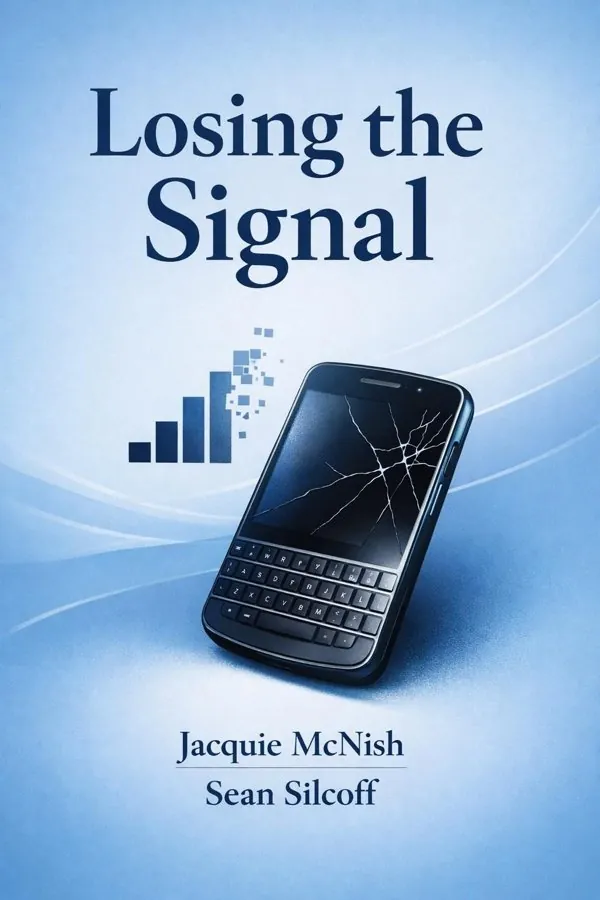
Losing the Signal: The Untold Story Behind the Extraordinary Rise and Spectacular Fall of BlackBerry: Summary & Key Insights
by Jacquie McNish, Sean Silcoff
 10 min9 chaptersAudio available
Key Takeaways from Losing the Signal: The Untold Story Behind the Extraordinary Rise and Spectacular Fall of BlackBerry
Great companies often begin not with a business plan, but with an obsession.
Many iconic businesses are built by tension, not harmony.
Products become indispensable when they remove a major frustration from everyday life.
Success becomes dangerous when it starts to feel like inevitability.
The greatest threat to a market leader is often not competition itself, but the belief that competition is misreading the market.
What Is Losing the Signal: The Untold Story Behind the Extraordinary Rise and Spectacular Fall of BlackBerry About?
Losing the Signal: The Untold Story Behind the Extraordinary Rise and Spectacular Fall of BlackBerry by Jacquie McNish, Sean Silcoff is a business book spanning 6 pages. Losing the Signal is the inside story of one of the most dramatic booms and busts in modern business history. In this deeply reported narrative, Jacquie McNish and Sean Silcoff trace how Research In Motion, later known as BlackBerry, rose from a small Canadian technology company into the maker of the world’s most addictive business device—and then unraveled with startling speed. At the center are two powerful, mismatched leaders: Mike Lazaridis, the engineering genius obsessed with elegant wireless technology, and Jim Balsillie, the relentless strategist who pushed BlackBerry onto the global stage. Their partnership built an empire, but their differences also exposed the company’s deepest weaknesses. What makes this book especially valuable is its combination of boardroom drama, technological detail, and strategic insight. Drawing on exclusive interviews, internal records, and years of business reporting, McNish and Silcoff show how success can blind even brilliant companies to changing consumer behavior, platform shifts, and internal dysfunction. This is more than a corporate postmortem. It is a vivid lesson in leadership, innovation, ego, and the danger of mistaking past strengths for future advantages.
This FizzRead summary covers all 9 key chapters of Losing the Signal: The Untold Story Behind the Extraordinary Rise and Spectacular Fall of BlackBerry in approximately 10 minutes, distilling the most important ideas, arguments, and takeaways from Jacquie McNish, Sean Silcoff's work. Also available as an audio summary and Key Quotes Podcast.
Losing the Signal: The Untold Story Behind the Extraordinary Rise and Spectacular Fall of BlackBerry
Losing the Signal is the inside story of one of the most dramatic booms and busts in modern business history. In this deeply reported narrative, Jacquie McNish and Sean Silcoff trace how Research In Motion, later known as BlackBerry, rose from a small Canadian technology company into the maker of the world’s most addictive business device—and then unraveled with startling speed. At the center are two powerful, mismatched leaders: Mike Lazaridis, the engineering genius obsessed with elegant wireless technology, and Jim Balsillie, the relentless strategist who pushed BlackBerry onto the global stage. Their partnership built an empire, but their differences also exposed the company’s deepest weaknesses.
What makes this book especially valuable is its combination of boardroom drama, technological detail, and strategic insight. Drawing on exclusive interviews, internal records, and years of business reporting, McNish and Silcoff show how success can blind even brilliant companies to changing consumer behavior, platform shifts, and internal dysfunction. This is more than a corporate postmortem. It is a vivid lesson in leadership, innovation, ego, and the danger of mistaking past strengths for future advantages.
Who Should Read Losing the Signal: The Untold Story Behind the Extraordinary Rise and Spectacular Fall of BlackBerry?
This book is perfect for anyone interested in business and looking to gain actionable insights in a short read. Whether you're a student, professional, or lifelong learner, the key ideas from Losing the Signal: The Untold Story Behind the Extraordinary Rise and Spectacular Fall of BlackBerry by Jacquie McNish, Sean Silcoff will help you think differently.
- ✓Readers who enjoy business and want practical takeaways
- ✓Professionals looking to apply new ideas to their work and life
- ✓Anyone who wants the core insights of Losing the Signal: The Untold Story Behind the Extraordinary Rise and Spectacular Fall of BlackBerry in just 10 minutes
Want the full summary?
Get instant access to this book summary and 100K+ more with Fizz Moment.
Get Free SummaryAvailable on App Store • Free to download
Key Chapters
Great companies often begin not with a business plan, but with an obsession. For Mike Lazaridis, that obsession was wireless communication—how information could move instantly, invisibly, and reliably across the air. In Waterloo, Ontario, far from Silicon Valley’s spotlight, Lazaridis immersed himself in electronics and computing with unusual intensity. He was less interested in building a conventional company than in solving hard technical problems others ignored.
This origin matters because it shaped BlackBerry’s DNA. Research In Motion was founded as an engineering-first company. Its early work involved consulting, industrial technology projects, and experiments in wireless data transmission. Instead of chasing flashy consumer trends, Lazaridis focused on efficiency, compression, battery life, and secure messaging. Those priorities later became BlackBerry’s defining strengths. The company did not initially win by being glamorous; it won by making mobile communication dependable.
The Waterloo setting also mattered. RIM emerged from a culture of technical rigor, frugality, and outsider ambition. Being away from major tech centers may have made the founders more independent and inventive, but it also contributed to later blind spots. The same insular confidence that helped them build something original eventually made it harder to see how quickly the industry was changing.
For entrepreneurs and managers, the lesson is clear: founding assumptions echo for decades. A company born from technical purity may excel at product discipline, but it may also undervalue branding, design, or customer emotion. A company built around market speed may face the opposite risk. The earliest choices become cultural habits.
Actionable takeaway: Identify the original bias in your team or organization—engineering, sales, finance, or design—and deliberately strengthen the capabilities your founding culture tends to overlook.
Many iconic businesses are built by tension, not harmony. BlackBerry’s rise depended on the uneasy partnership between Mike Lazaridis and Jim Balsillie. Lazaridis was the inventor: cerebral, product-focused, and driven by technical excellence. Balsillie was the operator and dealmaker: aggressive, political, and endlessly ambitious. Together, they formed a leadership duo that was unusually effective in the company’s ascent.
Balsillie joined RIM when the company still needed commercial direction and scale. He brought urgency, financial sophistication, and a willingness to fight for distribution, partnerships, and international growth. Where Lazaridis saw a technology problem, Balsillie saw a market opening. This division of labor allowed RIM to do something rare: build world-class hardware and software while also negotiating carrier relationships, enterprise contracts, and investor confidence.
But the same dual structure later created confusion. The co-CEO model blurred accountability. Employees had to navigate two centers of power with very different priorities. Strategic disagreements became harder to resolve because neither founder fully outranked the other. In growth, this arrangement looked like balance; in crisis, it looked like paralysis.
The broader business insight is that complementary leadership can be a superpower, but only if roles, decision rights, and conflict-resolution mechanisms are explicit. Without that clarity, companies drift into political factions. Teams begin optimizing for internal approval rather than customer outcomes.
In practical terms, startups and mature firms alike can learn from this. If leadership is shared, define who owns product, capital allocation, hiring, crisis calls, and public communication. Complementarity should produce faster decisions, not slower ones.
Actionable takeaway: If your organization depends on multiple powerful leaders, document decision ownership now—before success or stress turns healthy tension into destructive ambiguity.
Products become indispensable when they remove a major frustration from everyday life. BlackBerry’s early breakthrough was not simply inventing a smartphone; it was solving the problem of mobile email better than anyone else. At a time when laptops were bulky, wireless data was unreliable, and most mobile devices were awkward, BlackBerry offered something magical: secure, near-instant access to messages from almost anywhere.
The company’s innovation was cumulative rather than theatrical. It combined compression technology, efficient networking, physical keyboards, strong battery performance, enterprise-grade security, and centralized IT management. BlackBerry was not the prettiest device, but it was the most useful for a specific and highly valuable group: professionals who needed constant, reliable communication. The famous “push email” experience changed work culture. Executives, lawyers, bankers, and politicians became attached to the device because it reduced delay and increased responsiveness.
This is an important strategic lesson. BlackBerry did not initially dominate by pleasing everyone. It focused on a narrow use case and served it exceptionally well. By becoming essential to enterprise users, it built a reputation that expanded into broader markets. Many companies fail because they launch broad and shallow instead of narrow and excellent.
There is also a modern application here for product teams. Users do not reward feature lists; they reward friction removal. The best products create a new habit by making a painful task dramatically easier, faster, or safer. BlackBerry changed behavior because it was not merely interesting—it was useful enough to become routine.
Actionable takeaway: Instead of asking whether your product has enough features, ask which single customer frustration you can eliminate so effectively that users begin structuring their day around your solution.
Success becomes dangerous when it starts to feel like inevitability. Once BlackBerry proved itself in business circles, RIM expanded rapidly across corporations, governments, and international markets. The brand became synonymous with productivity, status, and secure communication. At its peak, BlackBerry was not just a device maker; it was a platform of habits, infrastructure, and identity.
Several forces drove this expansion. Corporate IT departments loved BlackBerry Enterprise Server because it gave them control and security. Mobile carriers valued BlackBerry’s efficient use of network bandwidth. Users prized the physical keyboard and message-centric interface. Governments trusted the company’s encrypted systems. Together, these advantages created a powerful ecosystem. The company became especially strong outside the United States, where carrier relationships and international demand helped offset competitive pressure.
But dominance can conceal strategic drift. As market share rises, companies often confuse channel power with product inevitability. RIM’s leadership came to believe that its existing strengths—security, keyboards, enterprise credibility, and carrier ties—would continue to anchor the future. Yet consumer technology markets shift when new expectations emerge. Touchscreens, rich mobile apps, media consumption, and intuitive browsing gradually became more important than the features BlackBerry had been optimized to deliver.
This chapter of the story shows that scaling a business requires more than expanding what already works. It requires noticing when your customers are changing faster than your organizational assumptions. A company can be excellent at serving yesterday’s core users and still miss tomorrow’s mainstream demand.
For leaders today, the practical implication is to segment growth honestly. Ask whether your market expansion reflects enduring product value or temporary structural advantages such as distribution, regulation, or incumbency.
Actionable takeaway: During periods of rapid growth, audit which parts of your success come from genuine customer love and which come from momentum, contracts, or habit—because the second category disappears faster than you expect.
The greatest threat to a market leader is often not competition itself, but the belief that competition is misreading the market. BlackBerry’s internal tensions grew sharper as the smartphone industry evolved. The company’s leaders disagreed on strategy, product direction, and acquisitions. The co-CEO structure slowed accountability, while product teams struggled to reconcile engineering priorities with market demands.
At the same time, technological change accelerated. Apple’s iPhone reframed the smartphone as a consumer computer rather than a business pager. Google’s Android pushed open, flexible ecosystems at scale. Suddenly, app development, touch interfaces, web browsing, media, and software platforms mattered as much as battery life and secure email. BlackBerry still had strengths, but the basis of competition had changed.
RIM’s response was hampered by internal culture. Leadership often treated keyboard-based communication as the central truth of mobile computing, underestimating how quickly user expectations could broaden. Teams were asked to defend existing architecture even when it was becoming outdated. Product launches grew more reactive. Instead of leading the next wave, BlackBerry was trying to catch up while preserving yesterday’s identity.
Organizations in many industries repeat this pattern. A company that has won through operational excellence may dismiss a disruptive rival as inferior on familiar metrics. But disruption rarely begins by outperforming incumbents on old standards. It begins by changing what customers value. That is why legacy strengths can become traps.
A practical way to avoid this is to create structured dissent. Ask teams to argue from the competitor’s perspective. Run scenario planning that assumes your current strengths become less relevant. Reward people who identify uncomfortable truths early.
Actionable takeaway: Build a regular leadership practice of challenging your core assumptions, especially the ones that made you successful in the first place.
Industries do not collapse all at once; they are redefined by a new logic. The arrival of the iPhone was not merely a product launch for BlackBerry to answer—it was a shift in what a phone was for. Apple transformed the smartphone from a communication tool centered on email and efficiency into a software-driven personal device centered on experience, touch, browsing, media, and apps. BlackBerry’s competitive frame suddenly looked too narrow.
RIM initially underestimated this change. Leadership viewed the iPhone through the lens of technical shortcomings: weak battery life, slower networks, limited security, and lack of a physical keyboard. On those terms, BlackBerry still looked superior. But customers were beginning to choose devices for different reasons. They wanted versatility, ease of use, and a growing app ecosystem. Developers wanted platforms that welcomed experimentation. Consumers increasingly influenced workplace technology purchases, reversing the old enterprise-down buying pattern.
This shift exposed a classic strategic error: measuring a new rival by your old scorecard. BlackBerry remained strong in secure messaging, but the center of gravity moved toward ecosystems. Once apps and touch-based interfaces became standard, operating system quality, developer support, and user delight mattered far more. RIM did not just need a better phone; it needed a new worldview.
For modern businesses, the lesson extends beyond tech. Competitors rarely beat incumbents by copying them exactly. They win by redefining value. Think streaming versus broadcast, cloud software versus installed software, or digital banking versus branch-based service. If you only compare features, you may miss the underlying behavioral shift.
Actionable takeaway: When a disruptive competitor appears, do not ask only, “Is it better than us today?” Also ask, “What customer behavior is it making normal that could make our strengths less important tomorrow?”
A company’s org chart may seem secondary during good times, but in moments of disruption it becomes destiny. BlackBerry’s leadership structure—especially the co-CEO arrangement—played a significant role in its inability to respond with clarity and speed. Mike Lazaridis and Jim Balsillie had complementary strengths, yet their shared authority often created competing priorities, mixed signals, and delayed decisions.
This mattered because the company faced not one challenge but several at once: new operating systems, changing consumer preferences, pressure from developers, global expansion complexities, and investor scrutiny. In such conditions, companies need clear strategy, ruthless prioritization, and fast execution. Instead, BlackBerry often looked fragmented. Leaders pursued acquisitions, tablet initiatives, operating system transitions, and international growth without resolving foundational questions about the company’s identity and platform future.
The issue was not simply personality conflict, though that mattered. It was governance. Boards tolerated ambiguity because the founders had delivered enormous success. But governance systems should be designed not only for growth but for correction. When boards hesitate to challenge star leaders, strategic inertia hardens.
There is a broad management lesson here. Many businesses idolize founder-led intensity, but scale requires decision architecture. Who says no? Who allocates capital? Who sets product priorities? Who communicates the company’s strategic narrative internally and externally? If those answers are vague, organizations waste energy in interpretation and politics.
In practice, leaders can prevent this by stress-testing their structure. Simulate a major market shift and ask how decisions would get made in the first thirty days. If the answer is unclear, the structure is already a risk.
Actionable takeaway: Review your leadership model during success, not crisis, and simplify authority so your organization can move decisively when the environment changes.
Decline often looks gradual from the inside because each warning sign can be rationalized. In BlackBerry’s later years, execution problems, delayed products, and strategic hesitations compounded one another. The company attempted to modernize its platform, defend enterprise relationships, expand internationally, and answer Apple and Android simultaneously. But instead of creating a coherent turnaround, these moves often revealed how far behind it had fallen.
One major issue was delay. In fast-moving technology markets, late products are not neutral events; they allow rivals to define customer expectations. BlackBerry’s software transitions and hardware responses repeatedly missed the moment. Another issue was denial. Leadership did not always fully accept that the old formula—secure email plus strong hardware plus enterprise loyalty—was no longer enough. As a result, resources were spread across defensive efforts rather than concentrated on a bold reinvention.
The book shows how corporate decline is rarely caused by one bad decision. It is the accumulation of small evasions: overstating temporary wins, misreading data, protecting internal narratives, and postponing difficult choices. By the time the need for change becomes undeniable, options have narrowed.
This pattern appears in many industries. Retailers ignore e-commerce until store traffic weakens. media companies dismiss creator platforms until audience habits change. manufacturers cling to legacy products while margins erode. Delay creates a compounding disadvantage because competitors improve while you debate.
Leaders can counter this by establishing trigger points. Decide in advance what market share loss, product delay, churn rate, or customer behavior change will force strategic escalation. Predefined thresholds reduce the temptation to explain away every problem.
Actionable takeaway: Create objective warning metrics for your business and commit to major review or action when they are crossed, so your organization cannot drift into decline by explanation alone.
A failed giant can still leave behind a powerful legacy. Although BlackBerry’s collapse as a smartphone leader was dramatic, the company’s broader impact on technology and business culture remains significant. It helped define mobile productivity, normalized secure messaging, and showed that a Canadian firm could compete at the highest level of global tech. It also seeded talent, ambition, and capital into the Waterloo technology ecosystem.
Losing the Signal makes clear that BlackBerry should not be remembered only as a cautionary tale. Its innovations changed how professionals worked. Before BlackBerry, mobile communication was intermittent and awkward. After BlackBerry, constant connectivity became expected. That shift reshaped corporate responsiveness, executive behavior, and eventually the always-on culture of modern work. In that sense, BlackBerry did not vanish; its core behavioral impact was absorbed into the digital world it helped create.
There is also a subtler legacy in institutional learning. BlackBerry’s story is now a case study in platform transitions, founder governance, disruption, and strategic myopia. Entrepreneurs, investors, and executives continue to study its trajectory because it captures a hard truth: yesterday’s breakthrough can become tomorrow’s rigidity if leaders cling to it too tightly.
For readers, this final lesson is constructive. Business history is most useful when it helps us interpret current decisions. The goal is not to admire or mock the past, but to recognize recurring patterns early in our own organizations—overconfidence, insularity, delayed adaptation, and unexamined assumptions.
Actionable takeaway: Treat failed innovators as learning assets, not just cautionary headlines, and regularly ask what your own organization might be doing today that future observers will see as obvious strategic blindness.
All Chapters in Losing the Signal: The Untold Story Behind the Extraordinary Rise and Spectacular Fall of BlackBerry
About the Authors
Jacquie McNish and Sean Silcoff are award-winning Canadian business journalists best known for their deep reporting on corporate power, strategy, and technology. McNish has been a senior writer at The Globe and Mail and is widely recognized for her investigative work and coverage of major business events. Silcoff is also a prominent business writer at The Globe and Mail, with particular expertise in technology, entrepreneurship, and corporate affairs. Together, they bring a rare mix of narrative skill and reporting discipline to Losing the Signal. Their account of BlackBerry is built on extensive interviews, internal documents, and years of close observation, giving the book both credibility and dramatic force. Their work stands out for making complex business stories accessible, human, and strategically insightful.
Get This Summary in Your Preferred Format
Read or listen to the Losing the Signal: The Untold Story Behind the Extraordinary Rise and Spectacular Fall of BlackBerry summary by Jacquie McNish, Sean Silcoff anytime, anywhere. FizzRead offers multiple formats so you can learn on your terms — all free.
Available formats: App · Audio · PDF · EPUB — All included free with FizzRead
Download Losing the Signal: The Untold Story Behind the Extraordinary Rise and Spectacular Fall of BlackBerry PDF and EPUB Summary
Key Quotes from Losing the Signal: The Untold Story Behind the Extraordinary Rise and Spectacular Fall of BlackBerry
“Great companies often begin not with a business plan, but with an obsession.”
“Many iconic businesses are built by tension, not harmony.”
“Products become indispensable when they remove a major frustration from everyday life.”
“Success becomes dangerous when it starts to feel like inevitability.”
“The greatest threat to a market leader is often not competition itself, but the belief that competition is misreading the market.”
Frequently Asked Questions about Losing the Signal: The Untold Story Behind the Extraordinary Rise and Spectacular Fall of BlackBerry
Losing the Signal: The Untold Story Behind the Extraordinary Rise and Spectacular Fall of BlackBerry by Jacquie McNish, Sean Silcoff is a business book that explores key ideas across 9 chapters. Losing the Signal is the inside story of one of the most dramatic booms and busts in modern business history. In this deeply reported narrative, Jacquie McNish and Sean Silcoff trace how Research In Motion, later known as BlackBerry, rose from a small Canadian technology company into the maker of the world’s most addictive business device—and then unraveled with startling speed. At the center are two powerful, mismatched leaders: Mike Lazaridis, the engineering genius obsessed with elegant wireless technology, and Jim Balsillie, the relentless strategist who pushed BlackBerry onto the global stage. Their partnership built an empire, but their differences also exposed the company’s deepest weaknesses. What makes this book especially valuable is its combination of boardroom drama, technological detail, and strategic insight. Drawing on exclusive interviews, internal records, and years of business reporting, McNish and Silcoff show how success can blind even brilliant companies to changing consumer behavior, platform shifts, and internal dysfunction. This is more than a corporate postmortem. It is a vivid lesson in leadership, innovation, ego, and the danger of mistaking past strengths for future advantages.
You Might Also Like






Browse by Category
Ready to read Losing the Signal: The Untold Story Behind the Extraordinary Rise and Spectacular Fall of BlackBerry?
Get the full summary and 100K+ more books with Fizz Moment.