
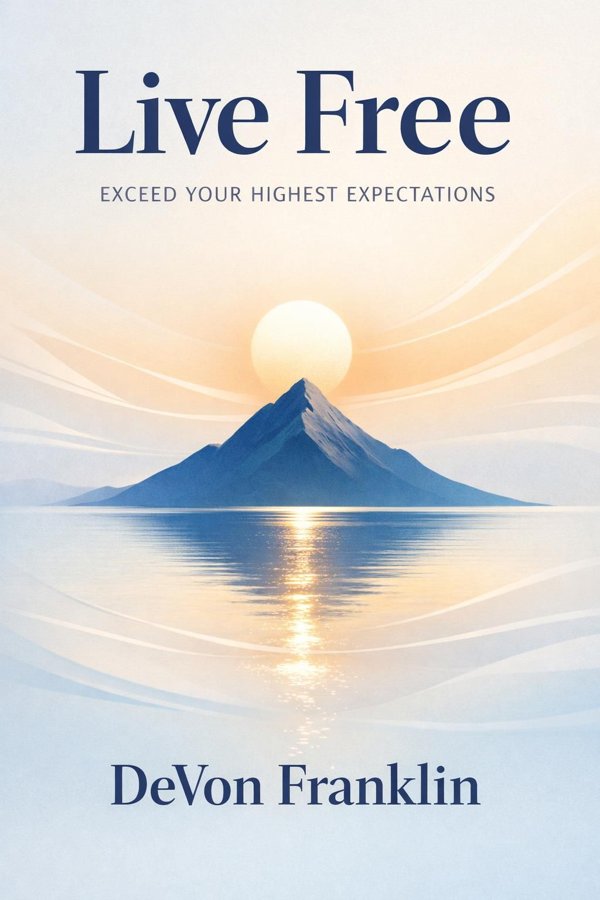
Live Free: Exceed Your Highest Expectations: Summary & Key Insights
 10 min9 chaptersAudio available
Key Takeaways from Live Free: Exceed Your Highest Expectations
It is not recklessness, rebellion, or escape from responsibility.
Some of the strongest prisons are built from love, praise, tradition, and good intentions.
Not every barrier in life comes from outside.
If you do not define success for yourself, the world will gladly do it for you.
For Franklin, that grounding comes from a spiritual identity that precedes achievement.
What Is Live Free: Exceed Your Highest Expectations About?
Live Free: Exceed Your Highest Expectations by DeVon Franklin is a self_awareness book spanning 12 pages. In Live Free, DeVon Franklin argues that many people are not trapped by a lack of talent or opportunity, but by the expectations they have absorbed from family, culture, religion, work, and even their own fear. The book is a call to stop performing a life that looks impressive from the outside and start building one that feels honest on the inside. Franklin’s central idea is simple but powerful: true freedom comes when you release the pressure to meet other people’s standards and begin living in alignment with your values, purpose, and faith. What makes the book resonate is Franklin’s authority on the subject. As a successful Hollywood producer, bestselling author, and speaker, he understands public pressure, ambition, image management, and the cost of chasing approval. Yet he writes not as someone offering abstract theory, but as someone who has had to examine his own motives and redefine success from the inside out. Blending personal experience, spiritual reflection, and practical guidance, Live Free offers a roadmap for anyone who wants more peace, clarity, courage, and authenticity in the way they live.
This FizzRead summary covers all 9 key chapters of Live Free: Exceed Your Highest Expectations in approximately 10 minutes, distilling the most important ideas, arguments, and takeaways from DeVon Franklin's work. Also available as an audio summary and Key Quotes Podcast.
Live Free: Exceed Your Highest Expectations
In Live Free, DeVon Franklin argues that many people are not trapped by a lack of talent or opportunity, but by the expectations they have absorbed from family, culture, religion, work, and even their own fear. The book is a call to stop performing a life that looks impressive from the outside and start building one that feels honest on the inside. Franklin’s central idea is simple but powerful: true freedom comes when you release the pressure to meet other people’s standards and begin living in alignment with your values, purpose, and faith.
What makes the book resonate is Franklin’s authority on the subject. As a successful Hollywood producer, bestselling author, and speaker, he understands public pressure, ambition, image management, and the cost of chasing approval. Yet he writes not as someone offering abstract theory, but as someone who has had to examine his own motives and redefine success from the inside out. Blending personal experience, spiritual reflection, and practical guidance, Live Free offers a roadmap for anyone who wants more peace, clarity, courage, and authenticity in the way they live.
Who Should Read Live Free: Exceed Your Highest Expectations?
This book is perfect for anyone interested in self_awareness and looking to gain actionable insights in a short read. Whether you're a student, professional, or lifelong learner, the key ideas from Live Free: Exceed Your Highest Expectations by DeVon Franklin will help you think differently.
- ✓Readers who enjoy self_awareness and want practical takeaways
- ✓Professionals looking to apply new ideas to their work and life
- ✓Anyone who wants the core insights of Live Free: Exceed Your Highest Expectations in just 10 minutes
Want the full summary?
Get instant access to this book summary and 100K+ more with Fizz Moment.
Get Free SummaryAvailable on App Store • Free to download
Key Chapters
Most people think freedom means having no limits, but Franklin suggests a more demanding and meaningful definition: freedom is the ability to live in integrity with who you truly are. It is not recklessness, rebellion, or escape from responsibility. In his view, a person can appear successful, admired, and independent while still being deeply unfree if their choices are being dictated by fear, image, or outside approval.
This idea matters because many forms of modern achievement are built around performance. You may choose a career because it earns respect, stay in a role because others expect it, or maintain an identity because it keeps you accepted. Franklin asks readers to pause and ask a harder question: Does this life reflect my calling, my convictions, and my deepest values? If the answer is no, then external success may actually be disguising internal captivity.
He reframes freedom as alignment between belief and behavior. When your public life and private truth match, your energy changes. Decision-making becomes clearer. Peace increases because you no longer spend so much effort maintaining a false version of yourself. This does not mean every choice becomes easy. In fact, authentic living often requires sacrifice, disappointment, and difficult conversations. But it replaces exhaustion with conviction.
A practical way to apply this is to review the major areas of your life—work, relationships, faith, habits, and goals—and ask where you feel most divided. Notice where you are saying yes outwardly but feeling no inwardly. Those tensions reveal where freedom is needed most.
Actionable takeaway: Write one sentence that defines freedom for you as alignment, not escape, and use it as a filter for your next major decision.
Some of the strongest prisons are built from love, praise, tradition, and good intentions. Franklin emphasizes that expectations often arrive disguised as guidance: parents want stability for you, mentors want excellence, communities want loyalty, and society rewards conformity. Yet even beneficial expectations can become burdens when they replace your own discernment.
The danger is not simply that others expect things from us; it is that we internalize those expectations so deeply that we stop noticing them. We begin to confuse inherited scripts with personal truth. You may feel obligated to marry by a certain age, pursue a prestigious title, maintain a particular image, or suppress parts of yourself to remain acceptable. Over time, that pressure creates anxiety, resentment, and a subtle sense of disconnection from your own life.
Franklin encourages readers to identify the sources of their pressure. Ask: Whose voice am I trying to satisfy? Which goals genuinely matter to me, and which ones do I pursue because they earn approval? This distinction is liberating. It does not require rejecting everyone’s input, but it does require reclaiming authority over your life.
Consider someone who stays in a high-paying job because their family sees it as proof they made it. Externally, the choice looks wise. Internally, it may feel deadening. Or think of a person who keeps saying yes to social obligations because they fear being seen as selfish. Their calendar becomes full while their inner life becomes depleted. In both cases, the issue is not busyness but bondage.
Actionable takeaway: Make a two-column list titled “My desires” and “Others’ expectations,” then choose one area this week where you will act from conviction instead of obligation.
Not every barrier in life comes from outside. Franklin highlights a quieter but equally powerful force: the limits we place on ourselves. These self-imposed constraints are often built from old disappointments, fear of failure, insecurity, or stories we have repeated so often they feel like facts. We say, “I’m not ready,” “People like me don’t do that,” or “It’s too late,” and then live inside the boundaries of those beliefs.
This is important because many people who want freedom still carry an inner narrative that prevents it. They may leave one set of external expectations only to be governed by internal doubt. Franklin encourages readers to look closely at the assumptions that shape their decisions. What would you attempt if you were not pre-rejecting yourself? Which opportunities do you dismiss because they challenge your identity? Where have you mistaken caution for wisdom?
A common example is someone who feels called to change careers, start a business, or step into leadership but keeps delaying action because they do not feel qualified enough. Another example is a person who longs for healthier relationships but assumes they must keep tolerating poor treatment because that is what they have always known. In both cases, the mind enforces a prison before the world does.
Franklin does not promote fantasy or denial. Instead, he advocates honest self-examination that separates real constraints from assumed ones. Once you identify the false beliefs, you can challenge them with new evidence, supportive community, and courageous action. Freedom grows not merely from insight but from tested experience.
Actionable takeaway: Identify one sentence you often tell yourself that keeps you small, and replace it with a truer statement you can prove through one concrete action this week.
If you do not define success for yourself, the world will gladly do it for you. Franklin warns that default definitions of success—money, status, visibility, productivity, influence—can be deeply seductive because they are easy to measure and socially rewarded. But metrics that impress others do not necessarily nourish the soul. A life can look elevated and still feel empty.
Franklin’s challenge is to move from borrowed success to meaningful success. He asks readers to examine whether their ambitions reflect purpose or merely pressure. Success, in his framework, is not just achievement but alignment with calling, peace, integrity, and contribution. It includes what you build, but also how you build it and what it costs you in the process.
This shift changes everyday choices. Instead of asking, “Will this make me look successful?” you ask, “Will this help me become whole?” That may affect the job you take, the pace at which you work, the boundaries you maintain, and the opportunities you decline. It can also protect you from the trap of endless striving, where each accomplishment only creates a new standard you must meet.
For example, someone might choose a role with less prestige but more room for family, faith, creativity, or service. Another person may stop comparing their timeline to peers and recognize that peace is a better indicator of progress than visibility. Franklin does not dismiss ambition; he redeems it by reconnecting it to values.
Actionable takeaway: Write your own definition of success in one paragraph, including how you want to feel, who you want to serve, and what you refuse to sacrifice to get there.
Franklin’s message is deeply shaped by faith, but even readers from different backgrounds can appreciate the core point: authenticity becomes sustainable when it is rooted in something deeper than mood, popularity, or circumstance. For Franklin, that grounding comes from a spiritual identity that precedes achievement. You are not valuable because you perform well; you perform from the security of already having value.
This matters because external approval is unstable. Public opinion changes, careers rise and fall, and even close relationships can shift. If your worth depends on these variables, you will constantly edit yourself to remain accepted. Franklin proposes that faith offers a steadier foundation. It reminds you that your identity is received, not earned, and your calling is discovered through surrender as much as through ambition.
Faith also helps with discernment. In a noisy world full of competing voices, spiritual practices create space to hear what is true. Prayer, reflection, scripture, meditation, or quiet contemplation can help you distinguish ego-driven striving from purpose-driven action. Franklin presents faith not as passive waiting but as active trust—moving forward with courage while remaining open to divine guidance.
In practical life, this may mean pausing before a big opportunity and asking whether it aligns with your values rather than simply advancing your image. It may mean enduring misunderstanding because you trust a deeper calling. It may also mean letting go of outcomes you cannot control.
Actionable takeaway: Create a daily five-minute practice of silence, prayer, or reflection to reconnect your decisions to your deepest source of identity and guidance.
Many people remain trapped not because they do not know what they want, but because they fear what will happen if they pursue it. Franklin pays special attention to the fear of judgment—the worry that others will misunderstand you, criticize you, or withdraw support if you change. That fear can keep people in unhealthy jobs, unequal relationships, and false identities for years.
One of the book’s most practical insights is that freedom requires both courage and boundaries. Courage helps you face disapproval. Boundaries help you protect what matters once you do. Without boundaries, even a newly awakened sense of self can be overwhelmed by other people’s demands. Saying no becomes a spiritual and psychological necessity, not a selfish act.
Franklin encourages readers to notice where fear is making decisions for them. Are you avoiding a conversation because you want to be liked? Are you overcommitting because you cannot tolerate disappointing others? Are you staying accessible to everyone except yourself? Boundary-setting can look like limiting work after certain hours, declining invitations that drain you, refusing manipulative dynamics, or reducing exposure to voices that shame your growth.
For example, someone trying to live more intentionally may need to stop taking every urgent request at work. Another person may need to tell friends or relatives that their life choices are not open for constant debate. Boundaries do not eliminate love; they make healthier love possible by removing resentment and confusion.
Actionable takeaway: Choose one recurring situation where fear makes you overextend, and practice one clear, respectful boundary statement before the next time it happens.
A surprising obstacle to freedom is the need to control everything. Franklin argues that many people exhaust themselves trying to force outcomes, manage perceptions, and guarantee certainty. Yet the more tightly they grip, the less room there is for purpose to unfold. Freedom, in this sense, is not only about deciding boldly but also about releasing what was never yours to manage.
This idea connects directly to purpose. According to Franklin, living with purpose means participating fully in your calling without trying to dominate every result. You prepare, work, and act responsibly, but you stop measuring your life solely by whether every plan unfolds exactly as expected. This allows you to adapt, respond, and remain open to opportunities that do not fit your original script.
Letting go of control can be difficult for high achievers, especially those whose identity is built around competence. But control often masks anxiety. It can keep you from delegation, creativity, vulnerability, and spiritual trust. Franklin invites readers to replace control with commitment: focus deeply on the choices, habits, and values that are yours to steward, and release the rest.
This applies during career transitions, creative work, parenting, leadership, and relationships. You can communicate honestly, but you cannot control how everyone interprets you. You can prepare for an opportunity, but you cannot command timing. You can love people well, but you cannot force them to grow. Accepting this does not weaken you; it steadies you.
Actionable takeaway: Make a list of what is in your control and what is not in a current challenge, then commit your energy only to the first list for the next seven days.
Freedom is not a solo achievement. Franklin shows that the quality of your relationships strongly shapes your ability to live authentically. Some relationships encourage growth, honesty, and purpose. Others depend on a version of you that stays agreeable, available, or diminished. A key part of living free is recognizing which relationships nourish your true self and which ones demand your performance.
This requires emotional honesty. Many people confuse loyalty with self-abandonment. They keep peace by hiding their needs, delaying hard conversations, or remaining in dynamics where they are loved conditionally. Franklin pushes against that pattern. Healthy relationships, whether romantic, familial, or professional, create space for truth. They may involve conflict, but they do not require pretending.
Living free in relationships means communicating clearly, taking responsibility for your own patterns, and refusing to make another person’s comfort the highest value in your life. It also means accepting that growth can change your social world. Some people will celebrate your clarity. Others may resist it because your transformation disrupts familiar roles.
Imagine someone who has always been the dependable rescuer in their family. When they start setting boundaries, relatives may accuse them of changing. In reality, they are becoming more honest. Or consider a partnership where one person finally admits they have been living according to expectations instead of conviction. That conversation may be uncomfortable, but it opens the possibility of a more genuine connection.
Actionable takeaway: Identify one important relationship where you have been performing instead of communicating, and initiate one honest, respectful conversation that reflects your real values and needs.
Transformation rarely happens in one dramatic moment. Franklin makes it clear that freedom is not a single breakthrough but a repeated practice. You do not liberate yourself once and remain forever unaffected by pressure, fear, comparison, or old habits. Instead, you build a life of freedom through daily choices that reinforce authenticity.
This is where the book becomes especially practical. Sustaining freedom requires routines, reflection, and a willingness to embrace change. As your life evolves, new expectations will emerge. A person who frees themselves in career may later face pressure in parenting, marriage, leadership, or public identity. The work is ongoing. But that is not discouraging; it means freedom is accessible through practice, not reserved for perfect people.
Franklin encourages habits that keep you grounded: regular self-examination, spiritual connection, trusted accountability, rest, and course correction when you drift. He also highlights the importance of embracing change rather than clinging to expired versions of yourself. Growth can make old labels feel too small. Rather than resisting that discomfort, you can treat it as evidence that your life is becoming more aligned.
A useful example is a person who once prized busyness because it signaled importance, but now notices that overwork disconnects them from purpose. Living free may require revising their schedule again and again until it matches their values. The same is true with relationships, personal habits, and self-talk.
Actionable takeaway: End each day with three questions: Where did I act freely today? Where did I betray myself? What one adjustment will help me live more aligned tomorrow?
All Chapters in Live Free: Exceed Your Highest Expectations
About the Author
DeVon Franklin is an American producer, author, and motivational speaker whose work sits at the intersection of faith, purpose, and personal development. He built a notable career in the entertainment industry, becoming known for producing successful films while also speaking openly about spirituality, integrity, and authentic success. Franklin has written bestselling books that encourage readers to pursue ambition without losing their values, and his message often focuses on identity, relationships, calling, and emotional freedom. What distinguishes him is his ability to translate deeply personal and spiritual lessons into practical guidance for everyday life. Through his books, talks, and media work, Franklin has become a trusted voice for people seeking both achievement and inner alignment.
Get This Summary in Your Preferred Format
Read or listen to the Live Free: Exceed Your Highest Expectations summary by DeVon Franklin anytime, anywhere. FizzRead offers multiple formats so you can learn on your terms — all free.
Available formats: App · Audio · PDF · EPUB — All included free with FizzRead
Download Live Free: Exceed Your Highest Expectations PDF and EPUB Summary
Key Quotes from Live Free: Exceed Your Highest Expectations
“Most people think freedom means having no limits, but Franklin suggests a more demanding and meaningful definition: freedom is the ability to live in integrity with who you truly are.”
“Some of the strongest prisons are built from love, praise, tradition, and good intentions.”
“Not every barrier in life comes from outside.”
“If you do not define success for yourself, the world will gladly do it for you.”
“For Franklin, that grounding comes from a spiritual identity that precedes achievement.”
Frequently Asked Questions about Live Free: Exceed Your Highest Expectations
Live Free: Exceed Your Highest Expectations by DeVon Franklin is a self_awareness book that explores key ideas across 9 chapters. In Live Free, DeVon Franklin argues that many people are not trapped by a lack of talent or opportunity, but by the expectations they have absorbed from family, culture, religion, work, and even their own fear. The book is a call to stop performing a life that looks impressive from the outside and start building one that feels honest on the inside. Franklin’s central idea is simple but powerful: true freedom comes when you release the pressure to meet other people’s standards and begin living in alignment with your values, purpose, and faith. What makes the book resonate is Franklin’s authority on the subject. As a successful Hollywood producer, bestselling author, and speaker, he understands public pressure, ambition, image management, and the cost of chasing approval. Yet he writes not as someone offering abstract theory, but as someone who has had to examine his own motives and redefine success from the inside out. Blending personal experience, spiritual reflection, and practical guidance, Live Free offers a roadmap for anyone who wants more peace, clarity, courage, and authenticity in the way they live.
More by DeVon Franklin

You Might Also Like
Rising Strong
Brené Brown
10 min
You Do You
Sarah Knight
10 min
Master Your Emotions: A Practical Guide to Overcome Negativity and Better Manage Your Feelings
Thibaut Meurisse
10 min
The Mountain Is You: Transforming Self-Sabotage Into Self-Mastery
Brianna Wiest
10 min
101 Essays That Will Change The Way You Think
Brianna Wiest
10 min
A Radical Awakening: Turn Pain into Power, Embrace Your Truth, Live Free
Shefali Tsabary
10 minBrowse by Category
Ready to read Live Free: Exceed Your Highest Expectations?
Get the full summary and 100K+ more books with Fizz Moment.