
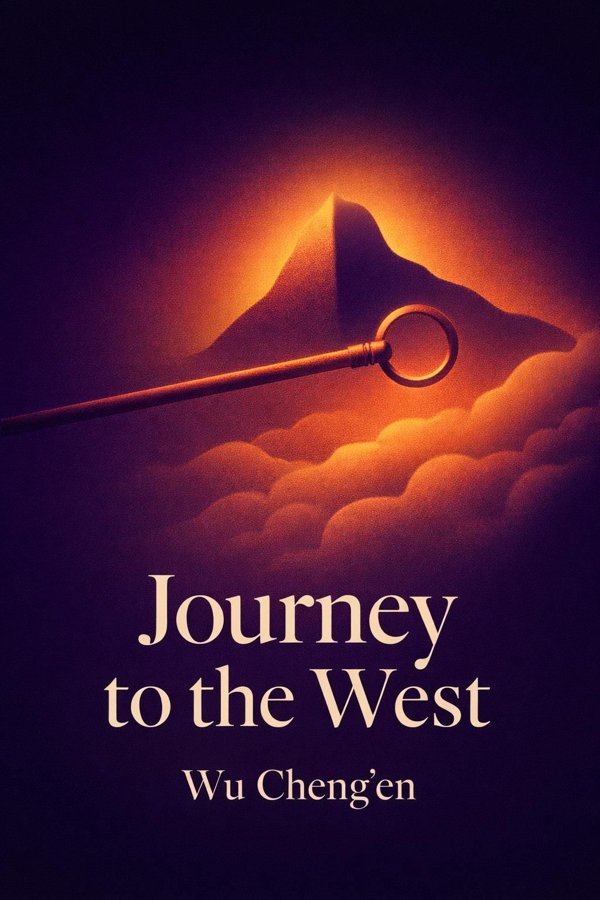
Journey to the West: Summary & Key Insights
by Wu Cheng'en
 10 min10 chaptersAudio available
Key Takeaways from Journey to the West
Power without discipline becomes its own prison.
A noble goal can guide flawed people farther than perfection ever could.
True freedom often begins the moment pride accepts responsibility.
Growth rarely happens alone; it is often forged in the irritation and necessity of traveling with others.
The road west is not just a route across landscapes; it is a map of the soul under pressure.
What Is Journey to the West About?
Journey to the West by Wu Cheng'en is a classics book spanning 9 pages. Journey to the West is one of the towering achievements of world literature: a dazzling Ming-dynasty epic traditionally attributed to Wu Cheng'en that combines adventure, religion, comedy, fantasy, and moral allegory into a single unforgettable pilgrimage. At its surface, the novel follows the monk Tang Sanzang as he travels from China to India to obtain sacred Buddhist scriptures, accompanied by three disciples: the brilliant but unruly Monkey King Sun Wukong, the gluttonous and weak-willed Zhu Bajie, and the steadfast Sha Wujing. But beneath its monsters, magical battles, and celestial bureaucracy lies a profound meditation on the human mind. Each companion represents impulses that must be disciplined, redirected, and purified on the path to enlightenment. Wu Cheng'en's authority rests not only in his storytelling genius, but in his remarkable fusion of Buddhist, Daoist, and Confucian ideas with satire and folklore. The result is a novel that can be enjoyed as a thrilling quest and studied as a philosophical masterpiece. Centuries later, it still speaks to readers because it understands a timeless truth: spiritual growth is rarely serene. It is noisy, difficult, comic, painful, and deeply transformative.
This FizzRead summary covers all 10 key chapters of Journey to the West in approximately 10 minutes, distilling the most important ideas, arguments, and takeaways from Wu Cheng'en's work. Also available as an audio summary and Key Quotes Podcast.
Journey to the West
Journey to the West is one of the towering achievements of world literature: a dazzling Ming-dynasty epic traditionally attributed to Wu Cheng'en that combines adventure, religion, comedy, fantasy, and moral allegory into a single unforgettable pilgrimage. At its surface, the novel follows the monk Tang Sanzang as he travels from China to India to obtain sacred Buddhist scriptures, accompanied by three disciples: the brilliant but unruly Monkey King Sun Wukong, the gluttonous and weak-willed Zhu Bajie, and the steadfast Sha Wujing. But beneath its monsters, magical battles, and celestial bureaucracy lies a profound meditation on the human mind. Each companion represents impulses that must be disciplined, redirected, and purified on the path to enlightenment. Wu Cheng'en's authority rests not only in his storytelling genius, but in his remarkable fusion of Buddhist, Daoist, and Confucian ideas with satire and folklore. The result is a novel that can be enjoyed as a thrilling quest and studied as a philosophical masterpiece. Centuries later, it still speaks to readers because it understands a timeless truth: spiritual growth is rarely serene. It is noisy, difficult, comic, painful, and deeply transformative.
Who Should Read Journey to the West?
This book is perfect for anyone interested in classics and looking to gain actionable insights in a short read. Whether you're a student, professional, or lifelong learner, the key ideas from Journey to the West by Wu Cheng'en will help you think differently.
- ✓Readers who enjoy classics and want practical takeaways
- ✓Professionals looking to apply new ideas to their work and life
- ✓Anyone who wants the core insights of Journey to the West in just 10 minutes
Want the full summary?
Get instant access to this book summary and 100K+ more with Fizz Moment.
Get Free SummaryAvailable on App Store • Free to download
Key Chapters
Power without discipline becomes its own prison. Sun Wukong begins Journey to the West as a figure of dazzling energy: born from stone, master of transformation, fearless before kings, dragons, and even heaven itself. He studies immortality, acquires a magical staff, and refuses to accept any limit imposed on him. His rebellion against the celestial order is thrilling, but Wu Cheng'en makes clear that raw talent and ambition are not the same as wisdom. Wukong can defeat armies, but he cannot govern himself. That is why the Buddha's act of subduing him beneath the Five Elements Mountain is more than punishment. It is the first necessary interruption of ego.
This episode works as allegory. Wukong represents the untamed mind: clever, restless, proud, and always in motion. Many people recognize this force in modern life. It appears in impulsive decision-making, constant distraction, overconfidence, and the desire to prove oneself superior. A gifted person can mistake capacity for maturity. Wukong's fall shows that without restraint, exceptional ability can become destructive both to others and to oneself.
Yet the mountain is also merciful. Imprisonment creates the conditions for reflection. Before transformation comes limitation; before service comes surrender. In practical terms, this means setbacks can become turning points. Losing status, facing consequences, or being forced to pause may feel humiliating, but such moments often reveal the difference between performance and character.
Actionable takeaway: identify one area where your strengths become excess—confidence into arrogance, speed into carelessness, independence into rebellion—and impose a useful constraint before life imposes one for you.
A noble goal can guide flawed people farther than perfection ever could. Tang Sanzang, the monk at the center of the pilgrimage, is chosen to travel west and bring Buddhist scriptures back to China. He is compassionate, devout, and morally serious, yet he is also fragile, trusting, and often unable to recognize danger. In a conventional adventure tale, a hero's weakness would disqualify him. In Journey to the West, it clarifies the point: holiness does not eliminate vulnerability, and spiritual purpose does not remove the need for help.
Tang Sanzang represents aspiration. He is the part of the human self that wants goodness, meaning, and salvation. But aspiration alone cannot survive the world. Again and again, he is deceived by appearances, manipulated by demons, and endangered by his own rigid idealism. His mission matters because it gives direction not only to his own life, but to the lives of his disciples. Around his sincerity, unruly strength is organized into service.
This has practical relevance beyond religion. In families, organizations, and communities, a clear mission often holds together people with very different temperaments. A compassionate leader may not be the strongest executor, but their moral clarity can align stronger personalities toward worthwhile ends. At the same time, Tang Sanzang reminds us that virtue needs realism. Good intentions without discernment invite trouble.
The brilliance of Wu Cheng'en is that he neither mocks nor idealizes the monk. He presents purity as powerful, but incomplete without courage, intelligence, and companionship. The quest succeeds because sincerity is joined to discipline and force.
Actionable takeaway: define a mission larger than your ego, then ask what practical protections, allies, and skills are needed to keep that mission from being undone by naivety.
True freedom often begins the moment pride accepts responsibility. When Tang Sanzang releases Sun Wukong from beneath the mountain, the event seems like liberation. But Wu Cheng'en complicates the idea immediately. Wukong is not set loose to resume his old life; he is placed in service to the monk and controlled by the magical headband that tightens when he disobeys. This is one of the novel's deepest paradoxes: the Monkey King becomes most fully himself not when he can do whatever he wants, but when his tremendous powers are bound to a meaningful duty.
At first, the arrangement feels humiliating. Wukong, who once challenged heaven, must now protect a vulnerable monk and submit to discipline. Yet this structure redirects rather than destroys him. His intelligence, bravery, and martial skill now have a worthy object. Instead of fighting for vanity, he fights for the pilgrimage. Instead of proving his greatness, he learns to express it through loyalty.
In modern terms, many people confuse freedom with the absence of obligation. But the novel suggests that a life without commitments can become chaotic and empty. A talented person may drift, self-sabotage, or become trapped in cycles of stimulation and boredom. Purposeful commitments—a vocation, a craft, a family responsibility, a code of conduct—can feel restrictive at first, yet they often create the conditions for deeper agency and self-respect.
The headband is a harsh symbol, but an instructive one. Every serious path has forms of accountability: deadlines, mentors, standards, consequences. These do not necessarily diminish us. They can train our power into reliability.
Actionable takeaway: choose one voluntary discipline that channels your strengths toward a meaningful goal, and treat that structure as a tool for freedom rather than a threat to it.
Growth rarely happens alone; it is often forged in the irritation and necessity of traveling with others. As the pilgrimage continues, Tang Sanzang gathers more disciples: Zhu Bajie, the comic embodiment of appetite and laziness, and Sha Wujing, quieter and more enduring, marked by former wrongdoing but capable of stable service. Together with Sun Wukong, they form a deliberately imperfect fellowship. No member is complete, and no member is unnecessary.
This companionship is one of the novel's most humane insights. Rather than presenting spiritual development as an individual triumph, Wu Cheng'en makes it communal. Each disciple carries a burden of past failure and a temperament that complicates the mission. Bajie is greedy, flirtatious, and often cowardly. Sha Wujing is less spectacular but dependable. Wukong is brilliant and volatile. Tang Sanzang is pure but impractical. Their differences generate conflict, comedy, and repeated delay, yet those same differences make survival possible.
The pattern reflects real life. Teams succeed not because everyone shares the same strengths, but because different strengths compensate for different weaknesses. In workplaces, families, and friendships, the person who moves fastest may need the person who steadies the process. The idealist may need the skeptic. The visionary may need the finisher. Redemption often begins when people stop demanding perfect companions and start learning from difficult ones.
Wu Cheng'en also insists that flawed people remain capable of sacred work. Past error does not eliminate future usefulness. Through shared labor, even unruly characters are refined.
Actionable takeaway: look at one frustrating relationship in your life and ask not only what that person lacks, but what function they may serve that you cannot easily replace. Then build cooperation around complementarity instead of sameness.
The road west is not just a route across landscapes; it is a map of the soul under pressure. On the surface, Journey to the West is a travel narrative filled with mountains, rivers, kingdoms, monasteries, and hostile territories. But the deeper structure is spiritual. Every mile traveled externalizes an inner struggle. The journey matters not only because the travelers seek scriptures, but because they must become capable of receiving what the scriptures mean.
This is why the novel repeats cycles of danger, rescue, error, and renewal. The repetition is purposeful rather than redundant. Human beings do not learn once and remain transformed forever. We revisit fear, desire, pride, distraction, and doubt in new forms. The pilgrimage dramatizes this truth. Progress is real, but it is uneven. There are advances, regressions, and long stretches where the travelers seem to face the same problems all over again.
Readers can apply this structure to any long-term effort: education, therapy, recovery, parenthood, creative work, or moral development. Important journeys rarely move in a straight line. We often misread recurring difficulty as failure, when it may simply be the normal rhythm of deep change. The point is not to eliminate all weakness immediately, but to continue moving while becoming more aware, more disciplined, and more compassionate.
Wu Cheng'en also suggests that sacred goals require embodied endurance. Enlightenment is not detached from fatigue, hunger, weather, conflict, and routine. Spiritual life happens in conditions of inconvenience.
Actionable takeaway: when a recurring challenge reappears in your life, stop asking, “Why am I back here?” and instead ask, “What am I meant to practice at this stage that I could not have practiced before?”
The most dangerous enemies are often the ones that look attractive, reasonable, or holy. Throughout Journey to the West, Tang Sanzang and his disciples are attacked by demons, monsters, shapeshifters, and deceptive spirits. These beings do not always appear grotesque. Often they disguise themselves as beautiful women, helpless victims, wise rulers, pious monks, or hospitable hosts. The recurring lesson is sharp: evil is not always loud, and illusion often succeeds by flattering what we already want to believe.
Tang Sanzang's vulnerability to deception is especially important. His compassion and moral seriousness, admirable in themselves, can be exploited because he judges by appearances and clings to rigid assumptions. Wukong, by contrast, often sees through disguises, but his aggressive methods create conflict within the group. The tension between perception and trust becomes one of the novel's most persistent themes.
This dynamic remains highly relevant. In modern life, false appearances take many forms: manipulative charisma, polished misinformation, shallow virtue signaling, predatory opportunities disguised as shortcuts, or self-deception dressed up as principle. People are not usually defeated by what they clearly recognize as harmful. They are defeated by what resembles goodness, urgency, or reward.
The novel does not recommend cynicism. Instead, it teaches discernment. Compassion needs perception. Sincerity needs judgment. Goodness without wisdom can be captured by illusion; skepticism without compassion can become cruelty. The ideal response is to cultivate both a clear eye and a steady heart.
Actionable takeaway: before accepting what appears noble, urgent, or irresistible, pause and test it against evidence, patterns, and trusted counsel. Ask not only how it looks, but what it consistently produces.
Laughter can expose truth more effectively than solemn preaching. One of the enduring pleasures of Journey to the West is its humor. Zhu Bajie complains, overeats, lusts, exaggerates, and looks for comfort at the worst possible moments. Wukong is witty, sarcastic, and theatrically indignant. The celestial world itself is often portrayed with comic bureaucracy and vanity. Far from weakening the novel's spiritual seriousness, this humor strengthens it by making moral insight memorable and humane.
Wu Cheng'en understands that people resist direct moral instruction, especially when it feels abstract or self-righteous. But when readers laugh at Bajie's gluttony, Wukong's ego, or Tang Sanzang's gullibility, they also recognize their own tendencies. Comedy lowers defensiveness. It turns judgment into recognition. We do not merely observe vice in others; we see our own appetites, vanities, and confusions reflected back in exaggerated form.
This has practical value. In leadership, parenting, teaching, and self-improvement, humor can create space for correction without humiliation. A person who can laugh at their own patterns is often more capable of changing them. Humor does not erase accountability, but it softens shame enough to make growth possible.
The novel's satire also extends upward. Gods, officials, and institutions are not immune from absurdity. This prevents spirituality from becoming self-important. Even sacred quests involve messy personalities and comic interruptions.
Actionable takeaway: the next time you notice a recurring flaw in yourself, try naming it with honest humor rather than harsh condemnation. Then pair that recognition with one concrete corrective behavior so insight becomes change instead of mere amusement.
Wisdom is rarely the result of one revelation; more often it is hammered into character through repeated mistakes. Journey to the West is episodic, with one ordeal after another, and some readers notice how often similar patterns recur: temptation, danger, misunderstanding, rescue, and recovery. But this repetition is not a flaw. It is the novel's psychology. Human beings do not overcome pride, fear, appetite, and delusion in a single lesson. We revisit them until a deeper response becomes possible.
Wukong repeatedly struggles with anger and impatience. Tang Sanzang repeatedly mistakes appearances for reality. Bajie repeatedly falls into comfort-seeking and complaint. Their persistence in weakness can be frustrating, but it is also realistic. Transformation is not instant moral clarity; it is the gradual training of attention, desire, and behavior under pressure.
This pattern is especially useful for readers who feel discouraged by slow personal progress. Whether someone is building discipline, recovering from harmful habits, developing a relationship, or pursuing spiritual maturity, the same issue may return many times. The novel encourages endurance rather than self-disgust. Failure matters, but quitting matters more. Every trial becomes another opportunity to practice a better response.
Importantly, repeated learning does not mean passive acceptance. The pilgrims survive because they continue adjusting. They seek help, use what they have learned, and keep going even when they are embarrassed by old errors.
Actionable takeaway: choose one recurring weakness in your life and stop treating its reappearance as proof of defeat. Instead, define the next improved response you want to practice, however small, and measure progress by recovery speed and awareness rather than by perfection.
Sacred truth has value, but receiving it requires readiness. When the pilgrims finally arrive in India and obtain the Buddhist scriptures, the moment is triumphant, yet Wu Cheng'en refuses to make it simplistic. The ending emphasizes not only arrival, but worthiness, merit, and completion. The scriptures are not a magical reward handed over merely for showing up. The travelers must endure, learn, and fulfill the conditions of the quest. In other words, enlightenment is linked to moral and spiritual preparation.
This is central to the novel's worldview. Knowledge alone is not enough. One may possess texts, doctrines, or correct language while remaining internally unchanged. The pilgrimage has value because it transforms the seekers into people capable of carrying what they receive. The scriptures symbolize truth, but the journey creates receptivity.
The idea translates easily to secular life. Credentials do not equal wisdom. Information does not equal maturity. A person may read leadership books without becoming trustworthy, study ethics without becoming kind, or consume spiritual content without becoming disciplined. Deep knowledge must be embodied through practice, humility, and tested experience.
The novel's conclusion also restores dignity to perseverance. The long hardships were not detours from the goal; they were the very means by which the goal became meaningful. What is attained at the end has weight because it has been suffered for.
Actionable takeaway: ask yourself where you are trying to receive a result without undergoing the formation it requires. Then commit to the process that makes the outcome deserved, not just desired.
The final test of transformation is what we become after success. Journey to the West does not end merely with the acquisition of scriptures. The pilgrims return, their mission is recognized, and each receives an appropriate spiritual reward. This closing movement matters because it reframes victory. The quest was never just about surviving monsters or reaching a destination. It was about becoming the kind of beings whose actions, loyalties, and sufferings had ripened into higher understanding.
The distribution of rewards reflects the moral architecture of the novel. Effort, repentance, service, and endurance are all acknowledged. Even imperfect figures are elevated according to what they have become through the journey. Redemption does not erase personality, but it orders personality toward the good. Wukong remains formidable, yet no longer anarchic. Bajie is not wholly purified, yet his role still fits the justice of the story. Sha Wujing's quiet steadiness receives its due. Tang Sanzang's devotion is fulfilled.
This ending suggests a mature view of achievement. Success is not simply reaching an objective and enjoying applause. It is integrating what the process has taught you. Many people arrive at goals—career milestones, academic honors, wealth, influence—without inner growth, and their success remains shallow. The novel insists that outer completion should correspond to inner change.
The return also reminds readers that great journeys ultimately reconnect the individual to a larger order. Enlightenment is not private self-congratulation; it is reconciliation with truth.
Actionable takeaway: when you reach an important goal, do not ask only, “Did I achieve it?” Ask, “Who have I become in the process, and what responsibility comes with that new state?”
All Chapters in Journey to the West
About the Author
Wu Cheng'en (c. 1500-c. 1582) was a Chinese writer and poet of the Ming dynasty, traditionally recognized as the author of Journey to the West, one of the Four Great Classical Novels of Chinese literature. Born in Huai'an, in present-day Jiangsu Province, he lived during a period of rich literary and cultural development. Although many details of his life remain uncertain, he is remembered for his sharp wit, inventive imagination, and mastery of satire. His writing draws on folk tales, religious traditions, and classical learning, especially Buddhist and Daoist themes. In Journey to the West, Wu Cheng'en transformed popular legends into a brilliant narrative that is at once comic, philosophical, and spiritually profound. His work has influenced centuries of Chinese storytelling and remains celebrated around the world.
Get This Summary in Your Preferred Format
Read or listen to the Journey to the West summary by Wu Cheng'en anytime, anywhere. FizzRead offers multiple formats so you can learn on your terms — all free.
Available formats: App · Audio · PDF · EPUB — All included free with FizzRead
Download Journey to the West PDF and EPUB Summary
Key Quotes from Journey to the West
“Power without discipline becomes its own prison.”
“A noble goal can guide flawed people farther than perfection ever could.”
“True freedom often begins the moment pride accepts responsibility.”
“Growth rarely happens alone; it is often forged in the irritation and necessity of traveling with others.”
“The road west is not just a route across landscapes; it is a map of the soul under pressure.”
Frequently Asked Questions about Journey to the West
Journey to the West by Wu Cheng'en is a classics book that explores key ideas across 10 chapters. Journey to the West is one of the towering achievements of world literature: a dazzling Ming-dynasty epic traditionally attributed to Wu Cheng'en that combines adventure, religion, comedy, fantasy, and moral allegory into a single unforgettable pilgrimage. At its surface, the novel follows the monk Tang Sanzang as he travels from China to India to obtain sacred Buddhist scriptures, accompanied by three disciples: the brilliant but unruly Monkey King Sun Wukong, the gluttonous and weak-willed Zhu Bajie, and the steadfast Sha Wujing. But beneath its monsters, magical battles, and celestial bureaucracy lies a profound meditation on the human mind. Each companion represents impulses that must be disciplined, redirected, and purified on the path to enlightenment. Wu Cheng'en's authority rests not only in his storytelling genius, but in his remarkable fusion of Buddhist, Daoist, and Confucian ideas with satire and folklore. The result is a novel that can be enjoyed as a thrilling quest and studied as a philosophical masterpiece. Centuries later, it still speaks to readers because it understands a timeless truth: spiritual growth is rarely serene. It is noisy, difficult, comic, painful, and deeply transformative.
More by Wu Cheng'en
You Might Also Like





Browse by Category
Ready to read Journey to the West?
Get the full summary and 100K+ more books with Fizz Moment.