
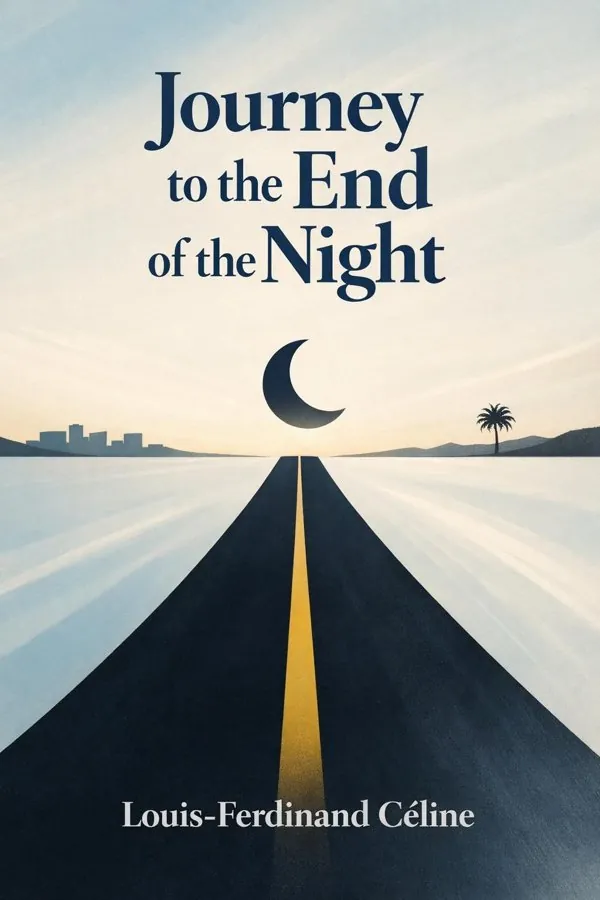
Journey to the End of the Night: Summary & Key Insights
 10 min8 chaptersAudio available
Key Takeaways from Journey to the End of the Night
The most frightening thing about war in Céline’s novel is not its violence alone, but how ordinary people learn to call that violence noble.
Distance does not purify corruption; it often reveals it more clearly.
Modernity does not always crush people with whips; often it does so with wages, efficiency, and fluorescent promises.
Few roles seem more noble than that of the physician, yet Céline uses medicine to reveal suffering without illusion.
Céline’s darkest claim is that people do not merely suffer; they survive by lying to themselves about why they suffer.
What Is Journey to the End of the Night About?
Journey to the End of the Night by Louis-Ferdinand Céline is a classics book spanning 5 pages. Originally published in 1932, Journey to the End of the Night is one of the most explosive novels of the twentieth century. Louis-Ferdinand Céline follows Ferdinand Bardamu, a restless and deeply skeptical man, through the trenches of World War I, the brutalities of colonial Africa, the assembly lines of industrial America, and the bleak margins of suburban Paris. What emerges is not a heroic coming-of-age story but a relentless descent through the false promises of modern civilization. War, empire, work, medicine, love, and progress are all stripped of their comforting myths. The novel matters because it changed how fiction could sound and what it could dare to say. Céline fused slang, bitter humor, lyrical intensity, and spoken rhythms into a style that felt scandalously alive. He wrote not as a distant moralist but as someone who had seen violence, poverty, and illness up close. Trained as a physician and marked by his own wartime experience, Céline brought unusual authority to his portrait of human suffering. Journey to the End of the Night remains essential because it confronts readers with a disturbing question: what if the systems we trust most are built on fear, exploitation, and self-deception?
This FizzRead summary covers all 8 key chapters of Journey to the End of the Night in approximately 10 minutes, distilling the most important ideas, arguments, and takeaways from Louis-Ferdinand Céline's work. Also available as an audio summary and Key Quotes Podcast.
Journey to the End of the Night
Originally published in 1932, Journey to the End of the Night is one of the most explosive novels of the twentieth century. Louis-Ferdinand Céline follows Ferdinand Bardamu, a restless and deeply skeptical man, through the trenches of World War I, the brutalities of colonial Africa, the assembly lines of industrial America, and the bleak margins of suburban Paris. What emerges is not a heroic coming-of-age story but a relentless descent through the false promises of modern civilization. War, empire, work, medicine, love, and progress are all stripped of their comforting myths.
The novel matters because it changed how fiction could sound and what it could dare to say. Céline fused slang, bitter humor, lyrical intensity, and spoken rhythms into a style that felt scandalously alive. He wrote not as a distant moralist but as someone who had seen violence, poverty, and illness up close. Trained as a physician and marked by his own wartime experience, Céline brought unusual authority to his portrait of human suffering. Journey to the End of the Night remains essential because it confronts readers with a disturbing question: what if the systems we trust most are built on fear, exploitation, and self-deception?
Who Should Read Journey to the End of the Night?
This book is perfect for anyone interested in classics and looking to gain actionable insights in a short read. Whether you're a student, professional, or lifelong learner, the key ideas from Journey to the End of the Night by Louis-Ferdinand Céline will help you think differently.
- ✓Readers who enjoy classics and want practical takeaways
- ✓Professionals looking to apply new ideas to their work and life
- ✓Anyone who wants the core insights of Journey to the End of the Night in just 10 minutes
Want the full summary?
Get instant access to this book summary and 100K+ more with Fizz Moment.
Get Free SummaryAvailable on App Store • Free to download
Key Chapters
The most frightening thing about war in Céline’s novel is not its violence alone, but how ordinary people learn to call that violence noble. At the start, Bardamu is swept into World War I by the fever of patriotic excitement. He does not enter the war because he is courageous in any meaningful sense; he enters because he is caught in a collective delirium. Once he reaches the front, the illusion collapses. War appears not as a stage for honor, but as a gigantic machine that consumes anonymous bodies while rewarding obedience, slogans, and stupidity.
Céline’s insight is devastating: institutions often survive by dressing absurdity in moral language. Officers speak of duty while sending men to die. Citizens celebrate ideals from a safe distance while soldiers endure terror, filth, and randomness. Bardamu’s horror comes from realizing that there is no hidden nobility behind the spectacle. There is only fear, coercion, and a public appetite for comforting lies.
This idea extends beyond the battlefield. In modern life, organizations of all kinds can transform destructive behavior into something respectable through rhetoric. A company may call exploitation “performance culture.” A government may call cruelty “security.” A group may call conformity “loyalty.” Céline asks readers to notice how language can sanctify the irrational.
Bardamu’s refusal to romanticize war is what makes him such a radical antihero. He sees cowardice not as shameful weakness but as honest recognition of danger. In a world built on mass delusion, fear can become a form of intelligence.
Actionable takeaway: whenever a system glorifies sacrifice, ask who benefits, who suffers, and what reality is being hidden behind heroic words.
Distance does not purify corruption; it often reveals it more clearly. After leaving the army, Bardamu drifts to colonial Africa, perhaps hoping that escape might bring renewal. Instead, he finds a world even more nakedly organized around domination, greed, and decay. The colony is not a noble mission of civilization, as imperial rhetoric claims. It is a feverish outpost where European power strips away its manners and shows its true face.
In Africa, Céline dismantles the fantasy that empire spreads order, enlightenment, or progress. Colonial officials are petty, sickly, and brutal. Trade is inseparable from coercion. The landscape itself feels less like an exotic paradise than a place onto which Europeans project their fantasies while draining it for profit. Bardamu encounters disease, loneliness, and moral emptiness. The supposed civilizers appear spiritually exhausted, while the system they serve depends on exploitation disguised as destiny.
The power of this section lies in how it exposes the gap between official narratives and lived experience. Colonialism does not simply harm the colonized; it corrodes everyone trapped in its logic, including those who believe they are agents of progress. Céline shows empire as a structure of self-deception. Its administrators cling to abstract ideals because the reality would be unbearable to admit.
This pattern remains recognizable. Institutions still justify extraction in the language of development, modernization, or opportunity. Whether in global labor chains, resource politics, or cultural dominance, exploitation often arrives packaged as benevolence.
Bardamu’s colonial experience teaches that one should distrust any system that insists its violence is educational or necessary. The more loudly power congratulates itself, the more likely it is concealing brutality.
Actionable takeaway: examine any claim of “help” or “progress” by looking at who controls resources, who bears the cost, and whose voice is missing from the story.
Modernity does not always crush people with whips; often it does so with wages, efficiency, and fluorescent promises. When Bardamu reaches America, he encounters a new form of domination. The violence is cleaner, faster, and more organized than in war or empire. Industrial civilization, especially in the factory, turns human beings into measurable units of production. The body is no longer sacrificed to patriotic slogans but to repetition, speed, and profit.
Céline’s portrait of America is not simply anti-American. It is a broader critique of industrial modernity. The factory represents a civilization obsessed with output, standardization, and movement. Workers are slotted into systems that demand performance while draining individuality. Life becomes rhythmic, mechanical, and strangely empty. What war does through force, the factory does through routine: it reduces persons to functions.
Yet Bardamu also sees the seductive side of this world. America dazzles with energy, novelty, and ambition. That is precisely what makes the critique stronger. Dehumanization does not always appear grim from the outside. It can look exciting, efficient, even progressive. A person may feel fortunate to have work while slowly becoming alienated from purpose, community, and self.
This section speaks directly to contemporary readers navigating burnout, hyper-productivity, and algorithmic management. Many people today live inside systems that reward optimization while eroding meaning. We track output, multitask relentlessly, and call exhaustion professionalism.
Céline invites us to ask a brutal question: if a society grows richer while its people become inwardly poorer, is that progress at all? The answer, for Bardamu, is clear. Material advancement without human dignity merely perfects misery.
Actionable takeaway: audit your work life for signs of mechanical living, and protect one daily habit that restores your sense of personhood rather than productivity.
Few roles seem more noble than that of the physician, yet Céline uses medicine to reveal suffering without illusion. Back in France, Bardamu works as a doctor among the poor, the sick, and the socially abandoned. Here the novel shifts from large systems to intimate damage. The battlefield, the colony, and the factory all reappear in miniature inside damaged bodies, exhausted homes, and failing neighborhoods. Civilization’s grand ideals end in private misery.
As a doctor, Bardamu occupies a morally complex position. He is neither saint nor savior. He is tired, cynical, and often emotionally detached. But precisely because he has no sentimental illusions, he can see what polite society ignores. Poverty is not just lack of money; it is humiliation, confinement, chronic stress, and inherited despair. Illness is never merely biological. It is entangled with class, loneliness, labor, and neglect.
Céline’s medical gaze gives the novel unusual force. He observes the daily, repetitive forms of suffering that public rhetoric overlooks. Not everyone dies in spectacular tragedy. Many simply endure a slow erosion of hope. Bardamu’s patients are trapped less by dramatic villainy than by systems that render them disposable.
This remains a powerful lesson for how we understand social problems today. Health care, mental health, addiction, and family instability cannot be separated from economic insecurity and social isolation. To treat symptoms while ignoring the conditions that produce them is to misunderstand the illness.
Bardamu’s medical work also suggests a modest form of ethics. He may not believe in grand redemption, but small acts of attention still matter. In a broken world, care need not be heroic to be meaningful.
Actionable takeaway: when judging your own or others’ struggles, look beyond individual behavior and ask what hidden pressures, environments, and deprivations might be shaping the outcome.
Céline’s darkest claim is that people do not merely suffer; they survive by lying to themselves about why they suffer. The “night” of the title is not just death, despair, or social decay. It is the condition of living inside illusions that make unbearable realities seem meaningful. Heroism, empire, romance, work, social respectability, even personal identity can become screens placed between consciousness and the void.
Bardamu keeps moving because motion itself functions like a defense against recognition. If one place disappoints, perhaps another will redeem life. If one ideal collapses, another might take its place. But every new environment reveals the same pattern: people cling to stories because the truth is too naked, too chaotic, too humiliating. The novel’s power comes from its refusal to provide a final consoling alternative. There is no philosophical system waiting to rescue us from disillusionment.
Yet this is not merely nihilism. Céline suggests that illusions become dangerous when we mistake them for reality. The problem is not that human beings seek meaning; the problem is that they often surrender judgment in exchange for comforting narratives. Bardamu’s relentless skepticism is painful, but it is also clarifying. He would rather endure bleak lucidity than be anesthetized by noble frauds.
For modern readers, this speaks to political mythmaking, consumer fantasies, personal branding, and self-deceptive ambition. We often build lives around images of success, belonging, or virtue that cannot survive honest scrutiny. The result is not fulfillment but exhaustion.
The novel does not teach optimism. It teaches vigilance. To confront illusion is unsettling, but it may be the beginning of a more honest existence.
Actionable takeaway: identify one story you tell yourself about success, love, or purpose, and test it against your lived experience rather than your hopes alone.
One of the strangest things about Journey to the End of the Night is how funny it can be. Céline does not use humor to soften despair; he uses it to expose it. The novel’s comedy is bitter, grotesque, and often unsettling, but it is essential to its vision. In a world so saturated with hypocrisy and suffering, laughter becomes a survival tool and a mode of truth-telling.
Bardamu’s mockery targets everyone: patriots, colonizers, bosses, idealists, lovers, bureaucrats, and himself. This universal derision prevents the novel from hardening into self-righteousness. Bardamu may see through illusions, but he is hardly pure. He is evasive, compromised, fearful, and often petty. The humor reminds us that human weakness is collective. No one stands entirely outside the mess.
This comic cruelty performs an important intellectual function. Solemn language can hide corruption by making systems sound dignified. Satire punctures that dignity. Once something ridiculous is seen as ridiculous, it loses part of its authority. A pompous official, a moral slogan, or a social ritual becomes less frightening when exposed as absurd theater.
There is also a practical human lesson here. People enduring stress, grief, or institutional nonsense often rely on dark humor not because they are heartless, but because humor creates psychological distance. Doctors, soldiers, nurses, and workers in difficult environments frequently joke about what they cannot control. It is a way of refusing total defeat.
Céline’s humor is not healthy in any simple sense; it can be corrosive and cruel. But it reveals that laughter and despair are not opposites. Sometimes they are companions.
Actionable takeaway: when confronted with inflated rhetoric or social pretense, use humor carefully to expose what is false without losing sight of the real suffering underneath.
Traditional novels often ask readers to admire their protagonists. Céline does something far riskier: he gives us a narrator who is perceptive, cowardly, damaged, and morally inconsistent. Bardamu is not a model to imitate. He flees danger, mistrusts ideals, struggles to love, and often drifts rather than acts. Yet his very inadequacy becomes the lens through which modern life is revealed.
The antihero matters because heroism can itself be a literary lie. A noble protagonist can impose too much order on a chaotic world. Bardamu, by contrast, feels believably human. He is vulnerable to fear, opportunism, boredom, and confusion. He does not master experience; he is battered by it. That makes his observations more unsettling. He lacks grandeur, so whatever truth he uncovers cannot be dismissed as exceptional wisdom from an exceptional man.
This narrative choice reshaped modern fiction. It opened space for protagonists who are fractured rather than admirable, consciousness-driven rather than plot-driven, and revealing precisely because they fail to transcend their world. Bardamu is not outside corruption; he is marinated in it. His awareness does not save him. It only sharpens his discomfort.
Readers may find him frustrating, but that frustration is part of the point. We often want moral clarity from stories because real life rarely offers it. Céline denies us that comfort. He suggests that insight does not automatically produce courage, and that seeing the truth about a system does not guarantee one can escape it.
In contemporary terms, Bardamu resembles the intelligent cynic who understands institutional absurdity yet still participates in it because survival leaves few clean options.
Actionable takeaway: stop expecting perfect consistency from yourself or others, but do use moments of discomfort and contradiction as clues to the pressures shaping your life.
Sometimes a book changes literature not only through what it says, but through how it sounds. Céline’s breakthrough was stylistic as much as philosophical. He rejected the polished, elevated diction expected of serious literature and replaced it with a voice that felt oral, jagged, slangy, rhythmic, and emotionally volatile. The result was a prose style that seemed closer to speech, panic, and raw consciousness than to classical decorum.
This matters because style is never neutral. Refined language can create distance from pain. It can make suffering elegant, and therefore easier to consume. Céline wanted the sentence itself to carry shock, disgust, speed, and collapse. His prose lurches, mocks, sings, and spits. It captures a world in which thought is unstable and emotion refuses to behave politely.
The style serves the novel’s anti-idealism. If the world is fractured, why should the language remain smooth? If public discourse is full of lies, why should literature imitate official calm? By violating literary respectability, Céline suggests that truthful art may need to sound indecorous.
This lesson has broad relevance. In writing, speaking, or creative work, form should fit reality. A sanitized message can betray a difficult truth. Sometimes clarity requires bluntness. Sometimes emotional honesty requires rhythm, interruption, or vernacular speech rather than polished abstraction.
Of course, innovation alone is not virtue. Céline’s style is powerful because it is inseparable from perception. The language does not merely decorate the vision; it enacts it. Readers may resist the voice at first, but that resistance is part of entering the book’s moral atmosphere.
Actionable takeaway: in your own communication, choose a style that clarifies the truth of your experience rather than one that merely sounds respectable.
All Chapters in Journey to the End of the Night
About the Author
Louis-Ferdinand Céline (1894–1961), born Louis-Ferdinand Destouches, was a French novelist and physician whose work transformed twentieth-century prose. He served in World War I, an experience that deeply shaped his antiwar outlook, and later practiced medicine among working-class communities. His fiction drew on firsthand encounters with suffering, bureaucracy, and social decay, giving it unusual intensity and authority. Céline became famous with Journey to the End of the Night, a novel celebrated for its radical pessimism, dark humor, and groundbreaking use of spoken rhythms and slang-like energy. His literary influence has been immense, affecting generations of writers interested in voice and modern alienation. At the same time, his legacy remains controversial because of his later antisemitic pamphlets and political extremism, which continue to complicate his place in literary history.
Get This Summary in Your Preferred Format
Read or listen to the Journey to the End of the Night summary by Louis-Ferdinand Céline anytime, anywhere. FizzRead offers multiple formats so you can learn on your terms — all free.
Available formats: App · Audio · PDF · EPUB — All included free with FizzRead
Download Journey to the End of the Night PDF and EPUB Summary
Key Quotes from Journey to the End of the Night
“The most frightening thing about war in Céline’s novel is not its violence alone, but how ordinary people learn to call that violence noble.”
“Distance does not purify corruption; it often reveals it more clearly.”
“Modernity does not always crush people with whips; often it does so with wages, efficiency, and fluorescent promises.”
“Few roles seem more noble than that of the physician, yet Céline uses medicine to reveal suffering without illusion.”
“Céline’s darkest claim is that people do not merely suffer; they survive by lying to themselves about why they suffer.”
Frequently Asked Questions about Journey to the End of the Night
Journey to the End of the Night by Louis-Ferdinand Céline is a classics book that explores key ideas across 8 chapters. Originally published in 1932, Journey to the End of the Night is one of the most explosive novels of the twentieth century. Louis-Ferdinand Céline follows Ferdinand Bardamu, a restless and deeply skeptical man, through the trenches of World War I, the brutalities of colonial Africa, the assembly lines of industrial America, and the bleak margins of suburban Paris. What emerges is not a heroic coming-of-age story but a relentless descent through the false promises of modern civilization. War, empire, work, medicine, love, and progress are all stripped of their comforting myths. The novel matters because it changed how fiction could sound and what it could dare to say. Céline fused slang, bitter humor, lyrical intensity, and spoken rhythms into a style that felt scandalously alive. He wrote not as a distant moralist but as someone who had seen violence, poverty, and illness up close. Trained as a physician and marked by his own wartime experience, Céline brought unusual authority to his portrait of human suffering. Journey to the End of the Night remains essential because it confronts readers with a disturbing question: what if the systems we trust most are built on fear, exploitation, and self-deception?
More by Louis-Ferdinand Céline
You Might Also Like
Browse by Category
Ready to read Journey to the End of the Night?
Get the full summary and 100K+ more books with Fizz Moment.