
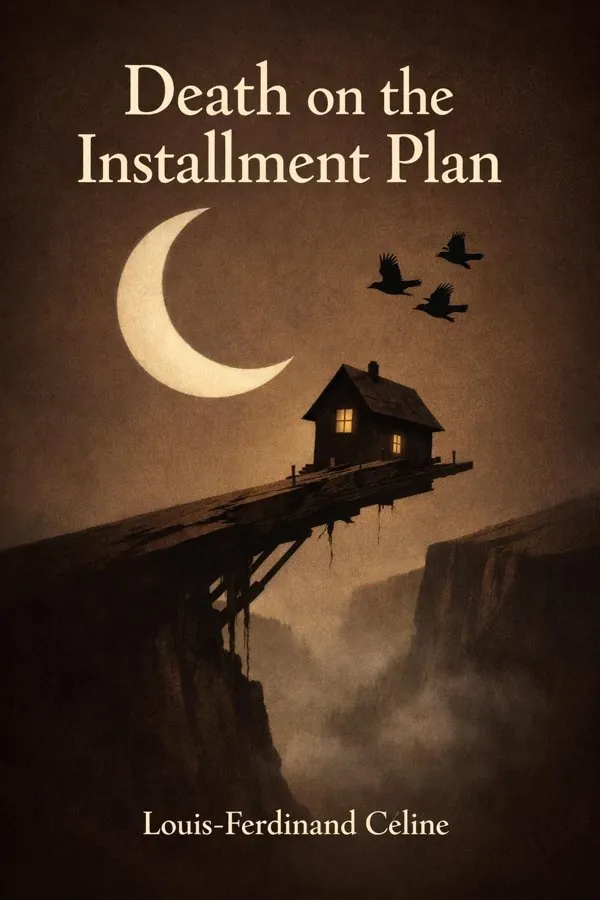
Death on the Installment Plan: Summary & Key Insights
 10 min8 chaptersAudio available
Key Takeaways from Death on the Installment Plan
Children often inherit not ideals, but atmospheres.
Institutions promise formation, but often deliver humiliation.
Communities often look stable from the outside while rotting from within.
Growing up often means discovering that work is not a ladder but a maze.
When families cannot bear their own disappointments, children learn to withdraw before they learn to understand.
What Is Death on the Installment Plan About?
Death on the Installment Plan by Louis-Ferdinand Céline is a classics book spanning 6 pages. First published in 1936, Death on the Installment Plan is Louis-Ferdinand Céline’s savage, feverish account of growing up in a world ruled by humiliation, fantasy, money worries, and slow emotional decay. The novel traces the early life of Ferdinand, Céline’s fictional alter ego, as he moves through a cramped petit-bourgeois household, cruel schools, failed apprenticeships, bizarre neighbors, and family disappointments that shape his bleak understanding of human nature. What makes the book endure is not only its subject matter, but its voice: broken, breathless, comic, bitter, and startlingly alive. Céline turned everyday misery into a new kind of prose, one that sounds less like polished literature than like consciousness speaking under pressure. The result is both deeply personal and broadly social, exposing how respectability, authority, and progress often conceal fear, violence, and absurdity. Céline remains one of the most influential and controversial writers of the twentieth century, and this novel stands as a landmark of modern fiction: abrasive, darkly funny, and unforgettable in the way it transforms childhood into a study of suffering paid out in installments.
This FizzRead summary covers all 8 key chapters of Death on the Installment Plan in approximately 10 minutes, distilling the most important ideas, arguments, and takeaways from Louis-Ferdinand Céline's work. Also available as an audio summary and Key Quotes Podcast.
Death on the Installment Plan
First published in 1936, Death on the Installment Plan is Louis-Ferdinand Céline’s savage, feverish account of growing up in a world ruled by humiliation, fantasy, money worries, and slow emotional decay. The novel traces the early life of Ferdinand, Céline’s fictional alter ego, as he moves through a cramped petit-bourgeois household, cruel schools, failed apprenticeships, bizarre neighbors, and family disappointments that shape his bleak understanding of human nature. What makes the book endure is not only its subject matter, but its voice: broken, breathless, comic, bitter, and startlingly alive. Céline turned everyday misery into a new kind of prose, one that sounds less like polished literature than like consciousness speaking under pressure. The result is both deeply personal and broadly social, exposing how respectability, authority, and progress often conceal fear, violence, and absurdity. Céline remains one of the most influential and controversial writers of the twentieth century, and this novel stands as a landmark of modern fiction: abrasive, darkly funny, and unforgettable in the way it transforms childhood into a study of suffering paid out in installments.
Who Should Read Death on the Installment Plan?
This book is perfect for anyone interested in classics and looking to gain actionable insights in a short read. Whether you're a student, professional, or lifelong learner, the key ideas from Death on the Installment Plan by Louis-Ferdinand Céline will help you think differently.
- ✓Readers who enjoy classics and want practical takeaways
- ✓Professionals looking to apply new ideas to their work and life
- ✓Anyone who wants the core insights of Death on the Installment Plan in just 10 minutes
Want the full summary?
Get instant access to this book summary and 100K+ more with Fizz Moment.
Get Free SummaryAvailable on App Store • Free to download
Key Chapters
Children often inherit not ideals, but atmospheres. In Death on the Installment Plan, Ferdinand grows up in a household obsessed with appearances and survival, where every coin matters and every social gesture is loaded with anxiety. His parents are not grand villains; they are ordinary people trapped by class insecurity. His mother pursues gentility, propriety, and the hope of rising a little higher. His father clings to rules, discipline, and the fantasy that order can protect a family from humiliation. Around them sits the shop, the ledgers, the dust, the stale routines of lower-middle-class life. Céline shows that this environment is not merely background. It is the machinery that shapes Ferdinand’s consciousness.
What makes this portrayal powerful is its refusal to sentimentalize childhood. Home is not a sanctuary. It is a pressure chamber where ambitions too small to inspire and too large to fulfill ferment into resentment. Respectability becomes a kind of illness: the family is forever acting, forever measuring itself against neighbors, customers, and invisible judges. Ferdinand learns early that adults are often driven less by love than by fear of slipping downward.
This idea still resonates. Many people grow up in families where status anxiety, financial stress, or social comparison silently governs daily life. A parent’s fixation on “what people will think” can shape a child’s sense of worth as surely as open cruelty. Céline’s insight is that emotional damage often arrives through repetition, not catastrophe.
Actionable takeaway: examine the atmosphere you inherited. Ask which habits of shame, comparison, or social performance still direct your decisions, and consciously choose what deserves to be carried forward.
Institutions promise formation, but often deliver humiliation. Ferdinand’s experience of school is one of the novel’s clearest demonstrations that society trains obedience before it cultivates wisdom. Teachers appear not as guides to knowledge but as petty authorities guarding their own fragile power. The classroom becomes an early laboratory of injustice, where favoritism, mockery, boredom, and punishment teach children that merit is far less important than compliance and performance.
For Ferdinand, school strips away the last illusions that effort will be rewarded fairly. He discovers that adults who speak most loudly of virtue can be vain, sadistic, or indifferent. This education in disappointment is central to the development of his cynicism. He stops expecting justice and begins reading the world through force, pretense, and absurdity. Céline is not merely attacking teachers; he is revealing how social systems normalize degradation while calling it discipline.
The idea remains relevant because many people first encounter arbitrary power in school. A child publicly shamed for a mistake, dismissed because of background, or praised only when useful can internalize lasting distrust. Even in adult life, workplaces and bureaucracies often repeat the same pattern: rules mask ego, and official ideals conceal petty cruelty.
Céline’s genius lies in showing that cynicism is not born in abstraction. It is trained into people through repeated small betrayals. When institutions fail to treat the vulnerable with dignity, they produce not maturity but emotional armor.
Actionable takeaway: whenever you hold authority over others, especially the young or inexperienced, replace humiliation with clarity. If you are the one carrying school-born cynicism, identify which lessons were true and which were merely wounds made to sound like wisdom.
Growing up often means discovering that work is not a ladder but a maze. As Ferdinand moves into apprenticeships and early attempts at useful employment, he enters a world that promises training, discipline, and advancement. What he actually finds is exploitation, confusion, wasted effort, and constant exposure to the vanity of adults. Céline portrays apprenticeship not as a noble passage into competence, but as an initiation into futility.
This matters because the novel attacks one of modern society’s most cherished myths: that labor naturally produces dignity and progress. In Ferdinand’s experience, work more often produces exhaustion, submission, and ridiculous power games. The adults who are supposed to model professionalism are frequently dishonest, incompetent, theatrical, or simply trapped themselves. The young are told to learn, but what they often learn is how institutions consume energy without delivering meaning.
Yet the chapter is not merely nihilistic. It reveals how disillusionment forms perception. Ferdinand becomes a keen observer precisely because he is not enchanted by the systems he enters. He sees the discrepancy between official language and lived reality. Anyone who has taken a job expecting mentorship and found bureaucracy, ego, and absurdity will recognize this lesson.
In practical terms, the novel reminds us that career disappointment is not always personal failure. Sometimes the structure is flawed. Sometimes “experience” mainly teaches what to avoid. That recognition can become the beginning of a more lucid path.
Actionable takeaway: evaluate work by what it is actually doing to your character and attention, not by its promises alone. If an environment repeatedly drains meaning while demanding loyalty, treat that clarity as useful knowledge, not as shame.
When families cannot bear their own disappointments, children learn to withdraw before they learn to understand. One of the most painful currents in Death on the Installment Plan is the slow unraveling of trust inside Ferdinand’s household. Financial strain, failed hopes, social embarrassment, and mutual blame erode tenderness. No single dramatic rupture defines the family; rather, emotional life frays through repeated scenes of tension, accusation, silence, and desperation.
Céline’s insight is that detachment can be a survival strategy. Ferdinand does not become cold because he lacks feeling. He becomes cold because feeling too much in such an atmosphere is dangerous. To remain exposed in a family consumed by anxiety is to be wounded constantly. So he develops distance, irony, and observational sharpness. The soul, in a sense, leaves before the body can. This is one of the book’s deepest psychological truths.
Many readers will recognize versions of this pattern. In unstable homes, children often become spectators of adult distress. They may turn sarcastic, numb, hypervigilant, or prematurely self-sufficient. Later in life, these habits can look like personality when they are really adaptations.
Céline does not offer easy reconciliation. He shows how love can survive inside damage, but not always enough to repair it. That honesty is part of the novel’s force. It refuses to turn suffering into a moral lesson with a neat recovery arc.
Actionable takeaway: notice where detachment has protected you in the past but impoverishes you in the present. Instead of condemning that distance, understand its origin. Then decide, carefully and intentionally, where genuine feeling can be reintroduced without self-betrayal.
Most people do not meet death only at the end; they encounter it in fractions along the way. The title Death on the Installment Plan captures one of Céline’s most haunting ideas: life wears people down gradually. Hopes are reduced, energies are spent, humiliations accumulate, and each compromise takes a small payment from the spirit. By the time death arrives physically, much has already been surrendered.
This is not simply melodrama. The novel presents daily existence as a series of diminishments. Poverty narrows imagination. Respectability crushes spontaneity. Institutions train submission. Family conflict corrodes trust. Work drains vitality. Through all of it, Ferdinand develops the sense that modern life does not destroy people all at once; it collects from them repeatedly, like a debt that can never be paid off.
Why is this idea so powerful? Because it names a form of suffering that is easy to miss. Not every life is shattered by one catastrophe. Many are depleted by routine. Readers may recognize this in jobs that slowly erode confidence, relationships maintained out of duty, or ambitions deferred until they no longer feel alive. Céline transforms this slow attrition into the novel’s governing metaphor.
Yet awareness of installment death can itself become a form of resistance. Once we see how life is being drained, we can begin to ask what restores it: attention, refusal, humor, freedom, or a changed environment.
Actionable takeaway: identify the recurring “small payments” your life demands from you. Which habits, obligations, or environments steadily exhaust your inner life? Reduce one of them this week before it hardens into fate.
Laughter can be a way of telling the truth when seriousness has become unbearable. One of the most distinctive features of Death on the Installment Plan is its dark humor. Céline’s world is bleak, but it is rarely solemn for long. Scenes of embarrassment, sickness, anger, failure, and social absurdity are rendered with grotesque comic energy. People posture, collapse, boast, miscalculate, and reveal themselves in ridiculous ways. The reader laughs, then realizes the laughter is mixed with pity and discomfort.
This humor is not decoration. It is a psychological weapon. Ferdinand survives not by believing in progress or moral order, but by seeing the grotesque comedy in human pretensions. The joke does not erase suffering; it keeps suffering from becoming numb abstraction. By exaggerating the ridiculousness of social life, Céline makes pain visible in a new way.
There is a practical insight here. In difficult environments, irony and humor often function as forms of endurance. Families use jokes to survive hardship. Workers laugh at absurd rules. Patients joke in hospitals. Such humor can become cruel if it denies vulnerability, but it can also preserve lucidity when sentimentality would lie.
Céline’s use of comedy reminds us that despair and laughter are not opposites. They are often neighbors. To laugh at a degrading system may be the first sign that one has stopped believing in its authority.
Actionable takeaway: use humor to expose false seriousness, but not to avoid all feeling. Ask of your own jokes: do they deepen clarity and connection, or merely hide pain you need to name more directly?
Sometimes the deepest honesty lies not in what is said, but in how it sounds. Céline revolutionized prose by breaking with elegant, balanced literary language and writing in a jerking, breathless, colloquial rhythm that feels spoken, wounded, and immediate. In Death on the Installment Plan, style itself becomes meaning. The fragmented momentum, exclamatory force, and abrupt tonal shifts mirror a consciousness under siege by memory, disgust, panic, and dark amusement.
This matters because the book’s subject is not only misery; it is the experience of being trapped inside misery. A polished style might have organized the chaos too neatly. Céline’s prose instead makes readers feel instability, emotional overload, and the violence of perception. The result was profoundly influential on modern literature, shaping later writers who wanted language to carry nervous energy, social anger, and intimate confession at once.
For readers, this can be challenging. The voice may seem excessive, abrasive, or relentless. But that difficulty is part of the point. Céline does not ask to be admired from a distance. He pulls the reader into a mind that has learned to narrate life as shock, recoil, and bitter song.
Beyond literature, the lesson is broader: form matters. In speech, writing, and storytelling, the chosen voice reveals a philosophy. Flat language can hide conflict; vivid language can expose it.
Actionable takeaway: when you tell your own story, pay attention to form as well as content. Ask whether your usual way of speaking clarifies experience or sanitizes it. Sometimes a more honest voice begins with abandoning the one that sounds most respectable.
All Chapters in Death on the Installment Plan
About the Author
Louis-Ferdinand Céline, the pen name of Louis-Ferdinand Destouches, was born in 1894 in France and became one of the most stylistically influential novelists of the twentieth century. Trained as a physician, he drew heavily on his experiences with war, poverty, illness, and urban life to create fiction marked by radical pessimism, dark humor, and a spoken, highly rhythmic prose style that transformed modern French literature. His best-known novels include Journey to the End of the Night and Death on the Installment Plan. Céline’s literary importance is inseparable from controversy: his antisemitic pamphlets and conduct during the years surrounding World War II have deeply damaged his legacy. He died in 1961, leaving behind a body of work that is both artistically groundbreaking and morally troubling.
Get This Summary in Your Preferred Format
Read or listen to the Death on the Installment Plan summary by Louis-Ferdinand Céline anytime, anywhere. FizzRead offers multiple formats so you can learn on your terms — all free.
Available formats: App · Audio · PDF · EPUB — All included free with FizzRead
Download Death on the Installment Plan PDF and EPUB Summary
Key Quotes from Death on the Installment Plan
“Children often inherit not ideals, but atmospheres.”
“Institutions promise formation, but often deliver humiliation.”
“Communities often look stable from the outside while rotting from within.”
“Growing up often means discovering that work is not a ladder but a maze.”
“When families cannot bear their own disappointments, children learn to withdraw before they learn to understand.”
Frequently Asked Questions about Death on the Installment Plan
Death on the Installment Plan by Louis-Ferdinand Céline is a classics book that explores key ideas across 8 chapters. First published in 1936, Death on the Installment Plan is Louis-Ferdinand Céline’s savage, feverish account of growing up in a world ruled by humiliation, fantasy, money worries, and slow emotional decay. The novel traces the early life of Ferdinand, Céline’s fictional alter ego, as he moves through a cramped petit-bourgeois household, cruel schools, failed apprenticeships, bizarre neighbors, and family disappointments that shape his bleak understanding of human nature. What makes the book endure is not only its subject matter, but its voice: broken, breathless, comic, bitter, and startlingly alive. Céline turned everyday misery into a new kind of prose, one that sounds less like polished literature than like consciousness speaking under pressure. The result is both deeply personal and broadly social, exposing how respectability, authority, and progress often conceal fear, violence, and absurdity. Céline remains one of the most influential and controversial writers of the twentieth century, and this novel stands as a landmark of modern fiction: abrasive, darkly funny, and unforgettable in the way it transforms childhood into a study of suffering paid out in installments.
More by Louis-Ferdinand Céline

You Might Also Like


Browse by Category
Ready to read Death on the Installment Plan?
Get the full summary and 100K+ more books with Fizz Moment.