
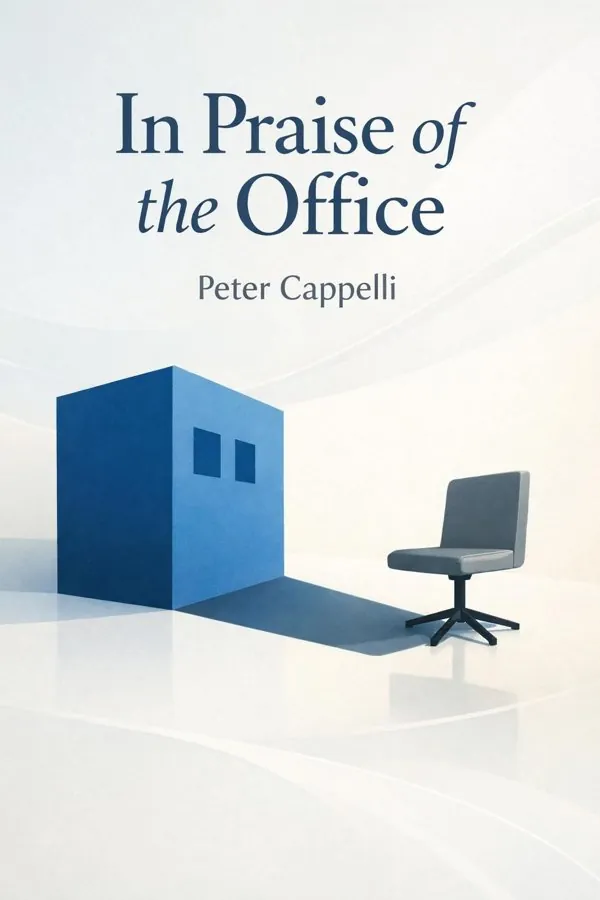
In Praise of the Office: Rebuilding the Workplace After the Pandemic: Summary & Key Insights
 10 min11 chaptersAudio available
What Is In Praise of the Office: Rebuilding the Workplace After the Pandemic About?
In Praise of the Office: Rebuilding the Workplace After the Pandemic by Peter Cappelli is a organization book spanning 11 pages. In this book, management scholar Peter Cappelli examines the post-pandemic debate over remote work and the future of the office. Drawing on research in organizational behavior and labor economics, Cappelli argues that the physical office remains essential for collaboration, innovation, and career development. He explores how companies can redesign office spaces and policies to balance flexibility with productivity, and how leaders can rebuild workplace culture in a hybrid world.
This FizzRead summary covers all 11 key chapters of In Praise of the Office: Rebuilding the Workplace After the Pandemic in approximately 10 minutes, distilling the most important ideas, arguments, and takeaways from Peter Cappelli's work. Also available as an audio summary and Key Quotes Podcast.
In Praise of the Office: Rebuilding the Workplace After the Pandemic
In this book, management scholar Peter Cappelli examines the post-pandemic debate over remote work and the future of the office. Drawing on research in organizational behavior and labor economics, Cappelli argues that the physical office remains essential for collaboration, innovation, and career development. He explores how companies can redesign office spaces and policies to balance flexibility with productivity, and how leaders can rebuild workplace culture in a hybrid world.
Who Should Read In Praise of the Office: Rebuilding the Workplace After the Pandemic?
This book is perfect for anyone interested in organization and looking to gain actionable insights in a short read. Whether you're a student, professional, or lifelong learner, the key ideas from In Praise of the Office: Rebuilding the Workplace After the Pandemic by Peter Cappelli will help you think differently.
- ✓Readers who enjoy organization and want practical takeaways
- ✓Professionals looking to apply new ideas to their work and life
- ✓Anyone who wants the core insights of In Praise of the Office: Rebuilding the Workplace After the Pandemic in just 10 minutes
Want the full summary?
Get instant access to this book summary and 100K+ more with Fizz Moment.
Get Free SummaryAvailable on App Store • Free to download
Key Chapters
Before the pandemic, the office had already been changing. The open-plan revolution promised transparency and efficiency, yet gradually revealed flaws—noise, distraction, a sense of surveillance. Flexibility entered the vocabulary of workplace design as businesses sought to attract talent through freedom of space and schedule. The office became less about personal territory and more about shared energy: co-working spaces erupted; coffee bars became the new meeting rooms.
In tracing this history, I examine how the physical layout of work both mirrored and shaped managerial philosophies. Frederick Taylor’s scientific management bred assembly-line offices; later, the cubicle era reflected hierarchies and control; the open plan symbolized collaboration and equality but often undermined both. What emerged was an uneasy balance—between the corporate desire for efficiency and the human need for autonomy, connection, and focus.
As I built on decades of workplace data, I saw a pattern: each shift in office design corresponded to technological and cultural changes. The digital age dissolved boundaries, pushing work beyond walls. Yet even in this pre-pandemic mobility, the office continued to function as an anchor. Employees still sought the clarity and bonding that physical proximity affords. It was never the desk that mattered but the density of interaction—the spontaneous conversation that refines an idea or builds trust between colleagues. That invisible architecture is what the pandemic would soon put to the test.
The pandemic disruption: The rapid shift to remote work and its short-term successes and challenges
No management revolution has ever unfolded as abruptly as the global pivot to remote work in 2020. In days, organizations dismantled centuries of habits, shifting millions of employees from offices to homes. The results startled many executives: productivity held steady, costs fell, and employees cherished the newfound autonomy. It seemed a vindication of technology’s promise—that work was finally liberated from physical constraints.
But beneath those early triumphs lay subtler patterns. Social ties weakened, onboarding faltered, and innovation slowed. My analysis of survey data and corporate experiences revealed that while remote work thrived for routine tasks and well-defined roles, it struggled with those demanding creativity, coordination, or mentorship. Leaders found themselves managing not through presence but through data and digital visibility, eroding the nuanced judgment that in-person interaction supports.
Psychologically, the home became both sanctuary and prison. Meetings multiplied, boundaries blurred, and the fatigue of constant connectivity took root. Employees often reported feeling more productive but less connected—a paradox of efficiency without vitality. In studying these dynamics, I could see the outlines of a larger truth: technology expands what is possible, but the human element—serendipity, trust, empathy—still thrives best in shared spaces. The real challenge was not remote work itself but the absence of deliberate social architecture to replace what the office once naturally provided.
+ 9 more chapters — available in the FizzRead app
All Chapters in In Praise of the Office: Rebuilding the Workplace After the Pandemic
About the Author
Peter Cappelli is the George W. Taylor Professor of Management at the Wharton School of the University of Pennsylvania and director of Wharton’s Center for Human Resources. He is a leading expert on workforce management, labor markets, and organizational behavior, and has authored several influential books on employment and talent strategy.
Get This Summary in Your Preferred Format
Read or listen to the In Praise of the Office: Rebuilding the Workplace After the Pandemic summary by Peter Cappelli anytime, anywhere. FizzRead offers multiple formats so you can learn on your terms — all free.
Available formats: App · Audio · PDF · EPUB — All included free with FizzRead
Download In Praise of the Office: Rebuilding the Workplace After the Pandemic PDF and EPUB Summary
Key Quotes from In Praise of the Office: Rebuilding the Workplace After the Pandemic
“Before the pandemic, the office had already been changing.”
“No management revolution has ever unfolded as abruptly as the global pivot to remote work in 2020.”
Frequently Asked Questions about In Praise of the Office: Rebuilding the Workplace After the Pandemic
In Praise of the Office: Rebuilding the Workplace After the Pandemic by Peter Cappelli is a organization book that explores key ideas across 11 chapters. In this book, management scholar Peter Cappelli examines the post-pandemic debate over remote work and the future of the office. Drawing on research in organizational behavior and labor economics, Cappelli argues that the physical office remains essential for collaboration, innovation, and career development. He explores how companies can redesign office spaces and policies to balance flexibility with productivity, and how leaders can rebuild workplace culture in a hybrid world.
More by Peter Cappelli

You Might Also Like
A Guide to the Project Management Body of Knowledge (PMBOK® Guide)
Project Management Institute
10 min
Organizational Behavior
Stephen P. Robbins
10 min
Accelerate: The Science of Lean Software and DevOps – Building and Scaling High Performing Technology Organizations
Nicole Forsgren, Jez Humble, Gene Kim
10 min
Awakening Compassion at Work: The Quiet Power That Elevates People and Organizations
Monica C. Worline, Jane E. Dutton
10 min
Building an Inclusive Organization: Leveraging the Power of a Diverse Workforce
Stephen Frost
10 min
Collaborative Intelligence: Thinking with People Who Think Differently
Dawna Markova, Angie McArthur
10 minBrowse by Category
Ready to read In Praise of the Office: Rebuilding the Workplace After the Pandemic?
Get the full summary and 100K+ more books with Fizz Moment.