
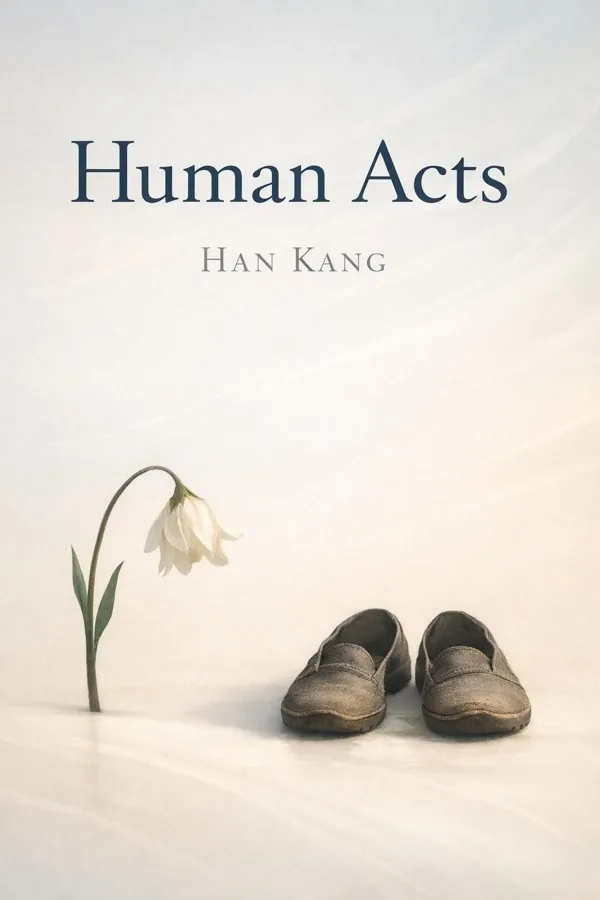
Human Acts: Summary & Key Insights
by Han Kang
 10 min9 chaptersAudio available
Key Takeaways from Human Acts
History often becomes most unbearable when it is reduced to numbers; Human Acts restores the faces, names, and textures that statistics erase.
One of the novel’s most startling insights is that the dead are not silent simply because institutions want them to disappear.
Grief is often described as a process, but Human Acts suggests that after atrocity it becomes a permanent atmosphere.
A massacre does not end when gunfire stops; it continues whenever power controls what can be said about it.
Trauma is not only remembered; it is carried.
What Is Human Acts About?
Human Acts by Han Kang is a classics book spanning 8 pages. What remains of a person after violence has stripped away safety, certainty, and even the right to be mourned? In Human Acts, Han Kang answers that question through a haunting, polyphonic novel set around the 1980 Gwangju Uprising in South Korea, when citizens protesting military rule were brutally suppressed by the state. Rather than recounting history from a distance, Kang enters the lives of ordinary people: a schoolboy searching for a missing friend, grieving families, prisoners, workers, editors, and finally a writer trying to face the past without betraying it. The result is both a historical novel and a moral inquiry into memory, dignity, and survival. Human Acts matters because it refuses to let atrocity become abstraction. It shows how political violence invades bodies, language, relationships, and decades of private life. Han Kang, one of South Korea’s most celebrated contemporary writers, is uniquely suited to this task. Known for her lyrical intensity and philosophical depth, she transforms a national trauma into a universal meditation on what human beings do to one another—and how, against all odds, compassion endures.
This FizzRead summary covers all 9 key chapters of Human Acts in approximately 10 minutes, distilling the most important ideas, arguments, and takeaways from Han Kang's work. Also available as an audio summary and Key Quotes Podcast.
Human Acts
What remains of a person after violence has stripped away safety, certainty, and even the right to be mourned? In Human Acts, Han Kang answers that question through a haunting, polyphonic novel set around the 1980 Gwangju Uprising in South Korea, when citizens protesting military rule were brutally suppressed by the state. Rather than recounting history from a distance, Kang enters the lives of ordinary people: a schoolboy searching for a missing friend, grieving families, prisoners, workers, editors, and finally a writer trying to face the past without betraying it. The result is both a historical novel and a moral inquiry into memory, dignity, and survival. Human Acts matters because it refuses to let atrocity become abstraction. It shows how political violence invades bodies, language, relationships, and decades of private life. Han Kang, one of South Korea’s most celebrated contemporary writers, is uniquely suited to this task. Known for her lyrical intensity and philosophical depth, she transforms a national trauma into a universal meditation on what human beings do to one another—and how, against all odds, compassion endures.
Who Should Read Human Acts?
This book is perfect for anyone interested in classics and looking to gain actionable insights in a short read. Whether you're a student, professional, or lifelong learner, the key ideas from Human Acts by Han Kang will help you think differently.
- ✓Readers who enjoy classics and want practical takeaways
- ✓Professionals looking to apply new ideas to their work and life
- ✓Anyone who wants the core insights of Human Acts in just 10 minutes
Want the full summary?
Get instant access to this book summary and 100K+ more with Fizz Moment.
Get Free SummaryAvailable on App Store • Free to download
Key Chapters
History often becomes most unbearable when it is reduced to numbers; Human Acts restores the faces, names, and textures that statistics erase. The novel opens in Gwangju in May 1980, where twelve-year-old Dong-ho searches for his missing friend Jeong-dae among rows of corpses gathered in a gymnasium. This setting is not merely a backdrop of warlike chaos. It is a moral testing ground where the living are forced into impossible intimacy with death. Dong-ho’s search captures a child’s bewildered attempt to make sense of state violence that has shattered the ordinary logic of the world.
Han Kang describes this scene with restraint rather than sensationalism. Bodies must be identified, washed, moved, and watched over. Volunteers try to preserve dignity even when institutions have collapsed. The emotional force comes from the contrast between routine acts of care and the scale of destruction around them. In this way, the novel shows that cruelty is often organized and systematic, while compassion appears in fragile, improvised gestures.
For readers, Dong-ho’s chapter offers a practical way to think about historical trauma: begin with the individual. Instead of asking only what happened politically, ask what it meant for one boy to walk among the dead, for one family to wait, for one community to hold itself together when power turns murderous. This lens changes how we read history, news, and even local tragedies today.
Actionable takeaway: when confronting a large-scale injustice, resist abstraction by focusing on one human story and asking what dignity required in that moment.
One of the novel’s most startling insights is that the dead are not silent simply because institutions want them to disappear. In the second major movement of Human Acts, Jeong-dae, Dong-ho’s missing friend, speaks from beyond death. His perspective hovers near his own corpse and observes the treatment of the bodies around him. This supernatural narrative choice is not a fantasy detour; it is Han Kang’s way of restoring voice to those whom political violence tries to erase twice, first through killing and then through denial.
Jeong-dae’s posthumous narration expands the novel’s moral universe. The dead are no longer passive victims in a historical record. They become witnesses to what the living do next: whether they honor, abandon, misname, or conceal the truth. This chapter also deepens the theme of bodily dignity. Even after life has ended, the body matters. The state may treat corpses as evidence to suppress or dispose of, but the novel insists that the dead remain bound to the living through memory, grief, and accountability.
In practical terms, this section helps us think about memorial culture today. Mass death, whether from war, dictatorship, or disaster, is always followed by a struggle over narrative. Who gets counted? Who gets named? Who gets forgotten? Communities, journalists, and families perform an essential ethical task when they preserve records, testimonies, and burial practices.
Actionable takeaway: honor the dead by supporting truthful remembrance—learn names, preserve stories, and resist narratives that make victims disappear into anonymous history.
Grief is often described as a process, but Human Acts suggests that after atrocity it becomes a permanent atmosphere. In the section centered on Dong-ho’s mother, Han Kang shifts from public catastrophe to intimate aftermath. The uprising may have ended in a formal sense, but mourning does not obey political timelines. A parent who loses a child to state violence must keep living inside a world that continues as if the unbearable were over. That contrast is one of the novel’s deepest wounds.
This chapter reveals how trauma inhabits ordinary time. A mother cooks, cleans, remembers, and endures, while absence settles into every routine. The state may seek closure, but the family experiences repetition: each object, room, and season returns the lost person to consciousness. Han Kang does not sentimentalize this sorrow. Instead, she shows grief as physical, ethical, and social. It changes how a person moves through the world and how a community speaks—or refuses to speak—about what happened.
The broader insight is that violence radiates outward through family systems. A killing does not end with the victim; it transforms parents, siblings, spouses, and neighbors. This is useful when we think about trauma-informed care, transitional justice, and memorialization. Any serious response to historical harm must consider bereaved families, not only official records or public ceremonies.
In everyday life, this chapter encourages a more patient understanding of mourning. People touched by political violence, suicide, accidents, or sudden loss often do not need solutions. They need acknowledgment that grief can remain active for years.
Actionable takeaway: do not rush someone toward closure; offer remembrance, presence, and the freedom to speak of the dead without apology.
A massacre does not end when gunfire stops; it continues whenever power controls what can be said about it. Human Acts explores censorship not as a secondary issue but as a continuation of violence by other means. In the aftermath of Gwangju, survivors and witnesses must navigate a world where truth is monitored, edited, denied, or punished. This is especially visible in the chapters involving publishing and the circulation of testimony, where language itself becomes a contested territory.
Han Kang shows that censorship harms on multiple levels. Politically, it protects perpetrators and stabilizes official lies. Socially, it isolates survivors by making their experiences unspeakable in public. Psychologically, it fractures memory, because people begin to doubt their right to what they know. The result is a society where silence is not peace but coercion. Words are not merely descriptive here; they are instruments of recognition. To forbid testimony is to deny reality.
This idea applies far beyond the historical context of South Korea. We see similar dynamics whenever governments suppress archives, intimidate journalists, rewrite textbooks, or punish dissenting speech. On a smaller scale, families and workplaces can also practice censorship by discouraging uncomfortable truths. The lesson is that suppression rarely neutralizes trauma. It drives it inward, where it becomes shame, fear, and inherited silence.
Readers can use this insight by paying closer attention to who controls public memory. Seek out primary testimonies, independent journalism, and the voices of those most directly affected. Truth often survives first in marginal spaces before it enters the mainstream.
Actionable takeaway: treat the defense of truthful speech as an ethical duty, especially when institutions would prefer amnesia.
Trauma is not only remembered; it is carried. One of Human Acts’ most powerful threads concerns imprisonment, torture, and the survivor whose body becomes an archive of state brutality. Han Kang refuses to separate politics from flesh. Scars, pain, sexual humiliation, and bodily fear are not incidental details. They are how power inscribes itself onto a human being. In this sense, the novel argues that the body often preserves what language cannot yet fully tell.
The prisoner’s testimony reveals the afterlife of violence in sensory form. A sound triggers panic. A confined space reactivates terror. Physical injury remains long after official denials and public routines resume. This matters because trauma is frequently misunderstood as something one should simply "get over" once external danger has passed. Human Acts insists otherwise. Survival may be ongoing, but it is never simple. To have lived through torture or arbitrary detention is to inhabit a changed relationship to one’s own body.
This insight has practical relevance in how we listen to survivors. Testimony may arrive fragmented, repetitive, or physically charged. That does not make it less credible; it may reflect the nature of traumatic memory itself. The novel also invites a broader compassion toward those who seem distant, irritable, numb, or overwhelmed. Such behaviors can be adaptations to pain rather than character flaws.
In personal and social contexts, this chapter encourages trauma-informed listening. Rather than demanding neat narratives, we can make room for pauses, contradictions, and bodily distress. Healing begins not with perfect articulation but with safety and recognition.
Actionable takeaway: when someone speaks from trauma, listen for what the body is expressing as carefully as you listen to the words.
We often assume survival is a straightforward blessing, but Human Acts exposes its darker companion: survivor’s guilt. Through the perspective of a factory worker and others who live on after Gwangju, Han Kang explores how remaining alive can become emotionally unbearable when others, often younger or more innocent, were killed. The question shifts from "How did I survive?" to "Why was it me?" and even "What do I owe the dead now?"
This guilt is not abstract. It shapes work, relationships, sexuality, sleep, and self-worth. Survivors may feel disqualified from ordinary happiness, as though joy betrays the dead. They may replay moments of escape or indecision, imagining alternative outcomes that could have saved someone else. Han Kang treats these spirals with seriousness and compassion. She shows that guilt is often the mind’s attempt to impose order on senseless brutality. If one could have acted differently, then perhaps the world is still morally legible. But atrocities often deny that comfort.
This idea has wide applicability for anyone who has outlived peers, endured disaster, or come through family trauma. It suggests that guilt should not be accepted as proof of responsibility. Instead, it can be transformed into remembrance, solidarity, and ethical action. The dead are not honored by a survivor’s self-destruction. They are honored when the survivor continues to live attentively, truthfully, and in connection with others.
In practical terms, this means recognizing guilt without obeying it. Therapy, testimony, community rituals, and artistic expression can help turn private torment into shared meaning.
Actionable takeaway: if you carry survivor’s guilt, ask not "Why did I live?" but "How can I live in a way that remembers well?"
Some events seem to exceed language, yet silence can become another form of betrayal. In the writer’s return to Gwangju, Human Acts confronts the limits of representation directly. Han Kang places the act of writing under ethical scrutiny: how can one describe torture, mass death, and collective grief without exploiting suffering or reducing it to artful effect? This self-questioning gives the novel much of its force. It does not pretend that language can fully contain trauma. Instead, it asks what responsible witnessing through language might look like.
The writer’s struggle is central because it mirrors the reader’s own dilemma. We want understanding, but understanding can become consumption if approached carelessly. Kang addresses this by using fractured structure, shifting perspectives, and lyrical restraint. These choices acknowledge incompleteness. The novel circles pain rather than mastering it. That method is itself a moral statement: some truths must be approached with humility.
This has practical implications for anyone who tells difficult stories—writers, journalists, teachers, historians, documentary makers, and even family members preserving painful memory. Accuracy matters, but so do tone, motive, and power. Are we speaking to illuminate the humanity of others, or to display our own sensitivity? Are we making room for complexity, or flattening pain into message?
In daily life, this chapter encourages a more ethical use of language around suffering. We can avoid sensational detail, respect the dignity of those harmed, and admit the limits of our knowledge while still refusing erasure. Imperfect witness is often better than polished silence.
Actionable takeaway: speak carefully about suffering, but do speak—humble language can protect memory better than eloquent avoidance.
Not all wounds announce themselves loudly; some endure as quiet, permanent absences that shape everything around them. In the closing movements of Human Acts, Han Kang returns to the persistence of loss across decades. The dead remain present not because grief refuses reality, but because violence alters the living world so completely that the missing continue to inhabit it. Empty places at tables, interrupted futures, and recurring memories become part of the social fabric.
The novel’s final effect is not closure but a more durable form of attention. Han Kang suggests that humanity survives not in triumphant recovery narratives but in the refusal to treat the lost as past tense. This is where the book’s title becomes especially resonant. "Human acts" includes cruelty, torture, and murder—but it also includes washing bodies, preserving names, listening to testimony, and carrying memory forward. The same species capable of atrocity is also capable of reverence.
This idea helps readers resist the modern appetite for neat endings. Historical trauma rarely resolves; it is integrated, contested, inherited, and revisited. Families transmit silence or testimony. Societies build monuments or suppress archives. Individuals learn how to live with ghosts, not without them. That does not mean hope is absent. It means hope must be honest.
In practical terms, this chapter invites us to think about remembrance as a practice rather than an anniversary event. Reading histories, supporting memorial institutions, asking elders about difficult pasts, and naming losses in community life are all ways to make absence meaningful rather than erased.
Actionable takeaway: create deliberate rituals of remembrance so that loss becomes a source of moral clarity rather than cultural forgetting.
When institutions become murderous, the smallest acts of care can carry immense moral weight. Across Human Acts, Han Kang repeatedly returns to gestures that might seem minor beside the scale of political violence: covering a body, sharing food, keeping vigil, listening without interruption, preserving a scrap of testimony. These acts do not undo atrocity, yet the novel presents them as forms of resistance because they reject the logic of dehumanization.
This is one of the book’s most valuable insights. We often imagine resistance only in dramatic or public terms, but Human Acts broadens the category. To insist that a corpse deserves respect, that a prisoner’s pain deserves language, or that a bereaved mother deserves to remember openly is to oppose a regime built on disposability. Compassion here is not softness. It is moral endurance.
The practical application is significant. Many readers will never face the exact historical circumstances of Gwangju, but everyone encounters environments where people are pressured into indifference. Bureaucracies reduce people to cases. Online discourse flattens suffering into content. Fast news cycles replace one tragedy with the next. Han Kang’s novel teaches a counter-practice: slow down, look closely, and respond concretely to human vulnerability.
Compassion also requires discipline. It means avoiding voyeurism, refusing cynicism, and staying present when pain is inconvenient. In this sense, the novel offers an ethics of attention. To care faithfully, even in small ways, is to keep humanity from being entirely captured by violence.
Actionable takeaway: practice resistance through concrete care—attend, listen, remember, and protect the dignity of people who are at risk of being overlooked.
All Chapters in Human Acts
About the Author
Han Kang, born in 1970 in Gwangju, South Korea, is a major contemporary novelist known for her lyrical prose, emotional intensity, and philosophical exploration of violence, memory, and the body. She studied Korean literature and began her literary career as a poet before turning to fiction, where she developed a distinctive voice marked by precision, restraint, and moral seriousness. She gained international recognition with The Vegetarian, which won the Man Booker International Prize and introduced global readers to her work. Other notable books include Human Acts, The White Book, and Greek Lessons. Han Kang’s fiction often engages with historical trauma and the hidden fractures beneath ordinary life. In Human Acts, her connection to the history of Gwangju and her sensitivity to questions of witness and dignity make her an especially powerful guide to this painful subject.
Get This Summary in Your Preferred Format
Read or listen to the Human Acts summary by Han Kang anytime, anywhere. FizzRead offers multiple formats so you can learn on your terms — all free.
Available formats: App · Audio · PDF · EPUB — All included free with FizzRead
Download Human Acts PDF and EPUB Summary
Key Quotes from Human Acts
“History often becomes most unbearable when it is reduced to numbers; Human Acts restores the faces, names, and textures that statistics erase.”
“One of the novel’s most startling insights is that the dead are not silent simply because institutions want them to disappear.”
“Grief is often described as a process, but Human Acts suggests that after atrocity it becomes a permanent atmosphere.”
“A massacre does not end when gunfire stops; it continues whenever power controls what can be said about it.”
“Trauma is not only remembered; it is carried.”
Frequently Asked Questions about Human Acts
Human Acts by Han Kang is a classics book that explores key ideas across 9 chapters. What remains of a person after violence has stripped away safety, certainty, and even the right to be mourned? In Human Acts, Han Kang answers that question through a haunting, polyphonic novel set around the 1980 Gwangju Uprising in South Korea, when citizens protesting military rule were brutally suppressed by the state. Rather than recounting history from a distance, Kang enters the lives of ordinary people: a schoolboy searching for a missing friend, grieving families, prisoners, workers, editors, and finally a writer trying to face the past without betraying it. The result is both a historical novel and a moral inquiry into memory, dignity, and survival. Human Acts matters because it refuses to let atrocity become abstraction. It shows how political violence invades bodies, language, relationships, and decades of private life. Han Kang, one of South Korea’s most celebrated contemporary writers, is uniquely suited to this task. Known for her lyrical intensity and philosophical depth, she transforms a national trauma into a universal meditation on what human beings do to one another—and how, against all odds, compassion endures.
You Might Also Like



Browse by Category
Ready to read Human Acts?
Get the full summary and 100K+ more books with Fizz Moment.