
Han Kang Books
Han Kang (born 1970) is a South Korean novelist best known internationally for 'The Vegetarian', which won the Man Booker International Prize. Her works are noted for their lyrical prose and philosophical depth, often exploring themes of violence, memory, and the human condition.
Known for: Human Acts
Books by Han Kang
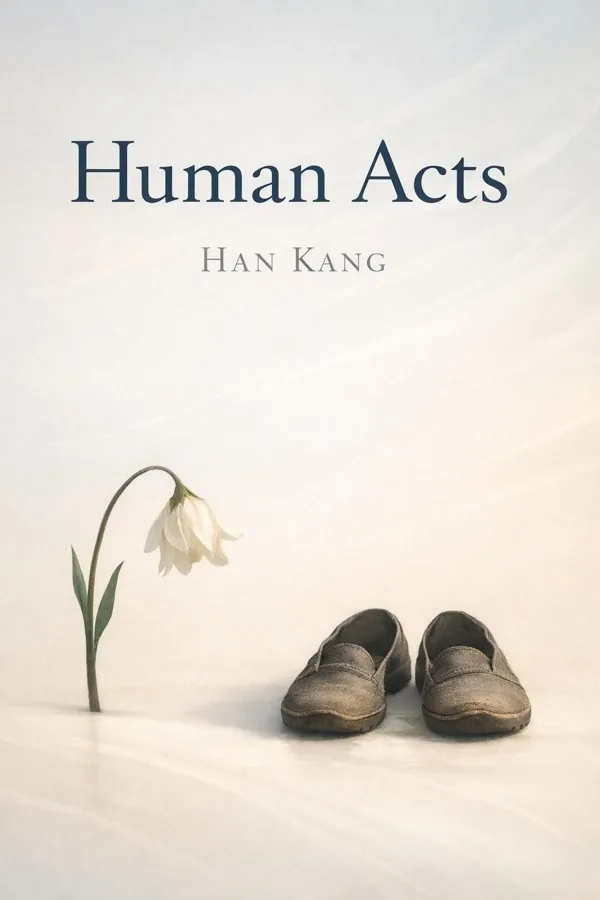
Human Acts
What remains of a person after violence has stripped away safety, certainty, and even the right to be mourned? In Human Acts, Han Kang answers that question through a haunting, polyphonic novel set around the 1980 Gwangju Uprising in South Korea, when citizens protesting military rule were brutally suppressed by the state. Rather than recounting history from a distance, Kang enters the lives of ordinary people: a schoolboy searching for a missing friend, grieving families, prisoners, workers, editors, and finally a writer trying to face the past without betraying it. The result is both a historical novel and a moral inquiry into memory, dignity, and survival. Human Acts matters because it refuses to let atrocity become abstraction. It shows how political violence invades bodies, language, relationships, and decades of private life. Han Kang, one of South Korea’s most celebrated contemporary writers, is uniquely suited to this task. Known for her lyrical intensity and philosophical depth, she transforms a national trauma into a universal meditation on what human beings do to one another—and how, against all odds, compassion endures.
Read SummaryKey Insights from Han Kang
Searching for the Dead in Gwangju
History often becomes most unbearable when it is reduced to numbers; Human Acts restores the faces, names, and textures that statistics erase. The novel opens in Gwangju in May 1980, where twelve-year-old Dong-ho searches for his missing friend Jeong-dae among rows of corpses gathered in a gymnasium...
From Human Acts
The Dead Still Demand Witness
One of the novel’s most startling insights is that the dead are not silent simply because institutions want them to disappear. In the second major movement of Human Acts, Jeong-dae, Dong-ho’s missing friend, speaks from beyond death. His perspective hovers near his own corpse and observes the treatm...
From Human Acts
A Mother’s Grief Has No Ending
Grief is often described as a process, but Human Acts suggests that after atrocity it becomes a permanent atmosphere. In the section centered on Dong-ho’s mother, Han Kang shifts from public catastrophe to intimate aftermath. The uprising may have ended in a formal sense, but mourning does not obey ...
From Human Acts
Censorship Extends Violence Beyond the Event
A massacre does not end when gunfire stops; it continues whenever power controls what can be said about it. Human Acts explores censorship not as a secondary issue but as a continuation of violence by other means. In the aftermath of Gwangju, survivors and witnesses must navigate a world where truth...
From Human Acts
The Body Records What Language Cannot
Trauma is not only remembered; it is carried. One of Human Acts’ most powerful threads concerns imprisonment, torture, and the survivor whose body becomes an archive of state brutality. Han Kang refuses to separate politics from flesh. Scars, pain, sexual humiliation, and bodily fear are not inciden...
From Human Acts
Survival Can Feel Like a Burden
We often assume survival is a straightforward blessing, but Human Acts exposes its darker companion: survivor’s guilt. Through the perspective of a factory worker and others who live on after Gwangju, Han Kang explores how remaining alive can become emotionally unbearable when others, often younger ...
From Human Acts
About Han Kang
Han Kang (born 1970) is a South Korean novelist best known internationally for 'The Vegetarian', which won the Man Booker International Prize. Her works are noted for their lyrical prose and philosophical depth, often exploring themes of violence, memory, and the human condition.




Frequently Asked Questions
Han Kang (born 1970) is a South Korean novelist best known internationally for 'The Vegetarian', which won the Man Booker International Prize. Her works are noted for their lyrical prose and philosophical depth, often exploring themes of violence, memory, and the human condition.
Read Han Kang's books in 15 minutes
Get AI-powered summaries with key insights from 1 book by Han Kang.