
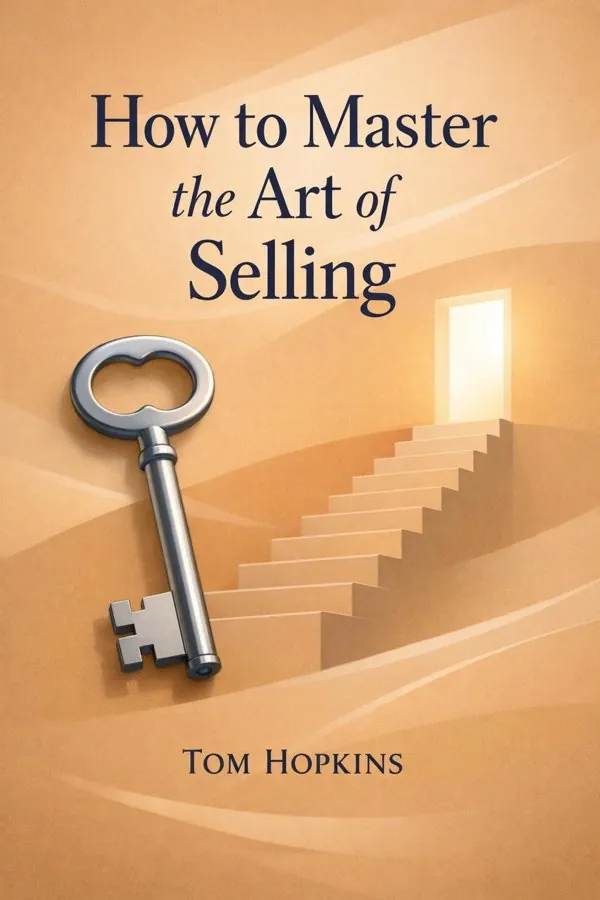
How to Master the Art of Selling: Summary & Key Insights
by Tom Hopkins
 10 min10 chaptersAudio available
Key Takeaways from How to Master the Art of Selling
Every sale is decided emotionally before it is justified logically.
Your sales results rarely rise above the level of your self-image.
Most sales problems begin long before the presentation; they begin with an empty pipeline.
A great presentation does not impress people by saying more; it persuades by saying what matters most.
Objections are not proof that a sale is failing; they are often proof that a buyer is thinking seriously.
What Is How to Master the Art of Selling About?
How to Master the Art of Selling by Tom Hopkins is a marketing book spanning 10 pages. How to Master the Art of Selling is a practical, motivational, and highly structured guide to becoming a more effective sales professional. In this classic sales manual, Tom Hopkins argues that great selling is not a mysterious talent reserved for a gifted few. It is a learnable discipline built on attitude, preparation, communication, persistence, and service. The book walks readers through the full sales process, from prospecting and first impressions to presentations, objection handling, closing, follow-up, and long-term relationship building. What makes the book enduringly valuable is its balance between psychology and technique. Hopkins does not treat selling as manipulation. Instead, he frames it as the skilled process of understanding people, solving problems, and helping buyers make confident decisions. His advice is concrete, repeatable, and rooted in real-world experience. Tom Hopkins is one of the most influential sales trainers of the modern era, having educated millions of salespeople through books, seminars, and training programs. His authority comes not only from teaching sales, but from mastering it himself. This book remains relevant because the core principles of trust, communication, and disciplined follow-through never go out of date.
This FizzRead summary covers all 10 key chapters of How to Master the Art of Selling in approximately 10 minutes, distilling the most important ideas, arguments, and takeaways from Tom Hopkins's work. Also available as an audio summary and Key Quotes Podcast.
How to Master the Art of Selling
How to Master the Art of Selling is a practical, motivational, and highly structured guide to becoming a more effective sales professional. In this classic sales manual, Tom Hopkins argues that great selling is not a mysterious talent reserved for a gifted few. It is a learnable discipline built on attitude, preparation, communication, persistence, and service. The book walks readers through the full sales process, from prospecting and first impressions to presentations, objection handling, closing, follow-up, and long-term relationship building.
What makes the book enduringly valuable is its balance between psychology and technique. Hopkins does not treat selling as manipulation. Instead, he frames it as the skilled process of understanding people, solving problems, and helping buyers make confident decisions. His advice is concrete, repeatable, and rooted in real-world experience.
Tom Hopkins is one of the most influential sales trainers of the modern era, having educated millions of salespeople through books, seminars, and training programs. His authority comes not only from teaching sales, but from mastering it himself. This book remains relevant because the core principles of trust, communication, and disciplined follow-through never go out of date.
Who Should Read How to Master the Art of Selling?
This book is perfect for anyone interested in marketing and looking to gain actionable insights in a short read. Whether you're a student, professional, or lifelong learner, the key ideas from How to Master the Art of Selling by Tom Hopkins will help you think differently.
- ✓Readers who enjoy marketing and want practical takeaways
- ✓Professionals looking to apply new ideas to their work and life
- ✓Anyone who wants the core insights of How to Master the Art of Selling in just 10 minutes
Want the full summary?
Get instant access to this book summary and 100K+ more with Fizz Moment.
Get Free SummaryAvailable on App Store • Free to download
Key Chapters
Every sale is decided emotionally before it is justified logically. That insight sits at the heart of Hopkins’s approach. Buyers rarely make decisions based on facts alone. They are influenced by fear, hope, pride, comfort, status, convenience, and trust. A salesperson who only recites features misses the real reasons people buy.
Hopkins emphasizes that selling begins with observation and empathy. You must learn to read verbal and nonverbal signals, ask thoughtful questions, and understand what matters most to the other person. One customer may care about price because security matters to them. Another may care more about quality because they fear making a poor decision. A third may need social proof before feeling comfortable moving forward. The same product should be presented differently depending on the buyer’s priorities.
This psychological awareness also helps you avoid resistance. When people feel pressured, they protect themselves. When they feel understood, they open up. For example, instead of pushing a product immediately, a skilled salesperson might ask, “What would an ideal solution look like for you?” That question shifts the interaction from persuasion to discovery.
Hopkins teaches that effective selling is not about overpowering objections but uncovering motivation. The better you understand why someone buys, delays, hesitates, or says no, the better you can serve them. Facts support a sale, but feelings drive it.
Actionable takeaway: In your next three sales conversations, spend more time asking diagnostic questions than presenting benefits, and identify the buyer’s top emotional motivation before offering a solution.
Your sales results rarely rise above the level of your self-image. Hopkins repeatedly stresses that skill matters, but attitude determines whether those skills are used consistently and confidently. Salespeople face rejection, uncertainty, and pressure more often than many other professionals. Without a strong mental foundation, even talented people can underperform.
Hopkins argues that a positive attitude is not naive optimism. It is disciplined emotional management. It means choosing productive beliefs, preparing mentally for setbacks, and refusing to let one failed interaction poison the next opportunity. A salesperson who sees rejection as personal becomes timid. A salesperson who sees it as part of the profession stays active and resilient.
Self-image is equally important. If you secretly believe you are bothersome, unqualified, or unworthy of success, your words and body language will reveal it. But if you view yourself as a professional problem-solver who brings value, your tone changes. You speak more clearly, listen more attentively, and ask for commitment more naturally.
Hopkins encourages routines that strengthen confidence: setting goals, using affirmations, reviewing wins, studying successful presentations, and maintaining professional appearance and habits. These are not superficial rituals. They create identity, and identity shapes behavior.
A practical example is the salesperson who begins each day reviewing targets, rehearsing common objections, and visualizing successful calls. That person enters the day prepared rather than reactive. Over time, consistency compounds into stronger performance.
Actionable takeaway: Create a five-minute pre-sales routine that includes one goal, one confidence statement, and one quick rehearsal of your opening so you begin each interaction with intention.
Most sales problems begin long before the presentation; they begin with an empty pipeline. Hopkins treats prospecting as the true foundation of a successful sales career because no closing technique can compensate for a lack of qualified opportunities. Salespeople often avoid prospecting because it feels tedious or uncomfortable, yet the professionals who master it enjoy steadier income and less emotional volatility.
The key is to approach prospecting systematically rather than sporadically. Hopkins recommends making it a daily habit, not an emergency response when business slows down. Leads can come from referrals, cold outreach, networking, repeat customers, community involvement, and follow-up from prior conversations. The source matters less than consistency.
He also emphasizes qualification. Not every prospect is worth equal time. Strong prospects typically have a genuine need, the authority to decide, the financial ability to buy, and a realistic timeline. By screening early, you protect your energy and improve conversion rates.
For example, a real estate agent might ask early questions about budget, location, and purchase timing before scheduling multiple showings. A B2B salesperson might clarify decision makers, current vendor pain points, and implementation urgency before building a proposal. Prospecting is not only about finding names; it is about finding fit.
Hopkins’s broader message is that prospecting reduces fear because activity creates momentum. When you have many opportunities in motion, you become less desperate in any one conversation. That confidence improves performance at every stage.
Actionable takeaway: Set a nonnegotiable daily prospecting target, such as five new outreach attempts or two referral requests, and track it for 30 days without exception.
A great presentation does not impress people by saying more; it persuades by saying what matters most. Hopkins teaches that effective presentations are structured around the prospect’s needs, not the salesperson’s enthusiasm. Too many salespeople rush into features, hoping information alone will carry the sale. But people pay attention when they see themselves in the message.
The first principle is preparation. Before presenting, you should understand the buyer’s priorities, concerns, and desired outcomes. The second principle is simplicity. A presentation should move clearly from need to solution to benefit. The third is engagement. Buyers should feel involved through questions, examples, demonstrations, and confirmation points.
Hopkins encourages salespeople to convert features into personal benefits. A feature is what something does. A benefit is why the buyer should care. For example, software with automated reporting is a feature. Saving a manager three hours a week and reducing errors is the benefit. A durable roof is a feature. Lower maintenance costs and peace of mind during storms are the benefits.
He also values storytelling because stories make benefits real. A brief account of how another customer solved a similar problem can build credibility more effectively than a list of claims. The best presentations are both logical and vivid.
Importantly, Hopkins advises reading reactions as you present. If the buyer seems confused, slow down. If they show enthusiasm about one point, explore it further. The presentation is not a speech; it is a guided conversation.
Actionable takeaway: Before your next presentation, list three customer problems, match each one to a relevant benefit, and include one short story or example that makes the solution tangible.
Objections are not proof that a sale is failing; they are often proof that a buyer is thinking seriously. Hopkins reframes objections as requests for reassurance. People hesitate because they fear making mistakes, wasting money, choosing poorly, or moving too quickly. A confident salesperson does not dread objections but welcomes them as openings to clarify value.
The first rule is to stay calm. Defensive reactions make buyers more skeptical. Hopkins advises listening fully, acknowledging the concern, and responding respectfully. Often the stated objection is not the real one. “It costs too much” may really mean “I don’t yet see enough value” or “I’m unsure this solves my problem.” This is why probing questions matter.
He recommends techniques such as feel-felt-found, clarifying questions, and reframing. For example: “I understand how you feel. Many clients felt the same way at first. What they found was that the higher upfront cost saved them money over time.” Used sincerely, such responses reduce friction without dismissing the buyer’s concern.
Preparation also plays a major role. The strongest salespeople identify common objections in advance and practice concise, truthful responses. If you frequently hear concerns about timing, price, trust, or complexity, you should be ready with evidence, examples, and simple explanations.
Handling objections well builds trust because it shows patience and competence. A buyer who feels heard is far more likely to continue the conversation. The goal is not to win an argument. It is to help the prospect resolve uncertainty.
Actionable takeaway: Write down your five most common objections, identify the fear behind each one, and prepare a calm, two-sentence response plus one follow-up question for each.
Closing should feel like the natural conclusion of a well-led conversation, not a dramatic last-minute trick. Hopkins is famous for teaching closing techniques, but his deeper message is that the close begins long before the final question. If you have built rapport, uncovered needs, presented relevant benefits, and addressed concerns, asking for the order becomes an act of service.
Many salespeople fail not because the prospect is unconvinced, but because they never clearly ask for commitment. They talk too much, hesitate, or leave the decision hanging in vague language. Hopkins insists that confidence matters here. If you believe your solution helps the buyer, then guiding them toward a decision is appropriate.
He outlines various closing methods, from assumptive closes to choice closes and summary closes. For example, after reviewing agreed-upon benefits, you might ask, “Would you prefer the standard plan or the premium option?” This narrows focus toward action. A summary close might revisit the buyer’s priorities and show how the solution meets each one before asking, “Shall we get started today?”
Still, Hopkins does not advocate pressure for its own sake. Closing must be ethical and timely. If a buyer still lacks understanding or trust, pushing harder usually backfires. The best close is earned through the quality of the conversation that came before it.
A strong close helps buyers move past indecision. People often appreciate being guided, especially when the cost of delay is real.
Actionable takeaway: In every sales conversation, decide in advance what commitment you will ask for, whether it is a purchase, appointment, trial, or follow-up meeting, and ask for it directly and confidently.
The sale is not the end of the process; it is the beginning of the customer relationship. Hopkins teaches that follow-up is one of the most neglected and profitable habits in selling. Many representatives work hard to win the order and then disappear, leaving customers to wonder whether the friendly attention was only an act. Consistent follow-up proves professionalism and builds long-term trust.
Effective follow-up serves several purposes. It reduces buyer’s remorse, confirms satisfaction, creates opportunities for referrals, encourages repeat business, and uncovers future needs. A simple call or message after the purchase can reassure the customer that they made the right decision and give them a chance to ask questions before minor concerns become major frustrations.
Hopkins sees customer care as a competitive advantage. In crowded markets, products are often similar. What distinguishes one salesperson is the quality of the relationship after the transaction. For example, an insurance agent who reviews coverage annually and checks in after life changes becomes an advisor, not just a policy seller. A consultant who follows up after implementation to ensure smooth adoption increases both loyalty and credibility.
Follow-up should be organized rather than random. Notes, reminders, calendars, and customer records help ensure no one is forgotten. The goal is to remain helpful without becoming intrusive. Value-based follow-up, such as sharing tips, updates, or relevant recommendations, is especially effective.
Customers remember how you make them feel after they have paid. That memory shapes renewals, referrals, and reputation.
Actionable takeaway: Build a simple follow-up schedule for every new customer, such as contact at 48 hours, 30 days, and 90 days, with each message focused on service rather than selling.
Sales success is often less about working harder than working deliberately. Hopkins argues that many salespeople stay busy but remain unproductive because they confuse motion with progress. Time management is therefore not an administrative skill on the side; it is a core sales discipline.
He encourages setting clear goals for income, activity, and results. Income goals provide direction, but activity goals create control. You cannot fully control how many people say yes, but you can control how many calls you make, appointments you set, proposals you send, or follow-ups you complete. By focusing on measurable actions, you create a repeatable path to performance.
Planning matters at multiple levels: yearly targets, monthly priorities, weekly scheduling, and daily execution. Hopkins recommends protecting high-value hours for prospecting, appointments, and client conversations instead of allowing the day to be consumed by low-return tasks. Administrative work has a place, but it should not dominate prime energy.
For instance, a salesperson might reserve the first two hours of each morning for outbound prospecting before checking email. Another might batch paperwork in the afternoon and use midday for client meetings. These choices prevent reactive behavior from dictating the entire day.
Goal setting also fuels motivation. Specific written targets create a sense of purpose and help you measure whether your habits align with your ambitions. Without goals, setbacks feel random. With goals, they become data.
Actionable takeaway: Define one monthly revenue goal and three daily activity metrics, then review them at the end of each week to see whether your calendar reflects your priorities.
Short-term persuasion can produce a transaction, but only integrity produces a career. Hopkins repeatedly emphasizes that the highest form of selling is service. This principle protects both the customer and the salesperson. When people feel manipulated, trust collapses. When they feel served, loyalty grows.
Ethical selling begins with honesty about the product, the fit, the timing, and the expected results. It means not exaggerating, hiding limitations, or pushing people into decisions that do not benefit them. Hopkins is clear that reputation is one of a salesperson’s greatest assets, and reputation is built one interaction at a time.
Service-first selling also changes your mindset. Instead of asking, “How can I make this person buy?” you ask, “What does this person truly need, and can I help?” That shift improves communication, reduces internal tension, and creates stronger customer relationships. In many cases, the ethical choice may be to recommend a smaller option, delay the sale, or even admit that your offering is not the best fit.
Paradoxically, this honesty often increases sales over time. Customers trust advisors who tell the truth, especially when the truth does not immediately benefit the seller. Referrals, repeat business, and long-term goodwill often come from moments where integrity was more visible than persuasion.
Hopkins does not see ethics as a constraint on success but as the foundation of sustainable success. Selling is most powerful when it improves the customer’s life while rewarding the seller fairly.
Actionable takeaway: Before making any recommendation, ask yourself one question: “Would I advise this choice if I were in the customer’s position?” If the answer is no, rethink the sale.
The best salespeople are not simply experienced; they are constantly improving. Hopkins presents mastery as an ongoing process of learning, reflection, and refinement. Markets change, buyers evolve, and even proven scripts lose power if they become stale or disconnected from reality. Success in sales belongs to those who keep sharpening their craft.
Continuous improvement begins with honest review. After meetings, calls, and presentations, strong professionals ask what worked, what failed, and what can be improved. They do not rely only on confidence or instinct. They study outcomes. If a certain opening consistently produces engagement, they strengthen it. If a certain objection repeatedly blocks progress, they train on it.
Hopkins also encourages ongoing education through reading, seminars, mentorship, observation, and role-play. Role-play, in particular, is valuable because it turns theory into muscle memory. A rehearsed response to a price objection will emerge more naturally under pressure than one merely understood in theory.
Long-term relationship building is part of this growth mindset. Every customer interaction teaches something about trust, communication, and value. By staying connected to clients over time, salespeople deepen not only their networks but also their understanding of human behavior.
Mastery is not a finish line. It is the decision to remain coachable. The salesperson who believes they already know enough starts declining the moment the market shifts. The one who keeps learning stays relevant and resilient.
Actionable takeaway: After each week, review one win and one lost opportunity, identify the lesson in each, and choose one small behavior to improve in the following week.
All Chapters in How to Master the Art of Selling
About the Author
Tom Hopkins is an American sales trainer, author, and motivational speaker widely regarded as one of the most influential figures in modern sales education. After achieving notable success in selling early in his career, he transitioned into training and built a global reputation for teaching practical, repeatable sales methods. Through seminars, books, workshops, and audio programs, he has trained millions of sales professionals across industries. Hopkins is known for his energetic style, clear frameworks, and emphasis on ethical, customer-centered selling. His work focuses on essential skills such as prospecting, presenting, handling objections, closing, and follow-up, as well as the mindset required for long-term success. His books remain popular because they translate sales theory into actionable habits that professionals can apply immediately.
Get This Summary in Your Preferred Format
Read or listen to the How to Master the Art of Selling summary by Tom Hopkins anytime, anywhere. FizzRead offers multiple formats so you can learn on your terms — all free.
Available formats: App · Audio · PDF · EPUB — All included free with FizzRead
Download How to Master the Art of Selling PDF and EPUB Summary
Key Quotes from How to Master the Art of Selling
“Every sale is decided emotionally before it is justified logically.”
“Your sales results rarely rise above the level of your self-image.”
“Most sales problems begin long before the presentation; they begin with an empty pipeline.”
“A great presentation does not impress people by saying more; it persuades by saying what matters most.”
“Objections are not proof that a sale is failing; they are often proof that a buyer is thinking seriously.”
Frequently Asked Questions about How to Master the Art of Selling
How to Master the Art of Selling by Tom Hopkins is a marketing book that explores key ideas across 10 chapters. How to Master the Art of Selling is a practical, motivational, and highly structured guide to becoming a more effective sales professional. In this classic sales manual, Tom Hopkins argues that great selling is not a mysterious talent reserved for a gifted few. It is a learnable discipline built on attitude, preparation, communication, persistence, and service. The book walks readers through the full sales process, from prospecting and first impressions to presentations, objection handling, closing, follow-up, and long-term relationship building. What makes the book enduringly valuable is its balance between psychology and technique. Hopkins does not treat selling as manipulation. Instead, he frames it as the skilled process of understanding people, solving problems, and helping buyers make confident decisions. His advice is concrete, repeatable, and rooted in real-world experience. Tom Hopkins is one of the most influential sales trainers of the modern era, having educated millions of salespeople through books, seminars, and training programs. His authority comes not only from teaching sales, but from mastering it himself. This book remains relevant because the core principles of trust, communication, and disciplined follow-through never go out of date.
You Might Also Like

Captivology: The Science of Capturing People's Attention
Ben Parr
10 min
Marketing 5.0: Technology for Humanity
Philip Kotler, Hermawan Kartajaya, Iwan Setiawan
10 min
Marketing Strategy
Paul Fifield
10 min
UnMarketing: Stop Marketing. Start Engaging.
Scott Stratten
10 min
$100M Leads: How to Get Strangers to Want to Buy Your Stuff
Alex Hormozi
10 min
80/20 Sales and Marketing: The Definitive Guide to Working Less and Making More
Perry Marshall
10 minBrowse by Category
Ready to read How to Master the Art of Selling?
Get the full summary and 100K+ more books with Fizz Moment.