
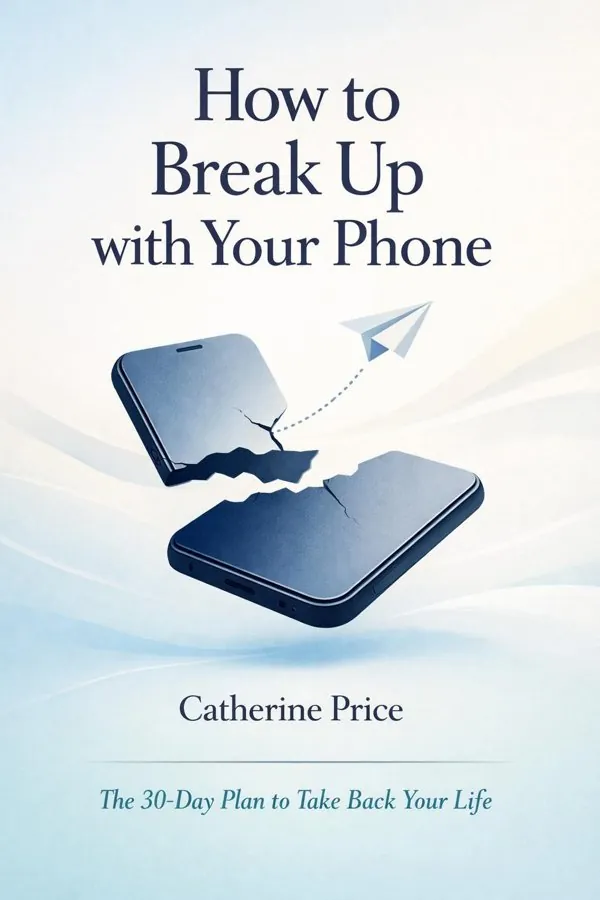
How to Break Up with Your Phone: The 30-Day Plan to Take Back Your Life: Summary & Key Insights
 10 min9 chaptersAudio available
Key Takeaways from How to Break Up with Your Phone: The 30-Day Plan to Take Back Your Life
The most unsettling truth about smartphone use is that excessive scrolling is rarely an accident.
Most people underestimate how often they use their phones because much of that use is automatic.
One reason phones dominate so much of modern life is that they thrive in the gap between impulse and awareness.
Change is easier when it has structure.
The first week of Price’s program focuses on one essential truth: you cannot change what you refuse to see.
What Is How to Break Up with Your Phone: The 30-Day Plan to Take Back Your Life About?
How to Break Up with Your Phone: The 30-Day Plan to Take Back Your Life by Catherine Price is a habits book spanning 9 pages. Smartphones promise connection, convenience, and efficiency, yet for many people they quietly erode attention, sleep, presence, and peace of mind. In How to Break Up with Your Phone, science journalist Catherine Price argues that the issue is not a lack of willpower, but the fact that our devices and apps are intentionally engineered to capture and keep our attention. This book offers a practical, compassionate, and highly structured 30-day plan to help readers reset their relationship with their phones without rejecting technology altogether. What makes Price’s approach especially valuable is that she combines behavioral science, neuroscience, mindfulness, and everyday realism. She explains why notifications feel irresistible, how habits become automatic, and why boredom has become so hard to tolerate. Then she translates those insights into concrete actions: auditing phone use, changing settings, creating friction, taking breaks, and rebuilding offline pleasures. This book matters because the battle for attention is really a battle over how we spend our lives. Price’s message is empowering: your phone should serve your values, not shape them. For anyone feeling distracted, drained, or digitally overdependent, this is a smart and actionable guide to taking control back.
This FizzRead summary covers all 9 key chapters of How to Break Up with Your Phone: The 30-Day Plan to Take Back Your Life in approximately 10 minutes, distilling the most important ideas, arguments, and takeaways from Catherine Price's work. Also available as an audio summary and Key Quotes Podcast.
How to Break Up with Your Phone: The 30-Day Plan to Take Back Your Life
Smartphones promise connection, convenience, and efficiency, yet for many people they quietly erode attention, sleep, presence, and peace of mind. In How to Break Up with Your Phone, science journalist Catherine Price argues that the issue is not a lack of willpower, but the fact that our devices and apps are intentionally engineered to capture and keep our attention. This book offers a practical, compassionate, and highly structured 30-day plan to help readers reset their relationship with their phones without rejecting technology altogether.
What makes Price’s approach especially valuable is that she combines behavioral science, neuroscience, mindfulness, and everyday realism. She explains why notifications feel irresistible, how habits become automatic, and why boredom has become so hard to tolerate. Then she translates those insights into concrete actions: auditing phone use, changing settings, creating friction, taking breaks, and rebuilding offline pleasures.
This book matters because the battle for attention is really a battle over how we spend our lives. Price’s message is empowering: your phone should serve your values, not shape them. For anyone feeling distracted, drained, or digitally overdependent, this is a smart and actionable guide to taking control back.
Who Should Read How to Break Up with Your Phone: The 30-Day Plan to Take Back Your Life?
This book is perfect for anyone interested in habits and looking to gain actionable insights in a short read. Whether you're a student, professional, or lifelong learner, the key ideas from How to Break Up with Your Phone: The 30-Day Plan to Take Back Your Life by Catherine Price will help you think differently.
- ✓Readers who enjoy habits and want practical takeaways
- ✓Professionals looking to apply new ideas to their work and life
- ✓Anyone who wants the core insights of How to Break Up with Your Phone: The 30-Day Plan to Take Back Your Life in just 10 minutes
Want the full summary?
Get instant access to this book summary and 100K+ more with Fizz Moment.
Get Free SummaryAvailable on App Store • Free to download
Key Chapters
The most unsettling truth about smartphone use is that excessive scrolling is rarely an accident. Catherine Price shows that many digital products are designed around the same psychological principles that make slot machines addictive: variable rewards, unpredictable notifications, social validation, and endless novelty. Every buzz, badge, and refresh offers the possibility of something interesting, flattering, urgent, or emotionally stimulating. That uncertainty keeps people checking.
This matters because it reframes the problem. If you find yourself opening your phone without a clear reason, the issue is not simply weak self-control. You are interacting with tools designed to bypass deliberation and trigger habit loops. Notifications interrupt your attention, social feeds exploit your need for belonging, and algorithmic content keeps serving more of what your brain finds hard to resist. Over time, this can fragment concentration, increase stress, and reduce your capacity to be fully present.
Price encourages readers to understand these mechanisms without shame. Once you see your phone less as a neutral object and more as an attention-extraction system, your choices become clearer. For example, turning off nonessential notifications immediately reduces external triggers. Moving tempting apps off your home screen adds friction. Logging out of social media changes a reflex into a decision.
The deeper lesson is that awareness creates leverage. You cannot effectively change a habit that you still believe is harmless or purely voluntary. Start by identifying the features on your phone that most often hijack your attention, and disable or remove at least three of them today.
Most people underestimate how often they use their phones because much of that use is automatic. Price argues that before trying to change behavior, you must first observe it honestly. That means treating yourself like a researcher rather than a critic: collect data, notice patterns, and ask what role your phone is actually playing in your life.
This self-assessment goes beyond screen-time totals. The more revealing questions are situational and emotional. When do you reach for your phone first thing in the morning? During work? In line? While watching television? When you feel lonely, bored, anxious, or tired? Which apps leave you energized, and which leave you depleted? Price encourages readers to pay attention not just to how much they use their phones, but why and with what result.
For example, you may discover that you tell yourself you check email for productivity, but in reality you are using it to avoid difficult work. Or you may find that social media gives a quick hit of stimulation yet leaves you feeling disconnected. A parent might notice they use the phone during family downtime because silence feels uncomfortable. A commuter may realize every spare moment has become filled by checking.
The point of the audit is not guilt; it is clarity. Vague discomfort rarely leads to lasting change, but specific observations do. Once you know your patterns, you can target the moments, emotions, and apps that matter most.
Actionable takeaway: for three days, track when you pick up your phone, what triggered it, what you did, and how you felt afterward. Review your notes and circle the three patterns you most want to change.
One reason phones dominate so much of modern life is that they thrive in the gap between impulse and awareness. Price emphasizes mindfulness not as a spiritual add-on, but as a practical tool for disrupting compulsive use. The goal is to notice what is happening in the moment you feel the urge to reach for your phone, rather than acting on autopilot.
This is powerful because smartphone habits are often less about genuine need than about escape. We check our phones when a conversation slows down, when a task becomes difficult, when we feel uncertain, or when we simply don’t know what else to do with ourselves. By becoming aware of these moments, we begin to see that the phone is often a coping mechanism. It helps us avoid boredom, discomfort, loneliness, and mental effort.
Price suggests brief pauses that create a wedge between urge and action. Before unlocking your phone, ask: Why am I picking this up right now? What do I intend to do? How long do I want to spend? That tiny check-in can reveal whether you are acting deliberately or reflexively. Mindfulness also helps you notice the aftermath. Did the check leave you better informed, or just distracted? More connected, or more agitated?
In practice, this might mean taking one breath before responding to a notification, leaving your phone in another room during meals, or sitting through a few moments of boredom without reaching for stimulation. These are small acts, but they rebuild attentional strength.
Actionable takeaway: adopt a simple rule for one week: every time you pick up your phone, say out loud or silently, “Why now?” If you don’t have a clear answer, put it back down.
Change is easier when it has structure. Rather than offering vague advice to “use your phone less,” Price organizes the book around a 30-day program designed to break old patterns and build healthier ones. The plan works because it combines education, reflection, environmental redesign, and behavioral experiments. Instead of relying on motivation alone, it gives readers a sequence of manageable steps.
The program is divided into phases. First comes awareness: noticing habits, identifying triggers, and understanding how your device captures attention. Then comes change: adjusting settings, removing temptations, introducing boundaries, and preparing for a short but meaningful break from optional smartphone use. The point is not permanent abstinence. It is to create enough distance to see your phone clearly and reclaim choice.
This method reflects a key principle from habit science: lasting change often requires both interruption and replacement. If you only try to resist your phone, the old habit loop remains intact. But if you redesign your environment and substitute healthier behaviors, new routines become possible. For example, replacing bedside scrolling with a physical alarm clock and a book changes not only what you do, but how your mornings feel. Creating phone-free rituals for meals, work blocks, or evening wind-downs restores boundaries that technology often dissolves.
The genius of the 30-day plan is that it treats behavior change as a process, not a declaration. You do not need to become a different person overnight. You need a system.
Actionable takeaway: instead of aiming to “cut screen time,” define a 30-day reset goal with specific rules, such as no phone during the first hour of the day, no social media on weekdays, and one scheduled digital Sabbath each week.
The first week of Price’s program focuses on one essential truth: you cannot change what you refuse to see. Phase One is about surfacing hidden habits, measuring use, and clarifying what you actually want from your technology. This early stage may seem simple, but it is where many readers experience their first breakthrough.
During this phase, you pay attention to metrics like pickups, time spent, and app frequency, but you also examine context. Which moments of the day feel most vulnerable? Are you using your phone to connect, to avoid, to soothe, or to stimulate yourself? Price pushes readers to identify the gap between intention and reality. You may believe your phone helps you stay informed, but if you spend most of your time bouncing between notifications, headlines, and feeds, your real experience may be fragmentation rather than knowledge.
Phase One also invites values-based reflection. What are you losing when your phone takes over? Deep work, sleep, eye contact, play, patience, boredom, or creativity? Naming these losses is motivating because it transforms the issue from abstract annoyance into a personal cost. A student may realize their focus has weakened. A partner may notice constant partial attention. A creative person may see that idle moments once used for ideas are now consumed by scrolling.
By the end of this week, the phone is no longer an invisible default. It becomes an object of deliberate examination. That shift is foundational, because lasting behavior change begins when the familiar becomes visible.
Actionable takeaway: write two lists: “What my phone gives me” and “What my phone takes from me.” Keep the lists visible during your reset so your decisions remain anchored in values, not impulse.
After awareness comes action. In the second phase of the program, Price helps readers redesign the conditions that make compulsive phone use so easy. This is a crucial shift. Many people try to change habits through self-discipline alone, but environment often matters more than intention. If your phone is always within reach, always lit up, and always filled with instant rewards, it will continue to win.
Price recommends making your device less seductive and less convenient for mindless use. That can include disabling most notifications, switching the screen to grayscale, removing social media apps, using app blockers, logging out after each session, charging your phone outside the bedroom, and moving it out of physical reach when you want to focus. These interventions may sound small, yet each one adds friction. Friction is the enemy of compulsion and the friend of conscious choice.
She also stresses replacing old routines with better alternatives. If you usually check your phone the moment you wake up, replace that ritual with stretching, journaling, or making coffee in silence. If you scroll during breaks, take a short walk instead. If your evenings disappear into passive consumption, create a visible menu of offline options: books, music, hobbies, conversations, exercise, or rest.
The broader insight is that habits do not disappear because you dislike them. They change when cues, rewards, and responses change. Your phone may still be useful, but it no longer needs unrestricted access to your attention.
Actionable takeaway: choose one high-risk situation, such as bedtime or work sessions, and redesign it completely by changing your phone’s location, settings, and your replacement behavior.
Attention is easy to talk about as a productivity issue, but Price makes clear that it is something much deeper: attention determines the texture of experience. Whatever captures your attention ends up shaping your days, your relationships, your memory, and your sense of meaning. If your focus is constantly broken, your life can begin to feel thin and scattered even when you are busy all the time.
Smartphones fragment attention by normalizing interruption. Even a brief glance at a notification can derail concentration and leave a residue of distraction. Repeated over hours and days, this weakens the ability to sustain deep thought, enjoy uninterrupted conversation, or fully inhabit leisure. Price argues that reclaiming attention is not about becoming more efficient for work alone. It is about becoming available again to reality.
The benefits are broad. You may notice improved concentration, calmer emotions, better sleep, and greater patience. You may find it easier to read, think, listen, and notice your surroundings. Relationships often improve because people can feel the difference between being near someone and actually having their attention. Even boredom regains value, because it creates space for reflection and creativity.
A practical example is creating focused blocks of time in which the phone is physically absent. Another is reclaiming transitional moments, such as waiting in line or walking somewhere, instead of automatically filling them with content. These small recoveries add up. They teach your brain that not every pause must be medicated with stimulation.
Actionable takeaway: schedule one 60-minute phone-free block every day for a week and protect it as seriously as an appointment. Use the time for deep work, conversation, exercise, reading, or simple presence.
One of the book’s most refreshing ideas is that the goal is not to demonize technology or retreat from modern life. Price does not argue that smartphones are inherently bad. They are useful, often indispensable tools. The problem begins when a tool quietly becomes a master. A healthy relationship with your phone means using it intentionally, in ways that support your values, instead of allowing it to dictate your habits and moods.
This framing matters because all-or-nothing approaches often fail. If you treat your phone as pure evil, you may swing between strict restriction and inevitable relapse. Price offers a more sustainable middle path: decide what your phone is for, what it is not for, and when it does and does not belong in your life. The emphasis is on alignment.
For example, you might decide your phone is for maps, calls, texts, photos, podcasts, and occasional messaging, but not for endless social browsing in bed. You might keep communication apps while deleting the platforms that provoke comparison or compulsive checking. You might choose set times for email instead of responding all day. These are not anti-tech choices; they are pro-agency choices.
A healthier relationship also includes emotional honesty. If you use your phone to numb discomfort, no setting alone will solve that. You need better alternatives for rest, connection, and regulation. This is why the book combines practical hacks with deeper reflection.
Actionable takeaway: write a personal phone policy with three categories: “Essential,” “Occasional,” and “Off-limits.” Use it to decide which apps, habits, and contexts deserve a place in your life.
A digital reset can feel liberating, but Price is realistic: old habits can return quickly if you do not create systems to maintain your gains. The final challenge is not just reducing phone use for a month. It is building a lifestyle in which attention is protected over the long term. Maintenance depends on boundaries, review, and a willingness to keep adjusting.
One important principle is that habits are never fully erased; they become less likely when conditions support better choices. That means you need recurring practices that reinforce your intentions. These might include weekly screen-time reviews, regular app cleanouts, phone-free mornings, device-free meals, and at least one recurring period each week when you unplug more fully. When your circumstances change, such as during stressful work periods or travel, your boundaries may need to become even more explicit.
Price also highlights the importance of noticing backsliding early. If you suddenly find yourself checking more often, ask what changed. Are you tired, anxious, lonely, or overworked? Are notifications creeping back? Did a deleted app return? Maintenance becomes much easier when relapse is treated as information rather than failure.
Long-term success also relies on having a life you want to pay attention to. The less empty space, curiosity, rest, connection, and purpose you have offline, the more tempting the phone becomes. Protecting your gains therefore means actively investing in relationships, hobbies, health, and meaningful routines.
Actionable takeaway: create a weekly digital reset ritual. Spend 10 minutes every Sunday reviewing screen time, deleting distractions, and choosing one boundary to strengthen for the coming week.
All Chapters in How to Break Up with Your Phone: The 30-Day Plan to Take Back Your Life
About the Author
Catherine Price is an American science journalist, author, and speaker who writes about health, technology, behavior, and the way modern life affects the mind and body. Her work has appeared in prominent publications including The New York Times, Popular Science, and other major outlets, where she has built a reputation for making complex research accessible, useful, and entertaining. Price is especially interested in translating science into practical guidance for everyday life, which is one reason her work resonates with a broad audience. In How to Break Up with Your Phone, she applies that talent to the problem of smartphone overuse, blending neuroscience, psychology, and habit science with a clear, relatable writing style. She is known for being insightful, evidence-based, and refreshingly humane.
Get This Summary in Your Preferred Format
Read or listen to the How to Break Up with Your Phone: The 30-Day Plan to Take Back Your Life summary by Catherine Price anytime, anywhere. FizzRead offers multiple formats so you can learn on your terms — all free.
Available formats: App · Audio · PDF · EPUB — All included free with FizzRead
Download How to Break Up with Your Phone: The 30-Day Plan to Take Back Your Life PDF and EPUB Summary
Key Quotes from How to Break Up with Your Phone: The 30-Day Plan to Take Back Your Life
“The most unsettling truth about smartphone use is that excessive scrolling is rarely an accident.”
“Most people underestimate how often they use their phones because much of that use is automatic.”
“One reason phones dominate so much of modern life is that they thrive in the gap between impulse and awareness.”
“Rather than offering vague advice to “use your phone less,” Price organizes the book around a 30-day program designed to break old patterns and build healthier ones.”
“The first week of Price’s program focuses on one essential truth: you cannot change what you refuse to see.”
Frequently Asked Questions about How to Break Up with Your Phone: The 30-Day Plan to Take Back Your Life
How to Break Up with Your Phone: The 30-Day Plan to Take Back Your Life by Catherine Price is a habits book that explores key ideas across 9 chapters. Smartphones promise connection, convenience, and efficiency, yet for many people they quietly erode attention, sleep, presence, and peace of mind. In How to Break Up with Your Phone, science journalist Catherine Price argues that the issue is not a lack of willpower, but the fact that our devices and apps are intentionally engineered to capture and keep our attention. This book offers a practical, compassionate, and highly structured 30-day plan to help readers reset their relationship with their phones without rejecting technology altogether. What makes Price’s approach especially valuable is that she combines behavioral science, neuroscience, mindfulness, and everyday realism. She explains why notifications feel irresistible, how habits become automatic, and why boredom has become so hard to tolerate. Then she translates those insights into concrete actions: auditing phone use, changing settings, creating friction, taking breaks, and rebuilding offline pleasures. This book matters because the battle for attention is really a battle over how we spend our lives. Price’s message is empowering: your phone should serve your values, not shape them. For anyone feeling distracted, drained, or digitally overdependent, this is a smart and actionable guide to taking control back.
More by Catherine Price

You Might Also Like

Atomic Habits: An Easy & Proven Way to Build Good Habits and Break Bad Ones
James Clear
10 min
A Complaint Free World: How to Stop Complaining and Start Enjoying the Life You Always Wanted
Will Bowen
10 minBadass Habits: Cultivate the Awareness, Boundaries, and Daily Upgrades You Need to Make Them Stick
Jen Sincero
10 min
Better Than Before: Mastering The Habits Of Our Everyday Lives
Gretchen Rubin
10 min
Change Anything: The New Science of Personal Success
Kerry Patterson
10 min
Discipline Equals Freedom: Field Manual
Jocko Willink
10 minBrowse by Category
Ready to read How to Break Up with Your Phone: The 30-Day Plan to Take Back Your Life?
Get the full summary and 100K+ more books with Fizz Moment.