
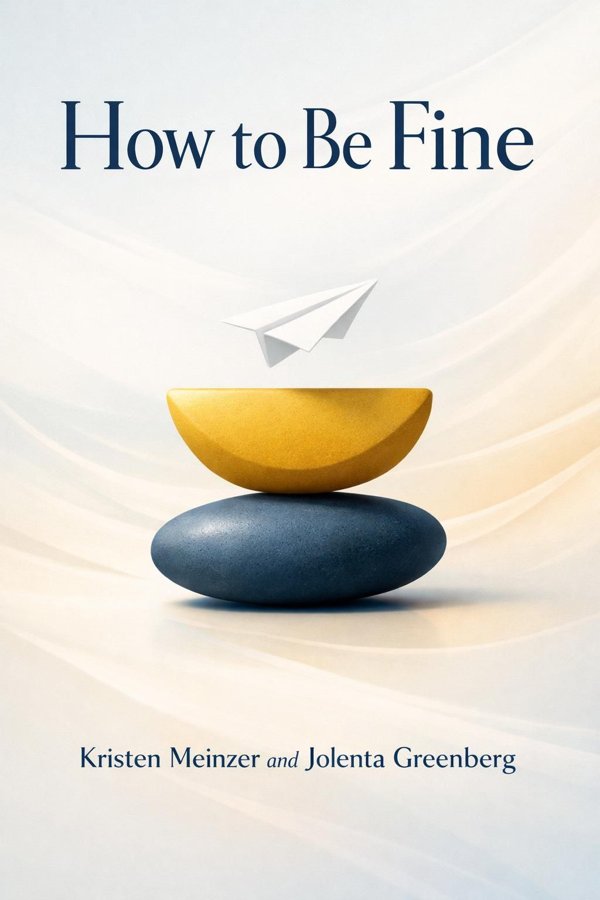
How to Be Fine: What We Learned from Living by the Rules of 50 Self-Help Books: Summary & Key Insights
by Kristen Meinzer, Jolenta Greenberg
 10 min10 chaptersAudio available
Key Takeaways from How to Be Fine: What We Learned from Living by the Rules of 50 Self-Help Books
One of the most revealing truths about self-help is that it rarely sells information alone; it sells reassurance.
Advice sounds simple until you actually obey it.
Grand transformation is exciting, but modest changes are usually more reliable.
Bad self-help is not just unhelpful; sometimes it is cruel in disguise.
Much self-help presents itself as universal while quietly assuming a very specific kind of reader.
What Is How to Be Fine: What We Learned from Living by the Rules of 50 Self-Help Books About?
How to Be Fine: What We Learned from Living by the Rules of 50 Self-Help Books by Kristen Meinzer, Jolenta Greenberg is a self_awareness book spanning 10 pages. How to Be Fine is a smart, funny, and surprisingly serious examination of the self-help industry through lived experience rather than abstract theory. Kristen Meinzer and Jolenta Greenberg, hosts of the podcast By the Book, spent years testing the advice of dozens of bestselling self-improvement books by following each book’s rules as literally as possible. What emerged was not just a catalog of tips that worked or failed, but a deeper investigation into why people turn to self-help in the first place. Their conclusion is both refreshing and humane: the goal is not to become perfect, but to become more honest about what actually helps us live better. The book matters because self-help promises transformation, yet often ignores the realities of personality, class, culture, mental health, and daily constraints. Meinzer and Greenberg bring credibility through immersion, skepticism, and candor. They are not detached critics; they are participants who took the genre seriously enough to test it. Their insights help readers separate useful practices from empty prescriptions and build a more compassionate, individualized philosophy of growth.
This FizzRead summary covers all 10 key chapters of How to Be Fine: What We Learned from Living by the Rules of 50 Self-Help Books in approximately 10 minutes, distilling the most important ideas, arguments, and takeaways from Kristen Meinzer, Jolenta Greenberg's work. Also available as an audio summary and Key Quotes Podcast.
How to Be Fine: What We Learned from Living by the Rules of 50 Self-Help Books
How to Be Fine is a smart, funny, and surprisingly serious examination of the self-help industry through lived experience rather than abstract theory. Kristen Meinzer and Jolenta Greenberg, hosts of the podcast By the Book, spent years testing the advice of dozens of bestselling self-improvement books by following each book’s rules as literally as possible. What emerged was not just a catalog of tips that worked or failed, but a deeper investigation into why people turn to self-help in the first place. Their conclusion is both refreshing and humane: the goal is not to become perfect, but to become more honest about what actually helps us live better.
The book matters because self-help promises transformation, yet often ignores the realities of personality, class, culture, mental health, and daily constraints. Meinzer and Greenberg bring credibility through immersion, skepticism, and candor. They are not detached critics; they are participants who took the genre seriously enough to test it. Their insights help readers separate useful practices from empty prescriptions and build a more compassionate, individualized philosophy of growth.
Who Should Read How to Be Fine: What We Learned from Living by the Rules of 50 Self-Help Books?
This book is perfect for anyone interested in self_awareness and looking to gain actionable insights in a short read. Whether you're a student, professional, or lifelong learner, the key ideas from How to Be Fine: What We Learned from Living by the Rules of 50 Self-Help Books by Kristen Meinzer, Jolenta Greenberg will help you think differently.
- ✓Readers who enjoy self_awareness and want practical takeaways
- ✓Professionals looking to apply new ideas to their work and life
- ✓Anyone who wants the core insights of How to Be Fine: What We Learned from Living by the Rules of 50 Self-Help Books in just 10 minutes
Want the full summary?
Get instant access to this book summary and 100K+ more with Fizz Moment.
Get Free SummaryAvailable on App Store • Free to download
Key Chapters
One of the most revealing truths about self-help is that it rarely sells information alone; it sells reassurance. Before Kristen Meinzer and Jolenta Greenberg began living by the rules of fifty self-help books, they first tried to understand the ecosystem they were entering. The genre is vast, stretching from moral handbooks and etiquette manuals to modern books about productivity, relationships, happiness, money, wellness, and spiritual awakening. What unites these books is not a single philosophy but a common promise: if you follow the right system, your life can become more manageable, meaningful, and successful.
That promise is powerful because it meets a real human need. People often reach for self-help when they feel stuck, ashamed, overwhelmed, lonely, or uncertain. A book that offers structure can feel like a lifeline. But the authors learned that the industry also depends on simplification. Complex problems are often reduced to habits, mindset shifts, or routines. This makes advice easy to market, but not always easy to live. A rule that sounds brilliant on a page may ignore mental health, caregiving demands, job insecurity, or cultural differences.
The book argues that self-help is not inherently foolish or manipulative. In fact, much of it contains useful wisdom. The problem begins when advice presents itself as universal. A morning routine that energizes one person may exhaust another. Radical positivity may comfort some readers while making others feel guilty for normal sadness. By studying the genre as both consumers and test subjects, Meinzer and Greenberg expose its central tension: self-help can genuinely help, but only when readers stop treating it like doctrine.
Actionable takeaway: the next time a self-help idea appeals to you, ask not “Is this true for everyone?” but “Under what conditions might this actually help me?”
Advice sounds simple until you actually obey it. Meinzer and Greenberg’s experiment was intentionally demanding: for each self-help book, they identified its core rules and then followed them as faithfully as possible for a set period. If a book prescribed gratitude journaling, assertive communication, decluttering, strict schedules, or nonstop positivity, they committed to doing it in real life. This method turned vague inspiration into measurable experience.
What made their approach so revealing was its literalness. Most readers cherry-pick the parts of a book they already like and quietly discard the rest. The authors did the opposite. They embraced each system whole enough to see its hidden assumptions. A rule might seem uplifting until it collides with family obligations, economic reality, introversion, grief, illness, or simple human messiness. By following advice to the letter, they could identify whether a book’s philosophy held together under ordinary pressure.
Their methodology also exposed how much context matters. The same rule could affect each woman differently because they had different personalities, bodies, needs, and thresholds. One might thrive under structure while the other felt constrained. One might appreciate directness in relationships while the other found it socially costly. This showed that no self-help prescription lands on a blank slate. It lands on a specific person with a specific history.
For readers, this is an important lesson in evaluation. We often judge advice based on how persuasive it sounds, not how it behaves in life. The authors encourage a more experimental mindset: test ideas, observe results, and remain willing to revise. Personal growth is less like converting to a belief system and more like running a series of thoughtful trials.
Actionable takeaway: when you read a self-help book, choose one or two specific practices to test for two weeks and evaluate them by actual impact, not just motivation.
Grand transformation is exciting, but modest changes are usually more reliable. After living by dozens of self-help systems, Meinzer and Greenberg found that the most useful advice was rarely dramatic. It was practical, repeatable, and forgiving. Habits like pausing before reacting, tidying a manageable space, expressing appreciation, scheduling rest, clarifying priorities, or naming your feelings often created more real benefit than sweeping promises about becoming a whole new person.
Why do small habits work so well? Because they fit into actual life. A complicated morning ritual involving meditation, affirmations, exercise, journaling, and goal visualization might feel inspiring for three days and impossible by day ten. In contrast, writing down three priorities, taking a walk, or sending one honest message to a friend can be sustained even during stressful weeks. Sustainable practices build trust with yourself. They create evidence that change is possible without demanding perfection.
The authors also noticed that useful advice tends to be concrete. “Value yourself” is emotionally appealing but hard to operationalize. “Set one boundary this week” is doable. “Be more present” is abstract; “put your phone away during dinner” is actionable. Good self-help translates ideals into behaviors. Better still, it allows room for adaptation. A practice should serve the reader, not turn into another standard used for self-criticism.
This insight challenges the common belief that improvement requires intensity. Often, what changes a life is not a complete reinvention but a handful of grounded practices repeated over time. The most effective advice feels less like punishment and more like support.
Actionable takeaway: ignore the urge to overhaul your life and choose one small habit that is easy enough to repeat even on your busiest or worst day.
Bad self-help is not just unhelpful; sometimes it is cruel in disguise. One of the clearest lessons from the book is that certain kinds of advice fail because they rest on unrealistic assumptions about time, money, energy, health, and emotional control. A book may insist that success is entirely a matter of discipline, or that happiness depends only on mindset, or that every obstacle can be overcome by positive thinking. These ideas can sound empowering, but they often collapse when tested against real life.
Meinzer and Greenberg discovered that advice becomes harmful when it confuses control with worth. If a system claims that people create every outcome through attitude and effort, then illness, grief, burnout, financial hardship, or discrimination begin to look like personal failures. This is not empowerment; it is blame. Similarly, books that demand constant optimization can turn daily life into an exhausting self-surveillance project. Instead of helping readers feel freer, they make people feel perpetually deficient.
The authors do not reject discipline or responsibility. Rather, they argue that useful advice respects limits. It recognizes that people have jobs, children, chronic conditions, mental health struggles, histories of trauma, and unequal access to resources. It leaves room for bad days. It acknowledges that not every problem can be solved with a checklist.
This idea is especially valuable for readers who blame themselves when a popular system does not work. Sometimes the issue is not your commitment. Sometimes the advice is poorly designed, too rigid, or blind to reality. Learning to spot that distinction is liberating.
Actionable takeaway: if a self-help rule makes you feel consistently ashamed, depleted, or defective, pause and ask whether the method is unrealistic rather than assuming you are the problem.
Much self-help presents itself as universal while quietly assuming a very specific kind of reader. Meinzer and Greenberg repeatedly found that many books rely on hidden advantages: flexible schedules, disposable income, physical safety, access to healthcare, supportive relationships, private space, and social legitimacy. Advice that looks neutral on the page may be easy only for people with substantial privilege.
Consider a book that recommends waking up early for a serene morning routine. That may be realistic for someone with stable work hours and no caregiving responsibilities, but nearly impossible for a night-shift worker or a parent of small children. Advice to "invest in yourself" may presume money for coaching, therapy, healthy food, childcare, or time off. Recommendations to speak boldly, negotiate aggressively, or say no without apology may carry different risks depending on gender, race, class, disability, or workplace power.
The authors’ insight here is not that privileged readers should ignore self-help, but that everyone should read it more critically. A book’s usefulness depends not just on its wisdom but on its awareness of structural reality. When authors act as if every reader has equal freedom, they erase the conditions that shape behavior. That erasure can make struggling readers feel personally inadequate for failing to implement advice that was never designed for their lives.
This perspective widens the conversation about personal growth. Improvement is not only about motivation or character; it is also about access, context, and social systems. The most humane self-help acknowledges those constraints and offers flexible tools rather than one-size-fits-all imperatives.
Actionable takeaway: before adopting any new rule, identify the resources it requires and ask whether it fits your actual circumstances or merely an idealized version of your life.
A surprising amount of self-help is really instruction in how to perform social roles. As Meinzer and Greenberg worked through books on relationships, confidence, communication, beauty, productivity, and domestic life, they noticed recurring gendered expectations. Women were often encouraged to be accommodating but not weak, attractive but effortless, ambitious but likable, nurturing but self-possessed, organized but never controlling. Advice marketed as empowerment sometimes recycled the very pressures it claimed to relieve.
This matters because readers do not encounter self-help in a vacuum. They encounter it in societies that reward and punish behavior unevenly. A recommendation to be more assertive may indeed help someone advocate for herself, but it may also expose her to backlash if her environment expects warmth, modesty, or deference. Likewise, messages about emotional labor, home management, motherhood, body image, and relationship upkeep often assume women should absorb responsibility for everyone else’s comfort.
The authors are particularly effective at showing how contradictory these demands can be. A woman may be told to set boundaries, but also to avoid seeming difficult. She may be told to pursue success, but also to remain pleasing and selfless. When self-help ignores these contradictions, it can turn systemic double standards into personal problems for women to solve alone.
At its best, the book helps readers distinguish between genuinely liberating advice and advice that simply repackages social pressure in a motivational tone. That distinction allows people to improve their lives without becoming more obedient to unfair expectations.
Actionable takeaway: when a self-help rule feels “helpful,” ask whose comfort it protects, whose labor it increases, and whether it expands your freedom or just polishes your performance.
Many self-help books promise relief from pain by encouraging readers to reframe, rise above, or replace negative feelings with better thoughts. Meinzer and Greenberg learned that while perspective can be useful, emotional denial usually backfires. You cannot build a stable life on top of feelings you refuse to acknowledge. The authors came to value emotional authenticity over compulsory cheerfulness.
This does not mean indulging every mood or romanticizing suffering. It means recognizing that anger, grief, fear, envy, embarrassment, and disappointment are not moral failures. They are signals. They tell us when something matters, when a boundary has been crossed, when we need support, when a dream has changed, or when we are simply exhausted. Advice that demands positivity at all times can sever people from those signals. Instead of processing difficult emotions, they begin managing appearances.
The authors found that more useful books allowed room for complexity. They encouraged readers to name what they feel, tolerate discomfort, and respond with curiosity instead of shame. For example, if you feel resentment, the answer may not be to force gratitude; it may be to examine an unfair dynamic. If you feel sadness, the goal may not be to fix it immediately but to make space for mourning. Honest emotional life is often less tidy than motivational culture wants it to be.
This lesson resonates because many readers turn to self-help hoping to stop feeling bad. The book offers a more compassionate alternative: learning how to feel bad without making it worse through self-judgment. That shift is often the beginning of real resilience.
Actionable takeaway: when a difficult emotion appears, resist the urge to instantly correct it and instead ask, “What is this feeling trying to tell me about my needs, values, or limits?”
A culture obsessed with self-improvement can make growth seem like a solo project. Yet one of the strongest conclusions in How to Be Fine is that relationships shape well-being more deeply than endless personal optimization. Across many books and experiments, Meinzer and Greenberg saw that connection, mutual support, and community often mattered more than productivity hacks, rigid routines, or identity makeovers.
This insight cuts against a major tendency in self-help: framing every challenge as an individual task. Loneliness becomes a mindset problem. Stress becomes a time-management issue. Conflict becomes a communication flaw to be corrected privately. But many problems improve not when we perfect ourselves, but when we lean on others, ask for help, repair ruptures, share burdens, and participate in reciprocal care.
The authors also observed that advice works better when supported socially. Gratitude is easier to sustain when expressed in real relationships. Boundaries are healthier when grounded in mutual respect. Accountability becomes more realistic when friends, partners, or communities participate. Even change that begins privately often needs relational reinforcement to last.
Importantly, the book does not idealize every relationship. Some ties require distance, stronger limits, or reevaluation. But it insists that a good life is not built through self-containment. It is built through honest connection. This broadens the meaning of self-help. Improvement is not only about becoming more efficient or disciplined. It is also about becoming more truthful, generous, and interdependent.
Actionable takeaway: instead of asking only what habit will improve your life, ask which conversation, repair, request, or act of support could strengthen the relationships that sustain you.
Much self-help quietly assumes that everyone wants the same things: productivity, confidence, wealth, romance, order, influence, or visible achievement. Meinzer and Greenberg learned that one of the most important acts of self-awareness is deciding what “better” actually means for you. Without that clarity, it is easy to chase goals that sound admirable but do not fit your values, temperament, or stage of life.
Their journey through fifty books revealed that many systems are persuasive because they offer a ready-made definition of success. Follow these rules and you will become calmer, richer, thinner, more desirable, more accomplished, more organized. But if a reader has not examined whether those goals are personally meaningful, self-help can become a treadmill. You keep striving, yet the finish line never feels satisfying because it was borrowed from someone else’s vision.
The authors’ alternative is not aimlessness but personal philosophy. Through experimentation, they began identifying what truly mattered: realistic habits, emotional honesty, humor, care, adaptability, and a rejection of perfectionism. In other words, being “fine” is not settling. It is refusing the fantasy that your worth depends on total self-mastery. It is building a life that is workable, humane, and aligned with your real priorities.
This is perhaps the book’s most liberating message. Growth becomes healthier when it is guided by values rather than insecurity. You do not need to optimize every part of yourself. You need to understand what kind of life feels meaningful and what trade-offs you are willing to accept.
Actionable takeaway: write your own definition of success in one sentence, using values you genuinely care about rather than goals that mainly impress other people.
The ultimate lesson of How to Be Fine is not that self-help is foolish or brilliant. It is that self-help becomes useful only when filtered through self-knowledge. After living by fifty books, Meinzer and Greenberg did not end up devoted to one perfect method. They became better editors of advice. They learned to borrow what helped, reject what harmed, and adapt what was partially useful. That selective approach is the real skill the book teaches.
A personal filter includes several questions. Does this advice respect my circumstances? Does it align with my values? Is it sustainable? Does it make me more compassionate or more ashamed? Does it help me relate better to others? Does it solve a real problem, or merely create a new standard to fail? These questions protect readers from mistaking confidence for wisdom. Many self-help books sound authoritative. Far fewer remain humane and practical when lived.
This idea also reframes growth as an ongoing conversation rather than a conversion experience. You do not have to pledge loyalty to a system. You can remain curious, skeptical, and flexible. One book may teach you a useful boundary-setting phrase. Another may offer a journaling practice you keep for years. A third may be valuable mostly because it shows you what does not work. All of that still counts as learning.
By the end, the authors offer a mature vision of self-improvement: less grandiose, more forgiving, and ultimately more effective. Being fine means being awake to your own life and capable of choosing with care.
Actionable takeaway: create a simple “advice filter” of three questions you will ask before adopting any self-help recommendation, and use it to evaluate every new practice.
All Chapters in How to Be Fine: What We Learned from Living by the Rules of 50 Self-Help Books
About the Authors
Kristen Meinzer and Jolenta Greenberg are the co-creators and co-hosts of the acclaimed podcast By the Book, where they became known for humorously and rigorously testing the advice of bestselling self-help books. Kristen Meinzer is an award-winning podcaster, writer, and cultural critic whose work spans media, identity, and personal development. Jolenta Greenberg is a comedian, writer, and performer celebrated for her sharp wit, honesty, and emotional openness. Together, they built a loyal audience by combining entertainment with thoughtful analysis, turning self-help experiments into deeper conversations about culture, relationships, privilege, and mental well-being. Their collaborative voice is engaging, skeptical, and compassionate, making them uniquely credible guides for readers trying to navigate the promises and pitfalls of the self-improvement industry.
Get This Summary in Your Preferred Format
Read or listen to the How to Be Fine: What We Learned from Living by the Rules of 50 Self-Help Books summary by Kristen Meinzer, Jolenta Greenberg anytime, anywhere. FizzRead offers multiple formats so you can learn on your terms — all free.
Available formats: App · Audio · PDF · EPUB — All included free with FizzRead
Download How to Be Fine: What We Learned from Living by the Rules of 50 Self-Help Books PDF and EPUB Summary
Key Quotes from How to Be Fine: What We Learned from Living by the Rules of 50 Self-Help Books
“One of the most revealing truths about self-help is that it rarely sells information alone; it sells reassurance.”
“Advice sounds simple until you actually obey it.”
“Grand transformation is exciting, but modest changes are usually more reliable.”
“Bad self-help is not just unhelpful; sometimes it is cruel in disguise.”
“Much self-help presents itself as universal while quietly assuming a very specific kind of reader.”
Frequently Asked Questions about How to Be Fine: What We Learned from Living by the Rules of 50 Self-Help Books
How to Be Fine: What We Learned from Living by the Rules of 50 Self-Help Books by Kristen Meinzer, Jolenta Greenberg is a self_awareness book that explores key ideas across 10 chapters. How to Be Fine is a smart, funny, and surprisingly serious examination of the self-help industry through lived experience rather than abstract theory. Kristen Meinzer and Jolenta Greenberg, hosts of the podcast By the Book, spent years testing the advice of dozens of bestselling self-improvement books by following each book’s rules as literally as possible. What emerged was not just a catalog of tips that worked or failed, but a deeper investigation into why people turn to self-help in the first place. Their conclusion is both refreshing and humane: the goal is not to become perfect, but to become more honest about what actually helps us live better. The book matters because self-help promises transformation, yet often ignores the realities of personality, class, culture, mental health, and daily constraints. Meinzer and Greenberg bring credibility through immersion, skepticism, and candor. They are not detached critics; they are participants who took the genre seriously enough to test it. Their insights help readers separate useful practices from empty prescriptions and build a more compassionate, individualized philosophy of growth.
You Might Also Like
Rising Strong
Brené Brown
10 min
You Do You
Sarah Knight
10 min
Master Your Emotions: A Practical Guide to Overcome Negativity and Better Manage Your Feelings
Thibaut Meurisse
10 min
The Mountain Is You: Transforming Self-Sabotage Into Self-Mastery
Brianna Wiest
10 min
101 Essays That Will Change The Way You Think
Brianna Wiest
10 min
A Radical Awakening: Turn Pain into Power, Embrace Your Truth, Live Free
Shefali Tsabary
10 minBrowse by Category
Ready to read How to Be Fine: What We Learned from Living by the Rules of 50 Self-Help Books?
Get the full summary and 100K+ more books with Fizz Moment.