
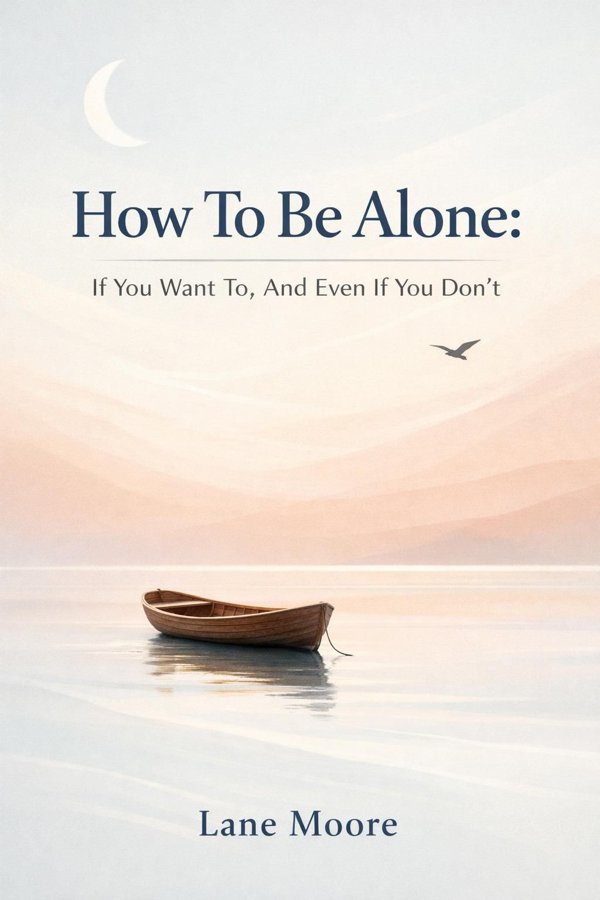
How To Be Alone: If You Want To, And Even If You Don't: Summary & Key Insights
by Lane Moore
 10 min9 chaptersAudio available
Key Takeaways from How To Be Alone: If You Want To, And Even If You Don't
One of the hardest truths about loneliness is that it often begins long before we understand what we are feeling.
We are often told that family is our first source of love, but Moore reminds us that family can also be our first lesson in alienation.
Many adults quietly suffer under the belief that friendship should happen naturally if they are likable enough.
A powerful illusion in modern culture is that romantic love will resolve loneliness once and for all.
When belonging feels uncertain, creative work can offer a different kind of home.
What Is How To Be Alone: If You Want To, And Even If You Don't About?
How To Be Alone: If You Want To, And Even If You Don't by Lane Moore is a self_awareness book spanning 9 pages. How To Be Alone: If You Want To, And Even If You Don’t is a deeply personal, sharply funny, and emotionally honest exploration of loneliness, belonging, and the difficult work of building a life that feels like home. In this memoir-in-essays, Lane Moore writes about growing up in an unstable and painful family environment, struggling to form secure relationships, and trying to make sense of isolation in a culture that treats connection as effortless and constant companionship as proof of worth. Rather than offering simplistic advice, Moore examines what it actually feels like to be alone when solitude is not always a choice. The book matters because it speaks to a widespread but often hidden experience: feeling disconnected even in a hyperconnected world. Moore’s authority comes not from clinical distance but from lived experience. As a writer, comedian, musician, and cultural commentator, she brings unusual clarity, vulnerability, and wit to topics many people struggle to name. Her insights resonate with anyone who has felt left out, misunderstood, emotionally neglected, or exhausted by the pressure to seem socially fulfilled. This is a book about surviving loneliness, understanding it, and transforming it into self-knowledge.
This FizzRead summary covers all 9 key chapters of How To Be Alone: If You Want To, And Even If You Don't in approximately 10 minutes, distilling the most important ideas, arguments, and takeaways from Lane Moore's work. Also available as an audio summary and Key Quotes Podcast.
How To Be Alone: If You Want To, And Even If You Don't
How To Be Alone: If You Want To, And Even If You Don’t is a deeply personal, sharply funny, and emotionally honest exploration of loneliness, belonging, and the difficult work of building a life that feels like home. In this memoir-in-essays, Lane Moore writes about growing up in an unstable and painful family environment, struggling to form secure relationships, and trying to make sense of isolation in a culture that treats connection as effortless and constant companionship as proof of worth. Rather than offering simplistic advice, Moore examines what it actually feels like to be alone when solitude is not always a choice.
The book matters because it speaks to a widespread but often hidden experience: feeling disconnected even in a hyperconnected world. Moore’s authority comes not from clinical distance but from lived experience. As a writer, comedian, musician, and cultural commentator, she brings unusual clarity, vulnerability, and wit to topics many people struggle to name. Her insights resonate with anyone who has felt left out, misunderstood, emotionally neglected, or exhausted by the pressure to seem socially fulfilled. This is a book about surviving loneliness, understanding it, and transforming it into self-knowledge.
Who Should Read How To Be Alone: If You Want To, And Even If You Don't?
This book is perfect for anyone interested in self_awareness and looking to gain actionable insights in a short read. Whether you're a student, professional, or lifelong learner, the key ideas from How To Be Alone: If You Want To, And Even If You Don't by Lane Moore will help you think differently.
- ✓Readers who enjoy self_awareness and want practical takeaways
- ✓Professionals looking to apply new ideas to their work and life
- ✓Anyone who wants the core insights of How To Be Alone: If You Want To, And Even If You Don't in just 10 minutes
Want the full summary?
Get instant access to this book summary and 100K+ more with Fizz Moment.
Get Free SummaryAvailable on App Store • Free to download
Key Chapters
One of the hardest truths about loneliness is that it often begins long before we understand what we are feeling. Lane Moore shows that for many people, loneliness is not simply the result of being single, living alone, or lacking plans on a weekend. It can start in childhood, especially in homes where affection is inconsistent, safety is uncertain, or emotional needs are ignored. In those environments, a child may learn that closeness is unpredictable and that connection can disappear without warning.
Moore’s reflections make clear that early loneliness shapes later expectations. If your first experiences of love involved instability, criticism, or neglect, you may grow up assuming that being misunderstood is normal. You may become highly independent not because independence feels empowering, but because depending on others feels dangerous. This kind of loneliness is not dramatic from the outside. It may look like competence, humor, or self-sufficiency. Internally, however, it can create a constant sense of emotional exile.
Recognizing these roots matters because adult loneliness is often treated as a personal failure instead of a learned emotional condition. When we understand that some of our social fears and attachment patterns were formed early, we can stop blaming ourselves for having them. Practical applications include journaling about childhood experiences of comfort and abandonment, noticing recurring beliefs like “people always leave,” and exploring therapy or support groups that address attachment wounds.
Actionable takeaway: Trace your present loneliness back to its earliest memories, and identify one old belief about connection that no longer deserves to control your life.
We are often told that family is our first source of love, but Moore reminds us that family can also be our first lesson in alienation. When the people who are supposed to protect, affirm, and know us instead create confusion, fear, or emotional inconsistency, belonging becomes complicated. A person may grow up surrounded by relatives and still feel fundamentally unseen.
Moore explores the painful contradiction of families that appear functional from the outside while being deeply damaging within. This gap between appearance and reality teaches children to distrust their own perceptions. If everyone insists things are fine when they clearly are not, emotional reality becomes difficult to name. Later in life, that can lead to minimizing harm, tolerating unhealthy relationships, or believing that love naturally comes with chaos.
The book challenges the romantic idea that biological ties automatically create meaningful connection. Sometimes family members are the least safe people in a person’s life. Accepting that truth can be both painful and liberating. It allows individuals to stop chasing impossible approval and to grieve what they did not receive. Practical examples include setting firmer boundaries with relatives, reducing contact when interactions are consistently harmful, and refusing to measure your worth by how well you fit into a dysfunctional system.
Moore’s insight is especially useful for readers who feel guilty for not feeling close to their families. The goal is not resentment for its own sake, but honesty. Healing often begins when we stop forcing ourselves to call something loving that never truly felt safe.
Actionable takeaway: Write down what healthy family support would actually look like, then compare it honestly with what your family offers so you can choose boundaries based on reality, not obligation.
Many adults quietly suffer under the belief that friendship should happen naturally if they are likable enough. Moore dismantles that myth by showing how friendship can be one of the most confusing forms of intimacy, especially for people whose early experiences taught them to expect rejection or inconsistency. Wanting friends does not automatically make friendship easy.
The book pays attention to a common but under-discussed pain: feeling peripheral in other people’s lives. You may care deeply, make effort, initiate plans, and still feel like the optional person. Moore gives language to this ache without reducing it to bitterness. Friendship can involve mismatched needs, emotional unavailability, and social dynamics that leave one person giving more than they receive.
This insight matters because loneliness is often intensified by comparison. Social media and cultural scripts suggest that everyone else has a tight inner circle, effortless group chats, and endless invitations. In reality, many adults are improvising. Building meaningful friendship requires vulnerability, repetition, and discernment. It also requires accepting that not every acquaintance should become a confidant.
Practical applications include paying attention to reciprocity, not just chemistry. Notice who checks in without being prompted, who follows through, and who makes space for your real self instead of just your entertaining or useful self. It can also help to invest in friendships through regular rituals: monthly calls, recurring dinners, or small acts of consistency.
Moore does not promise a foolproof way to avoid disappointment, but she does insist that friendship deserves seriousness. It is not a lesser relationship category. It is one of the main places where belonging is built or broken.
Actionable takeaway: Choose one friendship that feels mutual and strengthen it intentionally with a recurring plan instead of waiting for connection to happen by accident.
A powerful illusion in modern culture is that romantic love will resolve loneliness once and for all. Moore pushes back against that fantasy by showing that relationships can intensify loneliness when they are built on unmet needs, old wounds, or the hope of rescue. Being chosen by someone is not the same as being emotionally safe with them.
Her reflections suggest that people who have long felt alone may be especially vulnerable to mistaking intensity for intimacy. If deprivation has shaped your emotional life, even inconsistent affection can feel intoxicating. You may cling to people who are unreliable because any closeness feels better than none. This can create a cycle in which the fear of being alone keeps you attached to situations that make you feel even more abandoned.
Moore’s honesty is useful because it reframes relationship struggles as patterns worth examining, not evidence that love is impossible. The question is not simply whether you are with someone, but what being with them teaches your nervous system. Do you feel calmer, clearer, and more yourself? Or more anxious, confused, and desperate for reassurance?
Practical examples include slowing down the pace of emotional attachment, noticing if you are idealizing people who offer inconsistent attention, and asking whether you like the person or just the relief of not feeling alone for a moment. Healthy romance supports your life; it does not become your only source of emotional oxygen.
Moore encourages readers to seek connection without surrendering their self-respect. Real intimacy is built through trust, mutual care, and honesty, not through panic-driven attachment.
Actionable takeaway: Before investing further in a romantic connection, ask whether it brings steadiness or chaos, and let that answer guide your next decision.
When belonging feels uncertain, creative work can offer a different kind of home. Moore’s life as a writer, performer, and musician reveals how art can become both expression and survival. Creativity does not erase loneliness, but it can transform pain into meaning, structure, and connection. It gives form to feelings that may otherwise remain private and overwhelming.
This matters because identity often becomes fragile when relationships are unstable. If your value depends entirely on being wanted by others, every rejection feels existential. Creative work creates another axis of selfhood. You are not only the person who was excluded, abandoned, or misunderstood. You are also the person who makes things, notices things, says things only you can say.
Moore does not romanticize ambition. Career achievement cannot fully replace emotional closeness, and public recognition does not automatically heal private wounds. Still, meaningful work can be grounding. It builds competence, routine, and a sense of contribution. It can also attract communities of people who share your interests and values.
Practical applications include treating creativity less as performance and more as practice. You do not need a large audience to benefit from writing, drawing, singing, or making something regularly. If loneliness leaves you feeling passive, a creative ritual can restore agency. Set a weekly hour to work on a personal project, join a local class, or share your work with one trusted person rather than waiting for perfection.
The deeper lesson is that your inner life can be productive, not just painful. Solitude can become a place where your perspective sharpens instead of a void that swallows you.
Actionable takeaway: Start a small, repeatable creative practice this week and use it as a way to build identity from within rather than from external approval.
Few things are more confusing than feeling lonely while constantly surrounded by digital contact. Moore captures the strange emotional logic of social media and modern communication: we can be visible everywhere and known nowhere. Likes, messages, follows, and public interaction can create the appearance of community without delivering the deeper experiences of trust, presence, and care.
This idea matters because technology often intensifies comparison. You may interpret other people’s curated closeness as proof that your own life is lacking. Group photos, inside jokes, anniversary posts, and endless digital chatter can make isolation feel not only painful but shameful. Moore helps readers understand that the problem is not simply screen time. It is the gap between symbolic connection and embodied relationship.
At the same time, technology is not portrayed as purely harmful. For many people, especially those who feel marginalized or geographically isolated, the internet can provide access to understanding, language, and community. The key question is whether your online life deepens your reality or distracts you from it. Does it lead to conversation, support, and shared experience? Or does it mostly keep you hovering near other people’s lives without truly participating?
Practical steps include auditing how certain platforms make you feel, limiting time spent on accounts that trigger comparison, and using digital tools to create real follow-through. Instead of passive scrolling, send a message, propose a plan, join a niche community, or schedule a call. Turn ambient contact into intentional connection.
Moore’s broader point is that loneliness cannot be solved by visibility alone. Being seen is not the same as being held in mind.
Actionable takeaway: Replace one hour of passive online consumption this week with one deliberate act of reaching out to someone in a direct, personal way.
When people feel chronically alone, they often begin to assume the problem is their very nature. Moore argues that one of the most important forms of healing is learning to stop treating yourself as the main disappointment in your life. Self-acceptance is not vanity, passivity, or pretending everything is fine. It is the refusal to define your worth by who failed to love you well.
This is radical because many lonely people become experts in self-surveillance. They analyze every text, every silence, every social misstep, searching for the reason they were not chosen. Moore offers a gentler frame: some relationships fail not because you are defective, but because the fit is wrong, the other person is limited, or old patterns are replaying themselves. Self-acceptance interrupts the habit of turning every disappointment into self-indictment.
In practice, this means becoming more compassionate toward your needs and quirks instead of editing yourself for universal approval. It may involve acknowledging that you want closeness, that rejection hurts, and that your sensitivity is not a weakness to erase. It also means creating a life that reflects your preferences, not just your fear of being judged. Dress the way you like. Spend time in ways that restore you. Stop performing indifference if you care deeply.
Moore’s voice is especially helpful here because she does not make self-love sound easy or polished. It is often awkward, repetitive, and hard won. But it changes the emotional baseline. Once you stop abandoning yourself, other people’s inconsistency has less power to define your identity.
Actionable takeaway: Notice one way you routinely apologize for your personality or needs, and replace that apology with a clear statement of self-respect.
Not everyone receives a ready-made support system, and Moore treats that reality with both grief and hope. One of the book’s most affirming ideas is that family does not have to be limited to blood. Chosen family consists of the people who show up with consistency, care, and recognition. It is built through trust, not genetics; through mutual effort, not obligation.
This concept is powerful for anyone who has felt homeless inside traditional relationship structures. If your biological family is unsafe or your old friendships have faded, it is easy to assume you are destined to remain unsupported. Moore resists that fatalism. Chosen family may take time to assemble, and it may not resemble cultural ideals, but it can be real and sustaining.
Importantly, chosen family is not just a sentimental label for favorite people. It requires maintenance. The relationships that become life-giving are usually the ones where people communicate honestly, follow through, respect boundaries, and make room for imperfection. Building this kind of network often starts small: one reliable friend, one creative collaborator, one neighbor, one person who remembers important details about your life.
Practical applications include identifying the people who already make you feel more solid and reciprocating that energy. Host a small gathering. Start a ritual. Celebrate milestones together. Ask for help in manageable ways. Chosen family grows through accumulated acts of care, not dramatic declarations.
Moore offers an especially meaningful corrective here: if you were not cared for properly in the beginning, that is a tragedy, not a verdict. There are still ways to belong.
Actionable takeaway: Make a list of three people who consistently feel safe or sincere, and take one step toward deepening those relationships into a more intentional support system.
Healing is often imagined as a clean transformation, but Moore presents it as uneven, repetitive, and very human. The wounds of loneliness do not disappear simply because you understand them. Old fears can return. New relationships can trigger old patterns. Progress may be visible only in small moments: leaving a harmful situation sooner, asking for reassurance more clearly, or recovering faster after disappointment.
This perspective is crucial because perfectionism makes healing harder. If you expect yourself to become fully secure, endlessly social, or permanently unbothered, every setback feels like failure. Moore rejects that standard. Resilience is not the absence of pain; it is the growing capacity to survive pain without losing your sense of self.
Her work suggests that healing involves both grief and experimentation. You grieve the childhood you did not have, the friendships that failed, the relationships that hurt, and the years spent feeling invisible. At the same time, you test new ways of living. You set boundaries. You rest. You seek better people. You allow joy without demanding certainty.
Practical examples include measuring growth by behavior rather than mood. You may still feel lonely, but did you reach out instead of isolating completely? Did you tell the truth instead of pretending? Did you leave when someone treated you poorly? These are signs of healing, even if the emotions are still messy.
Moore’s most reassuring contribution is that loneliness does not cancel the possibility of a meaningful life. You can still become stronger, wiser, funnier, more discerning, and more connected than you once were.
Actionable takeaway: Define healing by one repeatable behavior you can practice this month, such as setting a boundary, asking for support, or returning to yourself more quickly after rejection.
All Chapters in How To Be Alone: If You Want To, And Even If You Don't
About the Author
Lane Moore is an American writer, comedian, musician, actor, and cultural critic known for her fearless honesty about relationships, loneliness, identity, and emotional survival. She has written for major outlets including Cosmopolitan, where her work gained attention for its wit, vulnerability, and sharp insight into modern intimacy. Moore is also a performer and the frontwoman of the band It Was Romance, bringing the same candor and creativity to music and live work that she brings to the page. Her voice stands out because she can make painful subjects feel both deeply personal and widely relatable. In How To Be Alone, she draws from her own experiences of family dysfunction, social isolation, and resilience, offering readers a memoir that is as funny and piercing as it is compassionate.
Get This Summary in Your Preferred Format
Read or listen to the How To Be Alone: If You Want To, And Even If You Don't summary by Lane Moore anytime, anywhere. FizzRead offers multiple formats so you can learn on your terms — all free.
Available formats: App · Audio · PDF · EPUB — All included free with FizzRead
Download How To Be Alone: If You Want To, And Even If You Don't PDF and EPUB Summary
Key Quotes from How To Be Alone: If You Want To, And Even If You Don't
“One of the hardest truths about loneliness is that it often begins long before we understand what we are feeling.”
“We are often told that family is our first source of love, but Moore reminds us that family can also be our first lesson in alienation.”
“Many adults quietly suffer under the belief that friendship should happen naturally if they are likable enough.”
“A powerful illusion in modern culture is that romantic love will resolve loneliness once and for all.”
“When belonging feels uncertain, creative work can offer a different kind of home.”
Frequently Asked Questions about How To Be Alone: If You Want To, And Even If You Don't
How To Be Alone: If You Want To, And Even If You Don't by Lane Moore is a self_awareness book that explores key ideas across 9 chapters. How To Be Alone: If You Want To, And Even If You Don’t is a deeply personal, sharply funny, and emotionally honest exploration of loneliness, belonging, and the difficult work of building a life that feels like home. In this memoir-in-essays, Lane Moore writes about growing up in an unstable and painful family environment, struggling to form secure relationships, and trying to make sense of isolation in a culture that treats connection as effortless and constant companionship as proof of worth. Rather than offering simplistic advice, Moore examines what it actually feels like to be alone when solitude is not always a choice. The book matters because it speaks to a widespread but often hidden experience: feeling disconnected even in a hyperconnected world. Moore’s authority comes not from clinical distance but from lived experience. As a writer, comedian, musician, and cultural commentator, she brings unusual clarity, vulnerability, and wit to topics many people struggle to name. Her insights resonate with anyone who has felt left out, misunderstood, emotionally neglected, or exhausted by the pressure to seem socially fulfilled. This is a book about surviving loneliness, understanding it, and transforming it into self-knowledge.
You Might Also Like
Rising Strong
Brené Brown
10 min
You Do You
Sarah Knight
10 min
Master Your Emotions: A Practical Guide to Overcome Negativity and Better Manage Your Feelings
Thibaut Meurisse
10 min
The Mountain Is You: Transforming Self-Sabotage Into Self-Mastery
Brianna Wiest
10 min
101 Essays That Will Change The Way You Think
Brianna Wiest
10 min
A Radical Awakening: Turn Pain into Power, Embrace Your Truth, Live Free
Shefali Tsabary
10 minBrowse by Category
Ready to read How To Be Alone: If You Want To, And Even If You Don't?
Get the full summary and 100K+ more books with Fizz Moment.