
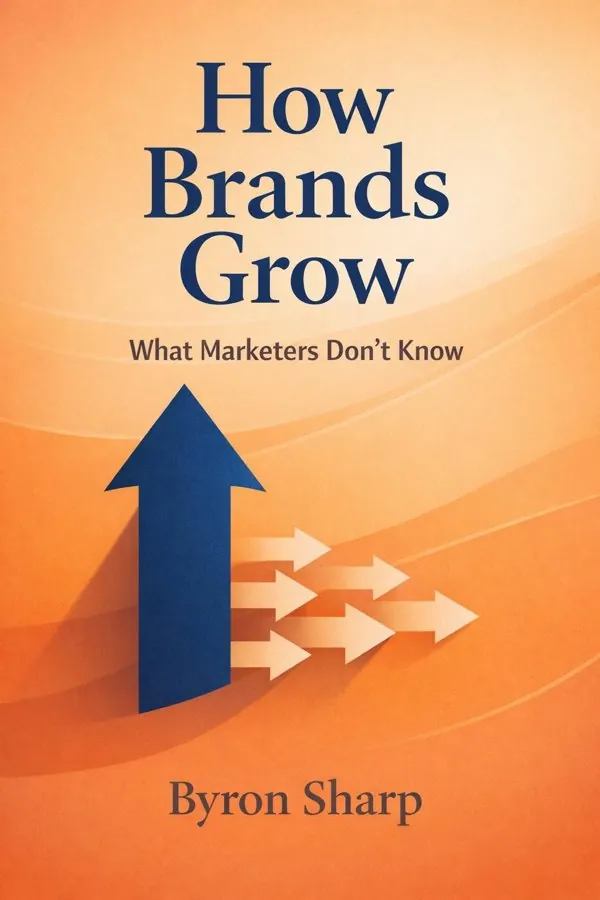
How Brands Grow: What Marketers Don't Know: Summary & Key Insights
by Byron Sharp
 10 min10 chaptersAudio available
Key Takeaways from How Brands Grow: What Marketers Don't Know
One of marketing’s most uncomfortable truths is that small brands usually do not merely have fewer customers; they also have slightly less loyal customers.
A brand rarely grows because existing customers suddenly become dramatically more loyal; it grows because more people buy it.
Marketers often imagine customers as devoted followers who consciously choose among brands based on strong preferences.
If growth depends on acquiring many buyers, then the next question is obvious: how do brands make that easier?
Many marketers chase differentiation as if growth depends on being perceived as uniquely superior.
What Is How Brands Grow: What Marketers Don't Know About?
How Brands Grow: What Marketers Don't Know by Byron Sharp is a marketing book spanning 12 pages. Most marketing advice sounds persuasive, but Byron Sharp asks a harder question: what does the evidence actually show? In How Brands Grow: What Marketers Don't Know, he challenges many of the ideas that dominate boardrooms, agencies, and brand plans, from the obsession with loyalty and differentiation to the belief that tightly targeted marketing is always best. Drawing on decades of empirical research, much of it associated with the Ehrenberg-Bass Institute, Sharp argues that brand growth is far more predictable than marketers assume. Brands typically grow by increasing penetration, reaching more category buyers, and building both mental and physical availability, not by cultivating a tiny group of devoted fans. That makes this book important because it replaces fashionable theory with practical laws of buyer behavior. For marketers, founders, product leaders, and anyone responsible for growth, Sharp offers a disciplined framework for deciding where to invest attention and budget. Whether you agree with every conclusion or not, this is one of the most influential and clarifying books in modern marketing because it forces strategy to confront reality.
This FizzRead summary covers all 10 key chapters of How Brands Grow: What Marketers Don't Know in approximately 10 minutes, distilling the most important ideas, arguments, and takeaways from Byron Sharp's work. Also available as an audio summary and Key Quotes Podcast.
How Brands Grow: What Marketers Don't Know
Most marketing advice sounds persuasive, but Byron Sharp asks a harder question: what does the evidence actually show? In How Brands Grow: What Marketers Don't Know, he challenges many of the ideas that dominate boardrooms, agencies, and brand plans, from the obsession with loyalty and differentiation to the belief that tightly targeted marketing is always best. Drawing on decades of empirical research, much of it associated with the Ehrenberg-Bass Institute, Sharp argues that brand growth is far more predictable than marketers assume. Brands typically grow by increasing penetration, reaching more category buyers, and building both mental and physical availability, not by cultivating a tiny group of devoted fans. That makes this book important because it replaces fashionable theory with practical laws of buyer behavior. For marketers, founders, product leaders, and anyone responsible for growth, Sharp offers a disciplined framework for deciding where to invest attention and budget. Whether you agree with every conclusion or not, this is one of the most influential and clarifying books in modern marketing because it forces strategy to confront reality.
Who Should Read How Brands Grow: What Marketers Don't Know?
This book is perfect for anyone interested in marketing and looking to gain actionable insights in a short read. Whether you're a student, professional, or lifelong learner, the key ideas from How Brands Grow: What Marketers Don't Know by Byron Sharp will help you think differently.
- ✓Readers who enjoy marketing and want practical takeaways
- ✓Professionals looking to apply new ideas to their work and life
- ✓Anyone who wants the core insights of How Brands Grow: What Marketers Don't Know in just 10 minutes
Want the full summary?
Get instant access to this book summary and 100K+ more with Fizz Moment.
Get Free SummaryAvailable on App Store • Free to download
Key Chapters
One of marketing’s most uncomfortable truths is that small brands usually do not merely have fewer customers; they also have slightly less loyal customers. Sharp highlights this as the Law of Double Jeopardy, an empirical pattern that appears again and again across categories. In practical terms, brands with lower market share tend to be bought by fewer people, and those people also buy them a little less often. This matters because it undermines the popular belief that niche brands can offset low scale with exceptional loyalty. In most markets, they cannot.
The principle helps explain why growth often feels so difficult. A challenger brand may assume the answer is to deepen emotional commitment among existing customers, yet the data suggests loyalty differences between brands are usually modest. The bigger constraint is simply that too few people buy the brand at all. Consider a supermarket shelf: the market leader is purchased by many households and appears often in shopping baskets, while a smaller brand is noticed and chosen less often, even by its own buyers. The same pattern can apply in banking, media subscriptions, airlines, and consumer packaged goods.
This does not mean loyalty is irrelevant. Rather, it means loyalty is often a consequence of scale, not its cause. Bigger brands benefit from broader usage, greater familiarity, and wider distribution, which naturally support repeat buying. Managers who misunderstand this may overinvest in retention schemes while neglecting acquisition and reach.
Actionable takeaway: measure your brand against category norms and focus first on increasing the number of buyers. If your market share is small, assume penetration is the main problem before assuming loyalty is the solution.
A brand rarely grows because existing customers suddenly become dramatically more loyal; it grows because more people buy it. Sharp’s emphasis on market penetration is one of the book’s central and most practical lessons. Penetration means the proportion of category buyers who purchase your brand in a given period. When that number rises, market share rises. This sounds obvious, but many marketing plans still center on increasing frequency, building loyalty clubs, or creating elite communities rather than broadening the buyer base.
The reason penetration matters so much is simple: most categories are bought by many light buyers, not a small core of heavy users. Even brands that feel beloved are often purchased occasionally by a wide range of people. A toothpaste brand, fast-food chain, or streaming service may have some regular customers, but a large share of sales comes from people who buy infrequently. If marketing excludes these light or occasional buyers, growth potential shrinks.
This has strategic implications. Budget decisions, media choices, distribution priorities, and creative strategy should all support broad reach. A snack brand, for example, grows less by persuading its current fans to buy a few extra packs and more by making itself easy to notice and easy to buy for millions of possible shoppers. Likewise, a software tool may scale by becoming widely understood and readily available for trial, not by endlessly nurturing a tiny user community.
Actionable takeaway: make penetration your primary growth metric. Track how many category buyers purchase your brand, and design campaigns, channels, and distribution plans to reach more of them, especially light buyers.
Marketers often imagine customers as devoted followers who consciously choose among brands based on strong preferences. Sharp shows a messier reality: buyers are often light, inconsistent, and only weakly attached. They switch between brands regularly, especially in repertoire categories where people buy from several acceptable options over time. That means many purchase decisions are not high-drama declarations of love but convenient, low-attention selections among familiar choices.
This insight changes how we interpret consumer behavior. If your buyers also buy competitor brands, that does not necessarily signal failure. It is often normal. Someone may alternate between coffee brands depending on store availability, price, mood, or what catches the eye. A household might use several cleaning products, snack brands, or apparel retailers over a year. Even in categories with stronger habits, exclusivity is rarer than marketers like to believe.
The practical consequence is profound. If behavior is naturally shared across brands, then trying to force exclusivity may be wasteful. Instead, successful brands increase the chances of being thought of and found in buying situations. They work to enter the buyer’s consideration set more often and remove friction at the point of purchase. This is more realistic than trying to transform category behavior into unwavering devotion.
It also helps managers avoid overreacting to switching data. Some churn is normal. A customer who buys elsewhere this month may still buy you next month. The priority is staying mentally available and physically accessible so your brand remains one of the easy options.
Actionable takeaway: plan for repertoire buying, not fantasy-level exclusivity. Build your brand so occasional, light, and switching buyers can easily notice, remember, and purchase it whenever the occasion arises.
If growth depends on acquiring many buyers, then the next question is obvious: how do brands make that easier? Sharp’s answer is through mental and physical availability. Mental availability is the likelihood that a buyer will notice or think of your brand in buying situations. Physical availability is how easy the brand is to buy, across channels, stores, formats, geographies, and moments of need. Strong brands usually excel at both.
Mental availability is built by creating and refreshing memory structures. When someone thinks of a lunch option, a gift, a vacation, or a headache remedy, certain brands come to mind first because they have been consistently linked to those situations over time. Physical availability means those brands are also actually there: on shelves, in search results, in nearby stores, on delivery apps, in suitable pack sizes, or at the right price point.
A brand can fail on either dimension. Great advertising with weak distribution produces demand people cannot act on. Excellent distribution without salience produces invisible stock. Imagine a beverage brand with a memorable campaign but poor convenience-store placement, or a business software brand listed on every marketplace but lacking clear category cues. In both cases, growth stalls because the buying system is incomplete.
This idea encourages broad, practical thinking. Availability is not just logistics or awareness; it is the combined probability that a buyer can think of you and buy you. Every barrier reduces growth.
Actionable takeaway: audit both dimensions at once. Ask where buyers encounter the category, what cues trigger recall, and where your brand is missing in stores, platforms, formats, or occasions. Fixing either gap can unlock growth.
Many marketers chase differentiation as if growth depends on being perceived as uniquely superior. Sharp argues that in many categories, meaningful differentiation is limited and often overstated. What matters more in everyday competition is distinctiveness: the brand’s ability to be quickly recognized and correctly identified. Distinctive brand assets include logos, colors, packaging shapes, taglines, sonic cues, characters, and other sensory signals that make the brand easy to spot and remember.
This is a major shift in emphasis. Instead of asking, “How are we fundamentally different?” Sharp encourages marketers to ask, “Are we easy to recognize?” Consumers often do not study brand propositions in detail. They scan shelves, feeds, menus, and marketplaces under time pressure and low attention. In those environments, the brands that win are often the ones with strong, consistent cues. Think of a telecom brand’s color palette, a chocolate bar’s wrapper shape, or a fast-food chain’s unmistakable golden iconography. These assets help buyers identify the brand instantly, even before they process any message.
Differentiation can still matter when it is real, visible, and relevant. But many supposed differences are subtle, forgettable, or copied quickly. Distinctive assets, by contrast, compound over time when used consistently. They amplify advertising, improve shelf impact, support recall, and reduce confusion with competitors.
For managers, this means brand building is not only about positioning statements. It is also about codifying and protecting recognizable assets. Consistency across campaigns, packaging, and channels turns ordinary symbols into durable commercial advantages.
Actionable takeaway: inventory your brand assets and test whether buyers can correctly link them to your brand. Then use the strongest ones repeatedly and consistently rather than reinventing your identity every campaign.
A common view of advertising is that it persuades consumers through argument, emotion, or information. Sharp does not deny that communication can influence beliefs, but he places heavier weight on a simpler and often more reliable function: advertising keeps the brand mentally available. It refreshes and builds memory structures so the brand comes to mind in relevant buying situations. In low-involvement, highly competitive categories, this may be more important than elaborate persuasion.
This explains why broad-reach campaigns can be effective even when individual messages seem light or repetitive. If many category buyers purchase infrequently, advertising must reach large audiences over time, not merely convert a tiny set of active intenders. A detergent ad, food-delivery campaign, or insurance sponsorship may work by maintaining salience among millions who are not ready to buy today but will enter the category later. The ad’s job is to ensure the brand is familiar and easy to notice when that moment comes.
The implication is that consistency matters. Advertising should repeatedly link the brand to category cues, occasions, and distinctive assets. Constantly changing slogans, visuals, or strategy can weaken memory building. Likewise, over-targeting can reduce the broad reach needed for penetration growth.
This does not mean creative quality is unimportant. Creativity helps ads get noticed and remembered. But the creative should ultimately serve brand recognition and category linkage, not merely entertain. A clever campaign people remember without remembering the brand is commercially weak.
Actionable takeaway: evaluate advertising by asking whether it reaches enough category buyers and strengthens memory for your brand in buying situations. Build creative around recognizable assets and repeatable category cues.
Discounts, reward schemes, and CRM programs can feel attractive because they produce visible short-term responses. Sharp cautions, however, that price promotions and loyalty programs are often overvalued as engines of long-term brand growth. Promotions can shift timing, attract deal-seekers, and temporarily lift volume, but they rarely change the underlying structure of buyer behavior in a durable way. Customers who buy on deal frequently remain light, polygamous buyers rather than becoming deeply loyal converts.
This does not make promotions useless. In some contexts they help manage inventory, support trade relationships, encourage trial, or defend volume against competitive pressure. The problem arises when firms mistake these tactical effects for strategic brand building. A supermarket brand that runs nonstop discounts may train shoppers to wait for deals, compress margins, and erode perceived value without materially increasing long-term penetration. Similarly, a points-based loyalty program may reward customers who would have purchased anyway while doing little to attract new category buyers.
Sharp’s evidence-driven perspective invites a harder budgeting question: what are we sacrificing by overinvesting in loyalty mechanics? If money and attention move away from broad-reach advertising, asset building, and distribution expansion, the brand may become more promotional but less available. That can hurt growth.
The healthier view is balance. Promotional tools should support short-term commercial goals, but they should not replace the broader work of making the brand famous, easy to find, and easy to choose.
Actionable takeaway: treat promotions and loyalty programs as tactical levers, not the core growth strategy. Measure whether they bring genuinely additional buyers and protect enough margin to justify their use.
Marketers love the idea of a perfectly defined target segment, but Sharp argues that many brands grow by reaching all category buyers, not by concentrating too narrowly on a supposedly ideal niche. Because most brands are bought by a wide range of people, excessive segmentation can artificially shrink the market. The more a brand speaks only to a narrow identity group, the more it risks excluding the light and occasional buyers that actually drive scale.
Sharp’s critique does not mean targeting should disappear. Some categories have legal, demographic, or usage-based constraints, and some brands genuinely serve specialized needs. But in mainstream markets, brands often overstate how different their buyers are from competitors’ buyers. The customer profiles of rival brands tend to overlap more than managers expect. If everyone is fishing in the same broad pool of category demand, then growth requires broad salience and access, not hyper-selective messaging.
This is especially relevant in digital marketing, where precision tools can create the illusion that narrow targeting is inherently superior. A campaign optimized only for existing enthusiasts or high-propensity users may improve dashboard efficiency while limiting real growth. By contrast, mass reach channels and broad creative can keep the brand available to the many buyers who enter the category unpredictably.
The strategic challenge is to be broadly appealing without becoming bland. Great brands do this by using distinctive assets, simple category-linked messages, and media plans that maximize coverage. They remain recognizable and relevant across diverse audiences.
Actionable takeaway: start with the assumption that your growth market is the whole category. Use targeting carefully, but do not let it cut off broad reach, especially when your brand can serve many kinds of buyers.
A powerful way to understand growth is through category entry points, the cues, needs, occasions, and contexts that trigger buyers to think about a category. People do not just buy coffee, insurance, or snacks in the abstract. They buy when tired in the morning, planning for family security, wanting a quick treat, preparing for guests, commuting, celebrating, or solving a problem. Sharp’s framework encourages brands to link themselves to as many relevant buying situations as possible.
This matters because mental availability is situational. A buyer may know your brand exists yet never think of it in a specific moment of need. For example, a food brand might be associated with dinner but not lunch, a bank with mortgages but not saving for travel, or a running shoe with performance athletes but not casual walkers. Every unclaimed category entry point is missed demand.
Brand growth, then, often involves broadening the number of situations in which the brand comes to mind. Advertising can dramatize usage occasions, packaging can signal convenience or sharing, and innovation can adapt the brand to additional moments. A beverage company might develop smaller formats for on-the-go use or advertise its product in both workout and social contexts. A SaaS product might connect itself to reporting, collaboration, onboarding, and planning, not just one core use case.
The key is relevance without fragmentation. The brand should consistently appear as an easy option across multiple entry points while remaining recognizable as the same brand.
Actionable takeaway: map the top buying situations in your category and identify where your brand is weak. Build communications, product formats, and distribution to strengthen association with more of those moments.
One of the quiet themes running through Sharp’s work is that growth is cumulative. Brands do not usually explode because of one brilliant tactic; they build over time through repeated exposure, broad reach, stable assets, and reliable availability. That is why consistency is not a boring execution detail but a strategic advantage. Every time a brand changes identity, abandons familiar assets, narrows distribution, or resets its message, it risks interrupting the accumulation of memory and recognition.
This perspective can feel countercultural in industries that celebrate novelty. Teams often want fresh campaigns, new positioning statements, redesigned packaging, and bold pivots. Sometimes change is necessary, especially when a brand is obscure, outdated, or genuinely misaligned with the category. But too much change can destroy valuable memory structures. Buyers are busy. They do not track your internal brand evolution as closely as you do. What feels repetitive inside the company may still be building familiarity outside it.
Sustainable growth therefore depends on discipline. Keep your strongest assets visible. Maintain broad distribution. Support the brand regularly rather than in sporadic bursts. Resist the temptation to overinterpret short-term fluctuations. Sharp’s evidence suggests that many brand metrics move gradually because buyer behavior itself is relatively stable.
For practitioners, this produces a more grounded model of marketing effectiveness. Instead of endlessly seeking silver bullets, invest in systems that endure: recognizable brand codes, broad communications, useful product formats, and route-to-market strength.
Actionable takeaway: identify the few elements of your brand that should remain stable for years, not months. Build plans that compound memory and access over time rather than resetting the brand every budget cycle.
All Chapters in How Brands Grow: What Marketers Don't Know
About the Author
Byron Sharp is a Professor of Marketing Science and the Director of the Ehrenberg-Bass Institute for Marketing Science at the University of South Australia. He is one of the leading advocates of evidence-based marketing, known for studying what brands actually do to grow rather than what marketers assume they do. His research focuses on buyer behavior, brand competition, advertising effectiveness, market penetration, and the empirical laws that shape performance across categories. Sharp’s work has influenced global marketers, agencies, and executives by challenging long-held beliefs about loyalty, differentiation, and segmentation. Through both academic research and practical application, he has helped shift modern marketing toward more measurable, replicable principles. How Brands Grow remains his most influential book and a cornerstone text for anyone interested in marketing science.
Get This Summary in Your Preferred Format
Read or listen to the How Brands Grow: What Marketers Don't Know summary by Byron Sharp anytime, anywhere. FizzRead offers multiple formats so you can learn on your terms — all free.
Available formats: App · Audio · PDF · EPUB — All included free with FizzRead
Download How Brands Grow: What Marketers Don't Know PDF and EPUB Summary
Key Quotes from How Brands Grow: What Marketers Don't Know
“One of marketing’s most uncomfortable truths is that small brands usually do not merely have fewer customers; they also have slightly less loyal customers.”
“A brand rarely grows because existing customers suddenly become dramatically more loyal; it grows because more people buy it.”
“Marketers often imagine customers as devoted followers who consciously choose among brands based on strong preferences.”
“If growth depends on acquiring many buyers, then the next question is obvious: how do brands make that easier?”
“Many marketers chase differentiation as if growth depends on being perceived as uniquely superior.”
Frequently Asked Questions about How Brands Grow: What Marketers Don't Know
How Brands Grow: What Marketers Don't Know by Byron Sharp is a marketing book that explores key ideas across 10 chapters. Most marketing advice sounds persuasive, but Byron Sharp asks a harder question: what does the evidence actually show? In How Brands Grow: What Marketers Don't Know, he challenges many of the ideas that dominate boardrooms, agencies, and brand plans, from the obsession with loyalty and differentiation to the belief that tightly targeted marketing is always best. Drawing on decades of empirical research, much of it associated with the Ehrenberg-Bass Institute, Sharp argues that brand growth is far more predictable than marketers assume. Brands typically grow by increasing penetration, reaching more category buyers, and building both mental and physical availability, not by cultivating a tiny group of devoted fans. That makes this book important because it replaces fashionable theory with practical laws of buyer behavior. For marketers, founders, product leaders, and anyone responsible for growth, Sharp offers a disciplined framework for deciding where to invest attention and budget. Whether you agree with every conclusion or not, this is one of the most influential and clarifying books in modern marketing because it forces strategy to confront reality.
You Might Also Like

Captivology: The Science of Capturing People's Attention
Ben Parr
10 min
Marketing 5.0: Technology for Humanity
Philip Kotler, Hermawan Kartajaya, Iwan Setiawan
10 min
Marketing Strategy
Paul Fifield
10 min
UnMarketing: Stop Marketing. Start Engaging.
Scott Stratten
10 min
$100M Leads: How to Get Strangers to Want to Buy Your Stuff
Alex Hormozi
10 min
80/20 Sales and Marketing: The Definitive Guide to Working Less and Making More
Perry Marshall
10 minBrowse by Category
Ready to read How Brands Grow: What Marketers Don't Know?
Get the full summary and 100K+ more books with Fizz Moment.