
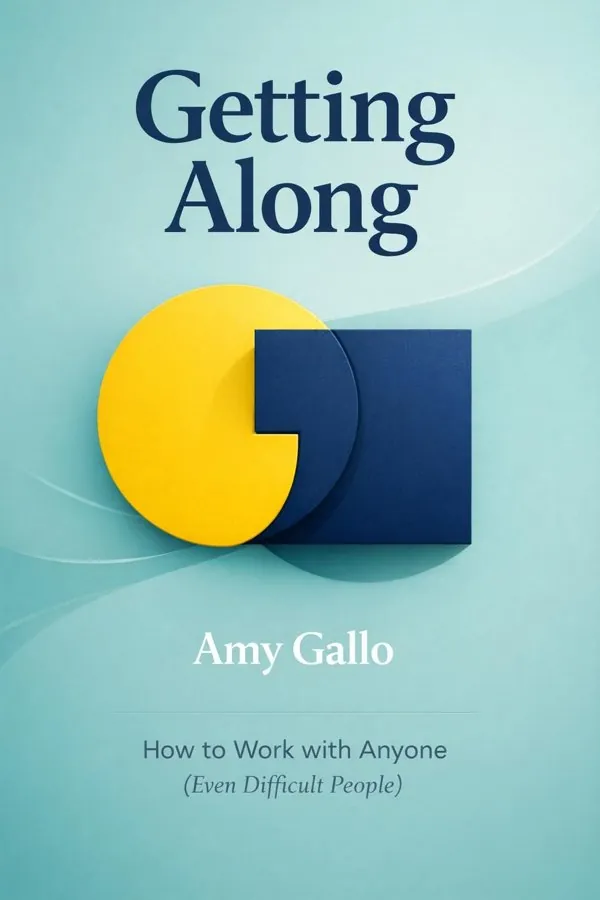
Getting Along: How to Work with Anyone (Even Difficult People): Summary & Key Insights
by Amy Gallo
 10 min9 chaptersAudio available
Key Takeaways from Getting Along: How to Work with Anyone (Even Difficult People)
Many people treat workplace conflict as proof that something has gone terribly wrong, but Amy Gallo invites us to see it differently.
Workplaces often pretend that emotions should stay outside the office, yet emotions quietly direct attention, interpretation, and behavior all day long.
One reason workplace conflict feels so exhausting is that we often treat every difficult person as if they require the same response.
A universal script will not solve every workplace relationship problem.
People often think difficult relationships are caused by personality clashes alone, but Amy Gallo shows how often communication habits intensify the problem.
What Is Getting Along: How to Work with Anyone (Even Difficult People) About?
Getting Along: How to Work with Anyone (Even Difficult People) by Amy Gallo is a organization book spanning 9 pages. Workplace stress is often blamed on pressure, deadlines, or constant change, but Amy Gallo argues that one of the biggest factors shaping our daily experience at work is far simpler: the people around us. In Getting Along: How to Work with Anyone (Even Difficult People), she shows that difficult colleagues are not rare exceptions but an unavoidable part of professional life. The real challenge is learning how to deal with them without losing your confidence, your focus, or your integrity. Rather than offering vague advice to “be more professional,” Gallo provides practical, research-based tools for understanding conflict, regulating emotions, setting boundaries, and improving communication. She explores why certain personalities trigger us, how power and politics complicate relationships, and what to do when collaboration feels impossible. A contributing editor at Harvard Business Review and a respected voice on workplace dynamics, Gallo draws on psychology, management research, and real-world examples to create a guide that is both empathetic and actionable. The result is a smart, deeply useful book for anyone who wants to work better with others while protecting their own well-being.
This FizzRead summary covers all 9 key chapters of Getting Along: How to Work with Anyone (Even Difficult People) in approximately 10 minutes, distilling the most important ideas, arguments, and takeaways from Amy Gallo's work. Also available as an audio summary and Key Quotes Podcast.
Getting Along: How to Work with Anyone (Even Difficult People)
Workplace stress is often blamed on pressure, deadlines, or constant change, but Amy Gallo argues that one of the biggest factors shaping our daily experience at work is far simpler: the people around us. In Getting Along: How to Work with Anyone (Even Difficult People), she shows that difficult colleagues are not rare exceptions but an unavoidable part of professional life. The real challenge is learning how to deal with them without losing your confidence, your focus, or your integrity. Rather than offering vague advice to “be more professional,” Gallo provides practical, research-based tools for understanding conflict, regulating emotions, setting boundaries, and improving communication. She explores why certain personalities trigger us, how power and politics complicate relationships, and what to do when collaboration feels impossible. A contributing editor at Harvard Business Review and a respected voice on workplace dynamics, Gallo draws on psychology, management research, and real-world examples to create a guide that is both empathetic and actionable. The result is a smart, deeply useful book for anyone who wants to work better with others while protecting their own well-being.
Who Should Read Getting Along: How to Work with Anyone (Even Difficult People)?
This book is perfect for anyone interested in organization and looking to gain actionable insights in a short read. Whether you're a student, professional, or lifelong learner, the key ideas from Getting Along: How to Work with Anyone (Even Difficult People) by Amy Gallo will help you think differently.
- ✓Readers who enjoy organization and want practical takeaways
- ✓Professionals looking to apply new ideas to their work and life
- ✓Anyone who wants the core insights of Getting Along: How to Work with Anyone (Even Difficult People) in just 10 minutes
Want the full summary?
Get instant access to this book summary and 100K+ more with Fizz Moment.
Get Free SummaryAvailable on App Store • Free to download
Key Chapters
Many people treat workplace conflict as proof that something has gone terribly wrong, but Amy Gallo invites us to see it differently. Disagreement at work is often a sign that people care, have competing priorities, or see a problem from different angles. In that sense, conflict is not the opposite of a healthy workplace; avoidance, resentment, and silence can be far more damaging. What matters is not whether conflict appears, but how people respond to it.
Gallo explains that conflict becomes destructive when assumptions harden into stories about another person’s motives. A missed deadline becomes “they don’t respect me.” A critical comment becomes “she’s trying to undermine me.” Once we move from behavior to character judgment, collaboration gets harder. The relationship starts to revolve around suspicion rather than problem-solving. By contrast, constructive conflict stays focused on actions, impacts, and shared goals.
This shift is especially useful in everyday workplace situations. If a colleague keeps interrupting in meetings, the unhelpful response is to label them arrogant and withdraw. A better response is to name the pattern and discuss its effect: “I’ve noticed I’m often cut off before I finish my point, and I want to make sure the team hears the full idea.” This keeps the issue concrete and solvable.
Gallo’s point is reassuring: you do not need a conflict-free workplace to do great work. You need the ability to stay curious, separate intent from impact, and address friction before it calcifies into contempt. The most effective professionals are not those who avoid tension altogether, but those who know how to channel it productively.
Actionable takeaway: The next time conflict arises, resist the urge to label the other person. Write down the specific behavior, its impact on your work, and one neutral question you can ask to open a constructive conversation.
Workplaces often pretend that emotions should stay outside the office, yet emotions quietly direct attention, interpretation, and behavior all day long. Amy Gallo argues that frustration, anxiety, envy, defensiveness, and even embarrassment are not signs of weakness; they are normal human reactions that influence how we listen, speak, and make judgments. Ignoring them does not make us more professional. It usually makes us less aware and more reactive.
A difficult coworker often triggers emotions before logic has time to catch up. A micromanager may spark irritation and self-doubt. A colleague who takes credit may provoke anger and resentment. A passive-aggressive teammate may leave you feeling confused and on edge. If you do not recognize these emotional reactions, they can easily control your response. You snap, overexplain, avoid the person, or ruminate for hours after a meeting.
Gallo emphasizes emotional regulation rather than emotional suppression. That means noticing what you feel, naming it accurately, and creating enough distance to choose your response. Small practices matter here: pausing before replying to an email, taking notes during a tense meeting so you do not interrupt impulsively, or asking for time to think instead of reacting on the spot. These actions protect both your credibility and your well-being.
She also reminds readers that difficult interactions are rarely one-sided in their emotional effects. The other person may be acting from fear, insecurity, stress, or perceived threat. Understanding this does not excuse poor behavior, but it can help you respond more strategically. If someone is defensive, more criticism may escalate the problem; reassurance and clarity may work better.
Actionable takeaway: When a colleague triggers you, pause and complete this sentence privately: “I’m feeling ___ because ___.” Naming the emotion reduces its grip and helps you choose a calm, intentional next step.
One reason workplace conflict feels so exhausting is that we often treat every difficult person as if they require the same response. Amy Gallo argues that this is a mistake. Not all challenging colleagues behave badly for the same reasons, and not all difficult behavior has the same impact. The colleague who is insecure and defensive needs a different approach than the one who is openly passive-aggressive, highly political, or chronically pessimistic.
Gallo outlines recurring patterns that appear across organizations: the insecure boss who overcontrols, the pessimist who drains momentum, the passive-aggressive coworker who avoids direct conversations, the know-it-all who dismisses others, the tormentor who intimidates, and the biased coworker whose behavior reflects exclusion or prejudice. These categories are not meant to be rigid diagnoses. Instead, they help you identify what dynamic you are actually dealing with.
This matters because naming the pattern changes your strategy. If someone constantly criticizes ideas in meetings, you might first assume they are hostile. But if they are actually an anxious perfectionist, giving them information in advance and asking for specific feedback may reduce friction. If someone flatters leaders and withholds support from peers, you may be dealing with a highly political operator, which means documenting decisions and building alliances becomes crucial.
Recognition also protects you from personalization. When you can see a difficult pattern clearly, you are less likely to conclude, “There must be something wrong with me.” Their behavior may still affect you, but it stops defining your self-worth. You move from confusion to diagnosis, and from diagnosis to action.
Actionable takeaway: Instead of asking, “Why is this person so impossible?” ask, “What pattern am I seeing?” Identify the dominant behavior, its likely driver, and one response tailored to that specific dynamic.
A universal script will not solve every workplace relationship problem. Amy Gallo’s most practical contribution is her insistence that each difficult type requires a customized approach. This is where the book moves beyond empathy and into strategy. Once you recognize the pattern, you can choose responses that reduce escalation and increase your odds of being heard.
For an insecure boss, reassurance and predictability may work better than confrontation. Sharing updates proactively, clarifying expectations, and showing alignment with team goals can reduce their urge to micromanage. With a know-it-all, direct status competition often backfires. It is more effective to ask focused questions, acknowledge what they know, and then redirect toward evidence or team objectives. A passive-aggressive colleague may avoid open disagreement but express resistance through delays, sarcasm, or selective cooperation. In that case, documenting agreements, asking clear follow-up questions, and moving vague conversations into concrete commitments helps bring the real issue into the open.
Gallo also stresses that not every strategy is about warmth. Some situations require boundaries rather than rapport. If you are dealing with a tormentor or someone who undermines you repeatedly, the right response may be to limit exposure, document incidents, involve a manager or HR, and protect your reputation with facts rather than emotional appeals.
The common thread is intentionality. Effective professionals do not simply react to difficult behavior. They test approaches, observe what changes, and adjust. They ask: What does this person value? What triggers them? What behavior do I need to reinforce, redirect, or stop? Tailored strategy turns a draining relationship into a manageable one, even if it never becomes easy.
Actionable takeaway: Choose one difficult relationship and create a simple plan: identify the person’s pattern, your usual unhelpful reaction, and one new behavior you will try in your next interaction.
People often think difficult relationships are caused by personality clashes alone, but Amy Gallo shows how often communication habits intensify the problem. Poor timing, vague language, mind-reading, defensive listening, and email misunderstandings can turn ordinary friction into lasting conflict. The good news is that communication is one of the few parts of a strained relationship you can improve immediately.
Gallo recommends clarity over accusation. Instead of saying, “You never listen,” describe what happened: “In yesterday’s meeting, I wasn’t able to finish my point before the discussion moved on.” This makes the conversation less inflammatory and easier to respond to. She also emphasizes curiosity. Asking, “Can you help me understand your concern?” or “What outcome are you aiming for?” shifts the interaction from combat to diagnosis.
Listening matters just as much as speaking. In tense situations, people often listen for flaws, not meaning. They prepare rebuttals while the other person is still talking. Gallo encourages reflective listening: summarizing what you heard, checking assumptions, and distinguishing between what someone said and what you inferred. This is especially useful when emotions are high or trust is low.
Medium matters too. Sensitive conversations rarely improve over email or chat, where tone is easy to misread and nuance disappears. A quick call or private meeting can prevent days of unnecessary resentment. Even small changes in wording help. “Here’s what I need” works better than “Why didn’t you?” and “What would make this easier?” works better than “What’s your problem?”
Actionable takeaway: Before your next hard conversation, prepare three sentences in advance: one factual observation, one statement of impact, and one open question. This structure keeps you grounded, clear, and less likely to escalate the situation.
The same conflict feels very different depending on who holds power. Amy Gallo makes clear that difficult workplace relationships cannot be understood fully without considering hierarchy, status, access, and influence. A disagreement with a peer may be stressful, but conflict with a manager, executive, or politically connected coworker carries higher stakes. People with less power often feel they must stay silent, while people with more power may underestimate the impact of their behavior.
Power affects what is safe to say, who gets believed, and whose mistakes are forgiven. That is why simple advice like “just have an honest conversation” can be naive. If your boss is insecure or volatile, direct feedback may jeopardize your standing. If a colleague has strong alliances with leadership, your version of events may be dismissed unless you have evidence and support. Gallo encourages readers to assess the political landscape before deciding how to act.
This does not mean becoming cynical. It means being realistic and strategic. You may need to choose the right timing, frame feedback in terms of business impact, or seek input from a trusted mentor before raising a concern. It may also mean strengthening your credibility proactively by delivering consistently, building cross-functional relationships, and documenting agreements. Influence is not only positional; it is also relational.
Gallo is especially thoughtful about biased or exclusionary behavior. When power and prejudice intersect, the emotional and professional costs are higher. In such cases, self-protection, allyship, and organizational accountability matter as much as communication skill.
Actionable takeaway: Map the power dynamic in one difficult relationship. Ask yourself what authority, alliances, and risks are involved, then choose an approach that protects both your message and your position.
Many workplace relationships deteriorate slowly: a few dismissive comments, a broken promise, a public disagreement, a pattern of exclusion. Over time, trust erodes and every interaction starts to feel loaded. Amy Gallo argues that while some relationships are too damaged to fully restore, many can improve if both people are willing to address what happened instead of pretending everything is fine.
Repair begins with specificity. Vague statements like “Things have felt off” rarely lead anywhere. It is more productive to identify the concrete moment or pattern that caused the rupture: being left out of decisions, receiving harsh feedback publicly, or feeling unsupported during a high-stakes project. Naming the issue clearly gives the other person something real to respond to.
Gallo also stresses the importance of accountability. Repair does not require mutual blame in equal measure, but it does require some recognition of impact. An effective apology acknowledges the behavior, the consequence, and a commitment to do differently. Equally, if you contributed to the breakdown by avoiding, reacting defensively, or making assumptions, owning your part can reopen dialogue without excusing the other person’s actions.
Trust is rebuilt through consistency, not one good conversation. That may involve setting new norms, clarifying expectations, or creating check-ins to prevent old patterns from resurfacing. For example, two coworkers who clashed over decision-making might agree to align before major meetings and document responsibilities in writing. These small structural changes support relational repair.
Actionable takeaway: If a relationship feels damaged, identify one specific incident to discuss, one responsibility you can own, and one concrete agreement that would make future interactions more reliable.
One of the hidden dangers of working with difficult people is isolation. When a relationship at work becomes tense, many people retreat inward. They ruminate privately, doubt their own perceptions, and try to solve everything alone. Amy Gallo argues that this instinct often makes the problem worse. A healthy support network provides perspective, emotional steadiness, and practical advice when your judgment is clouded by stress.
Support can take many forms: a trusted coworker who understands team dynamics, a manager who can offer context, a mentor who helps you think strategically, a friend outside work who reminds you that your job is not your whole identity, or a therapist or coach who helps you process recurring patterns. The goal is not to recruit allies for gossip or scorekeeping. It is to reality-check your assumptions and keep one difficult relationship from consuming your sense of self.
This is especially important when someone’s behavior makes you question your competence or worth. A tormenting colleague, dismissive manager, or biased teammate can distort how you see yourself. Supportive relationships counter that distortion. They help you distinguish between constructive feedback and corrosive treatment, between a normal setback and a toxic pattern.
Networks also matter politically. If a difficult colleague controls information or influences decision-makers, broadening your connections reduces your vulnerability. People who know your work, trust your judgment, and have seen your contributions firsthand can become informal advocates. Resilience at work is personal, but it is also social.
Actionable takeaway: Build a small work-resilience circle of three people: one peer for day-to-day perspective, one mentor for strategic guidance, and one outside confidant for emotional balance.
Difficult people do not operate in a vacuum. Amy Gallo reminds readers that organizations often reward, tolerate, or quietly enable the very behaviors employees complain about. A company that celebrates aggression as decisiveness, overwork as commitment, or political maneuvering as leadership will naturally produce more damaging conflict. If the culture discourages feedback or protects high performers regardless of conduct, individual skill alone may not be enough.
This broader view matters because it prevents overpersonalization. If multiple people find the same manager intimidating, the issue may not just be your chemistry with them. If meetings routinely reward interruption and grandstanding, the problem is partly systemic. Culture shapes what people think is normal, what they can get away with, and whether respectful collaboration is truly valued.
Gallo encourages readers, especially leaders, to create environments where conflict can be aired productively rather than expressed through gossip, avoidance, or sabotage. Clear norms help: no interrupting in meetings, disagreement focused on ideas not identity, feedback delivered directly, and roles defined to reduce turf wars. Leaders also need to model the behaviors they want to see. A manager who welcomes dissent, admits mistakes, and addresses bad behavior promptly sends a powerful signal.
At the individual level, you may not control the whole culture, but you can influence your immediate team. You can establish expectations, normalize direct but respectful communication, and refuse to participate in corrosive dynamics. Sometimes the healthiest conclusion is also that a culture is too toxic to fix from your position.
Actionable takeaway: Look beyond the difficult individual and ask what team norms are reinforcing the problem. Then identify one norm you can help establish, reinforce, or challenge in your immediate work environment.
All Chapters in Getting Along: How to Work with Anyone (Even Difficult People)
About the Author
Amy Gallo is a workplace expert, author, and contributing editor at Harvard Business Review, where she writes about conflict, communication, feedback, and interpersonal dynamics on the job. She is widely recognized for translating management research and psychology into clear, practical advice that professionals can apply immediately. Her work focuses on the human side of organizations: how people manage difficult colleagues, navigate tension, build trust, and become more effective collaborators and leaders. Gallo has written extensively on professional relationships and is known for combining empathy with realism, acknowledging both the emotional and political complexity of workplace life. In Getting Along, she brings together years of reporting, research, and coaching insight to help readers handle difficult people with greater confidence, clarity, and skill.
Get This Summary in Your Preferred Format
Read or listen to the Getting Along: How to Work with Anyone (Even Difficult People) summary by Amy Gallo anytime, anywhere. FizzRead offers multiple formats so you can learn on your terms — all free.
Available formats: App · Audio · PDF · EPUB — All included free with FizzRead
Download Getting Along: How to Work with Anyone (Even Difficult People) PDF and EPUB Summary
Key Quotes from Getting Along: How to Work with Anyone (Even Difficult People)
“Many people treat workplace conflict as proof that something has gone terribly wrong, but Amy Gallo invites us to see it differently.”
“Workplaces often pretend that emotions should stay outside the office, yet emotions quietly direct attention, interpretation, and behavior all day long.”
“One reason workplace conflict feels so exhausting is that we often treat every difficult person as if they require the same response.”
“A universal script will not solve every workplace relationship problem.”
“People often think difficult relationships are caused by personality clashes alone, but Amy Gallo shows how often communication habits intensify the problem.”
Frequently Asked Questions about Getting Along: How to Work with Anyone (Even Difficult People)
Getting Along: How to Work with Anyone (Even Difficult People) by Amy Gallo is a organization book that explores key ideas across 9 chapters. Workplace stress is often blamed on pressure, deadlines, or constant change, but Amy Gallo argues that one of the biggest factors shaping our daily experience at work is far simpler: the people around us. In Getting Along: How to Work with Anyone (Even Difficult People), she shows that difficult colleagues are not rare exceptions but an unavoidable part of professional life. The real challenge is learning how to deal with them without losing your confidence, your focus, or your integrity. Rather than offering vague advice to “be more professional,” Gallo provides practical, research-based tools for understanding conflict, regulating emotions, setting boundaries, and improving communication. She explores why certain personalities trigger us, how power and politics complicate relationships, and what to do when collaboration feels impossible. A contributing editor at Harvard Business Review and a respected voice on workplace dynamics, Gallo draws on psychology, management research, and real-world examples to create a guide that is both empathetic and actionable. The result is a smart, deeply useful book for anyone who wants to work better with others while protecting their own well-being.
You Might Also Like

A Guide to the Project Management Body of Knowledge (PMBOK® Guide)
Project Management Institute
10 min
Organizational Behavior
Stephen P. Robbins
10 min
Accelerate: The Science of Lean Software and DevOps – Building and Scaling High Performing Technology Organizations
Nicole Forsgren, Jez Humble, Gene Kim
10 min
Awakening Compassion at Work: The Quiet Power That Elevates People and Organizations
Monica C. Worline, Jane E. Dutton
10 min
Building an Inclusive Organization: Leveraging the Power of a Diverse Workforce
Stephen Frost
10 min
Collaborative Intelligence: Thinking with People Who Think Differently
Dawna Markova, Angie McArthur
10 minBrowse by Category
Ready to read Getting Along: How to Work with Anyone (Even Difficult People)?
Get the full summary and 100K+ more books with Fizz Moment.