
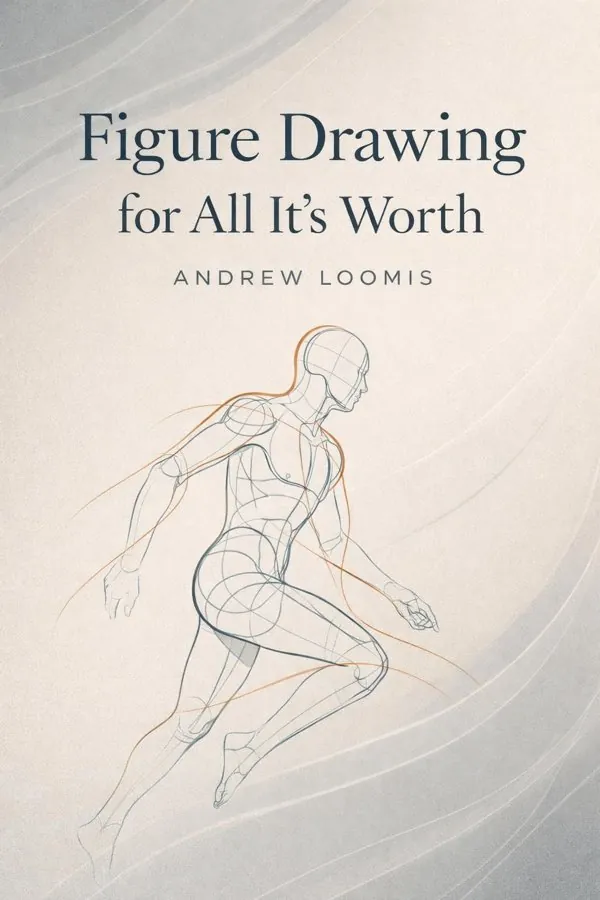
Figure Drawing for All It's Worth: Summary & Key Insights
 10 min9 chaptersAudio available
Key Takeaways from Figure Drawing for All It's Worth
One of Loomis’s most powerful insights is that the human figure only looks chaotic until you understand its underlying measurements.
A convincing figure is not drawn piece by piece; it is constructed.
Many artists believe anatomy is the secret to realism, but Loomis makes a subtler point: anatomy only becomes useful when it serves construction, movement, and design.
A technically correct figure can still feel dead if it lacks gesture.
Many artists can draw a standing figure from the side or front, but struggle the moment the pose turns, bends, or comes toward the viewer.
What Is Figure Drawing for All It's Worth About?
Figure Drawing for All It's Worth by Andrew Loomis is a design book spanning 12 pages. Figure Drawing for All It's Worth is one of the most enduring manuals ever written on drawing the human body. In this classic, illustrator and teacher Andrew Loomis breaks down what often feels like the most intimidating subject in art—the figure—into something logical, structured, and learnable. Rather than asking artists to memorize endless details, Loomis teaches them to see the body as an organized system of proportion, volume, balance, rhythm, and design. He moves from ideal measurements and simple construction forms to anatomy, movement, perspective, drapery, light, and professional illustration, showing how each principle supports convincing figure work. What makes the book matter decades after its publication is its combination of clarity and practicality. Loomis does not teach figure drawing as abstract theory; he teaches it as a working language for artists who want to create believable people from imagination, observation, or commercial assignments. His lessons help beginners build confidence while giving more advanced artists a stronger structural foundation. As a celebrated American illustrator whose instructional books shaped generations of artists, Loomis writes with the authority of someone who both understood the craft deeply and knew how to teach it exceptionally well.
This FizzRead summary covers all 9 key chapters of Figure Drawing for All It's Worth in approximately 10 minutes, distilling the most important ideas, arguments, and takeaways from Andrew Loomis's work. Also available as an audio summary and Key Quotes Podcast.
Figure Drawing for All It's Worth
Figure Drawing for All It's Worth is one of the most enduring manuals ever written on drawing the human body. In this classic, illustrator and teacher Andrew Loomis breaks down what often feels like the most intimidating subject in art—the figure—into something logical, structured, and learnable. Rather than asking artists to memorize endless details, Loomis teaches them to see the body as an organized system of proportion, volume, balance, rhythm, and design. He moves from ideal measurements and simple construction forms to anatomy, movement, perspective, drapery, light, and professional illustration, showing how each principle supports convincing figure work.
What makes the book matter decades after its publication is its combination of clarity and practicality. Loomis does not teach figure drawing as abstract theory; he teaches it as a working language for artists who want to create believable people from imagination, observation, or commercial assignments. His lessons help beginners build confidence while giving more advanced artists a stronger structural foundation. As a celebrated American illustrator whose instructional books shaped generations of artists, Loomis writes with the authority of someone who both understood the craft deeply and knew how to teach it exceptionally well.
Who Should Read Figure Drawing for All It's Worth?
This book is perfect for anyone interested in design and looking to gain actionable insights in a short read. Whether you're a student, professional, or lifelong learner, the key ideas from Figure Drawing for All It's Worth by Andrew Loomis will help you think differently.
- ✓Readers who enjoy design and want practical takeaways
- ✓Professionals looking to apply new ideas to their work and life
- ✓Anyone who wants the core insights of Figure Drawing for All It's Worth in just 10 minutes
Want the full summary?
Get instant access to this book summary and 100K+ more with Fizz Moment.
Get Free SummaryAvailable on App Store • Free to download
Key Chapters
One of Loomis’s most powerful insights is that the human figure only looks chaotic until you understand its underlying measurements. Beginners often see the body as a mass of confusing details—arms of uncertain length, torsos that shift unpredictably, legs that never seem to match. Loomis solves this by starting with proportion: the idea that the body follows a readable system of relationships. His famous use of the head as a unit of measure gives artists a practical way to compare body parts and maintain consistency. While real people vary widely, an idealized proportional framework trains the eye to notice when something feels too long, too short, too high, or too wide.
This matters because proportion is not about creating stiff formulas; it is about establishing a dependable baseline. Once you know the average placement of shoulders, waist, hips, knees, and hands, you can exaggerate, stylize, or individualize with much greater control. In illustration, animation, fashion drawing, or comics, this ability is essential. A figure can be heroic, elegant, slender, aged, or heavy, but if its proportional relationships are not intentional, the drawing often feels wrong even when viewers cannot explain why.
A practical way to apply Loomis’s method is to sketch standing figures using head units before adding any anatomical detail. Mark the major landmarks first: chin, nipples, navel, crotch, knees, and feet. Then compare male and female variations, or adapt the system for children and character designs. Over time, this repeated measuring develops intuition.
Actionable takeaway: Before rendering any figure, map the body in simple proportional units and place major landmarks first; accuracy in detail begins with accuracy in structure.
A convincing figure is not drawn piece by piece; it is constructed. That is one of Loomis’s central teachings, and it changes the entire approach to figure drawing. Instead of chasing outlines, he encourages artists to think in solid forms—boxes for the rib cage or pelvis, cylinders for limbs, spheres for joints, wedges for hands and feet. This method turns the figure into something you can rotate, pose, and light in your mind. It also prevents a common beginner mistake: drawing a flat silhouette that looks acceptable from one angle but collapses as soon as the pose becomes dynamic.
Construction matters because drawing is really a problem of translating three-dimensional form onto a two-dimensional page. If you understand the body as connected masses rather than decorative contours, the figure gains volume and credibility. The torso is no longer just a shape with a waist; it becomes an interlocking relationship between rib cage and pelvis. The arm is not a line from shoulder to wrist; it is a sequence of tapering cylinders with clear direction and articulation. This way of thinking helps artists work from reference, memory, or imagination with equal strength.
In practice, Loomis’s approach is especially useful for rough drafts, gesture block-ins, and complex poses. If a seated figure looks awkward, it is often because the major masses were never properly established. If a foreshortened arm looks strange, the cylinders may not be oriented correctly in perspective. Even stylized art improves when the underlying forms are sound.
Actionable takeaway: Start every figure as a set of simple three-dimensional masses before refining anatomy or contour; if the forms work, the finished drawing has a much stronger chance of succeeding.
Many artists believe anatomy is the secret to realism, but Loomis makes a subtler point: anatomy only becomes useful when it serves construction, movement, and design. Memorizing every muscle is not the goal. The real purpose of anatomical study is to understand what creates visible surface form, what influences motion, and what matters most in a drawing. Bones establish the body’s framework, joints determine movement, and major muscle groups explain the masses and tensions we actually see. This selective understanding is far more valuable than trying to become a medical illustrator without a practical drawing system.
Loomis treats the skeleton and musculature as the hidden machinery of the figure. The pelvis tilts, the rib cage turns, the scapula shifts, and the muscles stretch or compress in response. These internal mechanics explain why a pose feels balanced or strained, elegant or rigid. They also help artists avoid superficial copying. When you know what lies beneath the skin, you can simplify with intelligence. A boxer’s torso, a dancer’s back, and an elderly person’s hands each reveal structure differently, but all become easier to draw when you recognize the major forms driving the surface.
This knowledge has immediate applications. Portrait and character artists use anatomy to make poses believable. Comic and fantasy artists use it to exaggerate strength without losing plausibility. Even fashion illustrators benefit, because clothing hangs on anatomical structure, not on abstract mannequins.
Actionable takeaway: Study anatomy in layers—skeleton first, then major muscle masses, then surface forms—and focus only on the structures that visibly affect pose, proportion, and movement in your drawings.
A technically correct figure can still feel dead if it lacks gesture. Loomis understood that the body is never just a collection of parts; it is an organized expression of action, intention, and weight. Gesture is the living idea of the pose—the sweep, thrust, curve, opposition, and rhythm that make a figure feel active even when standing still. Balance is the physical truth that supports this life. A body must carry its weight somewhere, and convincing drawing depends on showing how that weight is distributed through the spine, hips, legs, and feet.
This is why many stiff drawings fail: the artist measures but does not feel. Loomis teaches artists to look for directional flow before details. Where is the action line? Which side is compressed, and which side is stretched? Which leg bears the weight? How does the pelvis tilt in response? These questions transform figure drawing from copying shape to understanding force. A relaxed standing person is not symmetrical; one hip usually rises, one leg bears more load, and the torso adjusts accordingly. In movement, these shifts become even more dramatic.
Gesture also improves storytelling. A leaning figure suggests hesitation or fatigue. An upward thrust through the chest can suggest pride or excitement. In illustration and character design, these physical cues communicate emotion before a face is even drawn. Quick gesture studies, especially timed ones, train the eye to capture essentials rather than getting trapped in details too early.
Actionable takeaway: Begin each drawing with a rapid gesture line and a clear indication of weight-bearing balance; if the energy and support of the pose work first, the rest of the figure becomes much easier to build.
Many artists can draw a standing figure from the side or front, but struggle the moment the pose turns, bends, or comes toward the viewer. Loomis addresses this by insisting that the figure must obey the same spatial laws as any other object. Perspective and foreshortening are not special effects reserved for advanced artists; they are everyday necessities for making the body appear solid in space. Once the torso, limbs, and head are understood as simple forms, they can be placed on perspective paths and rotated convincingly.
Foreshortening feels difficult because the eye tends to trust what it knows rather than what it sees. We know an arm is long, so when it points toward us, we hesitate to shorten it enough. Loomis’s construction approach solves this problem. A cylinder aimed at the viewer becomes an ellipse-led form, not a flat line. A rib cage turning away changes width and overlap. A thigh coming forward may visually dominate the body even if it is not actually larger. These distortions are not mistakes; they are the visible truth of perspective.
The practical value is enormous. Dynamic comics, cinematic illustration, sports art, and even fashion poses all benefit from figures that occupy space convincingly. Artists can stage more dramatic viewpoints and avoid the repetitive, flat poses that result from fear of spatial distortion. Loomis helps readers understand that perspective is a tool of clarity and drama, not merely technical correctness.
Actionable takeaway: Practice drawing torsos, heads, arms, and legs as simple forms rotated in space from extreme angles; mastering foreshortened construction unlocks more dynamic and believable figure drawing.
Not all figures should be built from the same template. Loomis emphasizes that while general proportional systems provide a foundation, successful figure drawing also depends on recognizing meaningful differences between male and female bodies, youthful and mature forms, idealized and ordinary physiques. These distinctions are not superficial decorations; they emerge from structural tendencies such as shoulder width, pelvic shape, rib cage mass, fat distribution, musculature, and the rhythms of contour.
Loomis’s treatment is especially useful because he avoids reducing difference to cliché. The male figure often carries greater angularity, broader shoulders, stronger visible muscle masses, and a narrower pelvis relative to the torso. The female figure tends toward softer transitions, broader hips relative to the waist, and a different pattern of balance and contour flow. But within these categories, character still matters. A laborer, dancer, child, elderly person, athlete, or aristocratic socialite each carries posture and structure differently. Understanding these variables allows artists to draw individuals rather than generic mannequins.
The same principle extends to the head and hands, which Loomis treats as especially expressive areas. Hands can suggest age, refinement, labor, anxiety, or confidence. Head construction influences personality, attractiveness, and emotional readability. In narrative art, these differences help define character before any costume or dialogue appears.
Artists can apply this by creating figure studies around specific identities rather than abstract bodies. Draw the same pose as a young athlete, an older office worker, and a teenager, adjusting structure and gesture accordingly. This develops observation and design sensitivity.
Actionable takeaway: Use ideal proportion as a starting point, then deliberately modify structure, contour, and rhythm to express sex, age, physique, and personality in each figure.
Clothing and shading often tempt artists into decoration before structure, but Loomis shows that both drapery and light should serve the figure rather than hide it. Fabric is not a separate subject floating over the body; it responds to anatomical structure, gravity, tension, compression, and movement. Likewise, light and shadow are not just aesthetic additions. They reveal planes, reinforce form, and help the viewer understand the body’s orientation in space. When used well, both drapery and value deepen realism and design at the same time.
Loomis teaches artists to think of folds as consequences. A bent elbow creates compression folds. A hanging sleeve produces gravity folds. A belt or waistband becomes a point of tension from which cloth radiates or drops. If the body underneath is poorly constructed, the drapery will also fail, no matter how elegantly rendered the folds appear. The same is true of shading. Random darkening muddies a drawing, but organized light describing major planes can make even a simple construction sketch feel dimensional.
This principle is crucial for illustration and concept art, where costumes often matter as much as anatomy. A cloak should help reveal movement. Trousers should explain the bend of the knee. Light can direct focus toward the face or hands while preserving the figure’s overall structure. Even minimal tonal work can separate overlapping forms, clarify foreshortening, and strengthen mood.
A practical exercise is to draw the same figure first nude in construction, then clothed, then under a single clear light source. This sequence trains you to see how surface effects depend on form.
Actionable takeaway: Never use clothing or shading to guess your way through a figure; define the body first, then let fabric and light explain, enhance, and design the forms already in place.
A well-drawn body is not automatically a successful picture. Loomis repeatedly reminds artists that figure drawing ultimately serves design, communication, and visual impact. Composition is what transforms anatomical knowledge into art. It governs how the figure fits the page, how shapes interact, where emphasis falls, how negative space supports the pose, and how the viewer’s eye travels through the image. In other words, the figure must not only be correct; it must also belong to the picture as a whole.
This is especially important because artists can become so absorbed in proportion and anatomy that they forget pictorial design. A beautifully constructed figure may still feel awkward if cropped poorly, centered without purpose, or surrounded by dead space. Loomis shows that silhouette, line rhythm, mass arrangement, and tonal grouping all contribute to the emotional and aesthetic strength of the drawing. The figure may dominate the composition, balance with other elements, or become part of a larger storytelling arrangement.
For professional artists, this idea is indispensable. Illustration, advertising art, editorial work, and entertainment design all require figures that communicate quickly and clearly. A gesture can lead the eye toward a product, a face, or another character. Lighting can create hierarchy. Repetition of curves or diagonals can strengthen drama or grace. Even in fine art, thoughtful compositional arrangement often separates an exercise from a finished work.
A practical method is to thumbnail several versions of the same figure placement before developing the final drawing. Adjust scale, cropping, background shape, and directional flow. Often the strongest solution emerges only after experimentation.
Actionable takeaway: Treat every figure as part of a designed image; before refining details, test multiple compositional arrangements to ensure the pose supports the picture’s overall impact.
Loomis does not present figure drawing as a talent some people simply possess. His broader message is that mastery grows from disciplined, intelligent practice directed toward clear visual problems. Artists improve when they repeatedly train proportion, construction, anatomy, gesture, perspective, and design together—not in isolation forever, but as interconnected skills. This practical mindset is one reason the book remains so influential. It speaks to learners who want results, not mystique.
He also understands the realities of professional art. Illustrators cannot wait for inspiration or rely solely on live models. They must invent figures, adapt references, solve compositional challenges, and deliver convincing results under real constraints. That requires a working method. Loomis offers exactly that: a sequence from simple to complex, from general to specific, from structure to finish. This approach supports not only academic study but also commercial application in publishing, advertising, concept art, comics, and visual storytelling.
The most valuable lesson here may be that growth is cumulative. Quick sketches sharpen gesture. Construction studies improve imagination. Anatomical review corrects recurring weaknesses. Finished renderings test patience and design judgment. Each kind of practice serves a different purpose. Artists stagnate when they only polish finished drawings or only copy references without analysis. They progress when they alternate between study, application, and review.
A strong modern application is to build a weekly routine: gesture sessions, mannequin construction, anatomy notes, master copies, and one complete figure composition. That mirrors Loomis’s philosophy of structured development.
Actionable takeaway: Create a deliberate practice system that rotates through observation, construction, anatomy, perspective, and finished figure work; steady, focused repetition is what turns knowledge into usable skill.
All Chapters in Figure Drawing for All It's Worth
About the Author
Andrew Loomis (1892–1959) was an American illustrator, art instructor, and author whose teaching books became foundational texts for generations of artists. He worked during the golden age of American commercial illustration, creating images for advertising and publishing while developing a reputation for exceptional draftsmanship and design clarity. Loomis had a rare gift for translating complex visual ideas into practical lessons, which led to influential books such as Figure Drawing for All It's Worth, Drawing the Head and Hands, Fun with a Pencil, and Creative Illustration. Though rooted in classical principles, his methods remain highly relevant to modern illustration, comics, animation, and concept art. Today he is widely regarded as one of the most important drawing teachers of the twentieth century.
Get This Summary in Your Preferred Format
Read or listen to the Figure Drawing for All It's Worth summary by Andrew Loomis anytime, anywhere. FizzRead offers multiple formats so you can learn on your terms — all free.
Available formats: App · Audio · PDF · EPUB — All included free with FizzRead
Download Figure Drawing for All It's Worth PDF and EPUB Summary
Key Quotes from Figure Drawing for All It's Worth
“One of Loomis’s most powerful insights is that the human figure only looks chaotic until you understand its underlying measurements.”
“A convincing figure is not drawn piece by piece; it is constructed.”
“Many artists believe anatomy is the secret to realism, but Loomis makes a subtler point: anatomy only becomes useful when it serves construction, movement, and design.”
“A technically correct figure can still feel dead if it lacks gesture.”
“Many artists can draw a standing figure from the side or front, but struggle the moment the pose turns, bends, or comes toward the viewer.”
Frequently Asked Questions about Figure Drawing for All It's Worth
Figure Drawing for All It's Worth by Andrew Loomis is a design book that explores key ideas across 9 chapters. Figure Drawing for All It's Worth is one of the most enduring manuals ever written on drawing the human body. In this classic, illustrator and teacher Andrew Loomis breaks down what often feels like the most intimidating subject in art—the figure—into something logical, structured, and learnable. Rather than asking artists to memorize endless details, Loomis teaches them to see the body as an organized system of proportion, volume, balance, rhythm, and design. He moves from ideal measurements and simple construction forms to anatomy, movement, perspective, drapery, light, and professional illustration, showing how each principle supports convincing figure work. What makes the book matter decades after its publication is its combination of clarity and practicality. Loomis does not teach figure drawing as abstract theory; he teaches it as a working language for artists who want to create believable people from imagination, observation, or commercial assignments. His lessons help beginners build confidence while giving more advanced artists a stronger structural foundation. As a celebrated American illustrator whose instructional books shaped generations of artists, Loomis writes with the authority of someone who both understood the craft deeply and knew how to teach it exceptionally well.
More by Andrew Loomis
You Might Also Like

The Design of Everyday Things
Don Norman
10 min
The Better Angels of Our Nature
Steven Pinker
10 min
A Designer's Art
Paul Rand
10 min
Architects' Sketchbooks
Various Editors
10 min
Architectural Graphic Standards
The American Institute of Architects
10 min
Design Is Storytelling
Ellen Lupton
10 minBrowse by Category
Ready to read Figure Drawing for All It's Worth?
Get the full summary and 100K+ more books with Fizz Moment.