
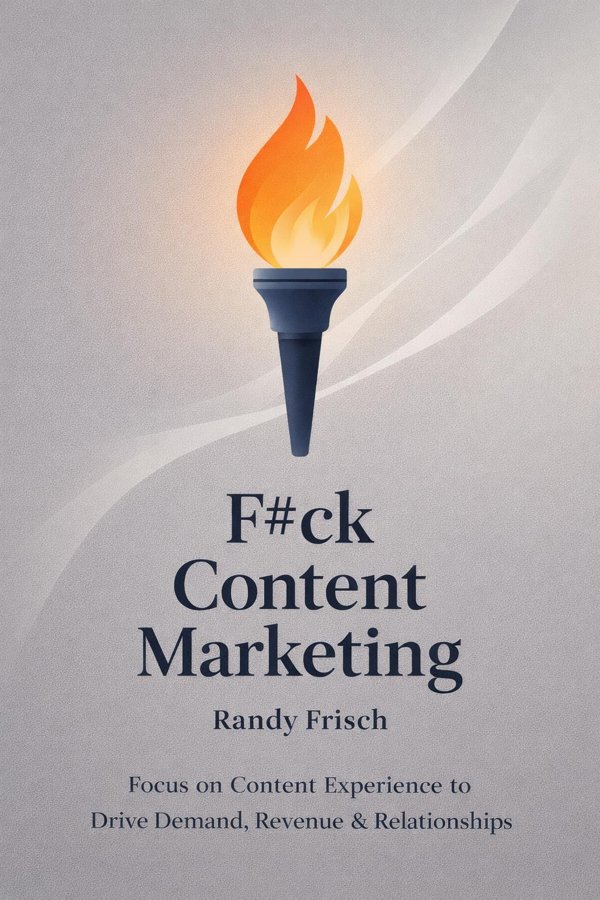
F#ck Content Marketing: Focus on Content Experience to Drive Demand, Revenue & Relationships: Summary & Key Insights
by Randy Frisch
 10 min10 chaptersAudio available
Key Takeaways from F#ck Content Marketing: Focus on Content Experience to Drive Demand, Revenue & Relationships
A great piece of content can still fail if the experience around it is poor.
The marketing world has confused activity with effectiveness.
People do not want more information; they want the right information at the right moment.
A pile of valuable content is still just a pile unless it is structured for discovery and movement.
Marketing technology often promises efficiency, but Frisch reminds readers that efficiency without experience is a hollow win.
What Is F#ck Content Marketing: Focus on Content Experience to Drive Demand, Revenue & Relationships About?
F#ck Content Marketing: Focus on Content Experience to Drive Demand, Revenue & Relationships by Randy Frisch is a marketing book spanning 10 pages. In F#ck Content Marketing, Randy Frisch delivers a sharp critique of one of modern marketing’s most exhausting habits: producing endless content without thinking enough about how people actually experience it. His argument is simple but powerful. Content alone does not create results. What drives demand, revenue, and customer relationships is the experience surrounding that content: how it is organized, personalized, presented, and connected to the buyer’s journey. Instead of asking teams to make more blogs, more ebooks, and more campaigns, Frisch urges marketers to make existing content easier to discover, more relevant to the audience, and more useful in context. This message matters because many organizations already have a large library of marketing assets, yet still struggle with engagement and conversion. Frisch, co-founder and Chief Evangelist of Uberflip, writes from deep experience in B2B marketing and content technology. He has spent years helping brands improve how prospects move through digital content environments. The book is both a challenge to outdated marketing habits and a practical guide for building smarter, more customer-centered content systems.
This FizzRead summary covers all 10 key chapters of F#ck Content Marketing: Focus on Content Experience to Drive Demand, Revenue & Relationships in approximately 10 minutes, distilling the most important ideas, arguments, and takeaways from Randy Frisch's work. Also available as an audio summary and Key Quotes Podcast.
F#ck Content Marketing: Focus on Content Experience to Drive Demand, Revenue & Relationships
In F#ck Content Marketing, Randy Frisch delivers a sharp critique of one of modern marketing’s most exhausting habits: producing endless content without thinking enough about how people actually experience it. His argument is simple but powerful. Content alone does not create results. What drives demand, revenue, and customer relationships is the experience surrounding that content: how it is organized, personalized, presented, and connected to the buyer’s journey. Instead of asking teams to make more blogs, more ebooks, and more campaigns, Frisch urges marketers to make existing content easier to discover, more relevant to the audience, and more useful in context.
This message matters because many organizations already have a large library of marketing assets, yet still struggle with engagement and conversion. Frisch, co-founder and Chief Evangelist of Uberflip, writes from deep experience in B2B marketing and content technology. He has spent years helping brands improve how prospects move through digital content environments. The book is both a challenge to outdated marketing habits and a practical guide for building smarter, more customer-centered content systems.
Who Should Read F#ck Content Marketing: Focus on Content Experience to Drive Demand, Revenue & Relationships?
This book is perfect for anyone interested in marketing and looking to gain actionable insights in a short read. Whether you're a student, professional, or lifelong learner, the key ideas from F#ck Content Marketing: Focus on Content Experience to Drive Demand, Revenue & Relationships by Randy Frisch will help you think differently.
- ✓Readers who enjoy marketing and want practical takeaways
- ✓Professionals looking to apply new ideas to their work and life
- ✓Anyone who wants the core insights of F#ck Content Marketing: Focus on Content Experience to Drive Demand, Revenue & Relationships in just 10 minutes
Want the full summary?
Get instant access to this book summary and 100K+ more with Fizz Moment.
Get Free SummaryAvailable on App Store • Free to download
Key Chapters
A great piece of content can still fail if the experience around it is poor. That is the core insight behind Frisch’s concept of content experience. He argues that marketers have spent too much time obsessing over the asset itself and not enough on the environment in which that asset is consumed. A blog post, ebook, video, or case study does not exist in isolation. It lives inside a digital journey shaped by navigation, recommendations, design, relevance, timing, and next steps. If that journey is confusing, fragmented, or generic, even strong content loses impact.
Frisch defines content experience as the full context in which content is presented and consumed. That includes how easy it is to find, how well it matches a visitor’s needs, and whether it smoothly guides the person forward. A landing page that dumps a visitor into a dead end is not an experience. Neither is a website where every asset sits in a giant library with no curation. In contrast, a thoughtful experience might group related resources by industry, pain point, or buying stage, then recommend the logical next piece based on behavior.
This shifts marketing from a production mindset to a design mindset. Instead of asking, “What content should we make next?” teams begin asking, “How do we help someone progress?” For example, a SaaS company could create a curated destination for CFOs exploring automation, combining short educational articles, a relevant case study, a calculator, and a demo invitation in one coherent path.
Actionable takeaway: Audit one of your highest-traffic content destinations and improve the surrounding journey, not just the asset itself.
The marketing world has confused activity with effectiveness. Frisch argues that many teams are trapped in a relentless cycle of content production because output feels measurable and productive. More blogs published, more white papers launched, more webinars scheduled. But the hidden cost of this volume-first approach is content overload. Buyers face an endless stream of material, while marketing teams burn time and budget creating assets that are never properly used, promoted, or connected.
This overload hurts both the audience and the organization. Prospects become overwhelmed and disengaged when every interaction feels like another disconnected piece of promotion. Internally, sales cannot find the right materials, old assets become buried, and performance data is spread across too many campaigns to generate insight. Instead of building momentum, content accumulation creates friction.
Frisch’s point is not that content is unimportant. It is that unmanaged abundance is wasteful. Many brands already possess enough valuable content to support better buyer journeys, but they fail to extract value because assets are scattered, poorly tagged, and rarely repurposed. A company may produce a brilliant research report, then fail to break it into blog posts, sales snippets, industry pages, nurture streams, and executive summaries. The issue is not scarcity. It is underutilization.
A practical application is to review your existing library before approving new production. Ask whether a new campaign truly needs fresh content or whether existing materials can be reorganized into a better experience. A demand generation team, for instance, might reduce new asset creation by creating tailored hubs for different personas using content already in hand.
Actionable takeaway: Create a “reuse before create” rule for campaigns so your team prioritizes curation, repackaging, and distribution before commissioning new assets.
People do not want more information; they want the right information at the right moment. Frisch emphasizes that relevance is what transforms passive content consumption into meaningful engagement. Context and personalization are therefore not optional enhancements. They are central to content experience. Without them, marketing feels generic, self-centered, and easy to ignore.
Context means understanding where the buyer is in their journey, what problem they are trying to solve, and what motivated them to arrive. Personalization means adjusting the content environment to reflect that understanding. This does not require invasive data practices or complex one-to-one automation from day one. It can begin with practical segmentation: by industry, role, account type, campaign source, funnel stage, or known interests.
Imagine two people visiting the same website: a first-time visitor researching a problem and a late-stage buyer from a target account. Showing both the same homepage, same ebook offer, and same sequence wastes opportunity. The first person may need educational content and clear orientation. The second may need case studies, integration details, and pricing-related proof. A personalized content experience helps each visitor move forward faster.
Frisch also highlights the emotional aspect of personalization. When audiences feel understood, trust rises. This matters especially in B2B, where buying journeys are complex and often involve multiple stakeholders. Personalized experiences can support each participant with curated paths rather than dumping everyone into one broad content archive.
Actionable takeaway: Start with one high-value segment, such as enterprise buyers or a priority industry, and build a tailored content path that reflects their needs, objections, and decision stage.
A pile of valuable content is still just a pile unless it is structured for discovery and movement. Frisch argues that one of the biggest missed opportunities in marketing is poor content organization. Teams often store assets in scattered folders, campaign pages, or CMS silos, making it difficult for both buyers and internal teams to find what matters. The result is a broken user experience and an underperforming content investment.
Effective organization means treating content like a journey architecture rather than a warehouse. Assets should be categorized and connected in ways that mirror audience needs. That can include sorting by persona, industry, use case, funnel stage, product line, or business problem. Just as importantly, organization should support sequencing. Once someone consumes one piece, what should they see next? What path reduces confusion and builds confidence?
For example, a cybersecurity company might organize content into themed destinations such as compliance, threat detection, and cloud security, each with beginner, intermediate, and decision-stage resources. A visitor who downloads a compliance checklist could then see related analyst reports, customer stories, and a webinar invitation, all within the same stream of relevance. This feels less like hunting through a website and more like being guided by a helpful expert.
Better organization also helps internal teams. Salespeople can locate relevant assets quickly, customer success can share educational materials more easily, and marketing can identify content gaps with more precision. Organization becomes an operational advantage, not just a design choice.
Actionable takeaway: Build a simple taxonomy for your content library and connect each asset to a persona, topic, and buyer stage so it can be surfaced in purposeful journeys.
Marketing technology often promises efficiency, but Frisch reminds readers that efficiency without experience is a hollow win. The purpose of content technology is not simply to publish faster or automate more touchpoints. It is to help marketers deliver more relevant, connected, and measurable content experiences. Platforms, data systems, and automation tools matter only insofar as they improve the audience journey.
This is where Frisch’s background with Uberflip becomes especially visible. He sees content experience platforms as a way to bridge the gap between content creation and demand generation. Instead of leaving assets trapped in static PDFs, disconnected landing pages, or generic resource centers, marketers can use technology to assemble dynamic hubs, recommend next-best content, personalize by audience, and track behavior across journeys.
The danger, however, is adopting tools without a strategy. A sophisticated platform will not fix poor messaging, bad taxonomy, or unclear audience priorities. Teams first need a vision of the experience they want to create. Then they can select technology that supports it. For example, a company running account-based marketing might use intent data, CRM signals, and content experience software to create personalized destination pages for target accounts. But that only works if content is already tagged, aligned to account needs, and designed to move conversations forward.
Frisch encourages marketers to think less about isolated tools and more about systems. The best stack is one where CMS, marketing automation, analytics, CRM, and content experience tools work together to create continuity from first touch to revenue.
Actionable takeaway: Evaluate your current martech stack by asking one question: does it help buyers discover and progress through relevant content, or does it mainly help your team publish more?
Bad content experiences are often symptoms of organizational misalignment. Frisch points out that content does not fail only because of weak ideas or poor design. It fails because teams operate in silos. Marketing creates assets for campaigns, sales asks for one-off materials, product marketing focuses on launches, and customer teams build separate enablement libraries. Each group is active, but the buyer experiences the result as fragmented and inconsistent.
To build strong content experiences, organizations need shared goals, common definitions, and cross-functional collaboration. Marketing cannot own the entire journey alone. Sales needs visibility into what content exists and when to use it. Product marketing needs to connect messaging to actual buyer questions. Revenue leaders need to support systems that prioritize relevance over raw output. Without alignment, content becomes a scattered set of departmental artifacts rather than a coherent growth engine.
Frisch’s approach encourages teams to unite around audience progression. Instead of measuring success by how many assets each team shipped, leaders should ask whether content is helping people move from awareness to trust to decision. That creates better conversations between departments. A sales team might reveal that prospects repeatedly ask about implementation, prompting marketing to elevate onboarding content earlier in the journey. Customer success might identify educational resources that help renewals and expansion.
A practical example is creating a shared content council that reviews audience needs, top-performing assets, content gaps, and journey friction. This turns content planning into a business-wide process rather than a marketing-only exercise.
Actionable takeaway: Bring marketing, sales, and customer-facing teams together once a month to review how content supports actual buyer and customer journeys, not just campaign calendars.
A page view can be comforting, but it can also be misleading. Frisch argues that traditional content metrics often reward the wrong behavior. Marketers celebrate downloads, visits, impressions, and clicks because these are easy to track. Yet none of them necessarily indicate that the audience experienced value or moved closer to a buying decision. If content experience is the goal, measurement must focus on progression, engagement quality, and business impact.
This means asking deeper questions. Did the visitor consume multiple related assets? Did they spend meaningful time with the material? Did the content path increase return visits, accelerate deal movement, or create stronger sales conversations? Did the experience influence pipeline, conversion, retention, or expansion? Metrics should help marketers understand how content contributes to momentum, not just exposure.
For example, a curated resource hub for healthcare buyers may attract fewer total visits than a broad blog, but if those visitors engage with several pieces, book more demos, and influence larger opportunities, the hub is more valuable. Similarly, a content stream used in account-based marketing might be judged by account engagement depth and meeting creation rather than total traffic.
Frisch does not reject top-of-funnel metrics entirely. He simply insists they should not be mistaken for outcomes. Better analytics allow teams to justify content investments, identify friction points, and optimize buyer journeys with purpose. Measurement becomes a feedback loop for experience design.
Actionable takeaway: Add at least three journey-focused metrics to your dashboard, such as assets consumed per session, progression to next-stage action, or pipeline influenced by content experiences.
One of the most persuasive aspects of Frisch’s argument is that content experience is not an abstract theory. It shows up clearly in real marketing situations where curation outperforms random distribution. Across examples and case studies, the lesson is consistent: when marketers package content thoughtfully around a specific audience need, engagement rises and outcomes improve.
Curation works because it reduces cognitive load. Instead of forcing someone to search through a huge content archive, marketers do the sorting for them. This makes the brand feel useful and informed. A software company targeting operations leaders, for instance, might create a destination called “The Modern Operations Playbook” featuring selected articles, benchmark data, a customer success story, and a short product video. The prospect does not have to guess where to start or what matters next. The experience itself signals competence.
These examples also show that curation helps marketers get more value from existing assets. Rather than launching a new campaign with entirely new material, teams can regroup past webinars, blog posts, guides, and testimonials into fresh, audience-specific experiences. This is both efficient and effective. It lets brands move faster without sacrificing relevance.
Frisch’s broader point is that audiences respond to intentionality. People notice when content feels assembled for their needs rather than thrown into a generic repository. This is especially important in B2B environments where trust, clarity, and expertise influence purchase decisions.
Actionable takeaway: Pick one campaign or persona and create a curated content hub from assets you already have, then compare its engagement and conversion rates with your standard landing pages.
Tools, tactics, and taxonomies matter, but Frisch ultimately argues for a deeper shift in mindset. The real problem with traditional content marketing is not just inefficient production. It is the belief that publishing more is inherently good. That belief leads teams to chase calendars, formats, and vanity metrics instead of customer progress. Content experience requires a different way of thinking: less like a publisher filling space and more like a strategist designing journeys.
This mindset starts with empathy. What is the audience trying to achieve? What questions are slowing them down? What proof do they need to trust us? From there, marketers can design experiences that reduce friction and increase confidence. The emphasis moves from “How many assets did we ship?” to “How effectively did we guide the buyer?”
Adopting this mindset also changes internal behavior. Teams become more willing to audit, repurpose, archive, and simplify. They accept that not every campaign needs a brand-new asset. They value coherence over quantity and utility over novelty. Leadership plays a crucial role here by rewarding outcomes rather than output. If teams are pressured to publish constantly, they will struggle to invest in better experiences.
Frisch’s challenge is ultimately cultural. Content experience is not a campaign tactic layered onto old habits. It is a strategic philosophy that reshapes planning, collaboration, technology use, and measurement. Organizations that embrace it can build trust and demand more efficiently than those stuck on the content treadmill.
Actionable takeaway: Redefine your team’s success criteria for the next quarter so at least one major objective focuses on improving content journeys, not increasing content volume.
As audiences become more selective and digital channels more crowded, simply creating content will deliver diminishing returns. Frisch sees the future of marketing belonging to organizations that can orchestrate useful, personalized, and seamless experiences across the full customer journey. In that future, content remains essential, but its value depends on how well it is activated.
This shift is driven by buyer behavior. Modern customers are self-directed, overloaded, and skeptical. They expect relevance, speed, and continuity. They move across channels and devices, involve multiple stakeholders, and compare vendors long before speaking to sales. Brands that still rely on isolated assets and generic follow-up will struggle to hold attention. Experience-led marketing, by contrast, treats every interaction as part of a connected relationship.
Frisch’s vision also extends beyond acquisition. Strong content experiences can support onboarding, customer education, loyalty, and expansion. A company that curates resources effectively for prospects can apply the same logic to customer success centers, partner enablement, and renewal programs. This makes content experience a growth strategy, not just a top-of-funnel tactic.
The organizations best positioned for this future are not necessarily the ones with the largest content budgets. They are the ones that use what they have intelligently, align teams around customer needs, and continuously optimize the path from interest to action. That is a more sustainable advantage than sheer output.
Actionable takeaway: Treat your content strategy as an end-to-end experience system by mapping how content supports awareness, evaluation, purchase, adoption, and retention.
All Chapters in F#ck Content Marketing: Focus on Content Experience to Drive Demand, Revenue & Relationships
About the Author
Randy Frisch is the co-founder and Chief Evangelist of Uberflip, a platform built to help marketers create better content experiences. He is widely recognized in the B2B marketing world for his work on demand generation, audience engagement, and the strategic use of content across the buyer journey. Through Uberflip, Frisch has worked with numerous brands to improve how their content is organized, personalized, and connected to business outcomes. He is also a frequent speaker at marketing conferences and a respected commentator on the future of digital marketing. In F#ck Content Marketing, he draws on both practical experience and industry observation to challenge the obsession with content volume and advocate for a more effective, experience-led approach.
Get This Summary in Your Preferred Format
Read or listen to the F#ck Content Marketing: Focus on Content Experience to Drive Demand, Revenue & Relationships summary by Randy Frisch anytime, anywhere. FizzRead offers multiple formats so you can learn on your terms — all free.
Available formats: App · Audio · PDF · EPUB — All included free with FizzRead
Download F#ck Content Marketing: Focus on Content Experience to Drive Demand, Revenue & Relationships PDF and EPUB Summary
Key Quotes from F#ck Content Marketing: Focus on Content Experience to Drive Demand, Revenue & Relationships
“A great piece of content can still fail if the experience around it is poor.”
“The marketing world has confused activity with effectiveness.”
“People do not want more information; they want the right information at the right moment.”
“A pile of valuable content is still just a pile unless it is structured for discovery and movement.”
“Marketing technology often promises efficiency, but Frisch reminds readers that efficiency without experience is a hollow win.”
Frequently Asked Questions about F#ck Content Marketing: Focus on Content Experience to Drive Demand, Revenue & Relationships
F#ck Content Marketing: Focus on Content Experience to Drive Demand, Revenue & Relationships by Randy Frisch is a marketing book that explores key ideas across 10 chapters. In F#ck Content Marketing, Randy Frisch delivers a sharp critique of one of modern marketing’s most exhausting habits: producing endless content without thinking enough about how people actually experience it. His argument is simple but powerful. Content alone does not create results. What drives demand, revenue, and customer relationships is the experience surrounding that content: how it is organized, personalized, presented, and connected to the buyer’s journey. Instead of asking teams to make more blogs, more ebooks, and more campaigns, Frisch urges marketers to make existing content easier to discover, more relevant to the audience, and more useful in context. This message matters because many organizations already have a large library of marketing assets, yet still struggle with engagement and conversion. Frisch, co-founder and Chief Evangelist of Uberflip, writes from deep experience in B2B marketing and content technology. He has spent years helping brands improve how prospects move through digital content environments. The book is both a challenge to outdated marketing habits and a practical guide for building smarter, more customer-centered content systems.
You Might Also Like
Captivology: The Science of Capturing People's Attention
Ben Parr
10 min
Marketing 5.0: Technology for Humanity
Philip Kotler, Hermawan Kartajaya, Iwan Setiawan
10 min
Marketing Strategy
Paul Fifield
10 min
UnMarketing: Stop Marketing. Start Engaging.
Scott Stratten
10 min
$100M Leads: How to Get Strangers to Want to Buy Your Stuff
Alex Hormozi
10 min
80/20 Sales and Marketing: The Definitive Guide to Working Less and Making More
Perry Marshall
10 minBrowse by Category
Ready to read F#ck Content Marketing: Focus on Content Experience to Drive Demand, Revenue & Relationships?
Get the full summary and 100K+ more books with Fizz Moment.