
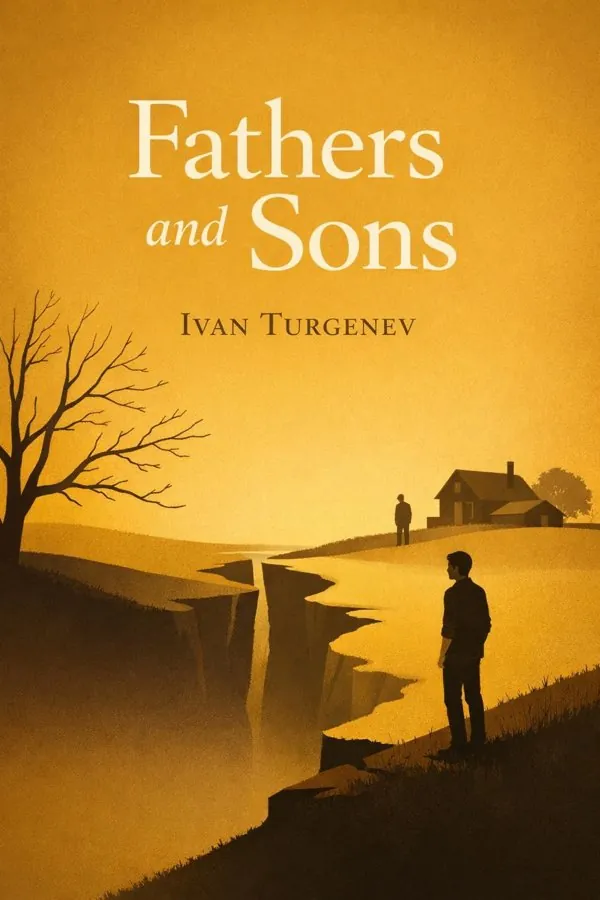
Fathers and Sons: Summary & Key Insights
 10 min9 chaptersAudio available
Key Takeaways from Fathers and Sons
The most revealing conflicts often begin in places that seem peaceful.
Every era creates a figure who believes demolition is more honest than devotion.
Conflict deepens when each side mistakes the other’s deepest motive.
Nothing tests a philosophy like an emotion it cannot control.
Growing up often means discovering that admiration is not identity.
What Is Fathers and Sons About?
Fathers and Sons by Ivan Turgenev is a classics book spanning 5 pages. First published in 1862, Fathers and Sons is Ivan Turgenev’s sharp, elegant portrait of a society caught between inheritance and rebellion. At its center is Yevgeny Bazarov, a brilliant young nihilist who rejects sentiment, tradition, authority, and nearly every ideal the older generation holds dear. When he arrives at the Kirsanov estate with his friend Arkady, his ideas ignite tensions in drawing rooms, family relationships, and matters of the heart. What follows is not simply a clash between parents and children, but a deeper confrontation between competing visions of truth, progress, love, and human purpose. The novel matters because it captures a recurring historical pattern: younger generations challenge institutions they see as empty, while older generations defend values they believe civilization cannot survive without. Turgenev explores this conflict with unusual fairness, refusing to turn any character into a caricature. That balance is part of his authority. As one of the great Russian novelists of the nineteenth century, Turgenev combined psychological insight, social observation, and stylistic grace, creating a work that still feels urgent wherever politics, identity, and family loyalties collide.
This FizzRead summary covers all 9 key chapters of Fathers and Sons in approximately 10 minutes, distilling the most important ideas, arguments, and takeaways from Ivan Turgenev's work. Also available as an audio summary and Key Quotes Podcast.
Fathers and Sons
First published in 1862, Fathers and Sons is Ivan Turgenev’s sharp, elegant portrait of a society caught between inheritance and rebellion. At its center is Yevgeny Bazarov, a brilliant young nihilist who rejects sentiment, tradition, authority, and nearly every ideal the older generation holds dear. When he arrives at the Kirsanov estate with his friend Arkady, his ideas ignite tensions in drawing rooms, family relationships, and matters of the heart. What follows is not simply a clash between parents and children, but a deeper confrontation between competing visions of truth, progress, love, and human purpose.
The novel matters because it captures a recurring historical pattern: younger generations challenge institutions they see as empty, while older generations defend values they believe civilization cannot survive without. Turgenev explores this conflict with unusual fairness, refusing to turn any character into a caricature. That balance is part of his authority. As one of the great Russian novelists of the nineteenth century, Turgenev combined psychological insight, social observation, and stylistic grace, creating a work that still feels urgent wherever politics, identity, and family loyalties collide.
Who Should Read Fathers and Sons?
This book is perfect for anyone interested in classics and looking to gain actionable insights in a short read. Whether you're a student, professional, or lifelong learner, the key ideas from Fathers and Sons by Ivan Turgenev will help you think differently.
- ✓Readers who enjoy classics and want practical takeaways
- ✓Professionals looking to apply new ideas to their work and life
- ✓Anyone who wants the core insights of Fathers and Sons in just 10 minutes
Want the full summary?
Get instant access to this book summary and 100K+ more with Fizz Moment.
Get Free SummaryAvailable on App Store • Free to download
Key Chapters
Every era creates a figure who believes demolition is more honest than devotion. In Bazarov, Turgenev presents that figure with unusual force. Bazarov calls himself a nihilist, meaning someone who accepts nothing on authority and rejects inherited ideals that cannot be tested, proven, or made useful. He mocks poetry, romance, aristocratic manners, and abstract principles. He values science, directness, and intellectual independence. To him, reverence is a form of weakness, and sentiment is often self-deception.
Yet Turgenev does not treat nihilism as a simple villain. Bazarov’s critique has power because much of what he attacks is indeed stale or performative. Empty politeness, social vanity, and unearned privilege deserve scrutiny. That is why Bazarov unsettles everyone around him: he exposes hypocrisy with precision. At the same time, his worldview risks becoming reductionist. By refusing what cannot be measured, he dismisses beauty, tenderness, and moral complexity as if they were illusions.
This tension gives the novel its intellectual life. Bazarov is not merely wrong or right; he is dangerously partial. Modern readers can recognize the same pattern in voices that reject institutions, traditions, or emotional language in the name of realism. Skepticism can liberate people from falsehood, but it can also strip life of meaning when it turns into contempt for everything human.
In practical terms, Bazarov invites us to test our own beliefs. Which values do we hold because they are true, and which because they are habitual? But he also warns against defining intelligence as perpetual negation. Actionable takeaway: question inherited ideas boldly, but do not assume that what cannot be quantified is therefore worthless.
Conflict deepens when each side mistakes the other’s deepest motive. One of the novel’s strongest insights is that the older and younger generations do not merely disagree; they interpret each other poorly. The older men, especially Pavel Petrovich, see the younger radicals as arrogant destroyers who have abandoned honor, form, and civilization itself. The younger men, especially under Bazarov’s influence, see their elders as decorative survivors of a dead age, clinging to manners because they have lost substance.
Neither view is entirely false, but neither is complete. Pavel can appear rigid and theatrical, yet he preserves a genuine belief that restraint, dignity, and cultivated behavior matter. Bazarov can seem brutal in his dismissiveness, yet he is motivated by an honest desire to cut through pretense and confront reality. Arkady moves between these camps, showing how people often inherit emotional loyalties from one world while intellectually aspiring to another.
This misreading matters because it shows why ideological disputes become personal so quickly. Once one side concludes that the other is not merely mistaken but morally unserious, dialogue collapses. The novel’s family dynamics make this painfully clear. Affection remains, but it is strained by the fear of becoming obsolete or ridiculous.
The same pattern appears in workplaces, politics, and social debates today. Older generations may dismiss younger voices as naive; younger generations may dismiss older ones as compromised. Productive exchange begins only when each side can see that behind the style of expression lies a real human concern.
Actionable takeaway: in any generational disagreement, identify the fear driving the other side—irrelevance, disorder, hypocrisy, loss, or betrayal—before trying to win the argument.
Nothing tests a philosophy like an emotion it cannot control. Bazarov prides himself on treating love as a chemical disturbance, a sentimental fiction inflated by weak minds. He believes human beings should resist illusions and submit only to what can be understood materially. Then he meets Anna Odintsova, an intelligent, self-possessed widow whose calm presence unsettles him. For perhaps the first time, his confidence in pure detachment begins to crack.
Turgenev handles this development with great subtlety. Anna is not simply a romantic object; she represents poise, intelligence, and emotional discipline. Bazarov’s attraction to her reveals that human beings cannot fully master themselves through theory alone. His confession of love is especially powerful because it is so at odds with his self-image. He is shaken not only by desire, but by the humiliation of needing something he cannot rationally command.
Anna, meanwhile, is drawn to Bazarov’s force but ultimately recoils from the instability he brings. She prefers order to surrender. Their failed relationship shows that emotional truth does not guarantee compatibility. It also demonstrates that insight into one’s feelings is different from the ability to live by them.
This part of the novel remains highly relevant. People often build identities around being logical, independent, or immune to vulnerability, only to discover that love, grief, attachment, and longing expose unseen needs. Ideologies may explain human behavior, but they rarely contain it.
In practical life, this suggests that self-knowledge requires more than intellectual coherence. Our reactions in intimacy often reveal beliefs we did not know we held. Actionable takeaway: notice where strong emotion disrupts your self-image; those moments often reveal the truths your worldview has failed to accommodate.
Growing up often means discovering that admiration is not identity. At first, Arkady appears thoroughly shaped by Bazarov’s influence. He echoes nihilist ideas, imitates Bazarov’s tone, and enjoys the borrowed confidence that comes from aligning with someone more forceful and original than himself. Like many young people, he mistakes the intensity of a mentor’s convictions for proof of their universal truth.
But Turgenev gradually shows that Arkady’s nature is different. He is not built for relentless negation. He is affectionate, sociable, and drawn to balance rather than extremity. His emotional loyalties to his father, to family life, and eventually to a more settled future cannot be permanently overridden by fashionable radicalism. This does not make him weak. Instead, it suggests that maturity involves distinguishing between ideas that stimulate us and ideas that actually fit our character and responsibilities.
Arkady’s development is one of the novel’s quiet triumphs. He does not defeat Bazarov in debate; he simply grows away from him. That is often how real intellectual change happens. We outlive borrowed postures not by spectacular renunciation, but by discovering what kind of life we are actually prepared to inhabit.
This arc has clear modern applications. Students, young professionals, and emerging thinkers frequently adopt the language of admired peers, online figures, or ideological communities before testing whether those beliefs can sustain a humane daily life. Influence can be educational, but dependence on influence prevents genuine selfhood.
Actionable takeaway: ask which of your strongest opinions arise from lived conviction and which are performances borrowed from someone you once wanted to impress.
The novel’s deepest tenderness lies in its recognition that love is often clumsy, unequal, and misunderstood. Nikolai Petrovich and Bazarov’s parents offer two different portraits of parental devotion, and both complicate the book’s ideological debates. Nikolai is gentle, somewhat self-conscious, and painfully aware that his son’s generation finds him old-fashioned. Still, he continues to love Arkady without demanding total agreement. His vulnerability gives the novel moral warmth.
Bazarov’s parents are even more moving. Simple, devoted, and almost reverential toward their son, they represent a kind of unconditional love that his intellect cannot fully honor. Bazarov may dismiss sentiment in principle, yet in their presence the reader sees how much tenderness exists outside systems of thought. Their household exposes the emotional poverty of any worldview that cannot recognize gratitude, dependence, and filial duty as serious human realities.
Turgenev’s insight is that parents and children rarely love each other in perfectly symmetrical ways. Parents often remain attached to earlier versions of their children; children often fail to understand the sacrifices embedded in ordinary care. This mismatch can produce embarrassment, impatience, or guilt, especially during moments of ideological separation.
Today, many adults still struggle to appreciate forms of love expressed through worry, repetition, awkward generosity, or values they no longer share. The novel encourages readers to look beneath style and education to the enduring fact of devotion.
Actionable takeaway: when family members express care imperfectly, try translating their behavior into the emotional intention behind it before judging its form.
Ideas become dangerous when personal vanity attaches itself to them. The conflict between Bazarov and Pavel Petrovich illustrates how philosophical disagreement can harden into a contest of ego. On one level, they oppose each other intellectually: Bazarov rejects aristocratic ideals, cultivated manners, and inherited authority, while Pavel defends honor, discipline, and civilized form. But their hostility exceeds the content of their arguments. Each man experiences the other as an insult to his entire way of being.
This escalation culminates in the duel, one of the novel’s most revealing episodes. The duel is both absurd and serious. It appears outdated, almost theatrical, yet it emerges from recognizable human impulses: wounded pride, sexual jealousy, and the inability to tolerate disrespect. Turgenev shows that even those who claim to live by reason or principle can be overtaken by ancient emotional reflexes.
The duel also exposes the limits of ideological purity. Pavel, defender of old codes, is trapped by forms that no longer fit the age. Bazarov, champion of modern realism, is drawn into a ritual he ought to despise. Both men are compromised by the gap between their stated beliefs and their actual behavior.
This remains strikingly contemporary. Public disputes today often begin around ideas but escalate because status, identity, and humiliation become involved. Once people feel mocked, they stop seeking truth and start seeking victory. Institutions, friendships, and teams can all be damaged this way.
Actionable takeaway: when a disagreement suddenly feels urgent, ask whether you are defending a principle or protecting your pride. Naming that distinction early can prevent needless escalation.
Mortality is the final test of every worldview. In the closing movement of Fathers and Sons, Bazarov’s illness and death bring the novel to its most profound register. A man who sought mastery through skepticism, discipline, and contempt for illusion confronts the one reality that cannot be argued down. His end is not presented as a punishment for nihilism, nor as a sentimental conversion. Instead, Turgenev allows death to reveal the human being beneath the pose.
Bazarov remains recognizably himself, but his vulnerability becomes impossible to ignore. The intensity that once made him formidable now appears tragic, even lonely. Around him gather the people whose love he never fully knew how to receive. In these scenes, Turgenev suggests that no amount of intelligence cancels our dependence on others. We may build identities around autonomy, but suffering returns us to the basic truths of care, fear, and connection.
The emotional power of the ending lies in its refusal to simplify. Bazarov does not become harmless or suddenly conventional. He remains one of literature’s great embodiments of rebellious intellect. Yet his death shows that rebellion alone cannot provide a whole philosophy of life. Human beings need more than critique; they need forms of belonging that survive defeat.
Modern readers can apply this insight broadly. Crisis often exposes which beliefs are merely rhetorical and which actually sustain us. Illness, grief, and uncertainty reveal the relationships and values that matter when performance drops away.
Actionable takeaway: do not wait for crisis to discover what truly sustains you; identify now the people, practices, and convictions you would want beside you when control disappears.
History changes quickly, but human life continues through quieter rhythms. After the novel’s conflicts, disappointments, and losses, Turgenev ends not with total rupture but with a complex sense of continuity. Relationships re-form, domestic life resumes, and the world does not stop because one ideology has risen or one powerful personality has fallen. This is not a trivial conclusion. It is Turgenev’s way of resisting both nostalgia and revolutionary absolutism.
The novel acknowledges that generations do transform society. New ideas matter. Old forms can decay. Certain beliefs truly become untenable. Yet Turgenev also insists that life cannot be reduced to manifestos. Marriage, work, family care, memory, and seasonal renewal continue to shape existence after intellectual battles have cooled. The future belongs neither wholly to the fathers nor wholly to the sons. It emerges from an unstable, ongoing negotiation between inheritance and change.
This perspective is especially valuable today, when social conflict is often framed in totalizing terms. People are tempted to imagine that one election, one movement, one cultural shift, or one ideological victory will permanently settle the meaning of society. Turgenev reminds us that history is less final than that. Human beings adapt, absorb, and carry fragments of opposing worlds forward.
The ending therefore offers a sober kind of hope. It does not deny pain, but it suggests that continuity itself is a moral resource. Communities endure not because they avoid conflict, but because life keeps asking people to build again.
Actionable takeaway: when facing cultural or personal upheaval, focus not only on what is collapsing, but also on what forms of care, responsibility, and renewal can still be preserved and passed on.
All Chapters in Fathers and Sons
About the Author
Ivan Sergeyevich Turgenev (1818–1883) was one of the great Russian writers of the nineteenth century, celebrated for his novels, short stories, and plays. Born into a wealthy landowning family, he studied in Moscow, St. Petersburg, and Berlin, experiences that helped shape his lifelong interest in the conflict between Russian tradition and European modernity. Turgenev became known for his graceful prose, psychological precision, and balanced treatment of social issues. Unlike more polemical writers, he excelled at portraying opposing viewpoints with sympathy and complexity. His major works include Rudin, A Nest of the Gentry, On the Eve, and Fathers and Sons, his best-known novel. Turgenev also played an important role in bringing Russian literature to Western Europe, influencing generations of readers and writers with his humane, deeply observant fiction.
Get This Summary in Your Preferred Format
Read or listen to the Fathers and Sons summary by Ivan Turgenev anytime, anywhere. FizzRead offers multiple formats so you can learn on your terms — all free.
Available formats: App · Audio · PDF · EPUB — All included free with FizzRead
Download Fathers and Sons PDF and EPUB Summary
Key Quotes from Fathers and Sons
“The most revealing conflicts often begin in places that seem peaceful.”
“Every era creates a figure who believes demolition is more honest than devotion.”
“Conflict deepens when each side mistakes the other’s deepest motive.”
“Nothing tests a philosophy like an emotion it cannot control.”
“Growing up often means discovering that admiration is not identity.”
Frequently Asked Questions about Fathers and Sons
Fathers and Sons by Ivan Turgenev is a classics book that explores key ideas across 9 chapters. First published in 1862, Fathers and Sons is Ivan Turgenev’s sharp, elegant portrait of a society caught between inheritance and rebellion. At its center is Yevgeny Bazarov, a brilliant young nihilist who rejects sentiment, tradition, authority, and nearly every ideal the older generation holds dear. When he arrives at the Kirsanov estate with his friend Arkady, his ideas ignite tensions in drawing rooms, family relationships, and matters of the heart. What follows is not simply a clash between parents and children, but a deeper confrontation between competing visions of truth, progress, love, and human purpose. The novel matters because it captures a recurring historical pattern: younger generations challenge institutions they see as empty, while older generations defend values they believe civilization cannot survive without. Turgenev explores this conflict with unusual fairness, refusing to turn any character into a caricature. That balance is part of his authority. As one of the great Russian novelists of the nineteenth century, Turgenev combined psychological insight, social observation, and stylistic grace, creating a work that still feels urgent wherever politics, identity, and family loyalties collide.
More by Ivan Turgenev
You Might Also Like




Browse by Category
Ready to read Fathers and Sons?
Get the full summary and 100K+ more books with Fizz Moment.