
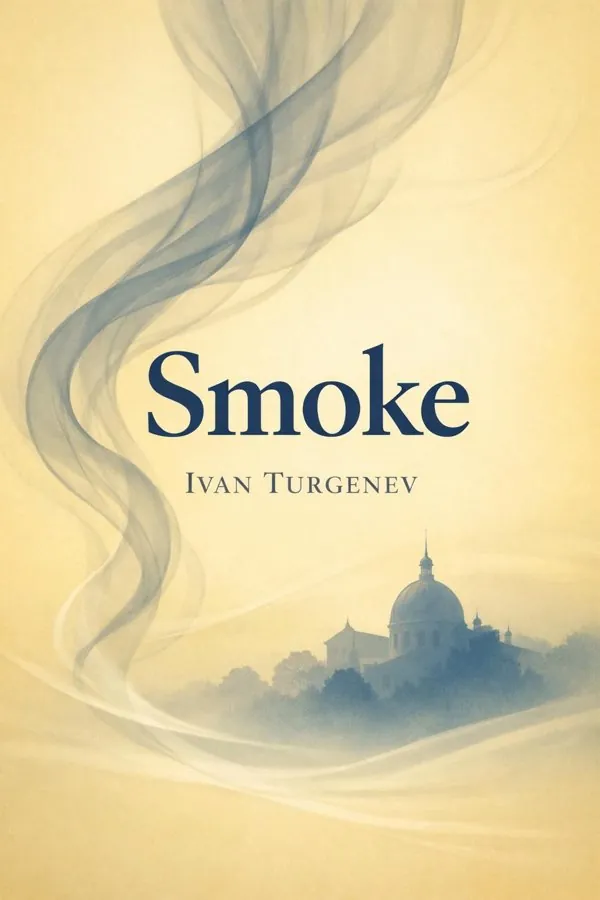
Smoke: Summary & Key Insights
 10 min8 chaptersAudio available
Key Takeaways from Smoke
One of the novel’s sharpest insights is that much of what society treats as serious, urgent, or powerful is little more than performance.
Turgenev understands that love does not merely delight or wound us; it exposes us.
A striking feature of Smoke is its satire of political and intellectual discussion among Russians abroad.
In Smoke, the most morally valuable qualities are not brilliance, social charm, or sophistication, but sincerity, steadiness, and truthfulness.
Few novelists depict self-deception as delicately as Turgenev.
What Is Smoke About?
Smoke by Ivan Turgenev is a general book. Ivan Turgenev’s Smoke is far more than a love story set in a fashionable European resort. First published in 1867, the novel unfolds in Baden-Baden, where Russian aristocrats, political exiles, opportunists, and dreamers gather in a haze of conversation, vanity, and restless ambition. At its center is Grigory Litvinov, a thoughtful young man engaged to the sincere and grounded Tatyana, whose life is thrown into turmoil when he reunites with his former love, the dazzling and destructive Irina. Through this emotional conflict, Turgenev explores a larger national drama: the confusion of Russian identity, the emptiness of social performance, and the difficulty of living honestly in a world clouded by illusion. The title itself suggests what Turgenev sees in both politics and passion: much that appears substantial dissolves into air. Turgenev writes with unusual authority because he stood at the crossroads of Russian and European culture, observing both with sympathy and irony. Smoke remains powerful because it captures a timeless truth: people often mistake noise, glamour, and ideology for real purpose, only to discover that integrity is quieter and harder won.
This FizzRead summary covers all 8 key chapters of Smoke in approximately 10 minutes, distilling the most important ideas, arguments, and takeaways from Ivan Turgenev's work. Also available as an audio summary and Key Quotes Podcast.
Smoke
Ivan Turgenev’s Smoke is far more than a love story set in a fashionable European resort. First published in 1867, the novel unfolds in Baden-Baden, where Russian aristocrats, political exiles, opportunists, and dreamers gather in a haze of conversation, vanity, and restless ambition. At its center is Grigory Litvinov, a thoughtful young man engaged to the sincere and grounded Tatyana, whose life is thrown into turmoil when he reunites with his former love, the dazzling and destructive Irina. Through this emotional conflict, Turgenev explores a larger national drama: the confusion of Russian identity, the emptiness of social performance, and the difficulty of living honestly in a world clouded by illusion. The title itself suggests what Turgenev sees in both politics and passion: much that appears substantial dissolves into air. Turgenev writes with unusual authority because he stood at the crossroads of Russian and European culture, observing both with sympathy and irony. Smoke remains powerful because it captures a timeless truth: people often mistake noise, glamour, and ideology for real purpose, only to discover that integrity is quieter and harder won.
Who Should Read Smoke?
This book is perfect for anyone interested in general and looking to gain actionable insights in a short read. Whether you're a student, professional, or lifelong learner, the key ideas from Smoke by Ivan Turgenev will help you think differently.
- ✓Readers who enjoy general and want practical takeaways
- ✓Professionals looking to apply new ideas to their work and life
- ✓Anyone who wants the core insights of Smoke in just 10 minutes
Want the full summary?
Get instant access to this book summary and 100K+ more with Fizz Moment.
Get Free SummaryAvailable on App Store • Free to download
Key Chapters
One of the novel’s sharpest insights is that much of what society treats as serious, urgent, or powerful is little more than performance. In Smoke, Baden-Baden becomes a stage on which Russian elites, would-be reformers, idle aristocrats, and self-important intellectuals talk endlessly, posture constantly, and rarely act meaningfully. Turgenev uses this atmosphere to suggest that human beings are deeply susceptible to illusion. We confuse motion with progress, conversation with thought, and reputation with substance. The title Smoke captures this perfectly: what seems dense and dramatic may quickly disperse when touched by reality.
This idea is not limited to politics or high society. It applies to everyday life. Many people chase titles, social approval, online visibility, or fashionable opinions without asking whether these things align with their deeper values. A person can appear successful while feeling inwardly directionless. A group can sound passionate about change while remaining trapped in vanity and rivalry. Turgenev does not deny that public life matters; he warns that it becomes hollow when detached from sincerity and responsibility.
Litvinov, the novel’s central figure, repeatedly encounters people who are full of opinions but lacking in clarity. Their talk creates fog rather than understanding. Against this, Turgenev places the possibility of a simpler, more grounded life based on commitment, useful work, and emotional honesty. The contrast is not glamorous, but it is morally revealing.
A practical application of this idea is to ask, whenever something appears impressive: what real value does this create? In work, relationships, and public debate, look for evidence, consistency, and character rather than spectacle. Actionable takeaway: regularly separate what is merely dramatic from what is genuinely meaningful, and choose the latter even when it attracts less attention.
Turgenev understands that love does not merely delight or wound us; it exposes us. Smoke centers on Litvinov’s engagement to the gentle, trustworthy Tatyana and his destabilizing reunion with Irina, the woman who once captivated him and still holds immense emotional power over him. Through this triangle, the novel shows how romantic attachment can uncover hidden weakness, vanity, longing, and self-deception. People like to believe they know themselves, but desire often reveals otherwise.
Litvinov enters the story with a reasonable path before him. He is engaged, his future appears stable, and he imagines himself capable of living according to principle. Yet when Irina reappears, all this confidence begins to crumble. Her beauty, sophistication, and emotional ambiguity awaken old passions and fantasies. He is not simply choosing between two women; he is choosing between two versions of himself. One version seeks rootedness, sincerity, and useful work. The other is seduced by intensity, status, memory, and the thrill of the unattainable.
This dynamic remains deeply recognizable. People often mistake emotional intensity for emotional truth. They return to destructive relationships because those bonds feel more vivid than healthier alternatives. They idealize past loves, forgetting the pain and instability that came with them. Turgenev does not portray this weakness with cruelty. Instead, he shows how intelligent, decent people can still be overwhelmed by unresolved desire.
The practical lesson is that attraction alone is not a trustworthy guide. A relationship should be judged not only by how intensely it feels, but by what kind of person it makes you become. Does it deepen your honesty, steadiness, and care for others, or does it feed confusion and self-absorption? Actionable takeaway: when love feels overwhelming, pause and ask whether the relationship supports your values or only inflames your fantasies.
A striking feature of Smoke is its satire of political and intellectual discussion among Russians abroad. Turgenev presents a world full of declarations, arguments, and ideological posturing, yet surprisingly poor in wisdom. Conservatives cling to habit and status. Progressives speak grandly about reform and national destiny. Everyone seems eager to classify, condemn, and impress. But much of this debate, in Turgenev’s view, produces heat without light. The problem is not that ideas matter too much; it is that they are often treated as badges of identity instead of tools for understanding reality.
This is one reason the novel provoked strong reactions in its own time. Turgenev refused to flatter any faction. He exposed the shallowness of aristocratic complacency, but he also mocked radical rhetoric when it turned abstract, vain, or disconnected from actual human improvement. His target is intellectual dishonesty in all forms. He suggests that public discourse becomes corrupt when people prefer belonging to a camp over thinking clearly for themselves.
The novel’s relevance is obvious today. Political conversations often reward certainty, outrage, and performance more than nuance, humility, or practical problem-solving. People repeat slogans from their chosen side and mistake this repetition for insight. Groups become echo chambers in which dissent feels like betrayal. Turgenev’s warning is not anti-political; it is anti-fog. He asks readers to notice when language obscures rather than clarifies.
A practical response is to test every idea against lived consequences. Does a proposal improve real lives? Does an argument invite thought or merely signal allegiance? Can the speaker acknowledge complexity? Productive civic engagement requires curiosity, patience, and the willingness to revise one’s views. Actionable takeaway: refuse ideological theater by valuing clear thinking, concrete evidence, and independent judgment over fashionable rhetoric.
In Smoke, the most morally valuable qualities are not brilliance, social charm, or sophistication, but sincerity, steadiness, and truthfulness. Turgenev builds much of the novel’s emotional power on this contrast. Irina dazzles. She is beautiful, worldly, and magnetically alive. Tatyana, by contrast, embodies a quieter goodness. She lacks theatrical glamour, yet she offers what the novel ultimately treats as far more sustaining: reliability, emotional clarity, and moral depth.
This opposition is not simplistic. Turgenev does not make Irina merely evil or Tatyana merely decorative. Instead, he examines a common human error: we are often drawn toward what excites us and blind to what nourishes us. Glamour promises transcendence. Sincerity asks for patience. Glamour flatters the imagination. Sincerity demands trust. Because it is quieter, sincerity is easy to underestimate until it is lost.
This pattern appears in many parts of life. In careers, people may choose prestige over meaningful work. In friendships, they may gravitate toward charisma rather than loyalty. In public life, they may admire dramatic personalities while ignoring dependable, unflashy competence. Turgenev suggests that such preferences carry emotional and moral costs. What sparkles may not endure. What endures often does not sparkle.
The practical lesson is to learn how to recognize depth beneath modest surfaces. Ask who remains kind under strain, who tells the truth when it is inconvenient, who acts responsibly without applause. These are signs of substance. Sincerity creates trust, and trust is the basis of lasting love, serious work, and social health.
Actionable takeaway: train yourself to value the people and paths that prove dependable over time, even if they seem less exciting in the short term.
Few novelists depict self-deception as delicately as Turgenev. In Smoke, characters rarely lie in the crude sense; instead, they blur, rationalize, and reinterpret their motives until they can no longer see themselves clearly. Litvinov is a central example. As he becomes entangled again with Irina, he does not simply decide to abandon one life for another. He drifts into confusion, persuading himself that old feelings justify new betrayals, that emotional urgency equals destiny, and that he can somehow preserve incompatible commitments.
This is how self-deception often works in real life. People usually do not say, “I am choosing badly.” They say, “I need closure,” “This is complicated,” or “I owe it to myself to explore my feelings.” Such statements may contain some truth, but they can also become elegant disguises for cowardice, vanity, or weakness. Turgenev is especially interested in the role of atmosphere: memory, flattery, luxury, and social excitement make bad judgment feel romantic.
The novel therefore offers an important psychological lesson. Clarity is hardest to maintain when emotions are strongest. Under pressure, people tend to narrate their desires as necessities. They focus on what they feel entitled to rather than what they owe others. Smoke shows the damage this can cause, not only to the self but to innocent people caught in the consequences.
A practical safeguard is to rely on principles before crisis arrives. If you know your commitments, limits, and responsibilities in advance, you are less likely to reinvent morality in the heat of temptation. It also helps to seek honest outside perspective from people who are not dazzled by the situation.
Actionable takeaway: when emotions become intense, distrust your first justifications and ask what a clear-eyed, principled observer would see in your choices.
Smoke is set not in Russia but in Baden-Baden, and this setting matters deeply. Away from home, the Russian characters do not become less Russian; in many ways they become exaggerated versions of themselves. Exile, travel, or distance often heightens identity rather than dissolving it. Removed from ordinary routines and responsibilities, people begin performing their nationality, beliefs, and status with greater intensity. Turgenev uses this dynamic to reveal both the absurdities and anxieties of Russian society.
In Baden-Baden, the characters gather in a semi-artificial environment devoted to leisure, display, and conversation. This removes practical constraints and allows social and ideological habits to float free in a highly visible way. Aristocrats obsess over rank. political talkers debate Russia endlessly from a safe distance. Emotional lives become theatrical. The foreign setting acts like a mirror, showing what remains when everyday function is stripped away.
This insight applies broadly. People living abroad often rediscover aspects of their culture they once ignored. They may become more protective of traditions, more defensive about criticism, or more nostalgic about what they left behind. Likewise, organizations and communities under pressure often define themselves more rigidly. Distance can bring perspective, but it can also encourage caricature.
Turgenev’s deeper point is that identity should not be based only on habit, pride, or opposition. It should be tested by reality. What in a culture is genuinely life-giving? What is merely inherited vanity? Healthy identity combines affection with self-criticism.
Actionable takeaway: when reflecting on your background, separate what deserves loyalty from what survives only through repetition, and build an identity grounded in values rather than performance.
At the heart of Smoke lies the possibility of renewal. Litvinov’s journey is painful because he must pass through confusion, temptation, humiliation, and regret before he can recover any sense of truth. Turgenev does not present moral growth as clean or triumphant. It often begins with failure. People discover what matters only after nearly losing it. Yet the novel insists that renewal is possible if one is willing to see clearly and accept responsibility.
This matters because many stories of error focus either on total ruin or easy redemption. Turgenev offers something more realistic. Litvinov is not destroyed by his weakness, but neither is he excused by his feelings. He must confront what his choices reveal about him. Renewal, in this sense, is not a matter of wishing the past away. It requires the courage to stop romanticizing mistakes, to recognize where illusion led you, and to choose differently afterward.
In modern life, people often postpone necessary corrections because they fear shame or loss. They stay in the wrong relationship, the wrong career, or the wrong social world because change would require admitting they were mistaken. Smoke suggests that this fear is itself part of the fog. Real dignity lies not in never erring, but in returning to reality before the damage becomes irreversible.
Practically, renewal begins with three steps: honest self-assessment, acknowledgment of harm, and commitment to concrete change. That may mean apologizing, ending a destructive pattern, rebuilding trust slowly, or choosing steadier work over exciting chaos. The process may feel less dramatic than the crisis that preceded it, but it is far more meaningful.
Actionable takeaway: if you recognize that illusion has shaped an important choice, act quickly to restore honesty rather than waiting for confusion to resolve itself.
All Chapters in Smoke
About the Author
Ivan Turgenev was a Russian novelist, playwright, and short story writer born in 1818, widely regarded as one of the great masters of nineteenth-century literature. Educated in Moscow, St. Petersburg, and Berlin, he brought a uniquely European perspective to Russian themes, often writing about social change, generational conflict, and the emotional costs of self-deception. His major works include A Sportsman’s Sketches, Fathers and Sons, On the Eve, and Smoke. Turgenev was admired for his graceful prose, psychological subtlety, and ability to combine intimate character studies with broader cultural critique. Much of his life was spent outside Russia, especially in Germany and France, which sharpened his observations of Russian society from a distance. He died in 1883, leaving a lasting influence on both Russian and European fiction.
Get This Summary in Your Preferred Format
Read or listen to the Smoke summary by Ivan Turgenev anytime, anywhere. FizzRead offers multiple formats so you can learn on your terms — all free.
Available formats: App · Audio · PDF · EPUB — All included free with FizzRead
Download Smoke PDF and EPUB Summary
Key Quotes from Smoke
“One of the novel’s sharpest insights is that much of what society treats as serious, urgent, or powerful is little more than performance.”
“Turgenev understands that love does not merely delight or wound us; it exposes us.”
“A striking feature of Smoke is its satire of political and intellectual discussion among Russians abroad.”
“In Smoke, the most morally valuable qualities are not brilliance, social charm, or sophistication, but sincerity, steadiness, and truthfulness.”
“Few novelists depict self-deception as delicately as Turgenev.”
Frequently Asked Questions about Smoke
Smoke by Ivan Turgenev is a general book that explores key ideas across 8 chapters. Ivan Turgenev’s Smoke is far more than a love story set in a fashionable European resort. First published in 1867, the novel unfolds in Baden-Baden, where Russian aristocrats, political exiles, opportunists, and dreamers gather in a haze of conversation, vanity, and restless ambition. At its center is Grigory Litvinov, a thoughtful young man engaged to the sincere and grounded Tatyana, whose life is thrown into turmoil when he reunites with his former love, the dazzling and destructive Irina. Through this emotional conflict, Turgenev explores a larger national drama: the confusion of Russian identity, the emptiness of social performance, and the difficulty of living honestly in a world clouded by illusion. The title itself suggests what Turgenev sees in both politics and passion: much that appears substantial dissolves into air. Turgenev writes with unusual authority because he stood at the crossroads of Russian and European culture, observing both with sympathy and irony. Smoke remains powerful because it captures a timeless truth: people often mistake noise, glamour, and ideology for real purpose, only to discover that integrity is quieter and harder won.
More by Ivan Turgenev



You Might Also Like
Duct Tape Marketing: The World's Most Practical Small Business Marketing Guide
John Jantsch
10 minDusk, Night, Dawn: On Revival and Courage
Anne Lamott
10 minFinish Big: How Great Entrepreneurs Exit Their Companies on Top
Bo Burlingham
10 minFirst As Tragedy, Then As Farce
Slavoj Zizek
10 minFirst Principles: What America's Founders Learned from the Greeks and Romans and How That Shaped Our Country
Thomas E. Ricks
10 minGood Habits, Bad Habits: The Science of Making Positive Changes That Stick
Wendy Wood
10 minBrowse by Category
Ready to read Smoke?
Get the full summary and 100K+ more books with Fizz Moment.