
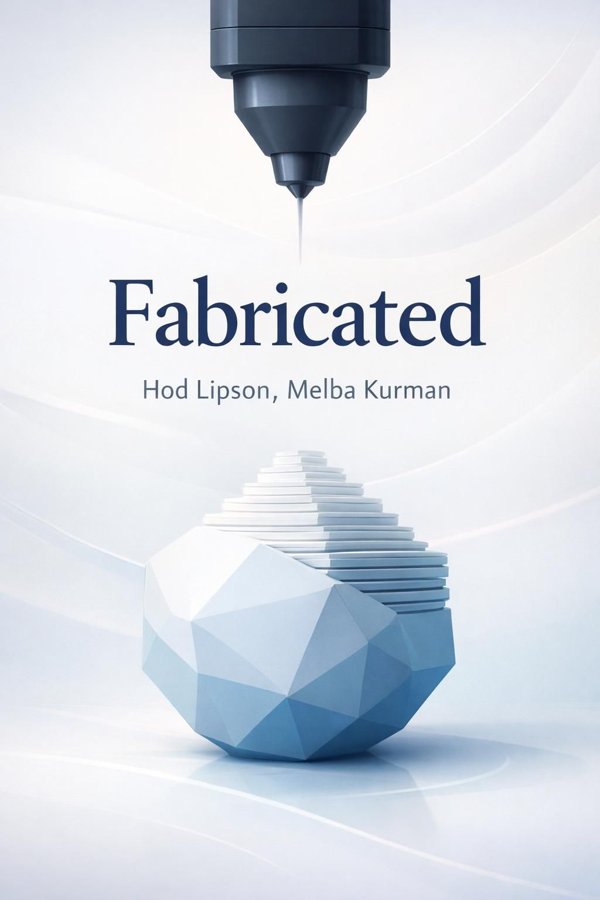
Fabricated: The New World of 3D Printing: Summary & Key Insights
 10 min8 chaptersAudio available
What Is Fabricated: The New World of 3D Printing About?
Fabricated: The New World of 3D Printing by Hod Lipson, Melba Kurman is a emerging_tech book spanning 8 pages. Fabricated explores the transformative potential of 3D printing technology, tracing its evolution from industrial manufacturing to personal and domestic use. The authors explain how 3D printing works, its applications across industries, and its implications for design, business, and society. The book envisions a future where individuals can create and customize products on demand, reshaping economies and creativity itself.
This FizzRead summary covers all 8 key chapters of Fabricated: The New World of 3D Printing in approximately 10 minutes, distilling the most important ideas, arguments, and takeaways from Hod Lipson, Melba Kurman's work. Also available as an audio summary and Key Quotes Podcast.
Fabricated: The New World of 3D Printing
Fabricated explores the transformative potential of 3D printing technology, tracing its evolution from industrial manufacturing to personal and domestic use. The authors explain how 3D printing works, its applications across industries, and its implications for design, business, and society. The book envisions a future where individuals can create and customize products on demand, reshaping economies and creativity itself.
Who Should Read Fabricated: The New World of 3D Printing?
This book is perfect for anyone interested in emerging_tech and looking to gain actionable insights in a short read. Whether you're a student, professional, or lifelong learner, the key ideas from Fabricated: The New World of 3D Printing by Hod Lipson, Melba Kurman will help you think differently.
- ✓Readers who enjoy emerging_tech and want practical takeaways
- ✓Professionals looking to apply new ideas to their work and life
- ✓Anyone who wants the core insights of Fabricated: The New World of 3D Printing in just 10 minutes
Want the full summary?
Get instant access to this book summary and 100K+ more with Fizz Moment.
Get Free SummaryAvailable on App Store • Free to download
Key Chapters
It’s important to begin where this technology truly started—not in the garage or the art studio, but in high-tech laboratories serving manufacturers who needed prototypes quickly. During the 1980s, engineers developed techniques to build objects layer by layer from digital blueprints, a method later called 'additive manufacturing.' Early adopters used these machines to accelerate product development by producing physical models from computer designs without needing full-scale production lines.
For years, 3D printing remained confined to industrial settings, valued mainly for efficiency and precision. Then came a crucial shift: as patents expired and software became more accessible, hobbyists and researchers began experimenting with smaller, cheaper machines. Online communities such as RepRap ignited the idea that 3D printers could replicate themselves or be built from open-source parts. This democratization mirrored the personal computing revolution decades earlier. What once required vast capital and technical expertise began moving into homes, classrooms, and small studios.
The industrial-to-personal transition revealed the heart of the movement: users—not corporations—could now innovate independently. People printed toy parts, custom tools, and even replacement pieces for household appliances. The excitement fed a new way of thinking: if manufacturing can become personal, creativity and commerce will merge. It was the birth of the maker economy, where the boundaries between producers and consumers started to blur.
Understanding 3D printing requires appreciating its simplicity. We begin with a digital model—a file created through design software or scanned from a real object. That file tells the printer what layers to produce and how each successive layer builds on the previous one. Unlike traditional 'subtractive' manufacturing, which carves material away, 3D printing adds material only where it’s needed. It’s a fundamentally more efficient, elegant process.
The materials range from plastics and metals to ceramics, resins, and even edible substances. Printers use different methods: fused deposition modeling extrudes melted plastic; laser sintering fuses powder into solid forms; stereolithography cures liquid resin with light. What these methods share is a transformation of digital information into tangible substance—each printed object a direct embodiment of data.
This detachment of form from factory enables unprecedented design freedom. Complex geometries, internal lattices, and organic shapes once impossible by traditional tooling now emerge effortlessly. For designers, it feels like sculpting with algorithms; for manufacturers, it’s a breakthrough in productivity. But for everyday people, it represents creative liberation. When you hold something you’ve printed from your own idea, you experience a moment that combines engineering, art, and a touch of magic.
+ 6 more chapters — available in the FizzRead app
All Chapters in Fabricated: The New World of 3D Printing
About the Authors
Hod Lipson is a professor of engineering at Columbia University known for his research in robotics and digital manufacturing. Melba Kurman is a technology analyst and writer specializing in emerging technologies and innovation policy.
Get This Summary in Your Preferred Format
Read or listen to the Fabricated: The New World of 3D Printing summary by Hod Lipson, Melba Kurman anytime, anywhere. FizzRead offers multiple formats so you can learn on your terms — all free.
Available formats: App · Audio · PDF · EPUB — All included free with FizzRead
Download Fabricated: The New World of 3D Printing PDF and EPUB Summary
Key Quotes from Fabricated: The New World of 3D Printing
“It’s important to begin where this technology truly started—not in the garage or the art studio, but in high-tech laboratories serving manufacturers who needed prototypes quickly.”
“Understanding 3D printing requires appreciating its simplicity.”
Frequently Asked Questions about Fabricated: The New World of 3D Printing
Fabricated: The New World of 3D Printing by Hod Lipson, Melba Kurman is a emerging_tech book that explores key ideas across 8 chapters. Fabricated explores the transformative potential of 3D printing technology, tracing its evolution from industrial manufacturing to personal and domestic use. The authors explain how 3D printing works, its applications across industries, and its implications for design, business, and society. The book envisions a future where individuals can create and customize products on demand, reshaping economies and creativity itself.
You Might Also Like

Blockchain Technology Guide (Chinese Edition)
Li Qilei
10 min
21st Century Technologies Revisited: What is Happening and What is Next
Organisation for Economic Co-operation and Development (OECD)
10 min
Autonomous Vehicles: Opportunities, Strategies, and Challenges
Various Authors
10 min
Autonomy
Lawrence Burns
10 min
Blockchain Basics: A Non-Technical Introduction in 25 Steps
Daniel Drescher
10 min
Blockchain Revolution: How the Technology Behind Bitcoin and Other Cryptocurrencies Is Changing the World
Don Tapscott & Alex Tapscott
10 minBrowse by Category
Ready to read Fabricated: The New World of 3D Printing?
Get the full summary and 100K+ more books with Fizz Moment.