
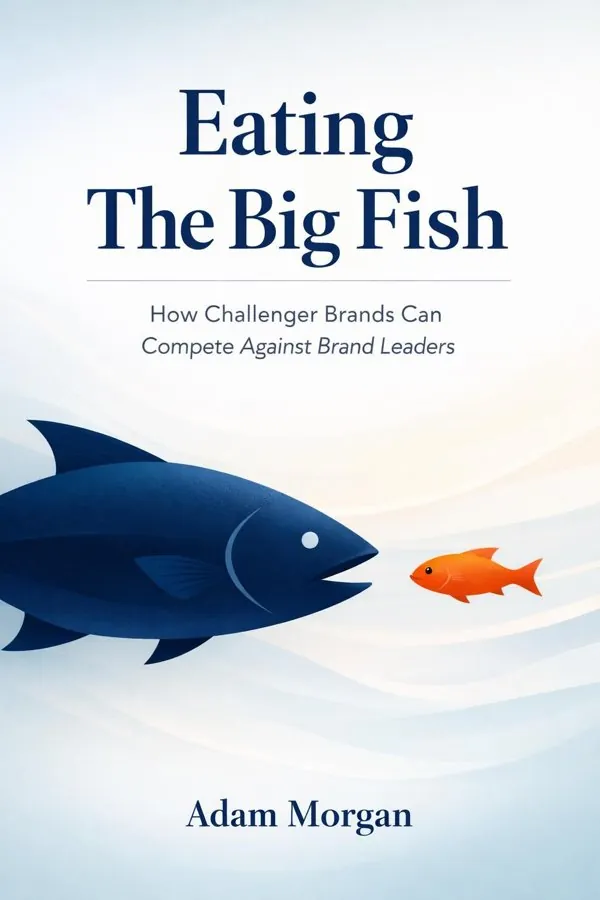
Eating The Big Fish: How Challenger Brands Can Compete Against Brand Leaders: Summary & Key Insights
by Adam Morgan
 10 min3 chaptersAudio available
What Is Eating The Big Fish: How Challenger Brands Can Compete Against Brand Leaders About?
Eating The Big Fish: How Challenger Brands Can Compete Against Brand Leaders by Adam Morgan is a marketing book spanning 3 pages. Eating the Big Fish es un libro que define las reglas y estrategias para las marcas desafiantes que buscan competir contra los líderes establecidos. Adam Morgan ofrece un marco mental y estratégico innovador para ayudar a las empresas a desarrollar una mentalidad de desafío, construir una identidad distintiva y ganar participación de mercado frente a competidores más grandes.
This FizzRead summary covers all 3 key chapters of Eating The Big Fish: How Challenger Brands Can Compete Against Brand Leaders in approximately 10 minutes, distilling the most important ideas, arguments, and takeaways from Adam Morgan's work. Also available as an audio summary and Key Quotes Podcast.
Eating The Big Fish: How Challenger Brands Can Compete Against Brand Leaders
Eating the Big Fish es un libro que define las reglas y estrategias para las marcas desafiantes que buscan competir contra los líderes establecidos. Adam Morgan ofrece un marco mental y estratégico innovador para ayudar a las empresas a desarrollar una mentalidad de desafío, construir una identidad distintiva y ganar participación de mercado frente a competidores más grandes.
Who Should Read Eating The Big Fish: How Challenger Brands Can Compete Against Brand Leaders?
This book is perfect for anyone interested in marketing and looking to gain actionable insights in a short read. Whether you're a student, professional, or lifelong learner, the key ideas from Eating The Big Fish: How Challenger Brands Can Compete Against Brand Leaders by Adam Morgan will help you think differently.
- ✓Readers who enjoy marketing and want practical takeaways
- ✓Professionals looking to apply new ideas to their work and life
- ✓Anyone who wants the core insights of Eating The Big Fish: How Challenger Brands Can Compete Against Brand Leaders in just 10 minutes
Want the full summary?
Get instant access to this book summary and 100K+ more with Fizz Moment.
Get Free SummaryAvailable on App Store • Free to download
Key Chapters
In a market where large, dominant players dictate consumer expectations, I conceived the metaphor of the 'Big Fish' as a symbol of complacent leadership. These are the established brands—the ones that have claimed the deep end of the pond and now swim slowly, secure in their power. But the pond, though seemingly full, is not closed off. Smaller fish can grow—not by mimicking the Big Fish, but by thinking differently about what it means to compete.
A Challenger Brand doesn’t merely seek to take market share from a leader; it seeks to challenge the norms of the entire category. It isn’t about size but attitude—a strategic stance born from constraint. Instead of seeing its limits as disadvantages, a challenger uses them to force creative leaps. Because where a leader relies on legacy, a challenger thrives on invention.
This mindset requires courage—the acceptance that you will not win by copying what works for others. You must instead define what you stand against and what you stand for. The Big Fish stands for tradition, dominance, safety. The Challenger stands for dynamism, reinvention, and meaning. That’s the foundation upon which every great challenger brand builds its story.
When I studied successful challenger brands—from Virgin in airlines to Apple during its rise against Microsoft—I found remarkable consistency in their behaviors. These weren’t isolated moments of luck. They shared patterns, approaches, and distinct ways of viewing competition. That’s what led me to articulate the Eight Credos—a set of guiding beliefs that transform mindset into practice.
The first credo is clarity of vision. Every challenger must know, viscerally, what it stands for and against. You can’t challenge effectively if you don’t have a point of tension. For Nike in its early days, it wasn’t about shoes—it was about personal performance against mediocrity. For Ben & Jerry’s, it was about fun and social activism against corporate coldness. Your vision becomes your flag in the battlefield of ideas.
The second credo introduces what I call the Lighthouse Identity—a brand so clear in its purpose and consistent in its projection that others navigate by its light. A lighthouse doesn’t chase ships; it stands firm and bright. It communicates not through ubiquity but through integrity. That’s the power of consistency when resources are limited.
Then there’s Intelligent Naivety—the third credo. As a challenger, you must approach your category with curious disrespect. Ask the questions that veterans have stopped asking: Why are things the way they are? What assumptions define this industry? This naïve questioning allows you to uncover opportunities hidden in plain sight.
The fourth credo is the Symbol of Re-Evaluation—your ability to make consumers pause and rethink everything they’ve taken for granted. Think of how MINI redefined small cars not as cheap but as premium fun; that moment of re-evaluation is priceless.
Sacrifice and Focus—the fifth credo—reminds you that concentration beats diffusion. Every challenger must choose what to excel at and consciously sacrifice the rest. Great brands become powerful not by doing everything, but by doing one thing extraordinarily well.
The sixth credo, Overcommitment, is about belief and momentum. You must throw your entire organizational soul behind your mission—externally in how you communicate, and internally in how you motivate your people. A challenger brand without conviction is just noise.
The seventh credo, Media Multiplier, challenges the assumption that more money means better communication. In reality, creativity and cultural resonance amplify far beyond paid media. You may not afford prime-time TV, but if your story ripples through conversation, it multiplies itself every day.
And finally, the eighth credo: Thought Leadership. You must become a cultural contributor rather than a mere seller of products. You must articulate ideas that shift the wider discourse. Look at how Patagonia tells stories about environmental responsibility—not as marketing but as movement. The Challenger succeeds by creating meaning beyond commerce.
These credos are not academic. They are lived strategies that have powered extraordinary success stories—the lifeblood of challenger thinking.
+ 1 more chapters — available in the FizzRead app
All Chapters in Eating The Big Fish: How Challenger Brands Can Compete Against Brand Leaders
About the Author
Adam Morgan es fundador de eatbigfish, una consultora especializada en el pensamiento de marca desafiante. Antes de fundar la empresa, trabajó en publicidad y estrategia de marca, y es reconocido por su enfoque en cómo las marcas pueden desafiar las convenciones del mercado y competir con los líderes establecidos.
Get This Summary in Your Preferred Format
Read or listen to the Eating The Big Fish: How Challenger Brands Can Compete Against Brand Leaders summary by Adam Morgan anytime, anywhere. FizzRead offers multiple formats so you can learn on your terms — all free.
Available formats: App · Audio · PDF · EPUB — All included free with FizzRead
Download Eating The Big Fish: How Challenger Brands Can Compete Against Brand Leaders PDF and EPUB Summary
Key Quotes from Eating The Big Fish: How Challenger Brands Can Compete Against Brand Leaders
“In a market where large, dominant players dictate consumer expectations, I conceived the metaphor of the 'Big Fish' as a symbol of complacent leadership.”
“When I studied successful challenger brands—from Virgin in airlines to Apple during its rise against Microsoft—I found remarkable consistency in their behaviors.”
Frequently Asked Questions about Eating The Big Fish: How Challenger Brands Can Compete Against Brand Leaders
Eating The Big Fish: How Challenger Brands Can Compete Against Brand Leaders by Adam Morgan is a marketing book that explores key ideas across 3 chapters. Eating the Big Fish es un libro que define las reglas y estrategias para las marcas desafiantes que buscan competir contra los líderes establecidos. Adam Morgan ofrece un marco mental y estratégico innovador para ayudar a las empresas a desarrollar una mentalidad de desafío, construir una identidad distintiva y ganar participación de mercado frente a competidores más grandes.
You Might Also Like
Captivology: The Science of Capturing People's Attention
Ben Parr
10 min
Marketing 5.0: Technology for Humanity
Philip Kotler, Hermawan Kartajaya, Iwan Setiawan
10 min
Marketing Strategy
Paul Fifield
10 min
UnMarketing: Stop Marketing. Start Engaging.
Scott Stratten
10 min
$100M Leads: How to Get Strangers to Want to Buy Your Stuff
Alex Hormozi
10 min
80/20 Sales and Marketing: The Definitive Guide to Working Less and Making More
Perry Marshall
10 minBrowse by Category
Ready to read Eating The Big Fish: How Challenger Brands Can Compete Against Brand Leaders?
Get the full summary and 100K+ more books with Fizz Moment.