
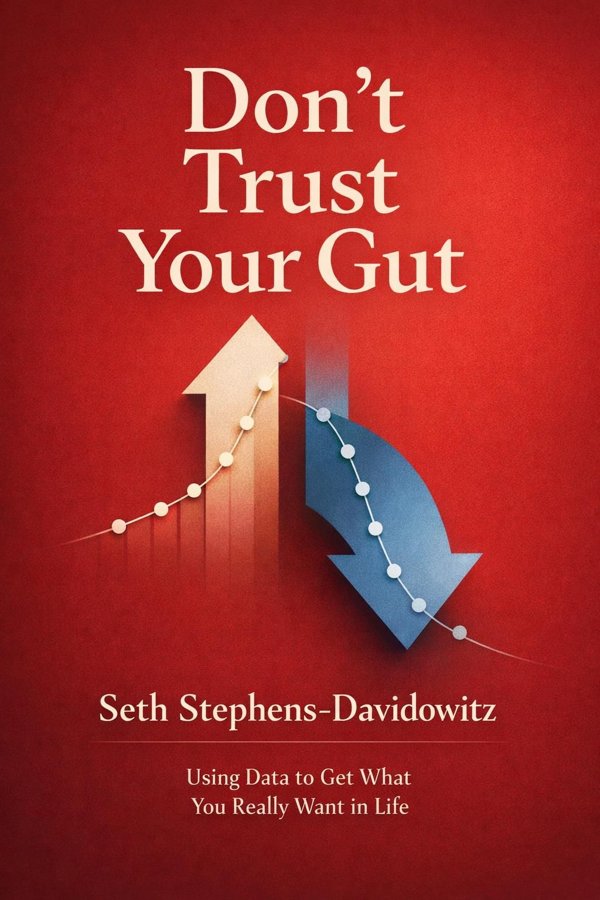
Don't Trust Your Gut: Using Data to Get What You Really Want in Life: Summary & Key Insights
 10 min12 chaptersAudio available
What Is Don't Trust Your Gut: Using Data to Get What You Really Want in Life About?
Don't Trust Your Gut: Using Data to Get What You Really Want in Life by Seth Stephens-Davidowitz is a data_science book spanning 12 pages. In this book, Seth Stephens-Davidowitz explores how data can reveal surprising truths about human behavior and decision-making. Drawing on large-scale datasets, he challenges common intuitions about success, happiness, and relationships, showing that our instincts often mislead us. The author uses empirical evidence to guide readers toward smarter choices in life, career, and love.
This FizzRead summary covers all 12 key chapters of Don't Trust Your Gut: Using Data to Get What You Really Want in Life in approximately 10 minutes, distilling the most important ideas, arguments, and takeaways from Seth Stephens-Davidowitz's work. Also available as an audio summary and Key Quotes Podcast.
Don't Trust Your Gut: Using Data to Get What You Really Want in Life
In this book, Seth Stephens-Davidowitz explores how data can reveal surprising truths about human behavior and decision-making. Drawing on large-scale datasets, he challenges common intuitions about success, happiness, and relationships, showing that our instincts often mislead us. The author uses empirical evidence to guide readers toward smarter choices in life, career, and love.
Who Should Read Don't Trust Your Gut: Using Data to Get What You Really Want in Life?
This book is perfect for anyone interested in data_science and looking to gain actionable insights in a short read. Whether you're a student, professional, or lifelong learner, the key ideas from Don't Trust Your Gut: Using Data to Get What You Really Want in Life by Seth Stephens-Davidowitz will help you think differently.
- ✓Readers who enjoy data_science and want practical takeaways
- ✓Professionals looking to apply new ideas to their work and life
- ✓Anyone who wants the core insights of Don't Trust Your Gut: Using Data to Get What You Really Want in Life in just 10 minutes
Want the full summary?
Get instant access to this book summary and 100K+ more with Fizz Moment.
Get Free SummaryAvailable on App Store • Free to download
Key Chapters
We like to imagine that intuition is a form of wisdom—that spontaneous, unspoken understanding that cuts through complexity. But when we look at data on human decision-making, intuition is rarely a reliable guide. Behavioral science shows again and again that our mental heuristics evolved for survival, not for modern complexity. We overestimate our own judgment, fall prey to confirmation bias, and remember outliers because they make better stories. The gut tells compelling tales, but they’re often wrong.
Consider economics or romance. People trust their feelings when buying homes or choosing partners, yet the numbers show these decisions are riddled with predictable biases. We assume we’ll be happier moving to a bigger house, but longitudinal studies say the initial excitement fades while commuting stress compounds. Likewise, people insist they’ll know their soulmate at first sight, but massive dating platform data reveals that lasting compatibility depends far more on patterns of daily kindness and emotional regulation than on sparks of attraction.
I don’t argue that intuition should vanish; rather, it must be put in perspective. Gut instinct can be good at sensing when something feels off, but not at calculating trade-offs or predicting happiness over time. In one sense, your instincts are data too—small samples from your personal experience. But the vast datasets now available allow us to check whether that small sample aligns with the larger human experience. And more often than not, the aggregate disproves the anecdote.
Once you start seeing your life decisions as experiments, you realize that intuition is just the first hypothesis. Data is the test. And reality—that’s what wins the argument.
Data has a power that stories alone lack: it reflects people as they are, not as they wish to appear. When you analyze anonymized web searches, survey data, or behavior from tens of millions of users, you glimpse the true impulses of humanity. People might tell pollsters they don’t care about status, but their clicks and purchases reveal otherwise. They say they value family time, yet their digital trails show hours of consumption and distraction.
In my earlier work, I explored what search data could say about our hidden selves. What impressed me most was the gap between public behavior and private truth. People often hide their doubts, desires, and mistakes because society rewards appearances. Yet data captures those unfiltered moments. When aggregated, those moments tell us not only who we are but what truly moves us.
This mirror can be uncomfortable. But it’s also liberating, because it frees us from myths. It helps us see that our struggles aren’t unique, that our biases and dreams fit within patterns as old as civilization. Once you embrace data not as cold abstraction but as an x-ray of human emotion, empathy expands. You realize every chart represents countless small acts of hope and confusion—the same ones shaping your own choices every day.
+ 10 more chapters — available in the FizzRead app
All Chapters in Don't Trust Your Gut: Using Data to Get What You Really Want in Life
About the Author
Seth Stephens-Davidowitz is an American data scientist, economist, and author known for his work analyzing big data to understand human behavior. He previously worked as a data scientist at Google and has written for The New York Times. His research focuses on how data can uncover hidden patterns in society.
Get This Summary in Your Preferred Format
Read or listen to the Don't Trust Your Gut: Using Data to Get What You Really Want in Life summary by Seth Stephens-Davidowitz anytime, anywhere. FizzRead offers multiple formats so you can learn on your terms — all free.
Available formats: App · Audio · PDF · EPUB — All included free with FizzRead
Download Don't Trust Your Gut: Using Data to Get What You Really Want in Life PDF and EPUB Summary
Key Quotes from Don't Trust Your Gut: Using Data to Get What You Really Want in Life
“We like to imagine that intuition is a form of wisdom—that spontaneous, unspoken understanding that cuts through complexity.”
“Data has a power that stories alone lack: it reflects people as they are, not as they wish to appear.”
Frequently Asked Questions about Don't Trust Your Gut: Using Data to Get What You Really Want in Life
Don't Trust Your Gut: Using Data to Get What You Really Want in Life by Seth Stephens-Davidowitz is a data_science book that explores key ideas across 12 chapters. In this book, Seth Stephens-Davidowitz explores how data can reveal surprising truths about human behavior and decision-making. Drawing on large-scale datasets, he challenges common intuitions about success, happiness, and relationships, showing that our instincts often mislead us. The author uses empirical evidence to guide readers toward smarter choices in life, career, and love.
You Might Also Like
Data Science from Scratch: First Principles with Python
Joel Grus
10 min
Applied Predictive Modeling
Max Kuhn, Kjell Johnson
10 min
Better Data Visualizations: A Guide for Scholars, Researchers, and Wonks
Jonathan Schwabish
10 min
Big Data: A Revolution That Will Transform How We Live, Work, and Think
Viktor Mayer-Schönberger, Kenneth Cukier
10 min
Big Data: Principles and Best Practices of Scalable Real-Time Data Systems
Nathan Marz
10 min
Data Points: Visualization That Means Something
Nathan Yau
10 minBrowse by Category
Ready to read Don't Trust Your Gut: Using Data to Get What You Really Want in Life?
Get the full summary and 100K+ more books with Fizz Moment.