
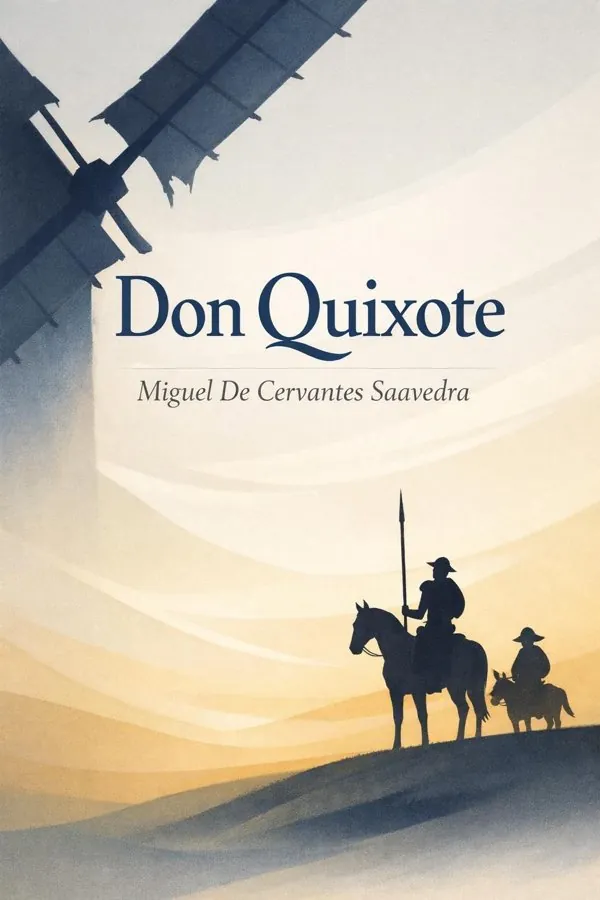
Don Quixote: The Ingenious Gentleman Don Quixote of La Mancha: Summary & Key Insights
by Miguel De Cervantes Saavedra
 10 min9 chaptersAudio available
Key Takeaways from Don Quixote: The Ingenious Gentleman Don Quixote of La Mancha
A person can change his life simply by changing the story he tells about himself.
Even the wildest dream needs a companion who can translate it into daily life.
Human beings rarely see the world as it is; we see it through the stories we need.
Sometimes the person we love most powerfully exists mainly in our imagination.
One reason Don Quixote feels so modern is that it understands people as creatures made of narratives.
What Is Don Quixote: The Ingenious Gentleman Don Quixote of La Mancha About?
Don Quixote: The Ingenious Gentleman Don Quixote of La Mancha by Miguel De Cervantes Saavedra is a classics book spanning 5 pages. Don Quixote by Miguel de Cervantes Saavedra is one of the foundational works of world literature: a comic adventure, a sharp satire, and a profound meditation on how human beings shape reality through stories. First published in two parts in 1605 and 1615, the novel follows Alonso Quixano, a country gentleman who reads so many romances of chivalry that he reinvents himself as Don Quixote, a knight-errant determined to restore honor, justice, and noble ideals to a disenchanted world. Accompanied by the practical and lovable Sancho Panza, he rides out in search of glory, only to collide repeatedly with ordinary reality. What makes Don Quixote endure is not just its humor or its famous episodes, but its emotional and intellectual depth. Cervantes turns parody into something larger: an exploration of imagination, identity, friendship, performance, and the fragile border between wisdom and madness. Widely regarded as the first modern novel, it changed what fiction could do by blending voices, perspectives, irony, and psychological complexity. Cervantes writes with unusual authority because he understood hardship, illusion, and resilience firsthand, and his masterpiece continues to speak to anyone who has ever struggled between the world as it is and the world as it should be.
This FizzRead summary covers all 9 key chapters of Don Quixote: The Ingenious Gentleman Don Quixote of La Mancha in approximately 10 minutes, distilling the most important ideas, arguments, and takeaways from Miguel De Cervantes Saavedra's work. Also available as an audio summary and Key Quotes Podcast.
Don Quixote: The Ingenious Gentleman Don Quixote of La Mancha
Don Quixote by Miguel de Cervantes Saavedra is one of the foundational works of world literature: a comic adventure, a sharp satire, and a profound meditation on how human beings shape reality through stories. First published in two parts in 1605 and 1615, the novel follows Alonso Quixano, a country gentleman who reads so many romances of chivalry that he reinvents himself as Don Quixote, a knight-errant determined to restore honor, justice, and noble ideals to a disenchanted world. Accompanied by the practical and lovable Sancho Panza, he rides out in search of glory, only to collide repeatedly with ordinary reality.
What makes Don Quixote endure is not just its humor or its famous episodes, but its emotional and intellectual depth. Cervantes turns parody into something larger: an exploration of imagination, identity, friendship, performance, and the fragile border between wisdom and madness. Widely regarded as the first modern novel, it changed what fiction could do by blending voices, perspectives, irony, and psychological complexity. Cervantes writes with unusual authority because he understood hardship, illusion, and resilience firsthand, and his masterpiece continues to speak to anyone who has ever struggled between the world as it is and the world as it should be.
Who Should Read Don Quixote: The Ingenious Gentleman Don Quixote of La Mancha?
This book is perfect for anyone interested in classics and looking to gain actionable insights in a short read. Whether you're a student, professional, or lifelong learner, the key ideas from Don Quixote: The Ingenious Gentleman Don Quixote of La Mancha by Miguel De Cervantes Saavedra will help you think differently.
- ✓Readers who enjoy classics and want practical takeaways
- ✓Professionals looking to apply new ideas to their work and life
- ✓Anyone who wants the core insights of Don Quixote: The Ingenious Gentleman Don Quixote of La Mancha in just 10 minutes
Want the full summary?
Get instant access to this book summary and 100K+ more with Fizz Moment.
Get Free SummaryAvailable on App Store • Free to download
Key Chapters
A person can change his life simply by changing the story he tells about himself. That is the radical beginning of Don Quixote. Alonso Quixano is an aging minor nobleman in La Mancha, unremarkable, solitary, and consumed by books of chivalry. Those stories do more than entertain him; they reorganize his imagination. Eventually, he decides that the world has gone wrong because knights no longer defend the weak, punish evil, or uphold honor. So he gives himself a new name, repairs an old horse, chooses a lady to adore, and steps into a new identity: Don Quixote de la Mancha.
Cervantes presents this transformation as both absurd and strangely admirable. On one hand, Quixote is deluded. He mistakes inns for castles and common people for figures from romance. On the other hand, he embodies a timeless human impulse: the desire to live by ideals rather than habit. He refuses to accept that ordinary life is the only possible life. In modern terms, his transformation resembles the way people reinvent themselves through careers, causes, communities, or personal missions. Sometimes that reinvention leads to growth; sometimes it becomes self-deception.
The brilliance of Cervantes is that he never lets us settle for one interpretation. Don Quixote is ridiculous, but he is not small. His fantasy exposes the dullness, selfishness, and moral compromise of the world around him. By imagining himself into nobility, he reveals how little nobility exists in others.
The practical lesson is to examine the stories shaping your identity. Ask which narratives elevate your character and which detach you from reality. Actionable takeaway: write down the role you are currently living and the role you aspire to live, then identify one grounded action that moves you from fantasy toward meaningful transformation.
Even the wildest dream needs a companion who can translate it into daily life. When Don Quixote rides out again, he does not go alone. He recruits his neighbor Sancho Panza, a farmer drawn less by glory than by the practical promise of reward: Quixote tells him that faithful service may earn him an island to govern. Sancho joins his master for reasons that are comic, material, and deeply human. He wants more from life, even if he does not fully believe the fantasy that offers it.
Sancho and Quixote form one of literature’s greatest partnerships because they represent two essential forces in every life: aspiration and reality. Quixote sees the world through ideals, symbols, and heroic narratives. Sancho sees hunger, weather, beatings, money, and common sense. Yet neither is complete without the other. Sancho tempers Quixote’s excesses, while Quixote enlarges Sancho’s imagination. Over time, their influence runs both ways. Sancho begins to speak in more imaginative terms, and Quixote occasionally reveals flashes of reason and moral clarity. Their friendship becomes the emotional heart of the novel.
This dynamic remains relevant in work, leadership, and personal growth. Visionaries need operators. Optimists need skeptics. Dreamers need people who can ask, “How will this actually work?” But practical people also need someone who reminds them that life cannot be reduced to caution and routine. The best partnerships do not erase difference; they convert difference into strength.
Cervantes also shows that loyalty does not require agreement. Sancho doubts his master constantly, but he stays with him, protects him, and learns from him. That is a deeper kind of companionship than flattery.
Actionable takeaway: identify whether you currently need more vision or more realism in your life, then seek out one relationship that productively balances your default tendencies.
Human beings rarely see the world as it is; we see it through the stories we need. The road adventures of Don Quixote dramatize this truth again and again. The most famous example is his attack on windmills, which he perceives as giant enemies. But the novel is full of similar collisions between imagination and fact: inns become castles, flocks become armies, shaving basins become golden helmets, and ordinary travelers become villains or enchanted figures. To Quixote, the world is charged with epic significance. To everyone else, it is embarrassingly ordinary.
These episodes are funny, but Cervantes uses them to ask a serious question: what happens when a cherished worldview cannot survive contact with reality? Quixote rarely abandons his interpretation. Instead, he revises it. If the windmills are not giants, then an enchanter must have transformed them. This is psychologically insightful. People often protect their beliefs by inventing explanations that preserve them. We do this in politics, business, relationships, and self-image. When evidence contradicts us, we may blame bias, sabotage, timing, or unseen forces rather than admit error.
Yet Cervantes does not simply mock belief. He shows that reality without imagination can be spiritually barren. Quixote’s mistakes are destructive, but they also reveal a hunger for meaning that many “sane” people lack. The challenge, then, is not to live without stories, but to hold them with humility.
A practical example is decision-making in modern life. If you are launching a project, leading a team, or navigating conflict, you need both conviction and feedback. Confidence without evidence becomes delusion; evidence without conviction becomes paralysis.
Actionable takeaway: the next time reality disappoints your expectations, pause before rationalizing. Ask, “What facts am I resisting, and how can I adjust my story without losing my purpose?”
Sometimes the person we love most powerfully exists mainly in our imagination. Don Quixote’s devotion to Dulcinea del Toboso is one of the novel’s clearest examples of how desire transforms reality. Dulcinea is not an active romantic partner in the story; she is a peasant woman, Aldonza Lorenzo, whom Quixote elevates into an exalted lady worthy of knightly service. He needs her less as a real person than as a symbol. She gives his quest beauty, purpose, and emotional structure.
Cervantes uses this idealization to reveal both the nobility and the danger of projection. On one level, Dulcinea represents the human capacity to see beyond surfaces and assign higher meaning to ordinary life. Art, love, and faith often begin this way: by perceiving more than what is immediately visible. On another level, idealization can erase reality. When we turn someone into a symbol, we stop seeing them as they are. We relate to our own fantasy, not to the actual person.
This theme applies far beyond romance. People idealize careers, leaders, lifestyles, and versions of success. A dream job may become a Dulcinea. A startup founder may idealize disruption. A community may idealize a political figure. The danger is not admiration itself, but disconnection from truth. When reality inevitably appears, disappointment can be severe because the original image was never real.
At the same time, Cervantes suggests that ideals still matter. Without some form of elevation, life becomes merely functional. The challenge is to let ideals inspire us without allowing them to blind us. Mature love and mature ambition preserve aspiration while making room for complexity, imperfection, and mutual recognition.
Actionable takeaway: choose one person or goal you may be idealizing, and list three real qualities and three imagined qualities. Use that distinction to pursue devotion with clearer eyes.
One reason Don Quixote feels so modern is that it understands people as creatures made of narratives. The novel is not just a single adventure tale; it contains embedded stories, competing perspectives, false documents, reported conversations, and characters who interpret one another through their own assumptions. Cervantes constantly reminds readers that what we know depends on who is telling the story and why. In this way, Don Quixote becomes a meditation on fiction itself.
Cervantes even plays with authorship and authenticity, presenting the narrative as if it were drawn from historical sources. This creates irony but also raises deeper questions about truth. Is a life defined by facts alone, or by the meanings attached to them? Don Quixote may be “wrong” about what he sees, yet his interpretation changes the social world around him. People react to him, imitate him, deceive him, pity him, and sometimes admire him. In other words, stories are not private fantasies; they have public consequences.
This insight is highly practical today. Organizations run on stories about mission and culture. Families preserve stories about identity and expectation. Nations build stories about history and destiny. Individuals carry stories about success, shame, and possibility. These narratives influence behavior even when they are partly inaccurate. To understand a person or institution, you must understand the story it believes about itself.
Cervantes also warns that storytelling can become manipulation. Characters in the novel stage scenes to control Quixote’s reactions, proving that whoever frames reality often guides action. That is why narrative literacy matters. We need to ask not only what story is being told, but who benefits from it.
Actionable takeaway: examine one major area of your life and identify the dominant story guiding it. Then ask whether that story is empowering, distorting, or overdue for revision.
Comedy is often dismissed as light entertainment, but Cervantes proves that laughter can be one of the sharpest tools for examining human weakness. Don Quixote is full of beatings, misunderstandings, inflated speeches, and ridiculous reversals. Readers laugh because Quixote’s certainty is so out of proportion to reality. Yet the humor does not flatten him into a joke. Instead, it makes room for sympathy, critique, and reflection all at once.
This layered comedy allows Cervantes to parody outdated chivalric romances while also exposing the vanity, cruelty, and pettiness of supposedly rational people. Many characters who recognize Quixote’s madness behave worse than he does. They deceive him for sport, exploit his innocence, or treat suffering as amusement. The result is morally unsettling: who is truly foolish, the man who believes in impossible honor or the sane people who lack compassion?
That question gives the novel much of its power. Humor lowers defenses. Readers come for entertainment and find themselves confronted with harder truths about ego, conformity, and social performance. This remains relevant in modern culture, where satire often reveals what formal argument cannot. A clever comedy about work may expose toxic management better than a policy memo. A humorous memoir may reveal the absurdity of social expectations more honestly than a sermon.
Cervantes also shows that laughing at others should be done carefully. Mockery without empathy becomes cruelty. The best humor preserves human dignity even while exposing delusion. Quixote is funny because he is recognizably human, not because he is disposable.
Actionable takeaway: when you use humor to criticize a person, system, or idea, ask whether your laughter clarifies truth or merely displays superiority. Aim for wit that illuminates rather than humiliates.
A society may abandon an ideal long before individuals stop needing it. Don Quixote’s obsession with knightly honor is outdated in his world, but Cervantes does not treat honor as meaningless. Instead, he asks what happens when inherited ideals survive after their social forms have collapsed. Quixote clings to codes of courage, fidelity, service, and dignity even though the surrounding culture no longer organizes life around them. He appears absurd precisely because he acts as if values should govern behavior rather than convenience.
This gives the novel an unexpectedly philosophical dimension. What values are worth preserving when society treats them as impractical? Quixote’s answer is extreme, but not trivial. He chooses a life directed by principle rather than comfort. His errors are many, but his refusal to live cynically has moral force. In contrast, many supposedly reasonable characters compromise easily, pursue self-interest, or submit passively to convention.
Cervantes links this to freedom. Don Quixote is free in one crucial sense: he authorizes his own life. He does not wait for permission to pursue meaning. Of course, his freedom is distorted by delusion, but the underlying question remains urgent. Are we living by values we have examined and chosen, or simply by habits inherited from our environment?
This idea applies in careers, relationships, and citizenship. A professional may refuse profitable work that violates conscience. A friend may remain loyal when loyalty is costly. A leader may defend dignity in a culture that rewards expedience. These choices can look impractical in the short term but define character in the long term.
Actionable takeaway: identify one value you claim to honor, then test whether your calendar, spending, and behavior actually reflect it. If not, make one concrete adjustment this week that aligns action with principle.
Few classics become more interesting when they become conscious of their own fame, but Don Quixote does exactly that in its second part. By 1615, Cervantes had already published the first part, and within the world of the sequel, characters have read about Don Quixote’s earlier exploits. This creates a fascinating new layer: Quixote and Sancho move through a society that already knows them as literary figures. People anticipate their behavior, manipulate them, and stage elaborate performances around their identities.
This development transforms the novel from a parody of chivalric romance into something even more modern: a study of how public narratives shape the self. Once people know your story, they start relating to the version of you they have heard, not necessarily the person you are. Don Quixote becomes trapped not only by his own fantasy, but by his reputation. Sancho, too, is affected, especially when he is briefly given a mock governorship that tests whether his common sense can survive theatrical power.
The second part therefore explores performance, fame, and self-consciousness in ways that feel contemporary. Today, many people live under curated identities shaped by social media, professional branding, or public expectation. Once an image solidifies, it can become difficult to act outside it. Cervantes saw early that identity is relational: we become who we are partly through the stories others circulate about us.
Yet this section is not merely cynical. It also allows Quixote and Sancho to grow. Their bond deepens, their dialogue becomes richer, and moments of tenderness emerge through the irony. Self-awareness does not destroy humanity; it can reveal it.
Actionable takeaway: consider where reputation may be scripting your behavior. Choose one context in which you can act more honestly rather than merely conforming to others’ expectations of who you are.
The most moving truth in Don Quixote is that every dream, however magnificent, must eventually meet mortality. After long wanderings, humiliations, and moments of strange grandeur, Don Quixote returns home defeated. In the final movement of the novel, his knightly identity begins to dissolve. He renounces the fantasies that governed him, reclaims the name Alonso Quixano, and prepares for death with sobriety and clarity. This ending is startling because it reverses the energy that animated the entire book.
Readers often feel conflicted here. Is Quixote finally cured, or is something precious being extinguished? Cervantes leaves room for both responses. On one level, the return to reason is a recovery from delusion. On another, it feels like the fading of a moral and imaginative force that made life larger than mere survival. The ending therefore asks whether sanity alone is enough for a meaningful life. A person may be realistic and still spiritually asleep.
What makes the conclusion powerful is that it does not simply praise illusion or reality. Instead, it honors the human struggle to live between them. We need truth, but we also need aspiration. We need limits, but we also need grandeur. Quixote’s life becomes tragic not because he dreamed, but because his dream could never fully inhabit the world he loved.
This has practical relevance for anyone reassessing an old ambition, identity, or life chapter. Letting go is not always failure. Sometimes it is wisdom. But healthy renunciation should preserve what was noble in the dream: courage, purpose, and openness to wonder.
Actionable takeaway: when closing an important chapter of your life, do not ask only what must be abandoned. Also ask what virtue from that chapter deserves to be carried forward into reality.
All Chapters in Don Quixote: The Ingenious Gentleman Don Quixote of La Mancha
About the Author
Miguel de Cervantes Saavedra (1547–1616) was a Spanish novelist, poet, and playwright whose work helped shape the modern novel. Born near Madrid, he lived through war, captivity, financial hardship, and repeated professional disappointments, experiences that deepened his understanding of human ambition, suffering, and resilience. He served as a soldier and was later held captive in Algiers for several years, an ordeal that left a lasting mark on his writing. Although he wrote plays, poems, and prose works, his enduring fame rests on Don Quixote, published in two parts in 1605 and 1615. Celebrated for its humor, psychological insight, and narrative innovation, the novel made Cervantes one of the most influential authors in world literature and a defining voice of Spain’s Golden Age.
Get This Summary in Your Preferred Format
Read or listen to the Don Quixote: The Ingenious Gentleman Don Quixote of La Mancha summary by Miguel De Cervantes Saavedra anytime, anywhere. FizzRead offers multiple formats so you can learn on your terms — all free.
Available formats: App · Audio · PDF · EPUB — All included free with FizzRead
Download Don Quixote: The Ingenious Gentleman Don Quixote of La Mancha PDF and EPUB Summary
Key Quotes from Don Quixote: The Ingenious Gentleman Don Quixote of La Mancha
“A person can change his life simply by changing the story he tells about himself.”
“Even the wildest dream needs a companion who can translate it into daily life.”
“Human beings rarely see the world as it is; we see it through the stories we need.”
“Sometimes the person we love most powerfully exists mainly in our imagination.”
“One reason Don Quixote feels so modern is that it understands people as creatures made of narratives.”
Frequently Asked Questions about Don Quixote: The Ingenious Gentleman Don Quixote of La Mancha
Don Quixote: The Ingenious Gentleman Don Quixote of La Mancha by Miguel De Cervantes Saavedra is a classics book that explores key ideas across 9 chapters. Don Quixote by Miguel de Cervantes Saavedra is one of the foundational works of world literature: a comic adventure, a sharp satire, and a profound meditation on how human beings shape reality through stories. First published in two parts in 1605 and 1615, the novel follows Alonso Quixano, a country gentleman who reads so many romances of chivalry that he reinvents himself as Don Quixote, a knight-errant determined to restore honor, justice, and noble ideals to a disenchanted world. Accompanied by the practical and lovable Sancho Panza, he rides out in search of glory, only to collide repeatedly with ordinary reality. What makes Don Quixote endure is not just its humor or its famous episodes, but its emotional and intellectual depth. Cervantes turns parody into something larger: an exploration of imagination, identity, friendship, performance, and the fragile border between wisdom and madness. Widely regarded as the first modern novel, it changed what fiction could do by blending voices, perspectives, irony, and psychological complexity. Cervantes writes with unusual authority because he understood hardship, illusion, and resilience firsthand, and his masterpiece continues to speak to anyone who has ever struggled between the world as it is and the world as it should be.
You Might Also Like
Browse by Category
Ready to read Don Quixote: The Ingenious Gentleman Don Quixote of La Mancha?
Get the full summary and 100K+ more books with Fizz Moment.