
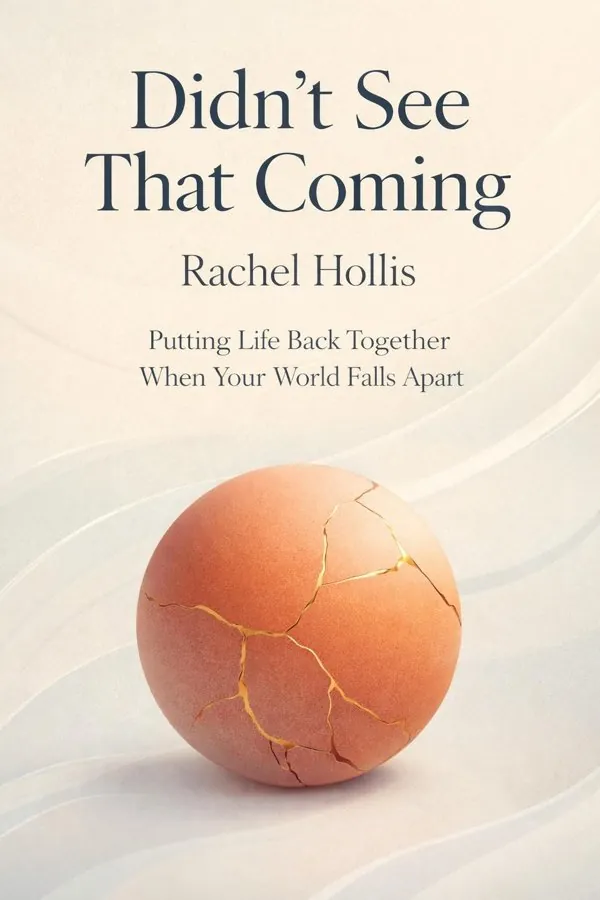
Didn't See That Coming: Putting Life Back Together When Your World Falls Apart: Summary & Key Insights
 10 min10 chaptersAudio available
Key Takeaways from Didn't See That Coming: Putting Life Back Together When Your World Falls Apart
The hardest part of any crisis is often not the event itself, but the gap between what happened and what we wish had happened instead.
One of the most damaging myths about suffering is that grief should move in neat stages and end on time.
Much of our suffering comes not only from what happened, but from the collapse of the future we had imagined.
Pain changes people, but that does not mean pain is good.
After life falls apart, confidence rarely returns through a dramatic breakthrough.
What Is Didn't See That Coming: Putting Life Back Together When Your World Falls Apart About?
Didn't See That Coming: Putting Life Back Together When Your World Falls Apart by Rachel Hollis is a self_awareness book spanning 11 pages. What do you do when life breaks in a way you never prepared for? In Didn't See That Coming, Rachel Hollis turns toward that painful question with unusual honesty. Rather than offering polished optimism or quick-fix inspiration, she writes from the middle of heartbreak, grief, disappointment, and disorientation. The book explores what it means to keep going when plans collapse, relationships change, loss arrives, or the future you imagined disappears. Hollis reflects on her own experiences with death, family pain, career pressure, identity shifts, and emotional unraveling to show that rebuilding is possible, even when it feels unbearably slow. What makes this book resonate is its mix of vulnerability and practicality. Hollis does not pretend healing is linear or easy. Instead, she argues that resilience begins with telling the truth, grieving honestly, and taking small, steady steps back toward yourself. Her authority comes less from theory than from lived experience: she writes as someone who has had to reconstruct meaning after her world changed. For readers navigating grief, transition, burnout, or uncertainty, this book offers both comfort and a roadmap for putting life back together.
This FizzRead summary covers all 10 key chapters of Didn't See That Coming: Putting Life Back Together When Your World Falls Apart in approximately 10 minutes, distilling the most important ideas, arguments, and takeaways from Rachel Hollis's work. Also available as an audio summary and Key Quotes Podcast.
Didn't See That Coming: Putting Life Back Together When Your World Falls Apart
What do you do when life breaks in a way you never prepared for? In Didn't See That Coming, Rachel Hollis turns toward that painful question with unusual honesty. Rather than offering polished optimism or quick-fix inspiration, she writes from the middle of heartbreak, grief, disappointment, and disorientation. The book explores what it means to keep going when plans collapse, relationships change, loss arrives, or the future you imagined disappears. Hollis reflects on her own experiences with death, family pain, career pressure, identity shifts, and emotional unraveling to show that rebuilding is possible, even when it feels unbearably slow.
What makes this book resonate is its mix of vulnerability and practicality. Hollis does not pretend healing is linear or easy. Instead, she argues that resilience begins with telling the truth, grieving honestly, and taking small, steady steps back toward yourself. Her authority comes less from theory than from lived experience: she writes as someone who has had to reconstruct meaning after her world changed. For readers navigating grief, transition, burnout, or uncertainty, this book offers both comfort and a roadmap for putting life back together.
Who Should Read Didn't See That Coming: Putting Life Back Together When Your World Falls Apart?
This book is perfect for anyone interested in self_awareness and looking to gain actionable insights in a short read. Whether you're a student, professional, or lifelong learner, the key ideas from Didn't See That Coming: Putting Life Back Together When Your World Falls Apart by Rachel Hollis will help you think differently.
- ✓Readers who enjoy self_awareness and want practical takeaways
- ✓Professionals looking to apply new ideas to their work and life
- ✓Anyone who wants the core insights of Didn't See That Coming: Putting Life Back Together When Your World Falls Apart in just 10 minutes
Want the full summary?
Get instant access to this book summary and 100K+ more with Fizz Moment.
Get Free SummaryAvailable on App Store • Free to download
Key Chapters
The hardest part of any crisis is often not the event itself, but the gap between what happened and what we wish had happened instead. When life falls apart, the first instinct is usually resistance. We tell ourselves this cannot be real, distract ourselves with work, numb out with entertainment, or keep repeating a story in which things still make sense. Rachel Hollis argues that healing starts only when we stop negotiating with reality and admit that something has changed.
This idea is powerful because denial can look productive. You might keep showing up, checking boxes, and telling everyone you are fine, while avoiding the emotional truth underneath. But pretending does not preserve your old life; it only postpones your recovery. Hollis encourages readers to name the loss clearly. A marriage ended. A loved one died. A dream failed. A diagnosis changed everything. Clarity is painful, but it is also stabilizing. Once you stop spending energy resisting facts, you can begin deciding what comes next.
In practical terms, facing reality might mean journaling the plain truth of your situation, saying it aloud to a trusted friend, or admitting that a chapter has closed. It may also mean abandoning the fantasy that healing should happen quickly. Acceptance is not approval, and it is not surrender. It is the brave choice to stand on solid ground, even when that ground is cracked.
Actionable takeaway: Write a one-sentence truth about what has changed in your life, without minimizing or dramatizing it, and let that sentence become the starting point for your healing.
One of the most damaging myths about suffering is that grief should move in neat stages and end on time. Hollis pushes back against that idea by reminding readers that grief is messy, cyclical, and deeply personal. You do not graduate from it once and for all. Instead, you learn to carry it differently over time.
This matters because many people judge themselves for grieving “wrong.” They feel fine for two weeks, then suddenly collapse in the grocery store over a song, a smell, or a memory. They think they are back at the beginning, when in truth grief often revisits us in waves. Hollis normalizes this pattern. Loss changes shape as life moves forward. Holidays, anniversaries, milestones, and ordinary routines can all reopen pain. That does not mean you are failing. It means you are human.
The practical lesson is to stop measuring your emotional life against someone else’s timeline. Give yourself permission to feel sadness, anger, numbness, relief, confusion, or all of them in the same day. Build rituals that honor what you lost: lighting a candle, writing letters you never send, visiting meaningful places, or speaking openly about the person or dream that is gone. Support groups, counseling, and honest conversations can also help you process grief rather than suppress it.
Hollis suggests that grief does not need to be conquered to make room for joy. You can miss someone and still laugh. You can mourn a former life and still create a new one. Those realities can coexist.
Actionable takeaway: Stop asking when you will be “over it,” and instead ask what your grief needs from you today: rest, expression, support, or remembrance.
Much of our suffering comes not only from what happened, but from the collapse of the future we had imagined. Hollis emphasizes that expectations can quietly rule our lives. We expect a relationship to last, a job to reward our effort, faith to shield us from heartbreak, or hard work to produce predictable outcomes. When reality violates those expectations, the pain often doubles.
Letting go of expectations is not the same as abandoning hope. It means loosening your grip on the script you thought your life had to follow. That script may have been inherited from family, culture, religion, ambition, or your younger self. The problem is that when we cling too tightly to one version of happiness, we can miss the possibility that meaning still exists beyond it.
For example, someone who expected a lifelong marriage may feel not only grief but also humiliation, identity loss, and fear of starting over. A person whose career plans collapse may feel worthless because achievement had become their measure of value. Hollis invites readers to separate their worth from their expectations. Just because your plan failed does not mean your life is ruined. It means the old map no longer applies.
Practically, this can involve identifying the sentences that still haunt you: “I should be further along,” “This was supposed to last,” or “People like me do not start over.” Once named, these expectations can be challenged. Ask whether they are true, useful, or simply familiar. Making peace with uncertainty creates room for reinvention.
Actionable takeaway: List three expectations that your pain has shattered, then rewrite each one as an open-ended possibility instead of a fixed demand.
Pain changes people, but that does not mean pain is good. Hollis makes an important distinction here: you do not need to celebrate suffering in order to learn from it. Loss, betrayal, illness, or disappointment can become teachers, but they are still painful, unfair, and real. The goal is not to glorify hardship. The goal is to ask whether something honest, useful, or transformative can emerge from it.
This perspective matters because many motivational messages rush too quickly into silver linings. That can make struggling people feel unseen. Hollis instead suggests that purpose is often discovered slowly, after the shock begins to settle. You may find that pain clarifies your values, reveals who truly shows up for you, exposes unhealthy patterns, or forces you to build a stronger inner life. A crisis can strip away illusion and leave you with a more grounded sense of what matters.
Meaning can take many forms. A grieving parent may become more present with the children they still have. A person recovering from burnout may stop chasing external validation and build healthier rhythms. Someone who endured heartbreak may finally develop standards, boundaries, and self-respect that were missing before. The suffering itself is not the gift. The transformation that follows can be.
To apply this idea, reflect on what your hardship has made impossible to ignore. What have you learned about your limits, needs, priorities, or relationships? What truth became visible only because your old life cracked open? These questions can help convert raw pain into wisdom over time.
Actionable takeaway: Ask yourself, “What is this experience teaching me about what matters most?” and write down one lesson you want to carry forward.
After life falls apart, confidence rarely returns through a dramatic breakthrough. More often, it comes back through small acts of self-trust. Hollis highlights that when people are overwhelmed, they often lose faith in their own ability to cope. They stop believing they can make good decisions, manage emotions, or create a meaningful future. The way back is not grandiosity. It is consistency.
Confidence is often misunderstood as boldness or certainty. In recovery, confidence is much humbler. It is waking up and doing the next needed thing. It is keeping one promise to yourself when everything feels unstable. That might be taking a shower, going for a ten-minute walk, making the therapy appointment, paying the bill, or turning off your phone early enough to sleep. These actions look small, but they rebuild identity. They tell your nervous system, “I am still here. I can care for myself. I can keep moving.”
This approach is especially helpful for people emerging from grief, divorce, burnout, or public failure. Big goals can feel impossible during upheaval. Tiny promises are manageable. As you keep them, you generate evidence that you are not powerless. Over time, those daily proofs become momentum.
Hollis encourages readers to stop waiting until they feel strong enough to act. Action often creates the feeling we are waiting for. Confidence is built behaviorally, not just emotionally. You trust yourself because you witness yourself showing up.
Actionable takeaway: Choose one small, specific promise you can keep every day this week, such as a morning walk or ten minutes of journaling, and treat consistency as your first step toward confidence.
Resilience is often described as a personality trait, as if some people naturally bounce back while others simply break. Hollis reframes it as a practice: resilience is a series of choices made under pressure. It is choosing to get up, tell the truth, ask for help, rest when needed, and continue anyway. In that sense, resilience is less about toughness and more about staying in relationship with your life.
This matters because people in pain often believe they are weak if they are struggling. But resilience does not mean you never cry, panic, rage, or collapse. It means those moments do not have the final word. The resilient person may have terrible days. What distinguishes them is their willingness to return, again and again, to what sustains them.
Hollis points to practical habits that support resilience: routines, movement, hydration, sleep, prayer or reflection, supportive relationships, and boundaries around what drains you. None of these erase pain, but they improve your capacity to meet it. In a season of chaos, structure becomes a form of mercy. Resilience also involves choosing your inputs wisely. Constant doom-scrolling, comparison, and negative self-talk weaken your ability to recover.
Another key part of resilience is self-compassion. If every hard day becomes evidence that you are failing, recovery gets much harder. But if you see difficult days as part of the process, you can begin again without shame.
Actionable takeaway: Create a short resilience list of five practices that stabilize you physically, emotionally, and spiritually, and use it as your reset plan whenever life feels unmanageable.
When circumstances become unpredictable, people search for something deeper than mood or control to hold onto. For Hollis, faith and perspective provide that anchor. Even readers who do not share her spiritual framework can recognize the value of believing that pain is not the whole story. In moments of collapse, perspective widens the lens. It helps us remember that today is not forever, that identity is larger than current suffering, and that uncertainty does not erase meaning.
Faith here is not presented as immunity from heartbreak. It does not guarantee that good people avoid loss or that prayers prevent disruption. Instead, it offers companionship in suffering and the possibility of endurance with purpose. Perspective performs a similar function psychologically. It interrupts the feeling that your current pain defines your entire existence. It reminds you that this chapter, however consuming, is still a chapter.
In practice, anchoring yourself might mean prayer, meditation, reading sacred texts, gratitude lists, silent walks, or conversations with wise people who can lend perspective when your own vision narrows. It may also involve limiting dramatic narratives such as “My life is over” or “Nothing good can come after this.” Those statements may feel emotionally true in the moment, but they are rarely the full truth.
A broader perspective does not dismiss pain; it contextualizes it. You are allowed to hurt deeply and still believe in a future. You can acknowledge what is broken without deciding that everything is broken.
Actionable takeaway: Develop a daily grounding practice, even for five minutes, that reconnects you to something bigger than your immediate crisis.
Emotional recovery is not purely mental. Hollis repeatedly brings healing back to the body and the ordinary rhythms of daily life. When the world falls apart, people often search for huge answers, but neglect the basic tools that make resilience possible. Sleep, nutrition, movement, hydration, therapy, journaling, and quiet are not glamorous, yet they can determine whether you have the capacity to function through distress.
This idea is especially important because trauma and grief do not stay in abstract thought. They show up as exhaustion, brain fog, irritability, panic, numbness, and physical tension. If you ignore the body, healing remains incomplete. Hollis encourages readers to treat themselves like someone worth caring for, even when motivation is absent. That can mean simplifying meals, keeping medical appointments, reducing alcohol, getting outside, or seeking professional support rather than trying to manage everything alone.
Practical tools also include emotional structure. You might designate time to grieve instead of being ambushed by it all day. You might use voice notes, lists, or calendars when your memory is strained. You might create a bedtime ritual to help calm your nervous system. These supports are not signs of weakness. They are intelligent responses to overload.
The larger lesson is that healing often happens through repetition, not revelation. Tiny physical acts communicate safety and dignity to a shaken self. Over time, they help restore energy, clarity, and steadiness.
Actionable takeaway: Pick two embodied healing practices you can begin immediately, such as a consistent bedtime and a daily walk, and protect them as nonnegotiable support for your recovery.
Suffering often isolates. People withdraw because they do not want to be a burden, feel ashamed of what happened, or simply lack the energy to explain their pain. Hollis challenges this instinct by showing that healing accelerates when we reconnect with others. We may not need a crowd, but we do need witnesses, people who can sit with the truth without trying to fix it too quickly.
Isolation can distort perspective. Alone, we tend to believe our pain is uniquely humiliating, permanent, or impossible to survive. Honest connection interrupts those stories. A trusted friend, counselor, support group, sibling, or mentor can remind us that we are not crazy, not weak, and not alone. Community also provides practical help: meals, childcare, accountability, prayer, laughter, and the simple relief of being known.
Hollis also touches on the importance of discerning connection. Not everyone deserves access to your vulnerability. Some people minimize, gossip, compete, or center themselves in your pain. Reconnection is not about telling everyone everything. It is about identifying safe people and letting them in. It may also require rebuilding your social world if your previous relationships were based on roles you have now outgrown.
Starting again often happens relationally. You borrow hope from others until your own returns. You hear your story reflected back with compassion, and that helps reduce shame. In time, your healing can also make you a better source of strength for others.
Actionable takeaway: Reach out to one emotionally safe person this week and tell them one honest thing about what you are carrying instead of pretending you are fine.
When a major life disruption occurs, old definitions of success can become useless or even harmful. Hollis argues that after loss, burnout, divorce, or identity upheaval, many people continue judging themselves by standards built for a different season. They expect peak productivity in survival mode, polished achievement during grief, or external success while their inner life is collapsing. That mismatch creates unnecessary shame.
Redefining success is not lowering the bar in a defeatist way. It is choosing metrics that match reality and support healing. In one season, success may mean building a business, writing a book, or chasing a dream. In another, it may mean getting out of bed, feeding your children, keeping sobriety, or staying present through grief. Hollis invites readers to ask what actually matters now, not what used to matter or what impresses other people.
This shift is deeply freeing because it returns success to a personal and values-based definition. Instead of measuring life by image, income, or approval, you begin measuring it by honesty, health, peace, alignment, and meaningful relationships. You stop trying to prove you are okay through performance. You start building a life that feels true.
Moving forward does not mean returning to your old self. It often means becoming someone wiser, more boundaried, and less dependent on external validation. The future may look different from what you planned, but different does not mean lesser.
Actionable takeaway: Write a new definition of success for your current season using values like peace, integrity, healing, and presence instead of old performance-based standards.
All Chapters in Didn't See That Coming: Putting Life Back Together When Your World Falls Apart
About the Author
Rachel Hollis is an American author, podcaster, speaker, and entrepreneur known for her accessible, motivational approach to personal development. She rose to wide popularity with bestselling books such as Girl, Wash Your Face and Girl, Stop Apologizing, which encouraged readers to pursue growth, confidence, and ambition. Over time, her work expanded to include themes of resilience, identity, discipline, and emotional recovery. In Didn't See That Coming, Hollis draws more directly from personal hardship, writing with greater vulnerability about grief, loss, disappointment, and rebuilding. Her style blends memoir, encouragement, and practical advice, making her a recognizable voice in contemporary self-help. While her public persona has sparked both strong support and criticism, she remains an influential figure for readers seeking candid reflections on growth through difficult seasons.
Get This Summary in Your Preferred Format
Read or listen to the Didn't See That Coming: Putting Life Back Together When Your World Falls Apart summary by Rachel Hollis anytime, anywhere. FizzRead offers multiple formats so you can learn on your terms — all free.
Available formats: App · Audio · PDF · EPUB — All included free with FizzRead
Download Didn't See That Coming: Putting Life Back Together When Your World Falls Apart PDF and EPUB Summary
Key Quotes from Didn't See That Coming: Putting Life Back Together When Your World Falls Apart
“The hardest part of any crisis is often not the event itself, but the gap between what happened and what we wish had happened instead.”
“One of the most damaging myths about suffering is that grief should move in neat stages and end on time.”
“Much of our suffering comes not only from what happened, but from the collapse of the future we had imagined.”
“Pain changes people, but that does not mean pain is good.”
“After life falls apart, confidence rarely returns through a dramatic breakthrough.”
Frequently Asked Questions about Didn't See That Coming: Putting Life Back Together When Your World Falls Apart
Didn't See That Coming: Putting Life Back Together When Your World Falls Apart by Rachel Hollis is a self_awareness book that explores key ideas across 10 chapters. What do you do when life breaks in a way you never prepared for? In Didn't See That Coming, Rachel Hollis turns toward that painful question with unusual honesty. Rather than offering polished optimism or quick-fix inspiration, she writes from the middle of heartbreak, grief, disappointment, and disorientation. The book explores what it means to keep going when plans collapse, relationships change, loss arrives, or the future you imagined disappears. Hollis reflects on her own experiences with death, family pain, career pressure, identity shifts, and emotional unraveling to show that rebuilding is possible, even when it feels unbearably slow. What makes this book resonate is its mix of vulnerability and practicality. Hollis does not pretend healing is linear or easy. Instead, she argues that resilience begins with telling the truth, grieving honestly, and taking small, steady steps back toward yourself. Her authority comes less from theory than from lived experience: she writes as someone who has had to reconstruct meaning after her world changed. For readers navigating grief, transition, burnout, or uncertainty, this book offers both comfort and a roadmap for putting life back together.
More by Rachel Hollis


You Might Also Like
Rising Strong
Brené Brown
10 min
You Do You
Sarah Knight
10 min
Master Your Emotions: A Practical Guide to Overcome Negativity and Better Manage Your Feelings
Thibaut Meurisse
10 min
The Mountain Is You: Transforming Self-Sabotage Into Self-Mastery
Brianna Wiest
10 min
101 Essays That Will Change The Way You Think
Brianna Wiest
10 min
A Radical Awakening: Turn Pain into Power, Embrace Your Truth, Live Free
Shefali Tsabary
10 minFeatured In
Browse by Category
Ready to read Didn't See That Coming: Putting Life Back Together When Your World Falls Apart?
Get the full summary and 100K+ more books with Fizz Moment.