
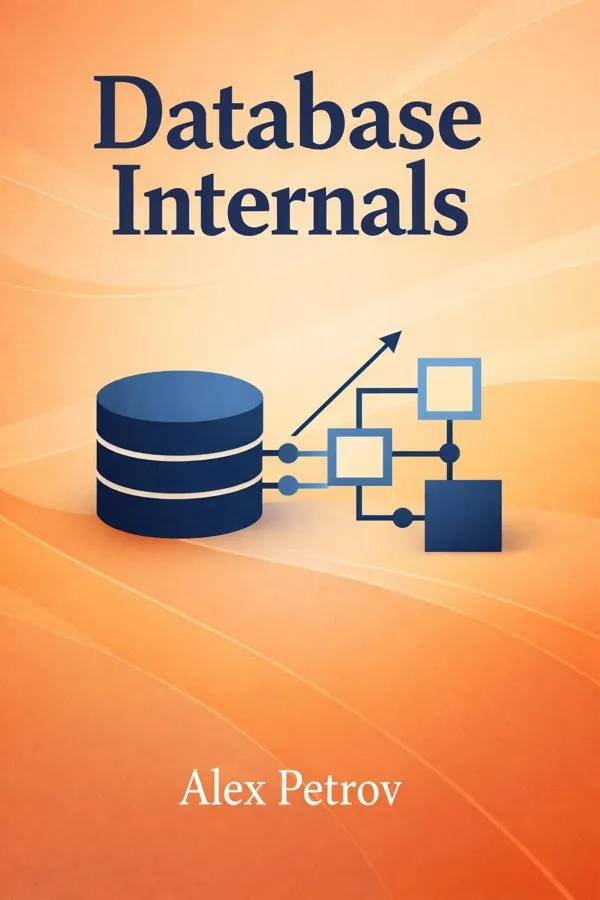
Database Internals: Deep Insights into How Distributed Data Systems Work: Summary & Key Insights
by Alex Petrov
 10 min7 chaptersAudio available
What Is Database Internals: Deep Insights into How Distributed Data Systems Work About?
Database Internals: Deep Insights into How Distributed Data Systems Work by Alex Petrov is a data_science book spanning 7 pages. Database Internals explores the architecture and design of modern distributed databases and storage systems. It provides a deep technical understanding of how data replication, consistency, and transaction processing are implemented in systems such as PostgreSQL, MySQL, and Cassandra. The book is aimed at engineers and architects who want to understand the inner workings of databases beyond the surface-level APIs.
This FizzRead summary covers all 7 key chapters of Database Internals: Deep Insights into How Distributed Data Systems Work in approximately 10 minutes, distilling the most important ideas, arguments, and takeaways from Alex Petrov's work. Also available as an audio summary and Key Quotes Podcast.
Database Internals: Deep Insights into How Distributed Data Systems Work
Database Internals explores the architecture and design of modern distributed databases and storage systems. It provides a deep technical understanding of how data replication, consistency, and transaction processing are implemented in systems such as PostgreSQL, MySQL, and Cassandra. The book is aimed at engineers and architects who want to understand the inner workings of databases beyond the surface-level APIs.
Who Should Read Database Internals: Deep Insights into How Distributed Data Systems Work?
This book is perfect for anyone interested in data_science and looking to gain actionable insights in a short read. Whether you're a student, professional, or lifelong learner, the key ideas from Database Internals: Deep Insights into How Distributed Data Systems Work by Alex Petrov will help you think differently.
- ✓Readers who enjoy data_science and want practical takeaways
- ✓Professionals looking to apply new ideas to their work and life
- ✓Anyone who wants the core insights of Database Internals: Deep Insights into How Distributed Data Systems Work in just 10 minutes
Want the full summary?
Get instant access to this book summary and 100K+ more with Fizz Moment.
Get Free SummaryAvailable on App Store • Free to download
Key Chapters
Every database begins with the simple promise of persistence: data once written should never be lost. To fulfill this promise, storage engines handle the mechanics of reading, writing, and organizing data on physical devices. They’re the beating heart of any database system, determining the trade-offs between durability, performance, and efficiency.
In this part of the book, I explore how storage engines are built and how they differ across systems like MySQL’s InnoDB, PostgreSQL’s heap manager, and Cassandra’s SSTable-based structure. Each engine has a different philosophy about when to write to disk, how to handle concurrency, and what to prioritize—speed, safety, or simplicity. I guide readers through the anatomy of these systems: how buffers, caches, and background threads interact to turn raw data into durable state.
The essence lies in knowing that not all storage engines fit all workloads. A system handling frequent writes must minimize disk seeks; one serving analytical queries must prioritize efficient sequential reads. Understanding the structure and capabilities of storage engines gives you the insight to pick what best serves your application’s behavior—not just its scale.
Underneath every storage engine lies a data structure that defines how efficiently it can store and retrieve records. This section dissects those structures in depth—starting with the venerable B-tree, cornerstone of relational systems, and the Log-Structured Merge (LSM) tree, backbone of modern NoSQL engines.
B-trees excel in balanced workloads, offering predictable latency for reads and writes. Their pages remain sorted and indexed, enabling efficient range scans and updates. Yet under write-heavy conditions, this balance becomes costly: random I/O and frequent page splits can stall throughput.
LSM trees, inspired by log-structured storage systems, invert the process. Instead of writing directly to sorted pages, they batch incoming data into immutable segments, merging them asynchronously. This architecture privileges sequential writes—a huge advantage for modern SSDs—but introduces complexities for reads and compaction management.
By comparing these structures across real implementations—RocksDB, LevelDB, and InnoDB—I emphasize that each data structure embodies a philosophy. Performance doesn’t emerge from magic; it’s a reflection of how the system trades write amplification against read complexity. And when you, as an engineer, grasp this, you begin to think in terms of trade-offs rather than assumptions.
+ 5 more chapters — available in the FizzRead app
All Chapters in Database Internals: Deep Insights into How Distributed Data Systems Work
About the Author
Alex Petrov is a database engineer and distributed systems expert known for his work on storage engines and consistency models. He has contributed to several open-source database projects and writes extensively about distributed data systems.
Get This Summary in Your Preferred Format
Read or listen to the Database Internals: Deep Insights into How Distributed Data Systems Work summary by Alex Petrov anytime, anywhere. FizzRead offers multiple formats so you can learn on your terms — all free.
Available formats: App · Audio · PDF · EPUB — All included free with FizzRead
Download Database Internals: Deep Insights into How Distributed Data Systems Work PDF and EPUB Summary
Key Quotes from Database Internals: Deep Insights into How Distributed Data Systems Work
“Every database begins with the simple promise of persistence: data once written should never be lost.”
“Underneath every storage engine lies a data structure that defines how efficiently it can store and retrieve records.”
Frequently Asked Questions about Database Internals: Deep Insights into How Distributed Data Systems Work
Database Internals: Deep Insights into How Distributed Data Systems Work by Alex Petrov is a data_science book that explores key ideas across 7 chapters. Database Internals explores the architecture and design of modern distributed databases and storage systems. It provides a deep technical understanding of how data replication, consistency, and transaction processing are implemented in systems such as PostgreSQL, MySQL, and Cassandra. The book is aimed at engineers and architects who want to understand the inner workings of databases beyond the surface-level APIs.
You Might Also Like
Data Science from Scratch: First Principles with Python
Joel Grus
10 min
Applied Predictive Modeling
Max Kuhn, Kjell Johnson
10 min
Better Data Visualizations: A Guide for Scholars, Researchers, and Wonks
Jonathan Schwabish
10 min
Big Data: A Revolution That Will Transform How We Live, Work, and Think
Viktor Mayer-Schönberger, Kenneth Cukier
10 min
Big Data: Principles and Best Practices of Scalable Real-Time Data Systems
Nathan Marz
10 min
Data Points: Visualization That Means Something
Nathan Yau
10 minBrowse by Category
Ready to read Database Internals: Deep Insights into How Distributed Data Systems Work?
Get the full summary and 100K+ more books with Fizz Moment.