
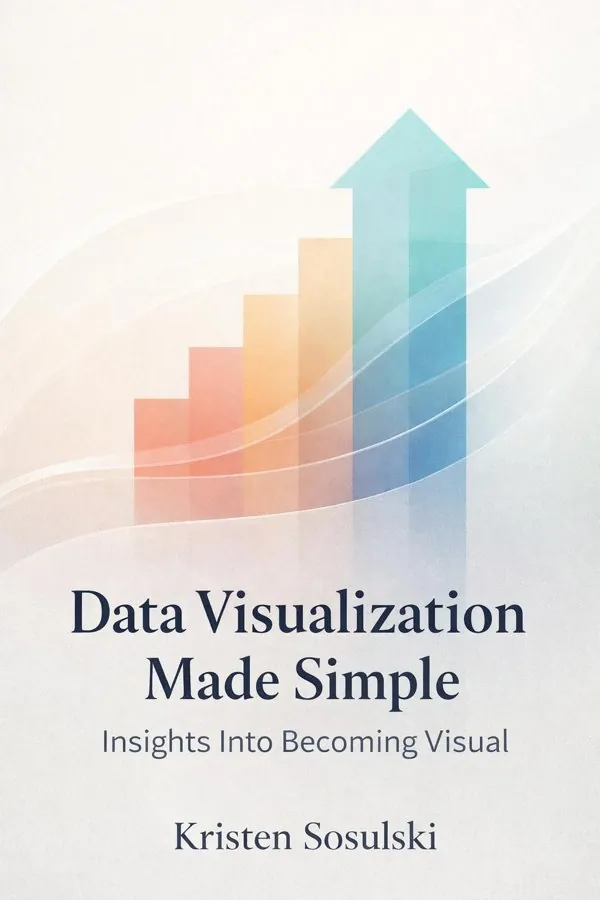
Data Visualization Made Simple: Insights Into Becoming Visual: Summary & Key Insights
 10 min9 chaptersAudio available
Key Takeaways from Data Visualization Made Simple: Insights Into Becoming Visual
Before people interpret data logically, they react to it visually.
Every visual choice sends a message, whether the designer realizes it or not.
A chart is not just a container for data; it is an argument about how the data should be understood.
Confusion in a visualization rarely comes from too little data; it usually comes from too much friction.
Data becomes persuasive when it is organized into a story.
What Is Data Visualization Made Simple: Insights Into Becoming Visual About?
Data Visualization Made Simple: Insights Into Becoming Visual by Kristen Sosulski is a data_science book spanning 9 pages. Data does not become useful the moment it is collected; it becomes useful when people can understand it, trust it, and act on it. In Data Visualization Made Simple: Insights Into Becoming Visual, Kristen Sosulski offers a practical and approachable guide to turning raw information into clear visual communication. The book shows that effective charts and dashboards are not merely decorative outputs but thinking tools that help individuals and organizations recognize patterns, make comparisons, and tell persuasive evidence-based stories. What makes this book especially valuable is its balance between design principles and real-world application. Sosulski explains how people visually process information, how choices like color and layout shape interpretation, and how different chart types support different analytical goals. She also addresses a crucial modern challenge: in a world flooded with metrics, visual clarity is a competitive advantage. Sosulski writes with the authority of a scholar and educator in information systems and analytics. As a professor at NYU Stern and an expert in data visualization and digital learning, she brings both academic rigor and practical experience. The result is a book that helps beginners build confidence and gives working professionals a sharper, more intentional visual mindset.
This FizzRead summary covers all 9 key chapters of Data Visualization Made Simple: Insights Into Becoming Visual in approximately 10 minutes, distilling the most important ideas, arguments, and takeaways from Kristen Sosulski's work. Also available as an audio summary and Key Quotes Podcast.
Data Visualization Made Simple: Insights Into Becoming Visual
Data does not become useful the moment it is collected; it becomes useful when people can understand it, trust it, and act on it. In Data Visualization Made Simple: Insights Into Becoming Visual, Kristen Sosulski offers a practical and approachable guide to turning raw information into clear visual communication. The book shows that effective charts and dashboards are not merely decorative outputs but thinking tools that help individuals and organizations recognize patterns, make comparisons, and tell persuasive evidence-based stories.
What makes this book especially valuable is its balance between design principles and real-world application. Sosulski explains how people visually process information, how choices like color and layout shape interpretation, and how different chart types support different analytical goals. She also addresses a crucial modern challenge: in a world flooded with metrics, visual clarity is a competitive advantage.
Sosulski writes with the authority of a scholar and educator in information systems and analytics. As a professor at NYU Stern and an expert in data visualization and digital learning, she brings both academic rigor and practical experience. The result is a book that helps beginners build confidence and gives working professionals a sharper, more intentional visual mindset.
Who Should Read Data Visualization Made Simple: Insights Into Becoming Visual?
This book is perfect for anyone interested in data_science and looking to gain actionable insights in a short read. Whether you're a student, professional, or lifelong learner, the key ideas from Data Visualization Made Simple: Insights Into Becoming Visual by Kristen Sosulski will help you think differently.
- ✓Readers who enjoy data_science and want practical takeaways
- ✓Professionals looking to apply new ideas to their work and life
- ✓Anyone who wants the core insights of Data Visualization Made Simple: Insights Into Becoming Visual in just 10 minutes
Want the full summary?
Get instant access to this book summary and 100K+ more with Fizz Moment.
Get Free SummaryAvailable on App Store • Free to download
Key Chapters
Before people interpret data logically, they react to it visually. That simple fact explains why some charts communicate instantly while others leave viewers confused. Sosulski emphasizes that human perception is tuned to notice contrast, shape, position, movement, and pattern far faster than it processes tables of numbers. In other words, a visualization succeeds not because it contains data, but because it aligns with how the brain detects meaning.
This cognitive perspective is foundational. When someone looks at a line chart and immediately notices a spike, or at a scatterplot and spots a cluster, they are not reading every value one by one. They are using preattentive processing, the brain’s rapid ability to register visual differences. Good visualizations make use of this natural advantage. Poor ones bury key insights beneath clutter, unnecessary decoration, or inconsistent encoding.
Consider a sales dashboard. If one region is significantly underperforming, a well-designed display can make that issue obvious through position, color contrast, or a simple annotation. A badly designed one might force the viewer to compare many bars, scan legends, and mentally calculate gaps. The data is the same, but the experience of understanding it is completely different.
Sosulski’s larger point is that becoming better with visualization starts with becoming visually aware. Instead of asking only, “What data do I have?” effective communicators ask, “What will people notice first?” and “What should they understand immediately?” That shift changes everything from chart selection to layout decisions.
Actionable takeaway: Before creating any visualization, identify the one pattern, comparison, or change you want viewers to see in the first three seconds, and design around that priority.
Every visual choice sends a message, whether the designer realizes it or not. Sosulski argues that color, shape, size, alignment, and spacing are not cosmetic details; they are the grammar of visual communication. When used with purpose, these elements help viewers understand hierarchy, relationships, and emphasis. When used carelessly, they distract, distort, or overwhelm.
Color is a particularly powerful tool. It can group related items, draw attention to a critical value, or signal difference between categories. But too many colors create confusion, and arbitrary palettes weaken meaning. Similarly, size can suggest magnitude, but only when it is applied consistently and in a way viewers can accurately compare. Spatial placement matters just as much. Objects placed close together appear related. Aligned elements feel organized. White space, often overlooked, gives the eye room to breathe and makes important information easier to find.
Imagine presenting monthly expenses to a leadership team. If every category is brightly colored and every label competes for attention, the audience will spend more time orienting themselves than understanding the message. But if the designer uses neutral tones for background categories, one accent color for a category of concern, and clean alignment throughout, the chart becomes easier to read and more persuasive.
Sosulski encourages readers to think like intentional communicators rather than software users. Visualization tools make it easy to add gradients, effects, icons, and excessive labels. The discipline is knowing what to remove. Effective design supports comprehension, not decoration.
Actionable takeaway: Audit every visual element in your next chart and ask, “Does this clarify meaning, create hierarchy, or guide attention?” If not, simplify or remove it.
A chart is not just a container for data; it is an argument about how the data should be understood. Sosulski stresses that one of the most important visualization skills is matching the form of the display to the structure of the information and the question being asked. There is no universally best chart type, only a chart that best serves a specific purpose.
Bar charts work well for comparisons across categories because people can easily compare lengths along a common scale. Line charts are ideal for showing change over time and helping viewers see trends, volatility, and turning points. Scatterplots reveal relationships between variables and can surface clusters or outliers. Maps make sense when geographic distribution matters. Tables are still valuable when precise lookup is more important than pattern recognition. Problems arise when people choose charts for novelty or appearance rather than analytical fit.
For example, a pie chart might seem intuitive for showing market share, but it becomes difficult to read when there are too many slices or when differences are small. In that case, a sorted bar chart may communicate the ranking and gaps far more clearly. Likewise, using a line chart for unrelated categories can imply continuity where none exists.
Sosulski’s guidance helps readers move beyond chart memorization toward visual reasoning. The right question to ask is not, “What kind of chart should I make?” but “What task should this chart support?” Should viewers compare, rank, locate, track over time, or detect correlation? Once that task is clear, the form becomes easier to choose.
Actionable takeaway: Before selecting a visualization type, define the viewer’s main task in one verb such as compare, trend, rank, locate, or relate, and choose the chart that makes that task easiest.
Confusion in a visualization rarely comes from too little data; it usually comes from too much friction. Sosulski highlights cognitive load as a central challenge in data communication. Every extra label, legend, gridline, color, or ornamental effect asks the viewer to spend mental energy decoding the presentation instead of understanding the insight. The more work the design demands, the less likely the audience is to grasp the message quickly and accurately.
Clear visualizations reduce unnecessary effort. Titles should explain what matters, not merely name a metric. Labels should appear where they are needed most. Legends should be avoided when direct labeling is possible. Axes should support interpretation without crowding the chart. Decorative elements such as 3D effects, shadows, or excessive icons often create noise without adding value. Simplicity is not about making charts empty; it is about making them efficient.
Think of an executive dashboard with ten widgets, each using different scales, colors, and formatting. Even if every panel is technically correct, the viewer must constantly reorient, switch contexts, and remember what each element means. A more coherent dashboard might present fewer metrics, consistent formatting, clear grouping, and one or two highlighted insights. That version supports decision-making instead of data fatigue.
Sosulski’s perspective is especially relevant in workplaces where dashboards are overbuilt and reports become cluttered to satisfy every stakeholder request. More information does not always produce more understanding. Often, the opposite is true. Visual clarity requires discipline, prioritization, and respect for the viewer’s attention.
Actionable takeaway: Review your visualization and remove at least three nonessential elements that do not directly help viewers understand the key message.
Data becomes persuasive when it is organized into a story. Sosulski explains that storytelling with data does not mean manipulating facts or adding drama for its own sake. It means helping viewers move from observation to meaning to action. A good visual story provides context, shows what is important, explains why it matters, and points toward a conclusion or decision.
Storytelling is especially important because audiences rarely approach data with the same familiarity as the analyst who prepared it. The creator may know the history, the caveats, and the key turning points. The viewer often does not. Without narrative guidance, even accurate charts can feel disconnected. A meaningful story frames the problem, identifies the central insight, and sequences information so that understanding builds naturally.
For example, a public health report might begin with a broad overview of rising cases, then focus on geographic hotspots, then show age-based differences, and finally highlight resource needs. Each chart supports the next. The viewer is not simply looking at isolated visuals; they are following an evidence-based argument. In business, the same principle can help explain customer churn, operational delays, budget overruns, or product performance.
Sosulski also suggests that effective stories are selective. Not every data point belongs in the final presentation. Storytelling requires judgment about what to include, what to omit, and how to create a clear throughline. Annotation, titles, callouts, and sequencing are all tools for guiding attention and interpretation.
Actionable takeaway: When preparing a presentation, write your main conclusion in one sentence first, then choose and arrange only the visuals that help the audience arrive at that conclusion logically.
Software can generate charts in seconds, but meaningful visualization still requires human judgment. Sosulski discusses the role of tools as enablers rather than substitutes for thinking. Programs such as Excel, Tableau, Power BI, and other visualization platforms make data exploration, dashboard building, and interactive reporting more accessible. Yet the availability of features can tempt users to mistake technical production for effective communication.
The danger is subtle. Many tools encourage default chart settings, prebuilt color schemes, and rapid drag-and-drop assembly. These capabilities are useful, but defaults are not neutral. They may produce crowded labels, weak hierarchy, misleading scales, or unnecessary visual complexity. Professionals who rely uncritically on software often create visuals that are functional yet uninspired, or worse, confusing.
Sosulski encourages readers to build tool fluency while maintaining conceptual control. The strongest users are not those who know the most buttons, but those who understand why to choose one structure over another, how to customize a view for a specific audience, and when interactivity helps rather than distracts. For instance, an analyst designing a dashboard for operational managers may use filters and drill-down features to support exploration. But if that same dashboard is shown to senior executives, a simpler summary view may be more effective.
Tools matter because they shape workflow, collaboration, and distribution. Still, they should remain servants of the message. The visualizer’s job is to think critically about audience, task, and context before opening the software, not after the chart has already taken form.
Actionable takeaway: Use software defaults as a starting point only, then deliberately revise titles, colors, scales, labels, and layout so the final visualization reflects your communication goal rather than the tool’s assumptions.
A visualization proves its value not when it looks impressive, but when it helps someone make a better decision. Sosulski grounds her ideas in practical use across business, education, research, and public communication. Her broader message is that visualization is not a niche design skill. It is a cross-functional capability that improves analysis, collaboration, and organizational learning.
In business settings, visualizations can reveal underperforming regions, customer behavior shifts, inventory bottlenecks, or budget anomalies. In education, they can help instructors and administrators monitor student engagement, compare learning outcomes, and identify intervention needs. In research, visual displays allow scholars to explore patterns, communicate findings, and make complex data understandable to broader audiences. Across all of these contexts, the goal is the same: transform complexity into usable insight.
A company reviewing customer retention might use a cohort chart to detect where drop-off occurs, then pair that with a segmented bar chart to compare churn across demographics. A school administrator could examine attendance patterns by grade level to target support resources more effectively. A nonprofit might map service access to identify underserved neighborhoods. In each case, the visualization becomes a practical instrument for action.
Sosulski also implies that organizations benefit when visualization literacy spreads beyond analysts. When managers, teachers, marketers, and executives all become better consumers and creators of visuals, discussion becomes more evidence-based and less dependent on intuition alone. This is one reason data visualization has strategic value: it improves shared understanding.
Actionable takeaway: Choose one recurring decision in your work and redesign the way its supporting data is presented so the next conversation centers on insight and action rather than explanation.
Every visualization contains choices, and every choice has ethical consequences. Sosulski treats visual ethics as a necessary part of responsible data communication. Charts can clarify reality, but they can also distort it through truncated axes, selective filtering, misleading proportions, loaded color use, omitted context, or overconfident framing. Because visualizations feel authoritative, their power to mislead can be especially strong.
Ethical visualization begins with honesty about what the data can and cannot support. If uncertainty exists, it should be acknowledged. If categories are uneven, scales inconsistent, or data incomplete, those limitations should be made visible rather than hidden. Designers should also be aware of how framing influences interpretation. Highlighting one comparison while omitting another can steer conclusions in subtle ways. Even seemingly minor design choices, such as exaggerating differences by narrowing an axis range, can push viewers toward a false impression.
Consider a chart showing year-over-year revenue growth. If the vertical axis begins at 95 instead of zero, a modest increase may appear dramatic. In some analytical contexts, a non-zero baseline is acceptable, but only when it is clearly justified and labeled. Ethical design means anticipating how a reasonable viewer might interpret the graphic and ensuring that interpretation is fair.
Sosulski also points to bias. Data is not collected in a vacuum, and audiences are not neutral. Visualization creators must reflect on whose perspective is centered, whose experience may be obscured, and whether the display promotes understanding or manipulation. Trust depends on this discipline.
Actionable takeaway: Before sharing a visualization, ask a colleague to review it specifically for possible misinterpretation, missing context, or design choices that exaggerate the message.
No important visualization is perfect on the first draft. Sosulski presents visual communication as a skill developed through repeated testing, critique, and revision. This mindset matters because creators often become too familiar with their own charts. What seems obvious to them may be unclear to others. Iteration closes that gap by exposing where attention goes, where interpretation breaks down, and what improvements increase clarity.
Feedback can come from many sources: colleagues, stakeholders, users, students, or even quick informal observation. Ask viewers what they notice first, what they think the chart is saying, and where they hesitate. Their answers often reveal whether the visual hierarchy is working. If people focus on the wrong detail, miss the main trend, or misunderstand the scale, the issue is usually design, not intelligence.
Iteration also encourages exploration. A single dataset may support several possible views, and the first chart chosen is not always the best one. A stacked bar chart might become a clearer grouped bar chart. A dense dashboard might become a simple sequence of visuals. A vague title might become a strong takeaway statement. These refinements accumulate into much stronger communication.
Sosulski’s approach is empowering because it reframes expertise. Becoming visual is not about innate artistic talent. It is about practice, reflection, and curiosity. Over time, creators build pattern recognition for what works and why. They become more critical of clutter, more sensitive to audience needs, and more confident in making intentional design decisions.
Actionable takeaway: Treat your next visualization as a prototype, test it with at least two representative viewers, and revise it based on what they actually understand rather than what you intended.
All Chapters in Data Visualization Made Simple: Insights Into Becoming Visual
About the Author
Kristen Sosulski is an Associate Professor of Information, Operations, and Management Sciences at New York University’s Stern School of Business. Her work sits at the intersection of data visualization, digital learning, analytics, and educational technology. She is known for helping students and professionals understand how information can be structured and presented in ways that improve learning, decision-making, and communication. Sosulski combines academic depth with practical clarity, making complex topics accessible to broad audiences. Through her teaching, writing, and applied work, she has built a reputation for showing how visual thinking can turn raw data into insight. In Data Visualization Made Simple, she draws on that expertise to offer a clear, user-friendly guide for anyone who wants to communicate data more effectively.
Get This Summary in Your Preferred Format
Read or listen to the Data Visualization Made Simple: Insights Into Becoming Visual summary by Kristen Sosulski anytime, anywhere. FizzRead offers multiple formats so you can learn on your terms — all free.
Available formats: App · Audio · PDF · EPUB — All included free with FizzRead
Download Data Visualization Made Simple: Insights Into Becoming Visual PDF and EPUB Summary
Key Quotes from Data Visualization Made Simple: Insights Into Becoming Visual
“Before people interpret data logically, they react to it visually.”
“Every visual choice sends a message, whether the designer realizes it or not.”
“A chart is not just a container for data; it is an argument about how the data should be understood.”
“Confusion in a visualization rarely comes from too little data; it usually comes from too much friction.”
“Data becomes persuasive when it is organized into a story.”
Frequently Asked Questions about Data Visualization Made Simple: Insights Into Becoming Visual
Data Visualization Made Simple: Insights Into Becoming Visual by Kristen Sosulski is a data_science book that explores key ideas across 9 chapters. Data does not become useful the moment it is collected; it becomes useful when people can understand it, trust it, and act on it. In Data Visualization Made Simple: Insights Into Becoming Visual, Kristen Sosulski offers a practical and approachable guide to turning raw information into clear visual communication. The book shows that effective charts and dashboards are not merely decorative outputs but thinking tools that help individuals and organizations recognize patterns, make comparisons, and tell persuasive evidence-based stories. What makes this book especially valuable is its balance between design principles and real-world application. Sosulski explains how people visually process information, how choices like color and layout shape interpretation, and how different chart types support different analytical goals. She also addresses a crucial modern challenge: in a world flooded with metrics, visual clarity is a competitive advantage. Sosulski writes with the authority of a scholar and educator in information systems and analytics. As a professor at NYU Stern and an expert in data visualization and digital learning, she brings both academic rigor and practical experience. The result is a book that helps beginners build confidence and gives working professionals a sharper, more intentional visual mindset.
You Might Also Like
Data Science from Scratch: First Principles with Python
Joel Grus
10 min
Applied Predictive Modeling
Max Kuhn, Kjell Johnson
10 min
Better Data Visualizations: A Guide for Scholars, Researchers, and Wonks
Jonathan Schwabish
10 min
Big Data: A Revolution That Will Transform How We Live, Work, and Think
Viktor Mayer-Schönberger, Kenneth Cukier
10 min
Big Data: Principles and Best Practices of Scalable Real-Time Data Systems
Nathan Marz
10 min
Data Points: Visualization That Means Something
Nathan Yau
10 minBrowse by Category
Ready to read Data Visualization Made Simple: Insights Into Becoming Visual?
Get the full summary and 100K+ more books with Fizz Moment.