
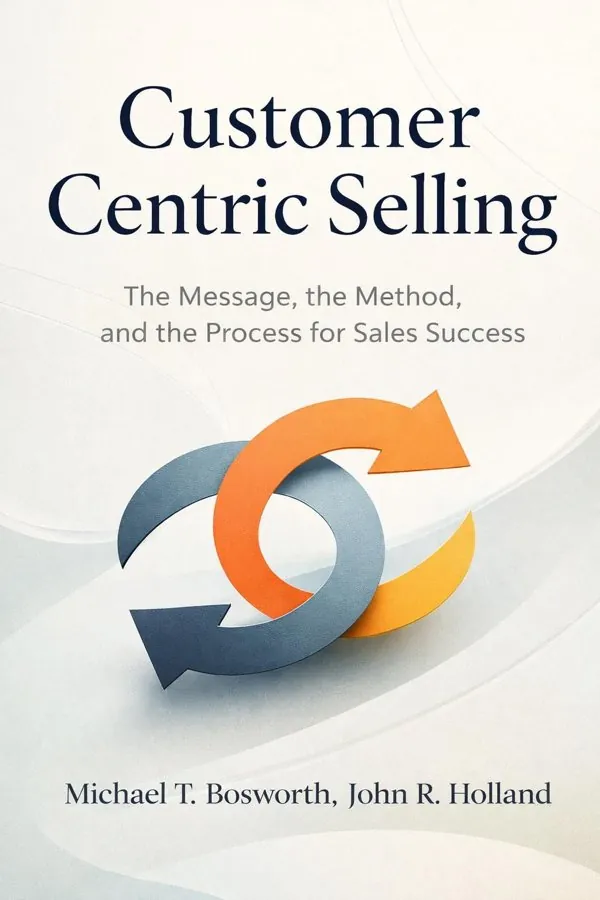
Customer Centric Selling: The Message, the Method, and the Process for Sales Success: Summary & Key Insights
by Michael T. Bosworth, John R. Holland
 10 min9 chaptersAudio available
Key Takeaways from Customer Centric Selling: The Message, the Method, and the Process for Sales Success
One of the most dangerous assumptions in selling is that the best product naturally wins.
A sale does not happen in one moment; it unfolds through a sequence of decisions.
The fastest way to lose relevance in a sales meeting is to talk too much too soon.
Not every interested prospect is a real opportunity, and one of the costliest sales mistakes is pursuing deals that will never close.
In complex sales, losing control rarely happens because a competitor has a better product.
What Is Customer Centric Selling: The Message, the Method, and the Process for Sales Success About?
Customer Centric Selling: The Message, the Method, and the Process for Sales Success by Michael T. Bosworth, John R. Holland is a marketing book spanning 5 pages. Customer Centric Selling argues that sales success does not come from delivering polished pitches or overwhelming buyers with product knowledge. It comes from understanding how customers make decisions, identifying the business problems they want to solve, and guiding them through change. In this book, Michael T. Bosworth and John R. Holland present a practical sales methodology built around consultative conversations, measurable customer outcomes, and disciplined process management. Rather than treating selling as persuasion, they frame it as facilitation: helping buyers clarify needs, evaluate options, and build confidence in a decision. That shift matters because modern buyers are better informed, more cautious, and often part of a complex committee. In such an environment, traditional feature-and-benefit selling frequently creates resistance instead of momentum. Bosworth, widely known for his work in sales methodology, and Holland, an experienced sales consultant, bring credibility through years of observing what works in real organizations. Their message is especially valuable for sales professionals, managers, and marketers who want a repeatable system for improving qualification, shortening sales cycles, and creating conversations customers actually find useful.
This FizzRead summary covers all 9 key chapters of Customer Centric Selling: The Message, the Method, and the Process for Sales Success in approximately 10 minutes, distilling the most important ideas, arguments, and takeaways from Michael T. Bosworth, John R. Holland's work. Also available as an audio summary and Key Quotes Podcast.
Customer Centric Selling: The Message, the Method, and the Process for Sales Success
Customer Centric Selling argues that sales success does not come from delivering polished pitches or overwhelming buyers with product knowledge. It comes from understanding how customers make decisions, identifying the business problems they want to solve, and guiding them through change. In this book, Michael T. Bosworth and John R. Holland present a practical sales methodology built around consultative conversations, measurable customer outcomes, and disciplined process management. Rather than treating selling as persuasion, they frame it as facilitation: helping buyers clarify needs, evaluate options, and build confidence in a decision.
That shift matters because modern buyers are better informed, more cautious, and often part of a complex committee. In such an environment, traditional feature-and-benefit selling frequently creates resistance instead of momentum. Bosworth, widely known for his work in sales methodology, and Holland, an experienced sales consultant, bring credibility through years of observing what works in real organizations. Their message is especially valuable for sales professionals, managers, and marketers who want a repeatable system for improving qualification, shortening sales cycles, and creating conversations customers actually find useful.
Who Should Read Customer Centric Selling: The Message, the Method, and the Process for Sales Success?
This book is perfect for anyone interested in marketing and looking to gain actionable insights in a short read. Whether you're a student, professional, or lifelong learner, the key ideas from Customer Centric Selling: The Message, the Method, and the Process for Sales Success by Michael T. Bosworth, John R. Holland will help you think differently.
- ✓Readers who enjoy marketing and want practical takeaways
- ✓Professionals looking to apply new ideas to their work and life
- ✓Anyone who wants the core insights of Customer Centric Selling: The Message, the Method, and the Process for Sales Success in just 10 minutes
Want the full summary?
Get instant access to this book summary and 100K+ more with Fizz Moment.
Get Free SummaryAvailable on App Store • Free to download
Key Chapters
One of the most dangerous assumptions in selling is that the best product naturally wins. Bosworth and Holland challenge this idea by showing that buyers rarely make decisions based on features alone. They buy when they clearly understand how a solution will improve their business, reduce risk, or help them achieve a desired result. That means the center of gravity in a sales conversation must shift away from the seller’s product and toward the buyer’s situation.
Traditional selling often starts with presentations, demos, and claims of superiority. Customer-centric selling starts with the customer’s goals, problems, and priorities. Instead of saying, “Let me show you what our platform can do,” an effective salesperson asks, “How are you currently handling this process, and what happens when it breaks down?” That subtle change transforms the conversation. The seller is no longer performing; they are diagnosing.
This approach is especially powerful in competitive markets where many products look similar. Buyers may not remember every feature, but they do remember the salesperson who understood their challenges and connected those challenges to meaningful outcomes. A software seller, for example, should not lead with dashboard capabilities. They should lead with questions about delayed reporting, missed forecasts, or costly manual work.
The method also improves credibility. Buyers are more likely to trust someone who helps them think through a business issue than someone who rushes to pitch. In this sense, customer-centric selling is not just a sales tactic; it is a mindset that treats relevance as more persuasive than enthusiasm.
Actionable takeaway: Before every sales call, define the customer problem you want to explore rather than the product points you want to present.
A sale does not happen in one moment; it unfolds through a sequence of decisions. That insight sits at the core of Customer Centric Selling. Buyers first recognize a problem or opportunity, then consider whether change is necessary, explore possible approaches, evaluate alternatives, manage internal politics, and finally commit. Salespeople often lose deals because they try to force the customer into a later stage before the buyer is mentally ready.
Bosworth and Holland emphasize that effective selling mirrors this decision process. If a prospect has not yet agreed that the current situation is costly or unsustainable, a product demo is premature. If stakeholders have not aligned internally, pushing for a close creates pressure instead of progress. The salesperson’s role is to identify where the buyer is in their journey and support the next logical step.
Consider a manufacturing company struggling with inventory inefficiencies. Early in the process, the seller should help quantify lost time, stockouts, and excess carrying costs. Later, they may facilitate discussions around implementation risks, integration needs, and approval requirements. Different stages require different conversations.
This stage-based view also improves forecasting and qualification. A deal should not be considered advanced simply because the buyer attended a demo or requested pricing. Progress should be measured by customer actions such as agreeing on a problem, sharing evaluation criteria, introducing decision makers, or outlining a timeline.
When sales teams adopt the buyer’s journey as their map, they become less reactive and more strategic. They stop confusing activity with movement and start recognizing what real advancement looks like.
Actionable takeaway: In every opportunity, ask yourself what decision the buyer must make next, and focus your conversation on helping them make that decision.
The fastest way to lose relevance in a sales meeting is to talk too much too soon. Bosworth and Holland argue that value is not created by delivering information; it is uncovered through conversation. Buyers often do not fully understand the costs of their current problems or the benefits of change until a skilled salesperson helps them articulate both.
Customer-centric conversations rely on purposeful questions. These are not generic discovery questions asked from a checklist. They are carefully designed to reveal business impact, workflow friction, decision criteria, and desired outcomes. Instead of asking, “Are you interested in improving productivity?” a stronger question would be, “Where do delays in this process create the biggest downstream costs?” That type of inquiry invites specificity and opens the door to a meaningful business case.
The book stresses that questions should guide, not interrogate. Buyers should feel helped, not handled. Good sellers listen for symptoms, causes, emotional urgency, and language the customer uses to describe success. Those details become the foundation for later proposals, demos, and presentations. If a prospect says, “Our sales managers spend two days a week stitching together reports,” the seller can later position the solution around time recovery and decision speed rather than abstract functionality.
These conversations also make demos more effective. Instead of showing everything, the salesperson can focus only on capabilities tied to expressed needs. This reduces overload and increases relevance.
In practical terms, consultative dialogue requires preparation, patience, and active listening. The best customer-centric sellers are not the most charismatic speakers. They are the most disciplined facilitators of buyer insight.
Actionable takeaway: Replace broad discovery with five specific questions that uncover business impact, current limitations, desired outcomes, stakeholders, and urgency.
Not every interested prospect is a real opportunity, and one of the costliest sales mistakes is pursuing deals that will never close. Customer Centric Selling treats qualification as a discipline, not a gut feeling. Bosworth and Holland encourage salespeople to evaluate whether a prospect has a meaningful problem, a reason to change, access to decision makers, and a realistic path to action.
Many sellers confuse friendliness with commitment. A prospect may gladly accept meetings, demos, and proposals without having urgency, budget, or internal alignment. The result is a bloated pipeline full of hopeful but weak deals. Customer-centric qualification asks harder questions earlier. What business issue is important enough to justify change? What happens if the customer does nothing? Who is affected? Who will approve the decision? By addressing these issues directly, sellers save time and improve forecast accuracy.
This is not about being cynical or aggressive. It is about respecting both sides. If the customer has no compelling reason to act, the seller should not pretend otherwise. For example, a sales rep offering cybersecurity services may discover that a prospect is merely gathering market information for next year. Rather than forcing a premature sales cycle, the rep can nurture the relationship and re-engage when urgency rises.
Qualification also protects resources inside the selling organization. Technical teams, executives, and proposal managers should be brought into deals only when there is evidence of real buyer movement. Strong qualification improves productivity because it directs effort toward opportunities where mutual value is possible.
Actionable takeaway: Create a qualification checklist based on customer pain, urgency, stakeholders, decision process, and consequences of inaction, then review every deal against it honestly.
In complex sales, losing control rarely happens because a competitor has a better product. More often, deals stall because the buying process involves multiple people, conflicting priorities, and unclear next steps. Bosworth and Holland show that customer-centric selling requires structure. A repeatable sales process helps teams manage complexity without slipping back into pitch-driven habits.
A good sales process is not a rigid script. It is a framework that connects selling activities to buyer milestones. Early stages might involve diagnosing problems and establishing business impact. Middle stages may focus on solution fit, stakeholder alignment, and proof of value. Later stages involve risk management, implementation planning, and final commitment. Each stage should have exit criteria based on what the customer has done, not just what the salesperson has completed.
This becomes crucial in enterprise selling. Imagine a company evaluating a new HR platform. The HR leader may care about usability, IT about integration, finance about total cost, and leadership about strategic outcomes. The salesperson must navigate these concerns in sequence and coordinate messages across functions. Without a process, the opportunity fragments. With one, the rep can anticipate bottlenecks and guide the account more effectively.
The authors also highlight the importance of internal alignment. Sales managers, product specialists, and executives should support the same customer-centered approach. When one part of the organization pushes discounting while another tries to build value, inconsistency confuses the buyer.
A disciplined process creates predictability. It improves coaching, forecasting, and handoffs, while helping salespeople avoid random acts of selling that waste momentum.
Actionable takeaway: Define clear buyer-based milestones for each sales stage and require evidence of customer progress before advancing an opportunity.
Buyers do not purchase features; they purchase the outcomes those features make possible. This is a central message in the book, and it changes how salespeople communicate. Product knowledge is necessary, but it becomes persuasive only when translated into business improvement, personal benefit, or strategic impact.
Bosworth and Holland encourage sellers to move beyond technical descriptions and speak in the language of customer usage scenarios. Instead of saying, “Our software includes automated workflow routing,” a customer-centric message says, “Your team can eliminate manual approvals that currently delay order processing by two days.” The feature remains important, but it is framed through the buyer’s reality.
This translation requires understanding role-specific value. A frontline manager may care about ease of use and time saved. A CFO may focus on cost reduction, cash flow, or predictable returns. An executive sponsor may care about growth, compliance, or competitive advantage. Effective messaging adapts without becoming inconsistent. The core solution remains the same, but the expressed value changes according to stakeholder priorities.
The book also implies that generic messaging weakens trust. When salespeople recite broad claims like “improve efficiency” or “drive innovation,” buyers hear marketing language, not meaningful relevance. Specificity creates credibility. If a seller can connect a solution to fewer service errors, faster onboarding, or shorter sales cycles, the message becomes tangible.
For organizations, this has implications beyond individual conversations. Marketing materials, presentations, and demos should all support outcome-based messaging. Consistency across channels helps reinforce the same customer-centered narrative.
Actionable takeaway: For each major feature you sell, write down the business outcome it enables and the specific stakeholder who would care most about that result.
Many sales teams treat the demo as the centerpiece of the sales process. Bosworth and Holland flip that assumption. In customer-centric selling, a demo is most effective when it comes after needs have been clarified, priorities established, and value agreed upon. Otherwise, it becomes a generic product tour that overwhelms the buyer and weakens the seller’s position.
A well-run demo should feel like a visual confirmation of the customer’s own goals. If a prospect has said they struggle with forecasting accuracy, approval delays, and poor visibility across teams, the demo should focus tightly on those three areas. Showing unrelated functionality may seem impressive, but it dilutes relevance and extends the conversation into details the buyer never asked about.
This approach also changes preparation. Instead of asking, “What should I show?” the salesperson asks, “What customer issues must this demo help resolve?” That question encourages collaboration with technical teams and ensures the demonstration serves a strategic purpose. Even in highly technical sales, the principle holds: features matter most when they are linked to an agreed business problem.
A focused demo also improves buyer engagement. Prospects can more easily imagine implementation and results when they see scenarios that resemble their own environment. For example, a logistics software demo should illustrate exception handling, route visibility, or reporting workflows if those are the prospect’s known pain points.
By making demos proof points instead of performances, sellers reduce information overload and increase decision confidence.
Actionable takeaway: Before any demo, confirm the top three customer issues to address and remove any content that does not directly support those priorities.
A customer-centric sales methodology cannot thrive if marketing and sales operate with different assumptions about buyers. Bosworth and Holland emphasize that organizational alignment is essential. Marketing often creates awareness and generates leads, but if those messages are product-heavy while sales is trying to be consultative, the customer experiences a disconnect. The result is confusion, mistrust, and lower conversion.
Alignment starts with a shared understanding of buyer problems, buying stages, and value messages. Marketing should produce content that helps buyers make decisions, not just admire the product. Case studies, comparison guides, problem-framing content, and role-specific value messaging can prepare prospects for more productive sales conversations. Meanwhile, sales should provide feedback from the field about objections, stakeholder concerns, and the language customers actually use.
This collaboration also improves lead quality. If marketing defines success by volume alone, sales teams may receive contacts who have shown mild interest but have no reason to act. A customer-centric organization instead looks for signals of problem awareness, engagement depth, and potential fit. That creates a healthier handoff.
Training and culture matter as well. Managers should reinforce the same principles across departments: understand the customer, communicate outcomes, and support the buyer’s process. In many companies, the challenge is not lack of effort but lack of consistency.
When sales and marketing align around the customer’s world, the organization becomes easier to buy from. Every message feels connected, and every interaction builds on the last instead of restarting from scratch.
Actionable takeaway: Hold regular sales-marketing reviews focused on buyer questions, objections, and content gaps, then update messaging based on real customer conversations.
Every meaningful purchase is, in some way, a decision to change. That means salespeople are not just selling products or services; they are helping customers move from a familiar current state to an unfamiliar future state. Bosworth and Holland make clear that this transition creates uncertainty, and uncertainty is often the real barrier to buying.
Buyers may agree that a problem exists and still hesitate because change feels disruptive. They worry about implementation effort, internal resistance, training requirements, budget scrutiny, or career risk if the decision fails. A customer-centric seller anticipates these concerns and treats them as legitimate parts of the buying process, not objections to dismiss.
This perspective is especially important in large organizations, where a proposed solution may alter workflows across departments. A new CRM system, for example, affects sales reps, managers, operations, and executives. The deal will move only if those groups can imagine a workable transition. The salesperson can help by sharing implementation roadmaps, customer examples, phased rollout options, and success metrics.
The broader lesson is that perceived risk often outweighs promised value. A great business case may not be enough if buyers fear disruption. Customer-centric selling addresses both sides of the decision: why change matters and how change can be managed responsibly.
This makes the seller more than a persuader. It makes them a guide through uncertainty. That role builds trust and can differentiate a seller even in crowded markets.
Actionable takeaway: In every opportunity, proactively discuss the risks of adopting the solution and offer a simple plan for reducing disruption, gaining adoption, and measuring early success.
All Chapters in Customer Centric Selling: The Message, the Method, and the Process for Sales Success
About the Authors
Michael T. Bosworth is a highly regarded sales trainer, speaker, and author best known for shaping modern consultative selling practices. He gained broad recognition through his work on Solution Selling and later through his contributions to customer-focused sales methodology. His work has influenced sales organizations across technology, services, and other complex B2B industries. John R. Holland is a sales consultant, trainer, and co-author known for helping companies improve sales effectiveness through better process, messaging, and buyer alignment. Together, Bosworth and Holland combine strategic sales insight with practical field experience. Their collaboration in Customer Centric Selling reflects a shared belief that successful selling depends less on persuasion and more on understanding customer needs, guiding decisions, and building organizational consistency around the buyer.
Get This Summary in Your Preferred Format
Read or listen to the Customer Centric Selling: The Message, the Method, and the Process for Sales Success summary by Michael T. Bosworth, John R. Holland anytime, anywhere. FizzRead offers multiple formats so you can learn on your terms — all free.
Available formats: App · Audio · PDF · EPUB — All included free with FizzRead
Download Customer Centric Selling: The Message, the Method, and the Process for Sales Success PDF and EPUB Summary
Key Quotes from Customer Centric Selling: The Message, the Method, and the Process for Sales Success
“One of the most dangerous assumptions in selling is that the best product naturally wins.”
“A sale does not happen in one moment; it unfolds through a sequence of decisions.”
“The fastest way to lose relevance in a sales meeting is to talk too much too soon.”
“Not every interested prospect is a real opportunity, and one of the costliest sales mistakes is pursuing deals that will never close.”
“In complex sales, losing control rarely happens because a competitor has a better product.”
Frequently Asked Questions about Customer Centric Selling: The Message, the Method, and the Process for Sales Success
Customer Centric Selling: The Message, the Method, and the Process for Sales Success by Michael T. Bosworth, John R. Holland is a marketing book that explores key ideas across 9 chapters. Customer Centric Selling argues that sales success does not come from delivering polished pitches or overwhelming buyers with product knowledge. It comes from understanding how customers make decisions, identifying the business problems they want to solve, and guiding them through change. In this book, Michael T. Bosworth and John R. Holland present a practical sales methodology built around consultative conversations, measurable customer outcomes, and disciplined process management. Rather than treating selling as persuasion, they frame it as facilitation: helping buyers clarify needs, evaluate options, and build confidence in a decision. That shift matters because modern buyers are better informed, more cautious, and often part of a complex committee. In such an environment, traditional feature-and-benefit selling frequently creates resistance instead of momentum. Bosworth, widely known for his work in sales methodology, and Holland, an experienced sales consultant, bring credibility through years of observing what works in real organizations. Their message is especially valuable for sales professionals, managers, and marketers who want a repeatable system for improving qualification, shortening sales cycles, and creating conversations customers actually find useful.
You Might Also Like
Captivology: The Science of Capturing People's Attention
Ben Parr
10 min
Marketing 5.0: Technology for Humanity
Philip Kotler, Hermawan Kartajaya, Iwan Setiawan
10 min
Marketing Strategy
Paul Fifield
10 min
UnMarketing: Stop Marketing. Start Engaging.
Scott Stratten
10 min
$100M Leads: How to Get Strangers to Want to Buy Your Stuff
Alex Hormozi
10 min
80/20 Sales and Marketing: The Definitive Guide to Working Less and Making More
Perry Marshall
10 minBrowse by Category
Ready to read Customer Centric Selling: The Message, the Method, and the Process for Sales Success?
Get the full summary and 100K+ more books with Fizz Moment.