
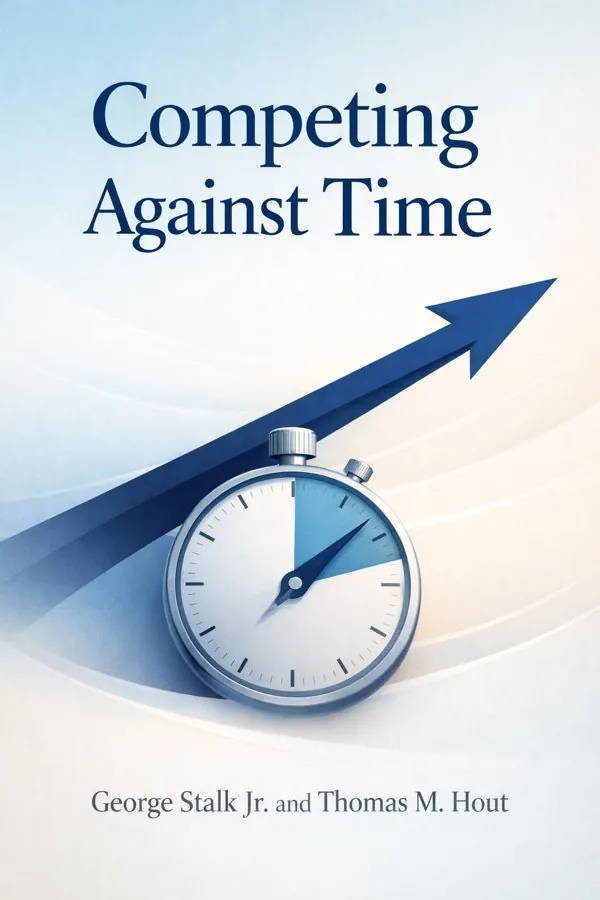
Competing Against Time: How Time-Based Competition Is Reshaping Global Markets: Summary & Key Insights
by George Stalk Jr., Thomas M. Hout
 10 min4 chaptersAudio available
What Is Competing Against Time: How Time-Based Competition Is Reshaping Global Markets About?
Competing Against Time: How Time-Based Competition Is Reshaping Global Markets by George Stalk Jr. and Thomas M. Hout is a strategy book spanning 4 pages. This influential business book explores how leading companies gain competitive advantage by managing time as a strategic resource. Stalk and Hout argue that speed in product development, production, and delivery can redefine market leadership. Drawing on case studies from global firms, the authors demonstrate how time-based competition transforms operations, customer responsiveness, and profitability.
This FizzRead summary covers all 4 key chapters of Competing Against Time: How Time-Based Competition Is Reshaping Global Markets in approximately 10 minutes, distilling the most important ideas, arguments, and takeaways from George Stalk Jr. and Thomas M. Hout's work. Also available as an audio summary and Key Quotes Podcast.
Competing Against Time: How Time-Based Competition Is Reshaping Global Markets
This influential business book explores how leading companies gain competitive advantage by managing time as a strategic resource. Stalk and Hout argue that speed in product development, production, and delivery can redefine market leadership. Drawing on case studies from global firms, the authors demonstrate how time-based competition transforms operations, customer responsiveness, and profitability.
Who Should Read Competing Against Time: How Time-Based Competition Is Reshaping Global Markets?
This book is perfect for anyone interested in strategy and looking to gain actionable insights in a short read. Whether you're a student, professional, or lifelong learner, the key ideas from Competing Against Time: How Time-Based Competition Is Reshaping Global Markets by George Stalk Jr. and Thomas M. Hout will help you think differently.
- ✓Readers who enjoy strategy and want practical takeaways
- ✓Professionals looking to apply new ideas to their work and life
- ✓Anyone who wants the core insights of Competing Against Time: How Time-Based Competition Is Reshaping Global Markets in just 10 minutes
Want the full summary?
Get instant access to this book summary and 100K+ more with Fizz Moment.
Get Free SummaryAvailable on App Store • Free to download
Key Chapters
Over much of industrial history, competition has been defined by cost and quality. Companies either sought to make things cheaper or better. But by the late twentieth century, those dimensions started to converge: quality became expected, and global cost competition equalized differences that once defined industry leaders. Amid this parity, we began noticing that certain firms, regardless of geography or sector, were pulling ahead—not because their costs were substantially lower but because they used time in fundamentally new ways. These companies didn't just manufacture faster; they developed, delivered, and responded faster.
Toyota, for instance, reengineered its production system not only to eliminate waste but also to compress cycle time. Cars were produced quickly without compromising quality. Similarly, Canon transformed its product development process by overlapping stages that most competitors treated as sequential. Engineers didn’t wait for final designs before beginning tooling; marketing teams didn’t wait for prototypes before testing customer perception. This parallelism gave Canon the ability to launch new models months ahead of rivals.
These examples reveal that the heart of time-based competition lies in synchronization. Firms that integrate functions across boundaries generate flow rather than friction. They convert information into action faster, aligning every department toward a shared temporal goal. This approach is not ephemeral—it redefines how value is created. When development time drops, the odds of product success rise because customers receive what they want when they want it. When production time shortens, inventory costs fall and cash cycles accelerate.
In studying these firms, we discovered that those who led in time-based competition often gained significant market share. Faster innovation meant they could respond to emerging needs swiftly and preempt competitors. In industries like consumer electronics, being first meant capturing the early adopters who dictated later market trends. Thus, speed became synonymous with strategic foresight. To embrace time-based competition is to accept that responsiveness—in production, in information, in customer engagement—creates the conditions for sustained success.
Let’s examine why cycle time matters. Cycle time represents the total duration from concept to market delivery. In traditional organizations, this cycle could span years: engineers design, procurement acquires materials, production tests prototypes, and marketing waits for final output. Each step carries idle time. Time-based companies bring radical change by viewing long cycles as the enemy. Shortening the cycle isn’t just about speed; it’s about removing non-value-added activity, eliminating functional bottlenecks, and aligning effort with market urgency.
When product development cycles collapse from eighteen months to nine, the organization experiences a cascading effect. Cash flow accelerates because the company earns revenue sooner. Customer feedback arrives earlier, allowing teams to iterate before competitors even launch. Costs decline because the entire system spends less time managing work-in-progress. More importantly, the company stays closer to market rhythm—its timing is synchronized with customer expectation and technological evolution.
Our research uncovered a powerful correlation: the shorter the cycle time, the larger the market share. Companies that consistently reduced cycle times often became segment leaders. Why? Because they could capitalize on trends faster, correct mistakes earlier, and redefine product categories ahead of rivals. This speed made them appear more innovative and more reliable to consumers. Time-based advantage thus generates not only internal efficiency but also external perception.
Consider the experience of Honda in motorcycle development. By compressing design-to-market cycles, Honda was able to respond immediately to changing styles and performance demands. A competitor still testing prototypes would find Honda already selling finished models. This responsiveness fed customer loyalty—everyone wanted to work with the company that moved quickly. In such cases, speed transformed into reputation.
Cycle time reduction also changes managerial behavior. Leaders learn to trust cross-functional teams rather than bureaucratic approvals. Decision-making moves closer to data and direct responsibility. Continuous improvement becomes daily practice rather than periodic intervention. And as everyone begins measuring time as a performance variable, culture itself evolves. The organization learns that every delay carries cost—and that every acceleration generates power.
+ 2 more chapters — available in the FizzRead app
All Chapters in Competing Against Time: How Time-Based Competition Is Reshaping Global Markets
About the Authors
George Stalk Jr. is a senior advisor and strategist known for his work on competitive strategy and operations management. Thomas M. Hout is a business consultant and author specializing in global competition and corporate strategy. Both have contributed extensively to the field of management through research and consulting.
Get This Summary in Your Preferred Format
Read or listen to the Competing Against Time: How Time-Based Competition Is Reshaping Global Markets summary by George Stalk Jr. and Thomas M. Hout anytime, anywhere. FizzRead offers multiple formats so you can learn on your terms — all free.
Available formats: App · Audio · PDF · EPUB — All included free with FizzRead
Download Competing Against Time: How Time-Based Competition Is Reshaping Global Markets PDF and EPUB Summary
Key Quotes from Competing Against Time: How Time-Based Competition Is Reshaping Global Markets
“Over much of industrial history, competition has been defined by cost and quality.”
“Cycle time represents the total duration from concept to market delivery.”
Frequently Asked Questions about Competing Against Time: How Time-Based Competition Is Reshaping Global Markets
Competing Against Time: How Time-Based Competition Is Reshaping Global Markets by George Stalk Jr. and Thomas M. Hout is a strategy book that explores key ideas across 4 chapters. This influential business book explores how leading companies gain competitive advantage by managing time as a strategic resource. Stalk and Hout argue that speed in product development, production, and delivery can redefine market leadership. Drawing on case studies from global firms, the authors demonstrate how time-based competition transforms operations, customer responsiveness, and profitability.
You Might Also Like

Mastery
Robert Greene
10 min
Cut Costs Not Corners: A Practical Guide to Staying Competitive and Improving Profits
Colin Barrow
10 min
Good Strategy/Bad Strategy: The Difference and Why It Matters
Richard P. Rumelt
10 min
On Grand Strategy
John Lewis Gaddis
10 min
The Six Disciplines of Digital Transformation
George Westerman
10 min
7 Powers: The Foundations of Business Strategy
Hamilton Helmer
10 minFeatured In
Browse by Category
Ready to read Competing Against Time: How Time-Based Competition Is Reshaping Global Markets?
Get the full summary and 100K+ more books with Fizz Moment.