
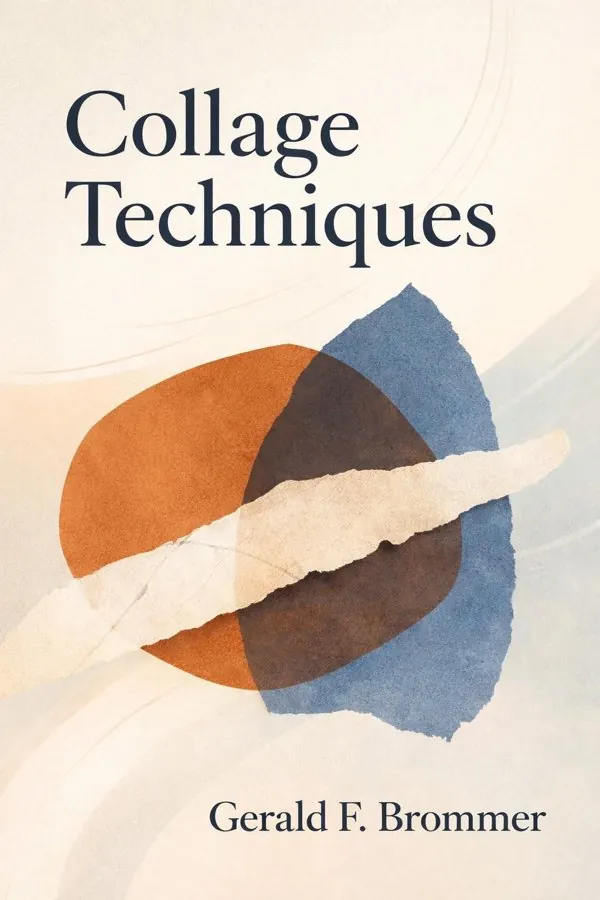
Collage Techniques: Summary & Key Insights
 10 min9 chaptersAudio available
Key Takeaways from Collage Techniques
Every collage begins with a simple but radical act: taking something made for one purpose and giving it a new visual life.
The quality of a collage is often decided before composition even begins—by the artist’s familiarity with materials.
A successful collage may look spontaneous, but beneath its energy lies deliberate design.
Collage becomes truly alive when color and texture start interacting across layers.
Collage is most powerful when it refuses to remain isolated from other media.
What Is Collage Techniques About?
Collage Techniques by Gerald F. Brommer is a design book spanning 8 pages. Collage Techniques by Gerald F. Brommer is a practical and inspiring guide to one of art’s most flexible, inventive, and accessible forms. More than a manual on cutting and pasting, the book shows how collage becomes a way of thinking visually—how found images, textures, papers, and marks can be arranged into compositions that communicate emotion, rhythm, and meaning. Brommer explores the medium from its historical roots to its modern classroom and studio applications, explaining materials, tools, design principles, color relationships, layering methods, and mixed-media possibilities with clarity and enthusiasm. What makes the book especially valuable is Brommer’s authority as both a practicing artist and a seasoned educator. He understands not only how collage works on the page, but how students and artists actually learn through making, experimenting, and revising. His demonstrations and examples help readers move from imitation to personal expression. For art students, teachers, hobbyists, and working creatives, this book matters because it treats collage as both a disciplined design practice and a liberating creative process—one capable of transforming everyday fragments into original visual statements.
This FizzRead summary covers all 9 key chapters of Collage Techniques in approximately 10 minutes, distilling the most important ideas, arguments, and takeaways from Gerald F. Brommer's work. Also available as an audio summary and Key Quotes Podcast.
Collage Techniques
Collage Techniques by Gerald F. Brommer is a practical and inspiring guide to one of art’s most flexible, inventive, and accessible forms. More than a manual on cutting and pasting, the book shows how collage becomes a way of thinking visually—how found images, textures, papers, and marks can be arranged into compositions that communicate emotion, rhythm, and meaning. Brommer explores the medium from its historical roots to its modern classroom and studio applications, explaining materials, tools, design principles, color relationships, layering methods, and mixed-media possibilities with clarity and enthusiasm. What makes the book especially valuable is Brommer’s authority as both a practicing artist and a seasoned educator. He understands not only how collage works on the page, but how students and artists actually learn through making, experimenting, and revising. His demonstrations and examples help readers move from imitation to personal expression. For art students, teachers, hobbyists, and working creatives, this book matters because it treats collage as both a disciplined design practice and a liberating creative process—one capable of transforming everyday fragments into original visual statements.
Who Should Read Collage Techniques?
This book is perfect for anyone interested in design and looking to gain actionable insights in a short read. Whether you're a student, professional, or lifelong learner, the key ideas from Collage Techniques by Gerald F. Brommer will help you think differently.
- ✓Readers who enjoy design and want practical takeaways
- ✓Professionals looking to apply new ideas to their work and life
- ✓Anyone who wants the core insights of Collage Techniques in just 10 minutes
Want the full summary?
Get instant access to this book summary and 100K+ more with Fizz Moment.
Get Free SummaryAvailable on App Store • Free to download
Key Chapters
Every collage begins with a simple but radical act: taking something made for one purpose and giving it a new visual life. Brommer starts by grounding collage in its historical and conceptual roots, reminding us that the word comes from the French coller, meaning “to glue.” Yet the significance of collage goes far beyond adhesion. It represents a shift in artistic thinking—from creating images solely by drawing or painting to assembling reality itself through fragments, textures, and found forms.
Brommer frames collage as both a modern art tradition and an enduring creative attitude. Historically, collage gained prominence when artists began incorporating newspaper, wallpaper, labels, and printed ephemera into fine art, challenging the boundaries between ordinary life and artistic expression. Conceptually, collage invites artists to see the world as material. A ticket stub, torn envelope, patterned wrapping paper, or magazine clipping can become part of a larger composition when placed in a new context.
This spirit of transformation is central to the medium. Collage is not only about arrangement; it is about reinterpretation. A fragment loses its original identity and gains emotional, symbolic, or formal power in relation to other fragments. That is why collage can feel playful and serious at the same time. It allows experimentation while also demanding sensitivity to balance, contrast, rhythm, and meaning.
Brommer also shows why collage remains especially relevant for learners. It lowers the fear of the blank page because artists start with existing materials rather than trying to invent everything from scratch. At the same time, it sharpens decision-making because every addition changes the whole composition.
Actionable takeaway: Begin your next collage by collecting ten everyday paper fragments and asking not what they are, but what they could become in a new visual relationship.
The quality of a collage is often decided before composition even begins—by the artist’s familiarity with materials. Brommer emphasizes that collage is uniquely dependent on the expressive possibilities of surfaces, adhesives, cutting methods, and found objects. Unlike media where the artist controls every mark directly, collage asks the artist to collaborate with preexisting textures, printed imagery, and physical edges.
He carefully explains the range of usable materials: handmade papers, tissue, magazine pages, photographs, fabric, cardboard, packaging, maps, painted scraps, and natural elements. Each carries different visual and tactile properties. Glossy magazine paper reflects light and brings sharp color saturation; old book pages offer muted tone and narrative residue; torn kraft paper adds warmth and softness. Even the difference between a torn edge and a clean-cut edge changes the emotional character of a composition.
Tools matter just as much. Scissors, craft knives, cutting mats, brayers, brushes, and adhesives are not merely technical accessories; they shape the working process. Brommer distinguishes between precision tools for controlled shapes and freer methods that preserve spontaneity. Adhesive choice affects durability, surface appearance, and handling. A glue stick may be convenient for lightweight papers, while matte medium can secure heavier elements and unify surface finish.
Importantly, Brommer encourages artists to test materials rather than assume they will behave predictably. Papers wrinkle, colors shift when layered, and some adhesives stain or buckle surfaces. Practical experimentation saves frustration and opens creative opportunities. A limited set of materials, deeply understood, often produces more coherent work than a chaotic accumulation of random scraps.
Actionable takeaway: Create a sample board using five paper types, two adhesives, and both cut and torn edges so you can learn how each material behaves before starting a finished piece.
A successful collage may look spontaneous, but beneath its energy lies deliberate design. Brommer makes clear that collage is not just accumulation; it is composition. Without structure, even the most interesting fragments become visual noise. With strong design, simple materials can achieve remarkable clarity and impact.
He introduces the essential principles of composition—balance, emphasis, proportion, rhythm, movement, unity, and variety—and shows how they operate in collage differently than in drawing or painting. Because collage uses separate pieces, relationships are often more visible and more immediate. A large dark rectangle can anchor the page. Repeated circular forms can create rhythm. A contrasting color patch can direct the eye toward a focal point. Empty space can be as important as filled space, preventing clutter and allowing forms to breathe.
Brommer encourages artists to think in terms of underlying structure before committing to glue. Thumbnail sketches, temporary arrangements, and shifting pieces around the surface help reveal stronger solutions. He also points out that collage can exploit both literal and abstract composition. A representational image—such as a city scene or figure—still relies on abstract design forces like directional lines, tonal contrast, and shape repetition.
Practical classroom and studio application emerges through staged building. An artist might begin by establishing a dominant shape, then introduce secondary forms, then refine with accent colors or textures. This layered decision-making mirrors professional design thinking and helps avoid overworking. Brommer’s emphasis is reassuring: good collage does not happen by chance. It is built through attention, revision, and sensitivity to relationships.
Actionable takeaway: Before gluing anything down, arrange your collage in three different compositional versions and evaluate each for focal point, balance, and movement across the page.
Collage becomes truly alive when color and texture start interacting across layers. Brommer treats these elements not as decoration but as engines of visual energy. In collage, color arrives from many sources—printed imagery, painted paper, tinted tissue, photographs, packaging, and stains. Texture enters through both actual surface quality and implied visual pattern. When these are layered thoughtfully, even a small composition can feel deep, dynamic, and emotionally charged.
Brommer explains that collage artists must think relationally about color. A red scrap means little in isolation; its power depends on the colors around it. Warm colors can advance, cool colors can recede, neutrals can stabilize, and repeated accents can unify the entire image. He encourages artists to use contrast deliberately—rough against smooth, matte against glossy, pale against saturated—to create interest without chaos.
Layering adds another dimension. Transparent or semi-transparent materials can soften edges and create atmospheric depth, while opaque papers can establish solidity and dominance. Overlaps suggest space, sequence, and history. One of collage’s special strengths is that each layer leaves evidence of process, allowing the artwork to reveal its own making. A partially obscured text fragment or peeking pattern can contribute mystery and narrative resonance.
For practical use, Brommer suggests building from broad relationships to finer adjustments. Establish a dominant color family, then break it with strategic contrast. Introduce texture where the composition feels flat. Use repeated tones or patterns to connect separate areas. If a work feels too busy, unify it with a translucent overlay or a limited palette.
Actionable takeaway: Choose one dominant color scheme and three contrasting texture types for your next collage so every layer contributes intentional visual tension and unity.
Collage is most powerful when it refuses to remain isolated from other media. Brommer argues that collage should not be treated as a closed technique but as an open platform where drawing, painting, and printmaking can interact. This mixed approach expands both expressive range and compositional control.
Drawing can unify a collage by adding linear movement, contour, or emphasis where found materials alone feel fragmented. A few ink lines can connect disconnected shapes, suggest forms, or guide the eye. Painting can alter papers before or after they are attached, allowing the artist to adjust color harmony, obscure unwanted details, or create transitions between elements. Printmaking techniques such as stamping, rubbings, transfers, and repeated motifs can introduce pattern and rhythm while preserving the layered character of collage.
Brommer’s key insight is that mixed-media integration helps the artist move from collecting images to transforming them. Instead of relying only on whatever happens to be available in printed material, the artist can modify, extend, and reinterpret fragments. For example, a magazine face might be combined with painted background washes, hand-drawn marks, and stamped textures to create a more unified and personal visual statement. A landscape collage might begin with torn paper shapes, then gain depth through ink crosshatching and monoprinted accents.
This approach also has educational value. Students who feel confident in one medium can use that strength to enter collage more comfortably. A strong drawer can use line to organize collage forms. A painter can create custom papers instead of depending entirely on found sources. The result is a more flexible, less formulaic practice.
Actionable takeaway: In your next collage, combine at least one found material with one hand-drawn element and one painted or printed intervention to shift the work from assembly toward transformation.
Creative growth often begins where certainty ends. Brommer repeatedly encourages experimentation because collage thrives on discovery, accident, and risk. Since the medium allows rearrangement, substitution, overlayering, and material contrast, it offers a natural space for playful testing. What matters is not random novelty but purposeful exploration that expands the artist’s visual vocabulary.
He invites readers to move beyond conventional paper collage into broader mixed-media territory. Fabrics, textured grounds, photocopies, transfers, sanded surfaces, painted scraps, found objects, and unconventional supports can all introduce new expressive possibilities. Changing scale alone can alter the experience: a tiny intimate collage asks for close reading, while a large work can become immersive and architectural. Working in series can also reveal ideas that a single composition cannot sustain.
Brommer understands that experimentation serves two functions. First, it frees artists from overdependence on rules or finished examples. Second, it teaches through direct contact with process. Artists learn what happens when glossy paper is glazed over, when transparent tissue covers text, when imagery is fragmented beyond recognition, or when geometric order collides with organic tearing. Even unsuccessful attempts contain useful information.
A practical method he implies is structured experimentation. Rather than trying everything at once, artists can vary one element at a time: material, scale, palette, adhesive, edge treatment, or support surface. This keeps exploration productive. In classrooms, such exercises build confidence and reduce fear of mistakes, while in studio practice they prevent repetition and stylistic stagnation.
Actionable takeaway: Set up a short experimental session in which you make three small collages, each changing only one variable—such as scale, material source, or degree of abstraction—to identify new directions worth developing.
Technique can make a collage competent, but personal vision is what makes it memorable. Brommer pushes beyond craft instruction to address a deeper challenge: how an artist moves from imitating methods to discovering a distinctive voice. In collage, this journey is especially important because the medium begins with borrowed materials. Originality comes not from inventing every component, but from the selection, transformation, and arrangement of those components in ways that reflect a unique sensibility.
He suggests that personal style grows through recurring choices. An artist may prefer muted historical papers, bold graphic contrasts, surreal juxtapositions, organic textures, political imagery, or abstract shape-based compositions. Over time, these preferences form a recognizable language. But Brommer also warns against forcing style too early. Students often want a signature look before they have explored enough possibilities. Style should emerge from sustained practice, reflection, and curiosity.
Conceptual direction matters as much as appearance. A collage can investigate memory, identity, urban life, nature, social commentary, humor, or pure formal relationships. When artists become more aware of what draws them emotionally or intellectually, their work gains coherence. A series built around family photographs, maps, and handwritten letters will communicate differently from one built around industrial textures and advertising fragments.
Practical development comes from reviewing finished work, noticing patterns, and asking better questions: What materials do I return to? What themes keep appearing? Which compositions feel most truthful to me? Brommer’s educational strength lies in helping readers treat these questions as part of artistic practice, not as abstract self-analysis.
Actionable takeaway: After completing several collages, lay them side by side and identify three repeated preferences in your materials, themes, or compositional habits to guide your emerging personal direction.
An artwork does not end when the last piece is glued down. Brommer pays important attention to the practical realities of presentation, preservation, and instruction, recognizing that collage is both fragile and highly teachable. Because it combines multiple materials, it requires thoughtful finishing if it is to remain stable and effective over time.
Presentation begins with craftsmanship. Clean edges, secure adhesion, and an appropriate support help the work feel intentional rather than provisional. Mounting, matting, and framing choices should support the visual character of the collage without overwhelming it. Brommer implies that the artist must consider not only composition within the image but the way the image occupies physical space as an object.
Preservation is especially relevant in collage because paper acidity, weak adhesives, and unstable found materials can lead to yellowing, lifting, cracking, or discoloration. Archival practices—acid-free supports, reliable adhesives, protective storage, and careful handling—matter if the work is to endure. Even classroom pieces benefit from basic preservation habits, since students learn to respect both materials and their own labor.
As an educator, Brommer is equally concerned with how collage is taught. He sees it as an ideal medium for introducing design, experimentation, and visual problem-solving. It is accessible to beginners because it reduces the pressure of representational drawing, yet sophisticated enough for advanced exploration. Good teaching in collage balances freedom with structure: enough guidance to support design decisions, enough openness to encourage invention.
Actionable takeaway: Finish each collage with one preservation step—such as using acid-free backing, checking all edges for secure adhesion, or storing the work flat in a protective sleeve—to build professional habits from the start.
Perhaps the book’s most lasting lesson is that collage changes not only what we make, but how we look at the world. Brommer presents collage as a discipline of visual awareness. Once artists begin practicing it seriously, they stop seeing papers, packages, images, and textures as disposable leftovers; they start seeing them as potential relationships, rhythms, and meanings waiting to be discovered.
This shift in perception has creative and educational power. A weathered label becomes interesting because of its typography and worn color. A torn map fragment suggests movement and memory. A patterned wrapper offers repetition, while a scrap of handwritten text introduces voice and intimacy. The artist develops an alertness to formal qualities in everyday life—shape, edge, hue, contrast, scale, and juxtaposition. In that sense, collage trains composition outside the studio before any work is physically assembled.
Brommer also suggests that collage supports a broader cultural awareness. Because it often incorporates fragments from mass media, print culture, and personal archives, it naturally engages with the visual environment we inhabit. It can comment on consumerism, memory, identity, urban clutter, or the layering of contemporary life. This makes collage not just an aesthetic method but a reflective one.
For students and practicing artists alike, this mindset is liberating. Inspiration no longer depends on waiting for a grand idea. It can begin with attention: noticing what materials resonate, what combinations create surprise, and what fragments carry emotional charge. The world becomes a studio inventory of forms and meanings.
Actionable takeaway: Spend one week collecting visual fragments from daily life and note why each catches your eye—color, text, texture, memory, or shape—to strengthen collage thinking before you begin composing.
All Chapters in Collage Techniques
About the Author
Gerald F. Brommer (1927–2020) was an American artist, teacher, and prolific author whose work helped shape modern art education. Best known for his instructional books on watercolor, collage, and mixed media, he had a gift for explaining artistic processes in ways that were clear, practical, and inspiring. Brommer combined professional studio knowledge with years of teaching experience, which made his books especially useful for students, classroom teachers, and self-taught artists. He also led workshops and lectures, earning a reputation as a generous educator who encouraged experimentation alongside strong design fundamentals. His writing reflects a deep respect for both craftsmanship and creativity. Through books like Collage Techniques, Brommer influenced generations of artists by showing that art-making is not just about skill, but also about curiosity, visual awareness, and personal expression.
Get This Summary in Your Preferred Format
Read or listen to the Collage Techniques summary by Gerald F. Brommer anytime, anywhere. FizzRead offers multiple formats so you can learn on your terms — all free.
Available formats: App · Audio · PDF · EPUB — All included free with FizzRead
Download Collage Techniques PDF and EPUB Summary
Key Quotes from Collage Techniques
“Every collage begins with a simple but radical act: taking something made for one purpose and giving it a new visual life.”
“The quality of a collage is often decided before composition even begins—by the artist’s familiarity with materials.”
“A successful collage may look spontaneous, but beneath its energy lies deliberate design.”
“Collage becomes truly alive when color and texture start interacting across layers.”
“Collage is most powerful when it refuses to remain isolated from other media.”
Frequently Asked Questions about Collage Techniques
Collage Techniques by Gerald F. Brommer is a design book that explores key ideas across 9 chapters. Collage Techniques by Gerald F. Brommer is a practical and inspiring guide to one of art’s most flexible, inventive, and accessible forms. More than a manual on cutting and pasting, the book shows how collage becomes a way of thinking visually—how found images, textures, papers, and marks can be arranged into compositions that communicate emotion, rhythm, and meaning. Brommer explores the medium from its historical roots to its modern classroom and studio applications, explaining materials, tools, design principles, color relationships, layering methods, and mixed-media possibilities with clarity and enthusiasm. What makes the book especially valuable is Brommer’s authority as both a practicing artist and a seasoned educator. He understands not only how collage works on the page, but how students and artists actually learn through making, experimenting, and revising. His demonstrations and examples help readers move from imitation to personal expression. For art students, teachers, hobbyists, and working creatives, this book matters because it treats collage as both a disciplined design practice and a liberating creative process—one capable of transforming everyday fragments into original visual statements.
You Might Also Like
The Design of Everyday Things
Don Norman
10 min
The Better Angels of Our Nature
Steven Pinker
10 min
A Designer's Art
Paul Rand
10 min
Architects' Sketchbooks
Various Editors
10 min
Architectural Graphic Standards
The American Institute of Architects
10 min
Design Is Storytelling
Ellen Lupton
10 minFeatured In
Browse by Category
Ready to read Collage Techniques?
Get the full summary and 100K+ more books with Fizz Moment.