
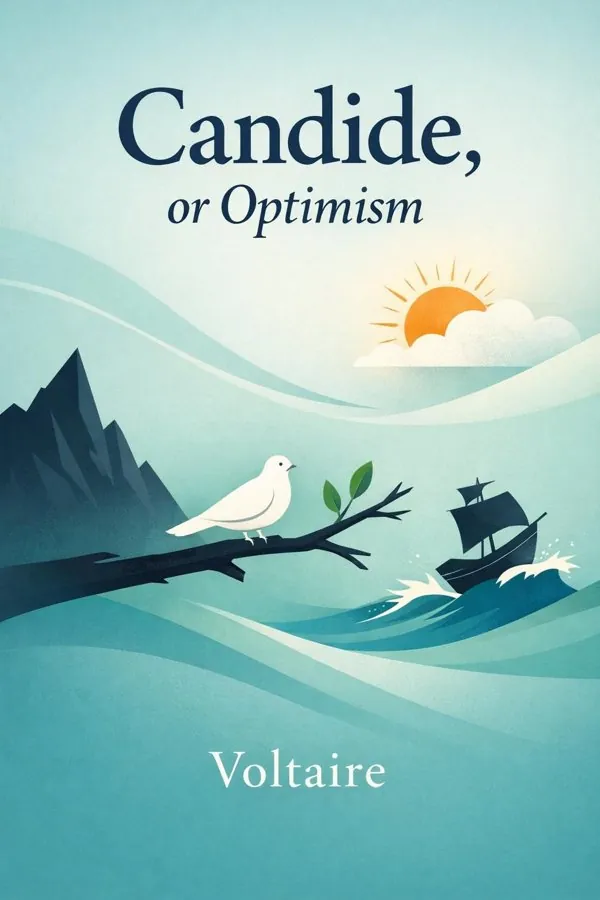
Candide, or Optimism: Summary & Key Insights
by Voltaire
 10 min10 chaptersAudio available
Key Takeaways from Candide, or Optimism
A protected mind often mistakes comfort for truth.
An idea becomes dangerous when it survives every contradiction untouched.
Society often gives violence a noble vocabulary before it gives it a moral justification.
When catastrophe arrives, explanation can become a form of evasion.
Moral language loses authority when it is severed from moral behavior.
What Is Candide, or Optimism About?
Candide, or Optimism by Voltaire is a classics book spanning 7 pages. Candide, or Optimism is Voltaire’s brilliant 1759 satirical novella about innocence colliding with reality. The story begins with Candide, a sheltered young man raised in a noble household and taught by his tutor, Pangloss, that this is “the best of all possible worlds.” Life quickly proves otherwise. Expelled from his home and separated from the beloved Cunégonde, Candide is hurled across Europe and the Americas, where he witnesses war, earthquake, religious persecution, greed, slavery, corruption, and betrayal. Each disaster tests the cheerful philosophical system he has been taught to trust. What makes Candide enduring is not only its speed, humor, and shock, but its intellectual sharpness. Voltaire uses exaggeration, irony, and relentless misfortune to attack blind optimism, empty metaphysics, and social hypocrisy. He asks a question that still feels urgent: how should people live in a world full of suffering they cannot explain away? Voltaire was one of the central voices of the Enlightenment, famous for his wit, skepticism, and defense of reason and civil liberty. In Candide, he turns philosophy into narrative and satire into moral inquiry, creating a classic that is both entertaining and deeply unsettling.
This FizzRead summary covers all 10 key chapters of Candide, or Optimism in approximately 10 minutes, distilling the most important ideas, arguments, and takeaways from Voltaire's work. Also available as an audio summary and Key Quotes Podcast.
Candide, or Optimism
Candide, or Optimism is Voltaire’s brilliant 1759 satirical novella about innocence colliding with reality. The story begins with Candide, a sheltered young man raised in a noble household and taught by his tutor, Pangloss, that this is “the best of all possible worlds.” Life quickly proves otherwise. Expelled from his home and separated from the beloved Cunégonde, Candide is hurled across Europe and the Americas, where he witnesses war, earthquake, religious persecution, greed, slavery, corruption, and betrayal. Each disaster tests the cheerful philosophical system he has been taught to trust.
What makes Candide enduring is not only its speed, humor, and shock, but its intellectual sharpness. Voltaire uses exaggeration, irony, and relentless misfortune to attack blind optimism, empty metaphysics, and social hypocrisy. He asks a question that still feels urgent: how should people live in a world full of suffering they cannot explain away?
Voltaire was one of the central voices of the Enlightenment, famous for his wit, skepticism, and defense of reason and civil liberty. In Candide, he turns philosophy into narrative and satire into moral inquiry, creating a classic that is both entertaining and deeply unsettling.
Who Should Read Candide, or Optimism?
This book is perfect for anyone interested in classics and looking to gain actionable insights in a short read. Whether you're a student, professional, or lifelong learner, the key ideas from Candide, or Optimism by Voltaire will help you think differently.
- ✓Readers who enjoy classics and want practical takeaways
- ✓Professionals looking to apply new ideas to their work and life
- ✓Anyone who wants the core insights of Candide, or Optimism in just 10 minutes
Want the full summary?
Get instant access to this book summary and 100K+ more with Fizz Moment.
Get Free SummaryAvailable on App Store • Free to download
Key Chapters
A protected mind often mistakes comfort for truth. At the beginning of Candide, the hero lives in a small, ordered world where hierarchy seems natural, love seems simple, and philosophy seems reassuring. In the Baron’s castle, he learns from Pangloss that everything is arranged for the best. That idea sounds convincing because Candide has never had to test it. The moment he is expelled for kissing Cunégonde, his education truly begins.
Voltaire builds the novel on this abrupt contrast between innocence and experience. Candide’s early naivety is not just a personal trait; it represents the human tendency to believe elegant theories while life remains convenient. Once he enters the larger world, he encounters forced military service, war, theft, hunger, and deception. These are not isolated accidents. Voltaire presents them as recurring facts of human society, reminding readers that suffering is not removed by refusing to look at it.
This idea still matters. Many people adopt comforting narratives about success, fairness, or morality because those stories match their limited experience. A person raised in stability may assume institutions are just until they encounter corruption. A student may believe talent always wins until office politics intervene. Candide’s shock resembles the moment real life breaks the logic of an idealized worldview.
Voltaire is not mocking innocence itself so much as warning against intellectual passivity. Candide’s goodness makes him sympathetic, but his passivity leaves him vulnerable. He confuses repetition with wisdom because Pangloss says things confidently.
The actionable takeaway is simple: test every comforting belief against reality. When a worldview explains away evidence too quickly, treat that as a warning sign, not a reassurance.
An idea becomes dangerous when it survives every contradiction untouched. Pangloss, Candide’s tutor, insists that all events, no matter how horrifying, are necessary parts of the best possible world. His optimism is not hopeful resilience; it is intellectual stubbornness. Even after witnessing brutality, disease, and disaster, he continues to twist every fact into proof that his theory is right.
Voltaire uses Pangloss to satirize philosophical systems that value consistency over truth. Pangloss does not learn from experience. Instead, he explains suffering away with abstract logic. If a city is destroyed by an earthquake, if innocents are tortured, if war leaves fields covered in bodies, he still insists that everything unfolds as it must. The comedy comes from how absurd this sounds when placed beside actual misery. The horror comes from recognizing how often people do the same thing in real life.
Blind optimism remains common today. Someone may say a destructive job is “all for the best” rather than confront exploitation. Leaders may call preventable failures “necessary growing pains.” Public figures may justify inequality as somehow beneficial for everyone. This kind of optimism protects systems and egos, but not people. It avoids responsibility by turning suffering into a philosophical abstraction.
Voltaire is not arguing for despair. He is distinguishing honest hope from delusional optimism. Hope looks at pain directly and still chooses action. Blind optimism denies pain in order to protect a theory. Pangloss prefers explanation to empathy, and that is one of the novel’s sharpest moral criticisms.
A practical way to apply this lesson is to ask, when facing a setback: am I learning from reality, or merely defending my prior beliefs? The actionable takeaway is to reject explanations that make suffering sound necessary when it may simply be preventable.
When catastrophe arrives, explanation can become a form of evasion. The Lisbon earthquake episode is one of the most famous parts of Candide because it compresses Voltaire’s philosophical attack into a single event. Nature destroys a city without regard for innocence, virtue, or theory. In the aftermath, human institutions make things worse. Instead of responding with humility and practical aid, authorities stage punishment and ritual, as if suffering can be managed by finding scapegoats.
Voltaire wrote with the real 1755 Lisbon earthquake in mind, an event that shook European confidence in a rationally ordered universe. In Candide, the disaster reveals that philosophical optimism fails not because it lacks elegance, but because it cannot speak honestly in the face of mass suffering. Pangloss keeps reasoning. Candide keeps enduring. The gap between words and reality widens.
The broader lesson is that not every event can be turned into a comforting story. Illness, natural disaster, economic collapse, and sudden loss often resist neat moral explanations. People commonly respond by saying everything happens for a reason, but such statements can become emotionally hollow, especially when they minimize grief or excuse inaction.
Voltaire’s alternative is not nihilism. He suggests that the first moral responsibility in crisis is to see clearly. Before assigning meaning, help the injured. Before explaining tragedy, reduce harm. In modern life this might mean focusing less on why a crisis symbolically happened and more on what concrete response is needed: donating, organizing, rebuilding, supporting, correcting failures.
The actionable takeaway is to resist premature explanations in moments of suffering. Lead first with clarity, compassion, and practical response; let theory come second, if it comes at all.
Moral language loses authority when it is severed from moral behavior. Throughout Candide, Voltaire repeatedly attacks religious hypocrisy, not spirituality itself. Priests, inquisitors, and self-proclaimed moral guardians often appear less concerned with mercy than with power, punishment, status, or appetite. People preach purity while acting cruelly. They defend doctrine while ignoring human pain.
This pattern matters because Voltaire shows how easily institutions can confuse sacred authority with ethical legitimacy. If a person speaks in the name of religion, society may grant automatic trust. Candide demonstrates why that trust must be earned, not assumed. Again and again, characters who should offer guidance instead exploit vulnerability. The satire is sharp because it exposes a contradiction: systems claiming to save souls often fail basic tests of decency.
The lesson extends beyond religion. Any institution built on moral prestige can fall into the same trap: schools, charities, governments, media organizations, activist groups, even families. The moment identity becomes more important than conduct, hypocrisy grows. An organization may preach justice but tolerate abuse internally. A leader may speak of values while manipulating others in private.
Voltaire’s criticism encourages moral independence. He pushes readers to evaluate actions rather than titles, compassion rather than ceremony, outcomes rather than declarations. A belief system should be measured partly by the kind of people it produces and the kind of suffering it relieves.
In practical terms, this means resisting the urge to confuse confidence, ritual, or moral vocabulary with actual goodness. Ask simple questions: who is protected, who is silenced, who is helped, and who is harmed? The actionable takeaway is to trust ethical behavior over moral posturing, and to judge every authority by whether it increases human dignity.
People often imagine that money solves suffering, but Voltaire shows that wealth removes only some problems while creating others. Candide’s visit to El Dorado and his later experiences with riches expose a central illusion: abundance can transform circumstances, yet it cannot automatically produce wisdom, loyalty, love, or inner stability.
El Dorado stands apart from the rest of the novel as a near-utopian society without obvious greed, religious persecution, or scarcity. Gold is treated as ordinary, not sacred. Voltaire uses this setting to reveal how irrational European society appears by comparison. Yet Candide chooses to leave. Why? Because even material perfection cannot satisfy his emotional longing for Cunégonde and his attachment to the familiar structure of desire. Once he carries treasure back into the ordinary world, his wealth attracts fraud, envy, danger, and disappointment.
The point is subtle. Voltaire is not claiming that poverty is noble or that money is irrelevant. Financial security clearly matters. What he rejects is the fantasy that possession alone creates a meaningful life. Many modern readers know this pattern. A promotion may reduce anxiety but not cure emptiness. Sudden success may attract opportunists. Luxury can mask confusion rather than resolve it.
There is also a social critique here: societies obsessed with wealth turn relationships into transactions. Candide repeatedly discovers that money changes how others treat him, but not necessarily how sincerely they care for him.
A practical application is to distinguish tools from purposes. Money is a tool for security, choice, and responsibility, not a complete philosophy of happiness. The actionable takeaway is to pursue resources wisely, but pair them with judgment, relationships, and values that cannot be bought.
Survival is rarely graceful. One of the striking features of Candide is how many characters reappear after seemingly impossible catastrophes. People are hanged, enslaved, abused, impoverished, exiled, and presumed dead, yet many continue onward in damaged, altered forms. Voltaire plays this for comic surprise, but beneath the exaggeration lies a serious insight: human beings are astonishingly durable, though not in tidy or inspirational ways.
Modern culture often celebrates resilience as a polished virtue, as if hardship automatically produces wisdom and strength. Candide rejects that simplification. His characters endure, but they are often scarred, bitter, compromised, exhausted, or absurd. They survive because life continues, not because suffering has made them noble. This makes the novel more psychologically honest than many uplifting narratives.
The old woman is especially important here. Her long account of deprivation and brutality dwarfs Candide’s own troubles and broadens the book’s perspective on survival. She does not romanticize endurance. She simply demonstrates that people keep going under conditions that theory can barely comprehend. Her realism counters Candide’s innocence and Pangloss’s abstractions alike.
This insight has practical value. When people face setbacks such as illness, grief, layoffs, divorce, or displacement, they often pressure themselves to emerge quickly as improved versions of themselves. Voltaire offers a harsher but kinder truth: survival may be untidy. One can endure and still remain confused, angry, or incomplete.
The actionable takeaway is to respect resilience without romanticizing suffering. Support yourself and others with patience, honesty, and practical help rather than demanding that pain immediately become a noble life lesson.
If Pangloss is wrong because he refuses to see evil, Martin is incomplete because he expects it everywhere. Midway through the novel, Candide travels with Martin, a deeply skeptical companion who believes the world is governed less by harmony than by greed, conflict, and disappointment. Martin acts as a philosophical counterweight to Pangloss. Where Pangloss explains away suffering, Martin predicts it.
Voltaire does not simply replace optimism with pessimism. Instead, he stages a debate between two inadequate extremes. Martin often seems more accurate than Pangloss because he is not surprised by corruption or selfishness. Yet his worldview can flatten reality just as much as Pangloss’s does. If one philosophy says everything is good and the other says everything is rotten, both risk becoming rigid filters rather than honest engagement with life.
Candide benefits from Martin’s skepticism because it reduces his gullibility. This reflects a useful modern lesson. A degree of skepticism can protect people from scams, manipulation, propaganda, and false promises. In business, politics, and personal relationships, blind trust is dangerous. At the same time, total cynicism can become paralyzing. It can prevent trust, generosity, or effort even when those things are warranted.
Voltaire uses Martin to show that disillusionment is not the same as wisdom. Clear thinking requires neither Panglossian reassurance nor universal suspicion, but evidence, discernment, and flexibility.
A practical application is to notice your default lens. Do you interpret every setback as secretly good, or every opportunity as likely corrupt? Both habits distort judgment. The actionable takeaway is to cultivate disciplined skepticism: question appearances, but remain open to goodness that proves itself in action.
Desire is easy to worship at a distance and much harder to sustain in the ordinary conditions of life. Candide’s love for Cunégonde drives much of the plot. He suffers, travels, fights, bargains, and endures humiliation in pursuit of reunion. At first, this seems like a romantic quest. But Voltaire gradually undermines the fantasy by showing how idealized love changes when confronted with time, hardship, vanity, and material reality.
Cunégonde is less a stable person in Candide’s imagination than a symbol of lost innocence and promised fulfillment. His commitment to her gives him direction, yet it also exposes how people build entire futures around imagined completion. By the time they are finally reunited for good, the ideal has faded. Beauty has changed, circumstances are diminished, and emotional truth is far less glamorous than romantic longing had suggested.
This does not mean love is meaningless. Rather, Voltaire distinguishes fantasy from commitment. Many people fall in love with possibilities: the life they imagine, the version of the other person they prefer, the story they tell themselves about rescue or destiny. Real partnership begins when idealization weakens and one must decide whether to act with steadiness rather than illusion.
In contemporary terms, this appears whenever attraction thrives on projection. A relationship may seem perfect at a distance, online, during travel, or in moments of crisis, then become complicated under routine pressures like money, work, family, and boredom. Candide suggests that maturity in love means seeing clearly without retreating into fantasy.
The actionable takeaway is to examine whether your attachments are rooted in a real person and shared responsibility, or in an idealized image that reality cannot sustain.
The wisest answer to chaos may be smaller, steadier, and more practical than we expect. Candide ends with one of literature’s most famous lines: “we must cultivate our garden.” This conclusion does not mean withdrawing selfishly from the world or refusing to think. It means rejecting empty speculation in favor of purposeful work, responsibility, and modest, concrete improvement.
By the end of the novel, Candide has heard enough systems. Pangloss still theorizes. Martin still doubts. Others still complain. But life does not become livable through endless argument. It becomes livable through labor, order, cooperation, and attention to immediate duties. The garden symbolizes a sphere of action where one can reduce suffering, create sustenance, and give time meaningful structure.
Voltaire’s ending is powerful because it is neither triumphant nor hopeless. The world remains flawed. Human beings remain foolish. There is no grand philosophical resolution. Yet practical activity offers a way forward. In modern life, this might mean investing energy in work that matters, caring for family, strengthening a local community, tending one’s health, building a craft, or contributing where one has real influence rather than drowning in abstract outrage.
This idea is especially relevant in an age of constant noise. Many people consume endless commentary about global crises while neglecting the small domains where they could genuinely help. Voltaire does not say large problems are unimportant; he says meaningful life begins when thought is translated into disciplined action.
The actionable takeaway is to define your garden: the relationships, tasks, and responsibilities where your effort can produce real good. Then tend them consistently instead of relying on theories to do the work of living.
All Chapters in Candide, or Optimism
About the Author
Voltaire, the pen name of François-Marie Arouet, was born in Paris in 1694 and became one of the most influential writers of the Enlightenment. A playwright, historian, essayist, philosopher, and satirist, he was renowned for his wit, clarity, and fearless criticism of intolerance, censorship, superstition, and political abuse. His clashes with authorities led to imprisonment and exile, experiences that sharpened his defense of civil liberties and intellectual freedom. Voltaire wrote across genres, but he is especially remembered for using satire to expose hypocrisy and challenge accepted beliefs. Candide remains his best-known fictional work, capturing his skepticism toward grand systems and his commitment to reason. He died in 1778, leaving a profound legacy in literature, philosophy, and modern liberal thought.
Get This Summary in Your Preferred Format
Read or listen to the Candide, or Optimism summary by Voltaire anytime, anywhere. FizzRead offers multiple formats so you can learn on your terms — all free.
Available formats: App · Audio · PDF · EPUB — All included free with FizzRead
Download Candide, or Optimism PDF and EPUB Summary
Key Quotes from Candide, or Optimism
“A protected mind often mistakes comfort for truth.”
“An idea becomes dangerous when it survives every contradiction untouched.”
“Society often gives violence a noble vocabulary before it gives it a moral justification.”
“When catastrophe arrives, explanation can become a form of evasion.”
“Moral language loses authority when it is severed from moral behavior.”
Frequently Asked Questions about Candide, or Optimism
Candide, or Optimism by Voltaire is a classics book that explores key ideas across 10 chapters. Candide, or Optimism is Voltaire’s brilliant 1759 satirical novella about innocence colliding with reality. The story begins with Candide, a sheltered young man raised in a noble household and taught by his tutor, Pangloss, that this is “the best of all possible worlds.” Life quickly proves otherwise. Expelled from his home and separated from the beloved Cunégonde, Candide is hurled across Europe and the Americas, where he witnesses war, earthquake, religious persecution, greed, slavery, corruption, and betrayal. Each disaster tests the cheerful philosophical system he has been taught to trust. What makes Candide enduring is not only its speed, humor, and shock, but its intellectual sharpness. Voltaire uses exaggeration, irony, and relentless misfortune to attack blind optimism, empty metaphysics, and social hypocrisy. He asks a question that still feels urgent: how should people live in a world full of suffering they cannot explain away? Voltaire was one of the central voices of the Enlightenment, famous for his wit, skepticism, and defense of reason and civil liberty. In Candide, he turns philosophy into narrative and satire into moral inquiry, creating a classic that is both entertaining and deeply unsettling.
You Might Also Like


Browse by Category
Ready to read Candide, or Optimism?
Get the full summary and 100K+ more books with Fizz Moment.