
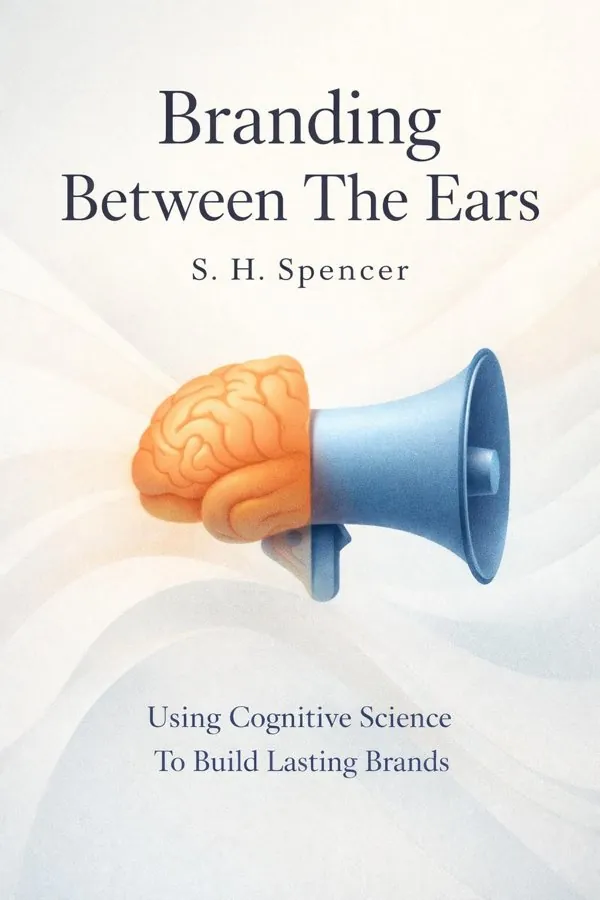
Branding Between The Ears: Using Cognitive Science To Build Lasting Brands: Summary & Key Insights
 10 min9 chaptersAudio available
Key Takeaways from Branding Between The Ears: Using Cognitive Science To Build Lasting Brands
A brand does not live on a shelf, in a logo file, or in a company handbook; it lives in the mental models people form over time.
People rarely remember information in isolation; they remember emotionally charged experiences.
Facts inform, but stories organize meaning.
Much of branding works below the level of deliberate analysis.
Consumers like to believe they make careful, rational decisions, but Spencer explains that much of brand choice is shaped by shortcuts.
What Is Branding Between The Ears: Using Cognitive Science To Build Lasting Brands About?
Branding Between The Ears: Using Cognitive Science To Build Lasting Brands by S. H. Spencer is a marketing book spanning 6 pages. Branding Between The Ears argues that brands are not built first in packaging, advertising, or design systems, but in the human mind. S. H. Spencer shows that every brand is ultimately a network of associations shaped by attention, memory, emotion, habit, and meaning. Drawing on cognitive science and psychology, the book explains why some brands become mentally available, emotionally trusted, and instantly recognizable, while others disappear into background noise. Rather than treating branding as a purely creative exercise, Spencer reframes it as a discipline grounded in how people actually perceive, remember, and choose. This perspective matters because modern consumers are overwhelmed with options, messages, and claims. In crowded markets, the winning brand is often the one that is easiest to understand, easiest to recall, and most emotionally resonant. Spencer combines strategic marketing insight with behavioral principles to show how stories, symbols, sensory cues, and mental shortcuts shape brand preference. The result is a practical guide for marketers, founders, product leaders, and creators who want to build brands that last. It is not just about looking distinctive; it is about becoming psychologically meaningful.
This FizzRead summary covers all 9 key chapters of Branding Between The Ears: Using Cognitive Science To Build Lasting Brands in approximately 10 minutes, distilling the most important ideas, arguments, and takeaways from S. H. Spencer's work. Also available as an audio summary and Key Quotes Podcast.
Branding Between The Ears: Using Cognitive Science To Build Lasting Brands
Branding Between The Ears argues that brands are not built first in packaging, advertising, or design systems, but in the human mind. S. H. Spencer shows that every brand is ultimately a network of associations shaped by attention, memory, emotion, habit, and meaning. Drawing on cognitive science and psychology, the book explains why some brands become mentally available, emotionally trusted, and instantly recognizable, while others disappear into background noise. Rather than treating branding as a purely creative exercise, Spencer reframes it as a discipline grounded in how people actually perceive, remember, and choose.
This perspective matters because modern consumers are overwhelmed with options, messages, and claims. In crowded markets, the winning brand is often the one that is easiest to understand, easiest to recall, and most emotionally resonant. Spencer combines strategic marketing insight with behavioral principles to show how stories, symbols, sensory cues, and mental shortcuts shape brand preference. The result is a practical guide for marketers, founders, product leaders, and creators who want to build brands that last. It is not just about looking distinctive; it is about becoming psychologically meaningful.
Who Should Read Branding Between The Ears: Using Cognitive Science To Build Lasting Brands?
This book is perfect for anyone interested in marketing and looking to gain actionable insights in a short read. Whether you're a student, professional, or lifelong learner, the key ideas from Branding Between The Ears: Using Cognitive Science To Build Lasting Brands by S. H. Spencer will help you think differently.
- ✓Readers who enjoy marketing and want practical takeaways
- ✓Professionals looking to apply new ideas to their work and life
- ✓Anyone who wants the core insights of Branding Between The Ears: Using Cognitive Science To Build Lasting Brands in just 10 minutes
Want the full summary?
Get instant access to this book summary and 100K+ more with Fizz Moment.
Get Free SummaryAvailable on App Store • Free to download
Key Chapters
A brand does not live on a shelf, in a logo file, or in a company handbook; it lives in the mental models people form over time. Spencer’s central insight is that branding is fundamentally a cognitive process. Before a customer buys, recommends, or rejects a product, the brain is already classifying it: Is this familiar? Is it trustworthy? Is it for people like me? Does it solve a problem I care about? These judgments often happen faster than conscious reasoning.
The book explains that consumers do not store brands as neat, rational profiles. They store fragments: a color, a promise, a feeling, a category, a memory, a reputation, a face, a phrase. Together, these pieces form a mental shortcut that helps people make decisions with minimal effort. Strong brands succeed because they organize these fragments into a coherent and repeatable impression.
This has major implications for strategy. If a company constantly changes its message, tone, visuals, or offer, it forces customers to rebuild their understanding from scratch. That creates friction and weakens recall. By contrast, a consistent brand reduces mental work. Think of a budget airline, a luxury watchmaker, or a productivity app: each wins when its positioning becomes instantly legible.
Spencer encourages brand builders to ask not “What do we want to say?” but “What do we want people to remember, feel, and expect?” That shift moves branding from self-expression to mental engineering. The practical lesson is simple: define the few associations your brand must own, repeat them relentlessly across touchpoints, and audit whether customers actually hold those associations in memory.
People rarely remember information in isolation; they remember emotionally charged experiences. Spencer shows that emotion is the glue that binds memory, which is why brands that trigger feeling often outperform brands that merely provide facts. A feature may explain a product, but an emotion gives it staying power.
From a cognitive perspective, emotionally meaningful events receive more attention and are encoded more deeply in memory. That does not mean every brand must be dramatic or sentimental. It means every brand should understand the feeling it wants to reinforce. Safety, excitement, relief, pride, belonging, confidence, nostalgia, and control are all emotionally potent states that can strengthen loyalty.
A healthcare brand might reduce anxiety through calm language and reassuring design. A sports brand may amplify motivation through challenge and identity. A coffee chain may create a sense of ritual and comfort that becomes part of the customer’s daily emotional landscape. In each case, the customer is not just buying a function; they are returning to a feeling.
Spencer also warns that negative emotions can be just as memorable. Confusing onboarding, inconsistent service, hidden fees, or dismissive support create emotional scars that shape future behavior. The brain uses these experiences as warnings.
For practitioners, the key is to identify the emotional consequence of the brand experience at every stage: seeing the ad, browsing the site, opening the package, using the product, asking for help, and sharing the result. The actionable takeaway is to map your customer journey by emotion, not just process, and intentionally design the moments that should create comfort, delight, confidence, or trust.
Facts inform, but stories organize meaning. Spencer argues that the human brain is naturally drawn to narrative because stories help us connect cause and effect, assign motives, anticipate outcomes, and remember sequences. In branding, storytelling is not decoration; it is a structure that makes a brand easier to understand and easier to care about.
A story gives customers a framework for why a brand exists, what problem it fights, and what role the customer plays within that mission. This matters because people do not simply buy products; they buy explanations that make choices feel sensible and significant. A skincare company can sell ingredients, or it can tell a story about restoring confidence. A software startup can promote features, or it can position itself as freeing teams from chaos.
Spencer emphasizes that effective brand stories are not vague corporate myths. They are clear, repeatable narratives anchored in tension and transformation. Who is the customer before the brand? What obstacle frustrates them? What change becomes possible through the brand? The best stories make the customer the protagonist and the brand the guide, catalyst, or tool.
This principle extends beyond advertising. Origin stories, packaging copy, founder interviews, onboarding flows, and customer testimonials all contribute to the larger narrative architecture. If these pieces contradict each other, meaning collapses. If they reinforce one another, the brand becomes more memorable and persuasive.
The practical takeaway is to build a simple narrative spine for your brand: problem, promise, proof, and transformation. Then ensure that your campaigns, product experience, and content all tell the same story in different forms.
Much of branding works below the level of deliberate analysis. Spencer explores how symbols, sounds, textures, colors, and other sensory cues influence perception before a customer consciously explains why. The brain is constantly scanning for patterns, and these signals help it infer meaning quickly. A sharp typeface can imply precision. Warm colors can suggest energy or friendliness. A clean interface can communicate trust and competence.
These elements matter because people often experience a brand long before they evaluate its claims. The tone of an app notification, the feel of packaging, the smell of a retail space, the rhythm of a sonic logo, or the look of an icon set can all become part of the brand’s mental signature. Repetition turns these cues into shortcuts for recognition.
Spencer’s point is not that sensory branding is magic. It works when sensory choices align with strategic meaning. A premium brand should not use cheap-feeling materials. A playful brand should not sound cold and bureaucratic. A wellness brand should not overload the senses with clutter and noise. When symbols and senses reinforce positioning, the brain experiences coherence, and coherence builds trust.
This idea is especially useful for digital brands that underestimate nonverbal communication. Even without physical stores, they still create sensory experiences through motion design, microcopy, sound, color hierarchy, and visual pace.
The actionable takeaway is to audit your brand’s sensory system. List the recurring visual, verbal, auditory, and tactile cues customers encounter. Then ask whether each one reinforces the emotion and meaning your brand wants to own. If not, simplify and align.
Consumers like to believe they make careful, rational decisions, but Spencer explains that much of brand choice is shaped by shortcuts. The brain relies on heuristics because time, attention, and cognitive energy are limited. In practice, people often choose what feels familiar, socially validated, easier to process, or safer than the alternatives.
This helps explain why branding matters even when products are similar. Familiarity bias makes repeated exposure powerful. Social proof makes popularity signals persuasive. The availability heuristic gives more weight to brands that come to mind quickly. Price can act as a quality cue. Category cues reduce uncertainty by telling people what kind of product this is and how it should be used.
A brand that understands these mechanisms can design for easier choice. For example, consistent presence across channels increases familiarity. Reviews, testimonials, and visible usage create social reassurance. Clear packaging and naming improve processing fluency. Strong category positioning helps people know when to choose you.
Spencer also notes that heuristics can work against brands. If your offer looks unfamiliar in the wrong way, if your message is cognitively heavy, or if your website creates uncertainty, people may default to a known competitor. This is not always a judgment of quality; often it is simply a judgment of mental effort.
The practical lesson is to reduce decision friction. Make your brand easy to recognize, easy to categorize, easy to trust, and easy to compare favorably. Review your touchpoints for moments where customers must think too hard, then simplify language, sharpen distinctions, and add credible signals that support intuitive choice.
A brand becomes powerful when it is easy to retrieve from memory in buying situations. Spencer calls attention to mental availability: the likelihood that a brand comes to mind when a relevant need appears. This is one of the most underappreciated outcomes of branding. A company may obsess over creativity, but if customers cannot recall it at the right moment, creativity alone has failed.
Mental availability is built through consistency and repetition, not endless novelty. Distinctive assets such as colors, taglines, shapes, characters, and verbal phrases help the brain recognize and remember a brand across contexts. Over time, these repeated cues build associative strength. The customer sees a visual pattern, hears a phrase, or encounters a familiar promise, and the brand surfaces quickly in memory.
This is why frequent rebrands can be costly. When businesses change their look, tone, or promise too often, they reset memory structures and weaken accumulated associations. Spencer does not argue against evolution, but he stresses that change should preserve recognizable anchors.
A practical example is a food brand with a signature package color and simple message repeated across shelves, ads, and social content. Another example is a B2B company that uses the same category framing, customer problem, and proof points in every sales interaction. These patterns make the brand easier to store and retrieve.
The actionable takeaway is to identify your core memory assets and protect them. Choose a small set of repeatable cues and use them everywhere with discipline. The goal is not to say something new every time; it is to become unforgettable in the moments that matter.
Trust is often discussed as a moral virtue, but Spencer shows that cognitively it also functions as a prediction system. People trust brands when they can reliably anticipate what will happen next. Will the product work? Will the service match the promise? Will the company behave consistently? The brain values predictability because it reduces uncertainty and perceived risk.
This means trust is not built by mission statements alone. It is built when signals and experiences line up over time. A premium brand that ships late, a friendly brand with robotic support, or a transparent brand with hidden fees all create cognitive dissonance. When expectation and experience conflict, trust erodes quickly.
Spencer argues that strong brands are dependable pattern-makers. Their language, service standards, product quality, pricing logic, and visual identity all reinforce the same expectations. Customers begin to feel they know the brand, and that familiarity lowers the anxiety of choosing.
In practical terms, trust can be strengthened through operational branding: clear promises, accurate descriptions, consistent quality control, intuitive interfaces, responsive customer support, and visible proof such as guarantees or third-party endorsements. Even small details matter. A confusing returns policy can undo months of positive messaging because it introduces uncertainty at a critical moment.
The actionable takeaway is to test your brand promise against real customer experience. Identify where your messaging creates expectations and check whether operations fulfill them consistently. If trust is weak, the answer is often not better copy, but better alignment between what the brand says and what customers repeatedly receive.
The final contribution of Spencer’s framework is pragmatic: cognitive science is only useful if it changes how brands are built. The book connects theory to strategy by showing how attention, memory, emotion, bias, sensory design, and identity can guide decisions across positioning, messaging, product design, customer experience, and growth.
A cognitively informed brand strategy starts with clarity. What category do you want to own in the customer’s mind? What few associations should define you? What emotional outcome do you want people to experience? What distinctive assets will help people recognize and remember you? From there, the company aligns touchpoints so those associations are reinforced rather than diluted.
This approach also improves measurement. Instead of tracking only awareness or conversion, teams can examine whether customers accurately recall the brand promise, whether they associate the brand with the intended emotion, whether distinctive assets are recognized, and whether experience matches expectation. These are signs of mental strength, not just short-term sales activity.
Spencer’s broader message is that brand building is not separate from business performance. A clearer, more memorable, more trusted brand reduces acquisition friction, supports premium pricing, improves retention, and increases word of mouth. Cognitive science does not replace creativity; it gives creativity direction.
The actionable takeaway is to turn your brand into a system. Define your desired associations, emotional cues, narrative, sensory assets, trust signals, and identity role. Then use those elements as decision criteria for campaigns, product choices, hiring, partnerships, and customer experience. Strategy becomes stronger when every part of the business teaches the brain the same lesson.
All Chapters in Branding Between The Ears: Using Cognitive Science To Build Lasting Brands
About the Author
S. H. Spencer is a marketing strategist and author whose work focuses on the intersection of branding, psychology, and consumer behavior. He is known for translating complex ideas from cognitive science into practical tools that businesses can use to strengthen brand perception and loyalty. Over the course of his career, Spencer has worked with companies on positioning, identity development, and customer engagement, helping them build brands that resonate not only visually but mentally and emotionally. His approach emphasizes that successful branding is rooted in how people actually think, feel, remember, and decide. In Branding Between The Ears, he brings together strategic marketing experience and psychological insight to show how lasting brands are built in the mind before they win in the market.
Get This Summary in Your Preferred Format
Read or listen to the Branding Between The Ears: Using Cognitive Science To Build Lasting Brands summary by S. H. Spencer anytime, anywhere. FizzRead offers multiple formats so you can learn on your terms — all free.
Available formats: App · Audio · PDF · EPUB — All included free with FizzRead
Download Branding Between The Ears: Using Cognitive Science To Build Lasting Brands PDF and EPUB Summary
Key Quotes from Branding Between The Ears: Using Cognitive Science To Build Lasting Brands
“A brand does not live on a shelf, in a logo file, or in a company handbook; it lives in the mental models people form over time.”
“People rarely remember information in isolation; they remember emotionally charged experiences.”
“Facts inform, but stories organize meaning.”
“Much of branding works below the level of deliberate analysis.”
“Consumers like to believe they make careful, rational decisions, but Spencer explains that much of brand choice is shaped by shortcuts.”
Frequently Asked Questions about Branding Between The Ears: Using Cognitive Science To Build Lasting Brands
Branding Between The Ears: Using Cognitive Science To Build Lasting Brands by S. H. Spencer is a marketing book that explores key ideas across 9 chapters. Branding Between The Ears argues that brands are not built first in packaging, advertising, or design systems, but in the human mind. S. H. Spencer shows that every brand is ultimately a network of associations shaped by attention, memory, emotion, habit, and meaning. Drawing on cognitive science and psychology, the book explains why some brands become mentally available, emotionally trusted, and instantly recognizable, while others disappear into background noise. Rather than treating branding as a purely creative exercise, Spencer reframes it as a discipline grounded in how people actually perceive, remember, and choose. This perspective matters because modern consumers are overwhelmed with options, messages, and claims. In crowded markets, the winning brand is often the one that is easiest to understand, easiest to recall, and most emotionally resonant. Spencer combines strategic marketing insight with behavioral principles to show how stories, symbols, sensory cues, and mental shortcuts shape brand preference. The result is a practical guide for marketers, founders, product leaders, and creators who want to build brands that last. It is not just about looking distinctive; it is about becoming psychologically meaningful.
You Might Also Like
Captivology: The Science of Capturing People's Attention
Ben Parr
10 min
Marketing 5.0: Technology for Humanity
Philip Kotler, Hermawan Kartajaya, Iwan Setiawan
10 min
Marketing Strategy
Paul Fifield
10 min
UnMarketing: Stop Marketing. Start Engaging.
Scott Stratten
10 min
$100M Leads: How to Get Strangers to Want to Buy Your Stuff
Alex Hormozi
10 min
80/20 Sales and Marketing: The Definitive Guide to Working Less and Making More
Perry Marshall
10 minFeatured In
Browse by Category
Ready to read Branding Between The Ears: Using Cognitive Science To Build Lasting Brands?
Get the full summary and 100K+ more books with Fizz Moment.