
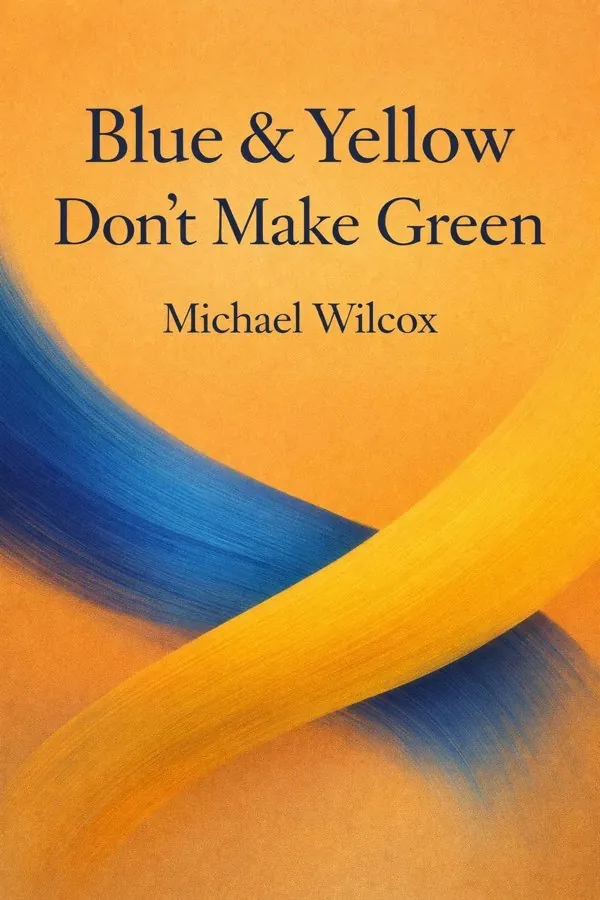
Blue & Yellow Don’t Make Green: Summary & Key Insights
 10 min6 chaptersAudio available
What Is Blue & Yellow Don’t Make Green About?
Blue & Yellow Don’t Make Green by Michael Wilcox is a design book spanning 6 pages. This book by artist and color theorist Michael Wilcox challenges the traditional color-mixing theory that blue and yellow make green. It introduces a systematic approach to color mixing based on the concept of bias in pigments, helping artists achieve cleaner, more predictable color results. The book provides detailed explanations, color charts, and practical exercises for painters seeking to master color harmony and control.
This FizzRead summary covers all 6 key chapters of Blue & Yellow Don’t Make Green in approximately 10 minutes, distilling the most important ideas, arguments, and takeaways from Michael Wilcox's work. Also available as an audio summary and Key Quotes Podcast.
Blue & Yellow Don’t Make Green
This book by artist and color theorist Michael Wilcox challenges the traditional color-mixing theory that blue and yellow make green. It introduces a systematic approach to color mixing based on the concept of bias in pigments, helping artists achieve cleaner, more predictable color results. The book provides detailed explanations, color charts, and practical exercises for painters seeking to master color harmony and control.
Who Should Read Blue & Yellow Don’t Make Green?
This book is perfect for anyone interested in design and looking to gain actionable insights in a short read. Whether you're a student, professional, or lifelong learner, the key ideas from Blue & Yellow Don’t Make Green by Michael Wilcox will help you think differently.
- ✓Readers who enjoy design and want practical takeaways
- ✓Professionals looking to apply new ideas to their work and life
- ✓Anyone who wants the core insights of Blue & Yellow Don’t Make Green in just 10 minutes
Want the full summary?
Get instant access to this book summary and 100K+ more with Fizz Moment.
Get Free SummaryAvailable on App Store • Free to download
Key Chapters
To appreciate why the phrase 'blue and yellow make green' persisted so stubbornly, we must look at its lineage. From Isaac Newton’s prism experiments to the simplified color wheels used in printing and art education, color systems have always strived for neatness. The three‑primary model—red, yellow, and blue—served perfectly for teaching because it could describe the mixing of paints and pigments without delving into messy chemical realities. Yet for practical artists, the elegant symmetry of the wheel was deceptive. Painters who tried to follow textbook instructions found their results inconsistent; greens turned brownish, violets looked heavy instead of luminous.
Throughout history, color theory tried to marry science and art, but much of what was taught rested upon optical models of light rather than physical pigments. When you mix light—on screens or through prisms—blue and yellow light indeed produce green. But when you mix real paint, you’re dealing with a subtractive process: each pigment absorbs certain wavelengths and reflects others. If the pigments aren’t pure, they absorb too much of the spectrum and dull the mix. Over centuries, artists adapted through intuition, learning by trial and error which mixtures worked. Still, textbooks continued to perpetuate the idealized diagram where blue and yellow at equal points yield a perfect green.
That gap between theory and practice is where frustration grew. Teachers repeated conventional wisdom because it simplified learning; manufacturers labeled colors with generic names—'Cadmium Yellow', 'Ultramarine Blue'—without clarifying their internal biases. And so generations of painters struggled to reconcile muddy mixtures with theoretical expectations. My role in this book is to bridge that divide. By returning to the physical truths of pigments, we reclaim control over our palettes and move from myth to mastery.
Imagine every pigment as having its own personality. No color exists in isolation; what you call 'blue' may whisper hints of violet or green depending on how it’s made. This subtle leaning is what I call pigment bias, and it’s the heartbeat of accurate color mixing.
To uncover pigment bias, I spent years studying manufacturer data, analyzing spectral absorption, and visually testing mixtures. When you mix two pigments, their biases either complement each other for a clean result or clash to cancel light, yielding a dull tone. For example, mix a green‑biased blue like Phthalo Blue with a greenish yellow such as Hansa Yellow—your mixture sings with a vibrant, clear green. But take a violet‑biased blue like Ultramarine and pair it with an orange‑biased yellow like Cadmium Yellow Deep, and the overlapping unwanted reds neutralize the mixture into brown. The problem that plagued artists wasn’t inadequate technique—it was the unrecognized presence of bias.
Seeing color this way transforms mixing from a guessing game into a deliberate act. You begin to notice warmth and coolness as directional vectors on the color wheel, not mere adjectives. A warm primary leans toward red or yellow; a cool primary leans toward blue or green. By understanding these directions, you can predict not just hue but the emotional tonality of your painting. A landscape painted with cool biased colors breathes crisp air and distant atmosphere, while one built from warm biases glows with intimacy and vitality. Rather than memorizing endless mixing recipes, knowing bias equips you to sculpt color relationships deliberately, controlling harmony at the source.
+ 4 more chapters — available in the FizzRead app
All Chapters in Blue & Yellow Don’t Make Green
About the Author
Michael Wilcox is a British artist, teacher, and author known for his pioneering work in color theory and pigment behavior. He founded the School of Color and has written several influential books on color mixing and painting techniques, widely used by artists and educators around the world.
Get This Summary in Your Preferred Format
Read or listen to the Blue & Yellow Don’t Make Green summary by Michael Wilcox anytime, anywhere. FizzRead offers multiple formats so you can learn on your terms — all free.
Available formats: App · Audio · PDF · EPUB — All included free with FizzRead
Download Blue & Yellow Don’t Make Green PDF and EPUB Summary
Key Quotes from Blue & Yellow Don’t Make Green
“To appreciate why the phrase 'blue and yellow make green' persisted so stubbornly, we must look at its lineage.”
“Imagine every pigment as having its own personality.”
Frequently Asked Questions about Blue & Yellow Don’t Make Green
Blue & Yellow Don’t Make Green by Michael Wilcox is a design book that explores key ideas across 6 chapters. This book by artist and color theorist Michael Wilcox challenges the traditional color-mixing theory that blue and yellow make green. It introduces a systematic approach to color mixing based on the concept of bias in pigments, helping artists achieve cleaner, more predictable color results. The book provides detailed explanations, color charts, and practical exercises for painters seeking to master color harmony and control.
You Might Also Like
The Design of Everyday Things
Don Norman
10 min
The Better Angels of Our Nature
Steven Pinker
10 min
A Designer's Art
Paul Rand
10 min
Architects' Sketchbooks
Various Editors
10 min
Architectural Graphic Standards
The American Institute of Architects
10 min
Design Is Storytelling
Ellen Lupton
10 minFeatured In
Browse by Category
Ready to read Blue & Yellow Don’t Make Green?
Get the full summary and 100K+ more books with Fizz Moment.