
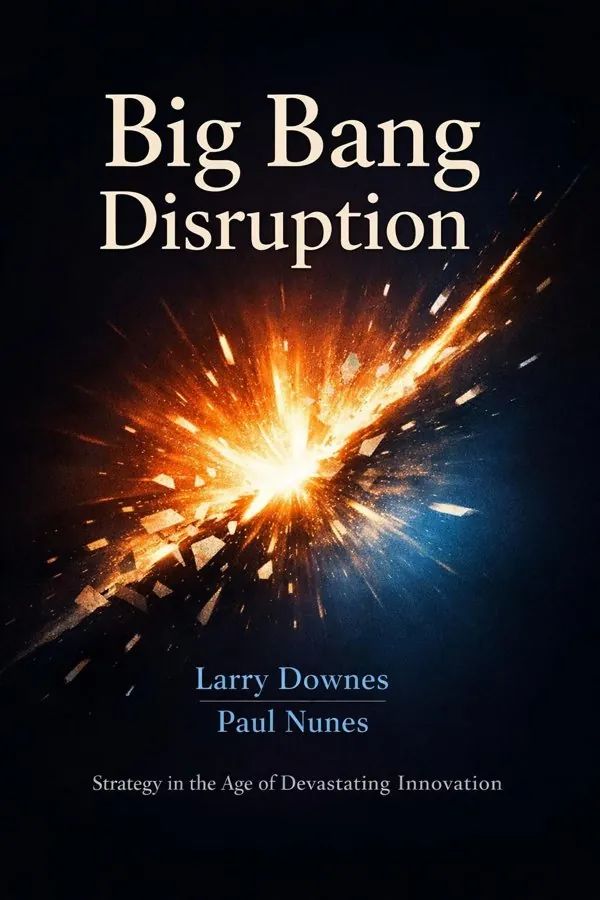
Big Bang Disruption: Strategy in the Age of Devastating Innovation: Summary & Key Insights
 10 min5 chaptersAudio available
What Is Big Bang Disruption: Strategy in the Age of Devastating Innovation About?
Big Bang Disruption: Strategy in the Age of Devastating Innovation by Larry Downes, Paul Nunes is a strategy book spanning 5 pages. Big Bang Disruption explores how rapid technological innovation can upend entire industries almost overnight. Larry Downes and Paul Nunes analyze how traditional models of incremental innovation have been replaced by sudden, large-scale disruptions that reshape markets and consumer behavior. The book provides strategic frameworks for businesses to anticipate, adapt to, and thrive amid these transformative changes.
This FizzRead summary covers all 5 key chapters of Big Bang Disruption: Strategy in the Age of Devastating Innovation in approximately 10 minutes, distilling the most important ideas, arguments, and takeaways from Larry Downes, Paul Nunes's work. Also available as an audio summary and Key Quotes Podcast.
Big Bang Disruption: Strategy in the Age of Devastating Innovation
Big Bang Disruption explores how rapid technological innovation can upend entire industries almost overnight. Larry Downes and Paul Nunes analyze how traditional models of incremental innovation have been replaced by sudden, large-scale disruptions that reshape markets and consumer behavior. The book provides strategic frameworks for businesses to anticipate, adapt to, and thrive amid these transformative changes.
Who Should Read Big Bang Disruption: Strategy in the Age of Devastating Innovation?
This book is perfect for anyone interested in strategy and looking to gain actionable insights in a short read. Whether you're a student, professional, or lifelong learner, the key ideas from Big Bang Disruption: Strategy in the Age of Devastating Innovation by Larry Downes, Paul Nunes will help you think differently.
- ✓Readers who enjoy strategy and want practical takeaways
- ✓Professionals looking to apply new ideas to their work and life
- ✓Anyone who wants the core insights of Big Bang Disruption: Strategy in the Age of Devastating Innovation in just 10 minutes
Want the full summary?
Get instant access to this book summary and 100K+ more with Fizz Moment.
Get Free SummaryAvailable on App Store • Free to download
Key Chapters
Through years of research, Paul and I distilled what appeared at first as chaos into a four-stage lifecycle—one that repeats across markets: Singularity, Big Bang, Big Crunch, and Entropy.
In the Singularity phase, the seeds of disruption germinate invisibly. Technologies converge and innovators experiment across boundaries. Unlike traditional R&D cells, these experiments often unfold not in labs but in garages, open-source communities, or startup accelerators. The crucial insight is that Singularity occurs at the intersection of technologies that are mature enough to be recombined. A new GPS chip, cheaper cloud storage, and an open API—each seemingly incremental—can fuse to produce a revolutionary new service. This hidden period is where disruptors play freely, unencumbered by legacy systems or cautious market testing.
Then comes the Big Bang—the moment of market explosion. The product, often launched to little fanfare, suddenly captures massive public attention. Early adopters and mainstream consumers converge instantly, collapsing Geoffrey Moore’s traditional “chasm.” Because the new entrant surpasses incumbents on all dimensions—price, performance, ease of use—it doesn’t need time to mature. Think of the shift from flip phones to smartphones, or from film cameras to digital imaging. Those explosions were instantaneous. The curve of adoption is no longer S-shaped; it’s vertical.
After the euphoric burst, the Big Crunch arrives. Competitors flood the field, prices fall, and margins collapse. Survivors—often not the original inventors—rise through scale and efficiency. Many pioneers perish in the fallout, unable to sustain their advantage amid rapid commoditization. This stage exposes how misleading traditional growth forecasts have become: what looks like stable expansion quickly contracts into fierce competition.
Finally comes Entropy—the stage when the market, now oversaturated, begins to lose coherence. Products and platforms fragment. Consumers move on to the next convergence, and the cycle begins anew. The unpredictability of Entropy makes traditional planning futile. Yet for those who understand the rhythm of the four stages, it signals not despair but renewal: disruption begets more disruption.
The idea of this lifecycle rewrites how strategy should be crafted. It tells us that timing—not protection—is everything. You must enter the market precisely at the Big Bang, withdraw before the Crunch erodes value, and prepare for the next Singularity before Entropy sets in. Only those who can move fluidly across these phases will thrive.
Disruption has always been part of business, but what makes our era “devastating” is the convergence of enabling technologies. Computing power, cloud infrastructure, mobile connectivity, social platforms, and analytics no longer advance separately—they amplify one another. Each new capability drives exponential leverage in others.
From my perspective, the disappearance of boundaries between industries is the most profound result of convergence. Telecom becomes computing; computing becomes content; content becomes data; data becomes prediction. This collapsing of silos explains why a handful of companies—Google, Apple, Amazon—could suddenly dominate spaces where incumbents had existed for decades. They leveraged convergence to deliver holistic experiences instead of isolated products.
Convergence also destroys the economic rationale for incremental development. Traditional firms optimize within one technology track, expecting a predictable rate of return. But convergent innovation changes the base assumptions—the cost structure drops by orders of magnitude as complementary tech matures. The consequence is that what used to require years of production refinement now happens in weeks of open-source collaboration.
An example we often cite is how digital cameras displaced film. Kodak saw image quality as the battleground. But the real convergence was between optics, sensors, memory, and digital connectivity. Once phones incorporated all of these, the fight over megapixels became irrelevant. The camera became an app, and Kodak’s manufacturing prowess meant nothing.
To lead amid convergence, you must think of technologies as networks, not assets. Each node you add multiplies your possible value creation. This mindset rejects defensive moats; instead, it embraces collaboration, continuous learning, and integration across frontiers. Businesses that cling to walls will vanish; those that understand flows will flourish.
+ 3 more chapters — available in the FizzRead app
All Chapters in Big Bang Disruption: Strategy in the Age of Devastating Innovation
About the Authors
Larry Downes is a business strategist and author known for his work on technology and innovation. Paul Nunes is a managing director at Accenture Research, focusing on business strategy and disruptive innovation.
Get This Summary in Your Preferred Format
Read or listen to the Big Bang Disruption: Strategy in the Age of Devastating Innovation summary by Larry Downes, Paul Nunes anytime, anywhere. FizzRead offers multiple formats so you can learn on your terms — all free.
Available formats: App · Audio · PDF · EPUB — All included free with FizzRead
Download Big Bang Disruption: Strategy in the Age of Devastating Innovation PDF and EPUB Summary
Key Quotes from Big Bang Disruption: Strategy in the Age of Devastating Innovation
“Through years of research, Paul and I distilled what appeared at first as chaos into a four-stage lifecycle—one that repeats across markets: Singularity, Big Bang, Big Crunch, and Entropy.”
“Disruption has always been part of business, but what makes our era “devastating” is the convergence of enabling technologies.”
Frequently Asked Questions about Big Bang Disruption: Strategy in the Age of Devastating Innovation
Big Bang Disruption: Strategy in the Age of Devastating Innovation by Larry Downes, Paul Nunes is a strategy book that explores key ideas across 5 chapters. Big Bang Disruption explores how rapid technological innovation can upend entire industries almost overnight. Larry Downes and Paul Nunes analyze how traditional models of incremental innovation have been replaced by sudden, large-scale disruptions that reshape markets and consumer behavior. The book provides strategic frameworks for businesses to anticipate, adapt to, and thrive amid these transformative changes.
You Might Also Like

Mastery
Robert Greene
10 min
Cut Costs Not Corners: A Practical Guide to Staying Competitive and Improving Profits
Colin Barrow
10 min
Good Strategy/Bad Strategy: The Difference and Why It Matters
Richard P. Rumelt
10 min
On Grand Strategy
John Lewis Gaddis
10 min
The Six Disciplines of Digital Transformation
George Westerman
10 min
7 Powers: The Foundations of Business Strategy
Hamilton Helmer
10 minFeatured In
Browse by Category
Ready to read Big Bang Disruption: Strategy in the Age of Devastating Innovation?
Get the full summary and 100K+ more books with Fizz Moment.