
Neil F. Johnson Books
Neil F. Johnson is a physicist and professor known for his research in complex systems, collective behavior, and interdisciplinary applications of physics.
Known for: Simply Complexity: A Clear Guide to Complexity Theory
Books by Neil F. Johnson
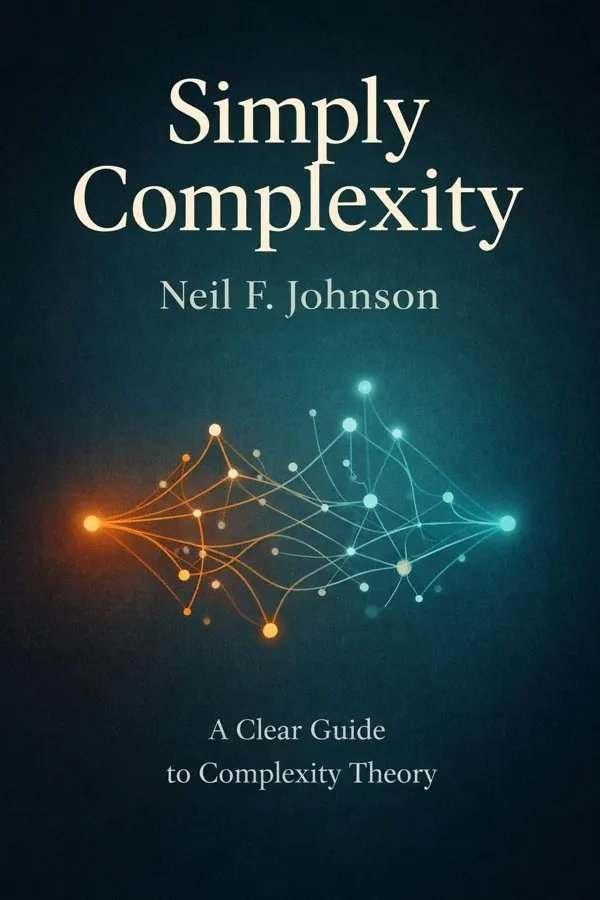
Simply Complexity: A Clear Guide to Complexity Theory
Why do traffic jams appear without any visible cause, financial markets swing wildly despite expert forecasts, and flocks of birds move as if guided by a single mind? In Simply Complexity, physicist Neil F. Johnson shows that these mysteries are not random quirks of the modern world but expressions of a deeper scientific pattern: complex behavior often emerges from simple interactions repeated across many parts of a system. This book is an accessible introduction to complexity theory, a field that bridges physics, biology, economics, and social science to explain how order, disorder, and adaptation arise together. Johnson’s gift is his ability to translate abstract ideas into vivid, concrete examples. He explores how networks, feedback loops, nonlinear effects, and self-organization shape everything from ecosystems and ant colonies to stock markets and online communities. Rather than treating complexity as a buzzword, he gives readers a clear conceptual toolkit for understanding systems that resist straightforward prediction. The result is a smart, engaging guide for curious readers, students, and professionals who want to think more realistically about the interconnected world they live in.
Read SummaryKey Insights from Neil F. Johnson
Simple Rules Create Surprising Complexity
One of the most powerful ideas in modern science is that complexity does not always require complicated instructions. Johnson shows that systems with very simple local rules can produce patterns so rich, varied, and unpredictable that they seem designed by an intelligent planner. This is the startin...
From Simply Complexity: A Clear Guide to Complexity Theory
Emergence Makes the Whole Different
The most important events in complex systems often happen at the collective level, not the individual one. Johnson uses the concept of emergence to explain how many interacting parts can produce patterns, functions, or behaviors that no single part contains on its own. Emergence is not magic. It is ...
From Simply Complexity: A Clear Guide to Complexity Theory
Nature Is Full of Complex Systems
What looks messy in nature is often organized by hidden principles. Johnson shows that complexity theory gives us a language for understanding ecosystems, weather, biological evolution, and living organisms without pretending they are clockwork machines. Natural systems are made of many components i...
From Simply Complexity: A Clear Guide to Complexity Theory
Society and Markets Behave Nonlinearly
Human systems may be built from conscious individuals, but they still display the hallmarks of complexity. Johnson argues that economies, crowds, organizations, and social networks often behave less like predictable machines and more like evolving ecosystems. People interact, imitate, compete, coope...
From Simply Complexity: A Clear Guide to Complexity Theory
Feedback Loops Shape System Behavior
A system becomes truly interesting when its outputs circle back and influence its future behavior. Johnson highlights feedback as one of the central engines of complexity. Positive feedback amplifies change, while negative feedback dampens it. Neither is inherently good or bad; both are necessary, a...
From Simply Complexity: A Clear Guide to Complexity Theory
Networks Determine How Influence Spreads
The structure of connections often matters as much as the things being connected. Johnson uses network thinking to show that complex systems are shaped not only by their components but also by the pattern of links between them. Whether we are studying friendships, power grids, food webs, disease tra...
From Simply Complexity: A Clear Guide to Complexity Theory
About Neil F. Johnson
Neil F. Johnson is a physicist and professor known for his research in complex systems, collective behavior, and interdisciplinary applications of physics. He has published widely on topics connecting physics, economics, and social science.


Frequently Asked Questions
Neil F. Johnson is a physicist and professor known for his research in complex systems, collective behavior, and interdisciplinary applications of physics.
Read Neil F. Johnson's books in 15 minutes
Get AI-powered summaries with key insights from 1 book by Neil F. Johnson.