
Karl Marx, Friedrich Engels Books
Karl Marx (1818–1883) was a German philosopher, economist, and political theorist best known for developing the theory of Marxism. Friedrich Engels (1820–1895) was a German social scientist, philosopher, and close collaborator of Marx.
Known for: The Communist Manifesto
Books by Karl Marx, Friedrich Engels
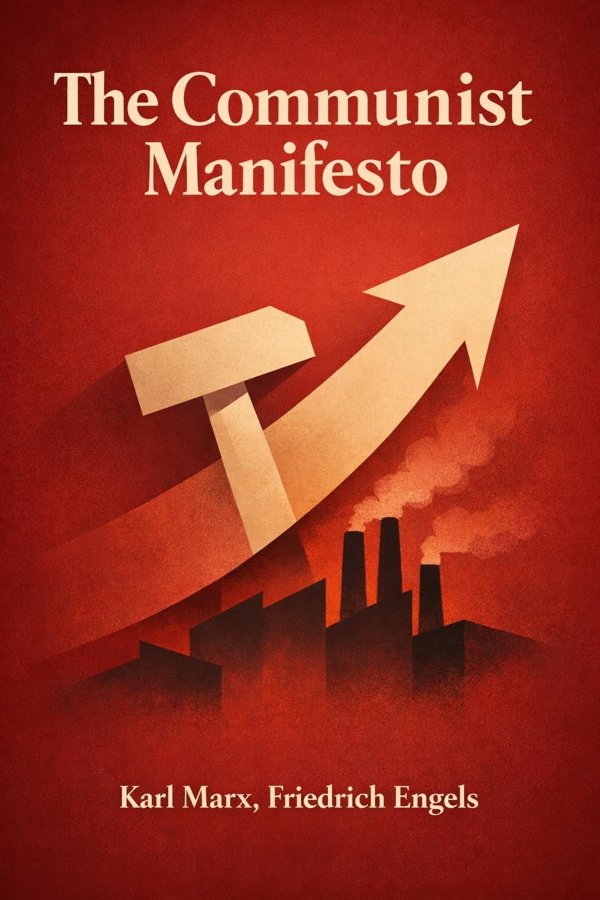
The Communist Manifesto
Published in 1848 on the eve of revolutionary upheaval across Europe, The Communist Manifesto is one of the most consequential political texts ever written. In a short but explosive work, Karl Marx and Friedrich Engels argue that history is shaped not primarily by ideals or heroic leaders, but by conflicts between social classes rooted in economic life. They trace the rise of capitalism, explain how the bourgeoisie transformed the world through industry and global trade, and predict that capitalism itself will produce its own gravedigger: the proletariat, or modern working class. More than a political pamphlet, the book is a framework for understanding power, inequality, labor, and social change. Its language is urgent, its claims sweeping, and its influence immense, inspiring socialist movements, revolutions, labor struggles, and fierce criticism in equal measure. Marx, a philosopher and economist, and Engels, a social theorist and sharp observer of industrial society, wrote with unusual authority about the economic transformations of their time. Whether one agrees with its conclusions or not, The Communist Manifesto remains essential reading for anyone trying to understand modern politics and capitalism.
Read SummaryKey Insights from Karl Marx, Friedrich Engels
History Moves Through Class Conflict
One of the manifesto’s most provocative claims is that the engine of history is not moral progress, national destiny, or brilliant rulers, but struggle between classes. Marx and Engels argue that every society has been organized around material production: who owns land, tools, factories, and resour...
From The Communist Manifesto
The Bourgeoisie Revolutionized the World
Few political texts are as critical of capitalism as The Communist Manifesto, yet few also describe its historical achievements with such force. Marx and Engels portray the bourgeoisie, the class that owns capital and controls production, as a revolutionary power that shattered feudal boundaries and...
From The Communist Manifesto
Capitalism Creates the Proletariat
A system built to maximize production also creates the class most capable of challenging it. Marx and Engels argue that capitalism does not simply enrich the bourgeoisie; it also gathers workers into factories, standardizes labor, and reduces many people to selling their labor power in order to surv...
From The Communist Manifesto
Capitalism Contains Deep Internal Contradictions
The manifesto’s critique of capitalism is not simply that it is unfair; it is that it is unstable. Marx and Engels argue that capitalism generates recurring crises because its drive for profit and expansion clashes with its social consequences. Businesses compete to increase productivity, lower labo...
From The Communist Manifesto
Workers Gain Power Through Collective Organization
The proletariat does not become revolutionary simply by suffering. Marx and Engels emphasize that workers gain power when they organize, develop class consciousness, and move from scattered grievances to collective action. Early on, workers may compete with one another, blame immigrants, resent mach...
From The Communist Manifesto
Communism Seeks Abolition of Class Rule
At the center of the manifesto lies a bold and controversial claim: communism aims not at abolishing all personal belongings, individuality, or human aspiration, but at abolishing bourgeois property relations that allow one class to dominate another. Marx and Engels argue that in capitalist society,...
From The Communist Manifesto
About Karl Marx, Friedrich Engels
Karl Marx (1818–1883) was a German philosopher, economist, and political theorist best known for developing the theory of Marxism. Friedrich Engels (1820–1895) was a German social scientist, philosopher, and close collaborator of Marx. Together, they co-authored The Communist Manifesto and laid the ...
Read more
Karl Marx (1818–1883) was a German philosopher, economist, and political theorist best known for developing the theory of Marxism. Friedrich Engels (1820–1895) was a German social scientist, philosopher, and close collaborator of Marx. Together, they co-authored The Communist Manifesto and laid the ...
Karl Marx (1818–1883) was a German philosopher, economist, and political theorist best known for developing the theory of Marxism. Friedrich Engels (1820–1895) was a German social scientist, philosopher, and close collaborator of Marx. Together, they co-authored The Communist Manifesto and laid the foundation for modern socialist and communist movements.


Frequently Asked Questions
Karl Marx (1818–1883) was a German philosopher, economist, and political theorist best known for developing the theory of Marxism. Friedrich Engels (1820–1895) was a German social scientist, philosopher, and close collaborator of Marx.
Read Karl Marx, Friedrich Engels's books in 15 minutes
Get AI-powered summaries with key insights from 1 book by Karl Marx, Friedrich Engels.