
J.E. Gordon Books
James Edward Gordon (1913–1998) was a British materials scientist and engineer known for his contributions to the understanding of structural mechanics and materials. He taught at the University of Reading and wrote several influential books that made engineering principles accessible to non-specialists.
Known for: Structures: Or Why Things Don"t Fall Down
Books by J.E. Gordon
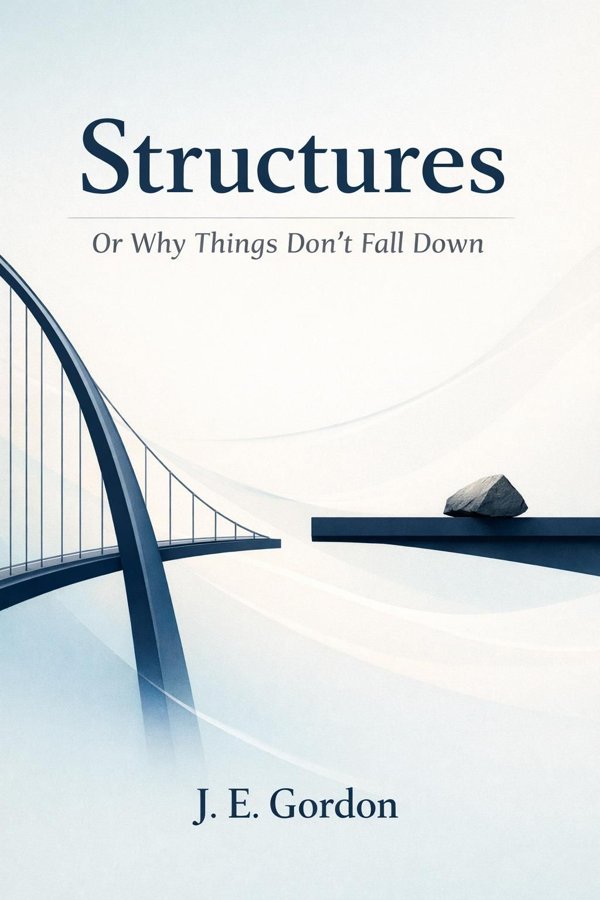
Structures: Or Why Things Don"t Fall Down
Why does a bridge remain standing under thousands of passing cars, while a small flaw can bring down a whole machine? In Structures: Or Why Things Don"t Fall Down, J.E. Gordon answers these questions with unusual clarity, wit, and humanity. Rather than treating engineering as a dry technical subject, he reveals it as a way of seeing the world: a practical science of forces, materials, shape, and failure. From cathedrals and ships to bones, trees, and aircraft, Gordon shows that all structures live under stress and survive only by managing it well. What makes this book enduring is its ability to turn intimidating ideas—stress, strain, compression, bending, fracture, safety factors, scaling—into vivid, memorable insights. Gordon was not only a distinguished materials scientist and engineer, but also one of the rare experts who could explain difficult principles to general readers without oversimplifying them. His examples are concrete, his humor is dry and charming, and his lessons remain relevant in an age of megastructures, lightweight materials, and ambitious design. This is a classic popular science book because it teaches more than engineering: it teaches how the physical world really works.
Read SummaryKey Insights from J.E. Gordon
Forces, Stresses, and Strains Everywhere
A structure does not fail because it exists; it fails because forces are asking more of it than it can give. That simple insight sits at the heart of Gordon’s book. Every object that stands, spans, carries, or protects is engaged in a constant negotiation with gravity, wind, motion, impact, and use....
From Structures: Or Why Things Don"t Fall Down
Tension and Compression Shape Destiny
Materials do not suffer all forces equally, and the difference between being pulled and being squeezed can determine whether a structure thrives or fails. Gordon treats tension and compression as the two great elementary conditions of structural life. In tension, a material is stretched; in compress...
From Structures: Or Why Things Don"t Fall Down
Shear, Bending, and Torsion Matter Too
Structures rarely enjoy the simplicity of pure pulling or pure crushing; most real failures happen in the messy middle. Gordon emphasizes that shear, bending, and torsion are often the less obvious but more dangerous ways loads act. These modes of loading are subtle because they combine or redirect ...
From Structures: Or Why Things Don"t Fall Down
Materials Carry History Inside Them
A material is never just a substance; it is a record of internal structure, manufacturing history, and hidden limitations. Gordon insists that engineering cannot be reduced to abstract equations because real materials are not idealized solids. They contain grain boundaries, fibers, defects, residual...
From Structures: Or Why Things Don"t Fall Down
Failure Is the Best Structural Teacher
Collapse is tragic, but from an engineering perspective it is also revealing. Gordon treats failure not as a mere accident but as a form of evidence. A structure that breaks tells us where our assumptions were wrong, where forces were misunderstood, or where material limits were exceeded. In that se...
From Structures: Or Why Things Don"t Fall Down
Design Means Managing Risk, Not Perfection
No structure is perfectly safe, perfectly light, perfectly cheap, and perfectly efficient at the same time. Gordon makes clear that engineering is an art of compromise governed by physical law. Good design is not about making things indestructible; it is about balancing function, economy, weight, re...
From Structures: Or Why Things Don"t Fall Down
About J.E. Gordon
James Edward Gordon (1913–1998) was a British materials scientist and engineer known for his contributions to the understanding of structural mechanics and materials. He taught at the University of Reading and wrote several influential books that made engineering principles accessible to non-special...
Read more
James Edward Gordon (1913–1998) was a British materials scientist and engineer known for his contributions to the understanding of structural mechanics and materials. He taught at the University of Reading and wrote several influential books that made engineering principles accessible to non-special...
James Edward Gordon (1913–1998) was a British materials scientist and engineer known for his contributions to the understanding of structural mechanics and materials. He taught at the University of Reading and wrote several influential books that made engineering principles accessible to non-specialists.


Frequently Asked Questions
James Edward Gordon (1913–1998) was a British materials scientist and engineer known for his contributions to the understanding of structural mechanics and materials. He taught at the University of Reading and wrote several influential books that made engineering principles accessible to non-specialists.
Read J.E. Gordon's books in 15 minutes
Get AI-powered summaries with key insights from 1 book by J.E. Gordon.