
Georg Wilhelm Friedrich Hegel Books
Georg Wilhelm Friedrich Hegel (1770–1831) was a German philosopher and a leading figure of German Idealism. He taught in Jena, Heidelberg, and Berlin, influencing numerous thinkers of the 19th and 20th centuries.
Known for: Phenomenology of Spirit
Books by Georg Wilhelm Friedrich Hegel
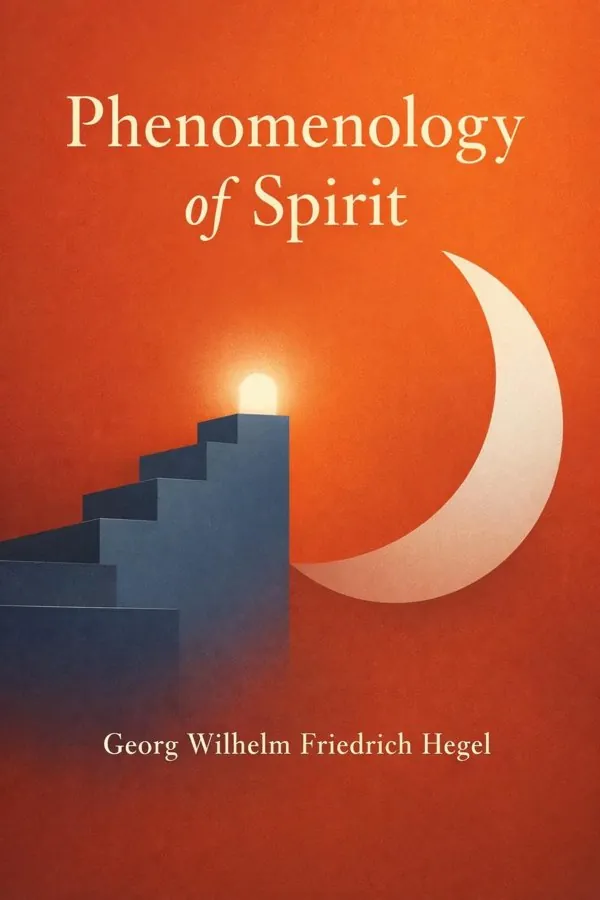
Phenomenology of Spirit
Georg Wilhelm Friedrich Hegel’s Phenomenology of Spirit is one of philosophy’s most ambitious books: a dramatic account of how consciousness develops from immediate sense-experience to self-knowledge, freedom, and philosophical understanding. Rather than presenting static doctrines, Hegel stages a journey. He follows the mind as it tests its own assumptions, discovers contradictions within them, and moves to richer ways of seeing the world. Along the way, he explores perception, self-consciousness, desire, social recognition, morality, religion, and absolute knowing. The result is not simply a theory of knowledge, but a sweeping vision of human development, culture, and history. The book matters because it asks questions that still shape modern thought: How do we know what is true? How does the self become itself? Why do conflict and misunderstanding seem built into human life? And can freedom emerge through struggle rather than despite it? Hegel, a central figure in German idealism, wrote a work that influenced existentialism, Marxism, critical theory, theology, and political philosophy. Difficult yet rewarding, Phenomenology of Spirit remains essential for readers who want to understand how consciousness, society, and history might form a single unfolding process.
Read SummaryKey Insights from Georg Wilhelm Friedrich Hegel
Consciousness Grows Through Failure
One of Hegel’s boldest insights is that error is not the opposite of truth but one of its necessary pathways. In Phenomenology of Spirit, consciousness does not begin with full knowledge and then simply add details. It begins with confidence in limited viewpoints and is forced beyond them when those...
From Phenomenology of Spirit
Experience Is Already Interpreted
What we call “raw experience” is rarely as raw as we think. Hegel challenges the common assumption that knowledge starts with pure, untouched data and only later adds concepts. For him, consciousness is always already organizing, selecting, and interpreting. This means that seeing is never just seei...
From Phenomenology of Spirit
Selfhood Needs Recognition From Others
A self cannot become fully itself in isolation. Hegel’s account of self-consciousness argues that we do not simply discover who we are by looking inward; we become selves through relations with other selves. Recognition is not a social luxury added to an already complete individual. It is a conditio...
From Phenomenology of Spirit
The Master-Slave Dialectic Explained
Power can hide a deeper dependence. Hegel’s famous master-slave dialectic is often summarized too quickly as a simple story about domination, but its deeper meaning concerns the instability of unequal recognition. Two self-conscious beings confront one another, each wanting acknowledgment of its ind...
From Phenomenology of Spirit
Freedom Emerges Inside Social Life
We often imagine freedom as independence from others, but Hegel argues that genuine freedom takes shape within institutions, practices, and shared forms of life. The isolated individual who rejects all dependence may feel unconstrained, yet such freedom is thin and unstable. Real freedom requires a ...
From Phenomenology of Spirit
History Is Rational Development
History, for Hegel, is not a random pile of events but a meaningful process in which forms of life reveal their strengths and contradictions over time. This does not mean every event is good or easily justified. Rather, it means that human history can be understood as the unfolding of freedom throug...
From Phenomenology of Spirit
About Georg Wilhelm Friedrich Hegel
Georg Wilhelm Friedrich Hegel (1770–1831) was a German philosopher and a leading figure of German Idealism. He taught in Jena, Heidelberg, and Berlin, influencing numerous thinkers of the 19th and 20th centuries. His works, including Science of Logic and Philosophy of Right, shaped modern philosophy...
Read more
Georg Wilhelm Friedrich Hegel (1770–1831) was a German philosopher and a leading figure of German Idealism. He taught in Jena, Heidelberg, and Berlin, influencing numerous thinkers of the 19th and 20th centuries. His works, including Science of Logic and Philosophy of Right, shaped modern philosophy...
Georg Wilhelm Friedrich Hegel (1770–1831) was a German philosopher and a leading figure of German Idealism. He taught in Jena, Heidelberg, and Berlin, influencing numerous thinkers of the 19th and 20th centuries. His works, including Science of Logic and Philosophy of Right, shaped modern philosophy, particularly in dialectics, metaphysics, and philosophy of history.


Frequently Asked Questions
Georg Wilhelm Friedrich Hegel (1770–1831) was a German philosopher and a leading figure of German Idealism. He taught in Jena, Heidelberg, and Berlin, influencing numerous thinkers of the 19th and 20th centuries.
Read Georg Wilhelm Friedrich Hegel's books in 15 minutes
Get AI-powered summaries with key insights from 1 book by Georg Wilhelm Friedrich Hegel.