
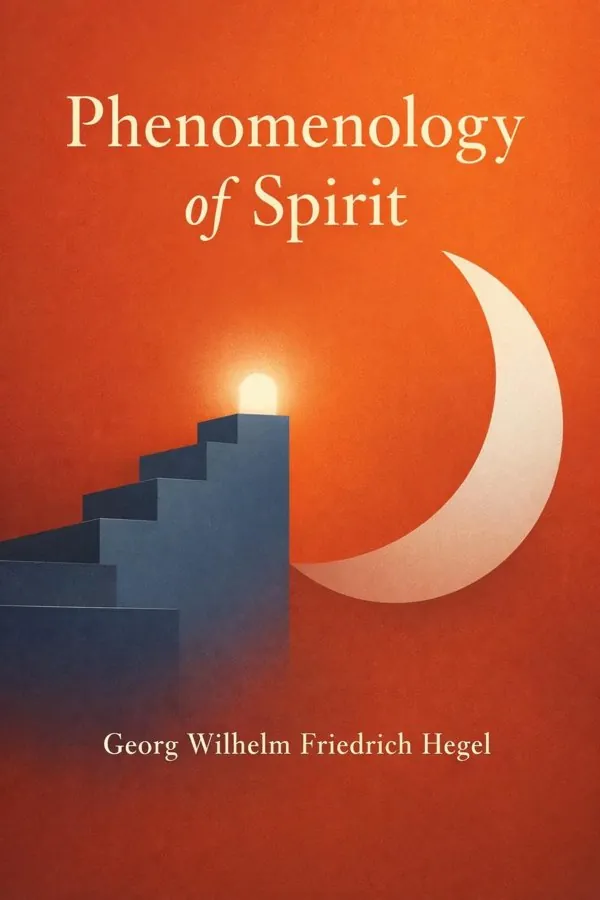
Phenomenology of Spirit: Summary & Key Insights
by Georg Wilhelm Friedrich Hegel
 10 min9 chaptersAudio available
Key Takeaways from Phenomenology of Spirit
One of Hegel’s boldest insights is that error is not the opposite of truth but one of its necessary pathways.
What we call “raw experience” is rarely as raw as we think.
A self cannot become fully itself in isolation.
Power can hide a deeper dependence.
We often imagine freedom as independence from others, but Hegel argues that genuine freedom takes shape within institutions, practices, and shared forms of life.
What Is Phenomenology of Spirit About?
Phenomenology of Spirit by Georg Wilhelm Friedrich Hegel is a general book. Georg Wilhelm Friedrich Hegel’s Phenomenology of Spirit is one of philosophy’s most ambitious books: a dramatic account of how consciousness develops from immediate sense-experience to self-knowledge, freedom, and philosophical understanding. Rather than presenting static doctrines, Hegel stages a journey. He follows the mind as it tests its own assumptions, discovers contradictions within them, and moves to richer ways of seeing the world. Along the way, he explores perception, self-consciousness, desire, social recognition, morality, religion, and absolute knowing. The result is not simply a theory of knowledge, but a sweeping vision of human development, culture, and history. The book matters because it asks questions that still shape modern thought: How do we know what is true? How does the self become itself? Why do conflict and misunderstanding seem built into human life? And can freedom emerge through struggle rather than despite it? Hegel, a central figure in German idealism, wrote a work that influenced existentialism, Marxism, critical theory, theology, and political philosophy. Difficult yet rewarding, Phenomenology of Spirit remains essential for readers who want to understand how consciousness, society, and history might form a single unfolding process.
This FizzRead summary covers all 9 key chapters of Phenomenology of Spirit in approximately 10 minutes, distilling the most important ideas, arguments, and takeaways from Georg Wilhelm Friedrich Hegel's work. Also available as an audio summary and Key Quotes Podcast.
Phenomenology of Spirit
Georg Wilhelm Friedrich Hegel’s Phenomenology of Spirit is one of philosophy’s most ambitious books: a dramatic account of how consciousness develops from immediate sense-experience to self-knowledge, freedom, and philosophical understanding. Rather than presenting static doctrines, Hegel stages a journey. He follows the mind as it tests its own assumptions, discovers contradictions within them, and moves to richer ways of seeing the world. Along the way, he explores perception, self-consciousness, desire, social recognition, morality, religion, and absolute knowing. The result is not simply a theory of knowledge, but a sweeping vision of human development, culture, and history.
The book matters because it asks questions that still shape modern thought: How do we know what is true? How does the self become itself? Why do conflict and misunderstanding seem built into human life? And can freedom emerge through struggle rather than despite it? Hegel, a central figure in German idealism, wrote a work that influenced existentialism, Marxism, critical theory, theology, and political philosophy. Difficult yet rewarding, Phenomenology of Spirit remains essential for readers who want to understand how consciousness, society, and history might form a single unfolding process.
Who Should Read Phenomenology of Spirit?
This book is perfect for anyone interested in general and looking to gain actionable insights in a short read. Whether you're a student, professional, or lifelong learner, the key ideas from Phenomenology of Spirit by Georg Wilhelm Friedrich Hegel will help you think differently.
- ✓Readers who enjoy general and want practical takeaways
- ✓Professionals looking to apply new ideas to their work and life
- ✓Anyone who wants the core insights of Phenomenology of Spirit in just 10 minutes
Want the full summary?
Get instant access to this book summary and 100K+ more with Fizz Moment.
Get Free SummaryAvailable on App Store • Free to download
Key Chapters
One of Hegel’s boldest insights is that error is not the opposite of truth but one of its necessary pathways. In Phenomenology of Spirit, consciousness does not begin with full knowledge and then simply add details. It begins with confidence in limited viewpoints and is forced beyond them when those viewpoints collapse under pressure. What looks like failure becomes development.
Hegel opens with forms of consciousness that seem natural and convincing. Sense-certainty assumes that immediate experience gives direct access to reality: what is here, now, and given must be the truest knowledge. Yet the attempt to express this immediacy turns it into something universal and abstract. Perception then treats things as stable objects with properties, but this too creates contradictions between what belongs to the object and what is supplied by the observer. Understanding seeks laws beneath appearances, but it also discovers that the mind’s own activity shapes what it claims merely to observe.
This pattern defines the book: each stage contains a truth, but not the whole truth. Consciousness learns by inhabiting a form of knowing until its internal tensions become visible. In modern life, the same process appears when a person trusts first impressions in a workplace conflict, then realizes they misread motives, and finally adopts a more reflective view that includes context, systems, and their own assumptions. A team, a culture, or even a scientific discipline often advances in the same way—through models that work for a while, then break down.
Hegel’s lesson is deeply practical. Growth often feels like disillusionment because what once seemed solid starts to fail. But this breakdown is not meaningless. It can be the sign that a narrower perspective is giving way to a wider one. Actionable takeaway: when your current framework no longer explains your experience, do not cling to it defensively; ask what larger perspective the failure is inviting you to develop.
What we call “raw experience” is rarely as raw as we think. Hegel challenges the common assumption that knowledge starts with pure, untouched data and only later adds concepts. For him, consciousness is always already organizing, selecting, and interpreting. This means that seeing is never just seeing; it is a way of taking something as something.
In the early chapters, Hegel shows why immediate certainty cannot remain immediate. If I say, “This object here is real because I directly perceive it,” I imagine I am pointing to something singular and undeniable. But the moment I speak or think it, I use universal terms like “this,” “here,” and “now.” The supposedly unique experience slips into conceptual form. Perception, then, is not free of thought. Even when I believe I am just observing, I rely on categories, distinctions, and expectations that make the object intelligible at all.
This insight remains powerful today. A manager reviewing an employee’s performance may believe they are simply reporting facts, while in reality they are filtering behavior through assumptions about professionalism, confidence, or leadership. A person following the news may think they are consuming neutral information, but interpretation is already at work in framing, emphasis, and prior belief. In personal relationships, we often mistake our interpretation of someone’s silence for the silence itself.
Hegel is not saying truth is impossible. He is saying that truth requires becoming aware of the concepts through which the world appears. Better knowledge comes not from pretending to eliminate interpretation, but from examining it critically and making it more adequate. Actionable takeaway: when you feel certain that you are “just seeing the facts,” pause and ask what assumptions, language, or categories are quietly shaping what you take those facts to be.
A self cannot become fully itself in isolation. Hegel’s account of self-consciousness argues that we do not simply discover who we are by looking inward; we become selves through relations with other selves. Recognition is not a social luxury added to an already complete individual. It is a condition for genuine selfhood.
This idea appears most famously in the struggle for recognition. Self-consciousness wants certainty of itself, but it finds that certainty only when another consciousness acknowledges it. The problem is that each seeks recognition while also trying to assert independence. This can turn into conflict, because each wants to be affirmed without granting equal standing to the other. The result is a dramatic tension: the self needs the other, yet resists dependence on the other.
Hegel’s insight helps explain why disrespect, exclusion, and humiliation cut so deeply. They do not merely hurt feelings; they wound the very social basis through which identity is formed. In everyday life, a child develops confidence when caregivers recognize their agency. An employee flourishes when their contribution is seen rather than treated as replaceable. Citizens demand legal rights not only for material protection but also for public acknowledgment of equal worth. Even online life reveals the same structure, though often in distorted form: people seek visibility because being ignored can feel like nonexistence.
Recognition also has ethical implications. If my selfhood depends on others, then domination is self-defeating. A relationship based on fear, manipulation, or one-sided control cannot provide the mutual recognition that freedom requires. Healthy friendship, partnership, teaching, and leadership all involve forms of reciprocal acknowledgment.
Hegel invites us to treat social life not as a distraction from authenticity but as one of its foundations. Actionable takeaway: strengthen your identity not by demanding attention alone, but by practicing mutual recognition—listen seriously, acknowledge others’ agency, and build relationships in which both sides can be seen as fully human.
Power can hide a deeper dependence. Hegel’s famous master-slave dialectic is often summarized too quickly as a simple story about domination, but its deeper meaning concerns the instability of unequal recognition. Two self-conscious beings confront one another, each wanting acknowledgment of its independence. Their struggle leads to an unequal arrangement: one becomes master, the other servant. At first, this seems to secure the master’s superiority. Yet the arrangement contains a contradiction.
The master wants recognition from another self-conscious being, but the recognition received from a subordinated dependent is inadequate. The servant has been denied equal standing, so the acknowledgment lacks the freedom the master actually needs. Meanwhile, the servant—through labor, discipline, and engagement with the material world—undergoes development. By working on things, delaying immediate desire, and transforming the world, the servant gains a deeper relation to reality and to selfhood. The master enjoys immediate consumption; the servant acquires formative power.
This reversal makes the dialectic enduringly relevant. In a company, an executive who assumes status alone proves authority may become insulated from reality, while those doing the practical work understand systems, constraints, and possibilities more clearly. In politics, regimes that rely on subordination often discover that those they treat as passive subjects become the true agents of transformation. In personal life, someone who controls a relationship may appear stronger, yet emotional maturity often develops more in the one who has had to reflect, adapt, and endure.
Hegel is not glorifying oppression. He is showing that domination fails on its own terms. Recognition cannot be forced, and the side that works through reality may become the side that truly develops. Actionable takeaway: do not confuse status with growth; look for where real learning, discipline, and world-shaping activity are happening, because that is often where deeper power is being formed.
History, for Hegel, is not a random pile of events but a meaningful process in which forms of life reveal their strengths and contradictions over time. This does not mean every event is good or easily justified. Rather, it means that human history can be understood as the unfolding of freedom through conflict, transformation, and learning.
In Phenomenology of Spirit, consciousness is never merely private. Its shapes are also historical formations embodied in cultures, institutions, religions, and social worlds. Ways of understanding reality emerge, stabilize, and eventually break apart when they can no longer contain the aspirations or tensions within them. New forms arise not from nowhere but from the unresolved contradictions of earlier ones. History therefore has movement and intelligibility.
This idea influenced generations of thinkers because it offers a way to connect personal development with social change. Consider how attitudes toward rights evolve. A society may begin with a narrow idea of who counts as fully human. Over time, excluded groups challenge that limitation, exposing a contradiction between proclaimed universal principles and actual practice. The result can be institutional reform and a broader conception of freedom. The process is conflict-ridden and incomplete, but not meaningless.
The same logic can be applied more modestly in organizations or communities. A school may pride itself on excellence yet ignore unequal access. Eventually, the contradiction between its stated mission and lived reality forces reflection and reform. Hegel teaches us to look for tensions not as accidental flaws alone, but as signals of historical movement.
Still, his view requires caution. Not every outcome is progress, and appeals to “history” can become excuses for complacency. The point is to understand development critically, not to worship whatever exists. Actionable takeaway: when examining social change, ask what contradictions are driving it and how present institutions may contain the seeds of their own transformation.
Feeling divided from yourself or your world may be painful, but Hegel suggests that alienation can also become a route to deeper truth. Much of Phenomenology of Spirit explores forms of consciousness that are estranged—from nature, from society, from moral certainty, or from the divine. Yet this estrangement is not merely a dead end. It can expose simplistic harmonies and force a more mature reconciliation.
A crucial example appears in what Hegel calls the “unhappy consciousness,” a divided self that experiences an unbridgeable gap between finite human life and an infinite beyond. The self feels inadequate, fragmented, and unable to coincide with what it takes to be truly real or holy. While this condition is painful, it also marks a significant development: consciousness has become aware of its own split rather than resting in naïve unity. Through this suffering, it may prepare the way for a higher understanding in which the opposition is reworked rather than simply denied.
Modern readers can recognize this pattern in secular terms. A person may achieve professional success yet feel strangely detached from their work, discovering that external achievement alone does not answer deeper questions of purpose. A society may celebrate equality while many experience exclusion, and the discomfort of that mismatch can generate ethical clarity. In learning, students often reach moments when old certainties dissolve before a more integrated understanding emerges.
Hegel’s insight is not that suffering is good in itself. It is that alienation becomes fruitful when it is interpreted and worked through rather than numbly endured. The gap we feel may reveal a contradiction that needs transformation. Actionable takeaway: when you experience estrangement, resist the urge to dismiss it as mere weakness; ask what false unity has broken apart and what more honest form of integration might now be possible.
Abstract ideals can inspire us, but if they remain detached from lived reality, they often become destructive or empty. Hegel repeatedly shows that reason must become concrete—it must take shape in practices, institutions, and forms of life that can actually sustain it. Otherwise, noble principles may collapse into hypocrisy, fanaticism, or impotence.
As the book moves through morality, culture, and spirit, Hegel examines what happens when individuals cling to pure inward conviction without reconciling it with the complexity of the world. A person may insist on moral purity while ignoring consequences, social responsibilities, or the legitimacy of other perspectives. In such cases, conscience can become self-enclosed, mistaking private certainty for universal truth. Hegel is skeptical of any stance that claims righteousness while refusing the hard work of mediation.
This remains highly relevant. In public debate, people often affirm justice, freedom, or authenticity in the abstract while neglecting the institutional design needed to realize those values. In organizations, leaders may speak about transparency yet create incentives for secrecy. In personal life, someone may declare commitment to honesty but communicate carelessly, causing avoidable harm. The issue is not whether ideals matter—they do—but whether they are embodied responsibly.
Hegel pushes us beyond the false choice between cynical realism and empty idealism. Reason becomes real when principles are tested, revised, and enacted in ways that acknowledge complexity. That includes compromise at times, but not surrender. It means bringing universals into contact with particulars without losing either.
Actionable takeaway: whenever you hold a strong principle, ask how it can be made concrete—what habits, structures, language, and responsibilities are required for that ideal to exist in more than words.
The phrase “absolute knowing” can sound like a claim to omniscience, as if Hegel believed philosophy could float above history and possess every truth once and for all. But in the context of Phenomenology of Spirit, absolute knowing is better understood as a transformed perspective on knowledge itself. It is the point at which consciousness recognizes that truth emerges through its own historical movement rather than standing as a fixed object wholly outside that movement.
At the end of the book, Hegel does not simply hand the reader a final doctrine to memorize. Instead, he seeks a standpoint from which the earlier stages can be understood as necessary moments in a larger development. Absolute knowing grasps that the opposition between subject and object, knower and known, has been too crudely conceived. Consciousness comes to see that what it encounters as external is always already related to the structures through which it knows, and that these structures themselves have a history.
In practical terms, this is a lesson in reflexive maturity. A seasoned scholar no longer imagines their discipline began with them or that methods are neutral tools without history. A wise leader understands that every decision emerges from institutional patterns, inherited language, and evolving self-understanding. A reflective person stops asking only, “What do I know?” and also asks, “How did this way of knowing become possible?”
Absolute knowing is therefore not the end of questioning but the end of naïveté about questioning. It is a standpoint of reconciliation with the labor of thought, where contradictions are not denied but comprehended as moments of development. Actionable takeaway: deepen understanding by reflecting not only on your conclusions, but on the path, assumptions, and historical conditions that made those conclusions possible.
All Chapters in Phenomenology of Spirit
About the Author
Georg Wilhelm Friedrich Hegel (1770–1831) was a German philosopher and one of the most influential thinkers in modern intellectual history. Born in Stuttgart, he studied theology and philosophy and became a leading figure in German idealism alongside Kant, Fichte, and Schelling. Hegel taught at Jena, Heidelberg, and Berlin, where his lectures attracted wide attention. His major works include Phenomenology of Spirit, Science of Logic, Encyclopedia of the Philosophical Sciences, and Elements of the Philosophy of Right. Hegel developed a powerful vision of reality as a dynamic process shaped by contradiction, development, and reconciliation. His ideas profoundly influenced later philosophy, politics, theology, and social theory, leaving a lasting mark on thinkers from Marx and Kierkegaard to twentieth-century existentialists and critical theorists.
Get This Summary in Your Preferred Format
Read or listen to the Phenomenology of Spirit summary by Georg Wilhelm Friedrich Hegel anytime, anywhere. FizzRead offers multiple formats so you can learn on your terms — all free.
Available formats: App · Audio · PDF · EPUB — All included free with FizzRead
Download Phenomenology of Spirit PDF and EPUB Summary
Key Quotes from Phenomenology of Spirit
“One of Hegel’s boldest insights is that error is not the opposite of truth but one of its necessary pathways.”
“What we call “raw experience” is rarely as raw as we think.”
“A self cannot become fully itself in isolation.”
“Hegel’s famous master-slave dialectic is often summarized too quickly as a simple story about domination, but its deeper meaning concerns the instability of unequal recognition.”
“We often imagine freedom as independence from others, but Hegel argues that genuine freedom takes shape within institutions, practices, and shared forms of life.”
Frequently Asked Questions about Phenomenology of Spirit
Phenomenology of Spirit by Georg Wilhelm Friedrich Hegel is a general book that explores key ideas across 9 chapters. Georg Wilhelm Friedrich Hegel’s Phenomenology of Spirit is one of philosophy’s most ambitious books: a dramatic account of how consciousness develops from immediate sense-experience to self-knowledge, freedom, and philosophical understanding. Rather than presenting static doctrines, Hegel stages a journey. He follows the mind as it tests its own assumptions, discovers contradictions within them, and moves to richer ways of seeing the world. Along the way, he explores perception, self-consciousness, desire, social recognition, morality, religion, and absolute knowing. The result is not simply a theory of knowledge, but a sweeping vision of human development, culture, and history. The book matters because it asks questions that still shape modern thought: How do we know what is true? How does the self become itself? Why do conflict and misunderstanding seem built into human life? And can freedom emerge through struggle rather than despite it? Hegel, a central figure in German idealism, wrote a work that influenced existentialism, Marxism, critical theory, theology, and political philosophy. Difficult yet rewarding, Phenomenology of Spirit remains essential for readers who want to understand how consciousness, society, and history might form a single unfolding process.
You Might Also Like
Duct Tape Marketing: The World's Most Practical Small Business Marketing Guide
John Jantsch
10 minDusk, Night, Dawn: On Revival and Courage
Anne Lamott
10 minFinish Big: How Great Entrepreneurs Exit Their Companies on Top
Bo Burlingham
10 minFirst As Tragedy, Then As Farce
Slavoj Zizek
10 minFirst Principles: What America's Founders Learned from the Greeks and Romans and How That Shaped Our Country
Thomas E. Ricks
10 minGood Habits, Bad Habits: The Science of Making Positive Changes That Stick
Wendy Wood
10 minBrowse by Category
Ready to read Phenomenology of Spirit?
Get the full summary and 100K+ more books with Fizz Moment.