
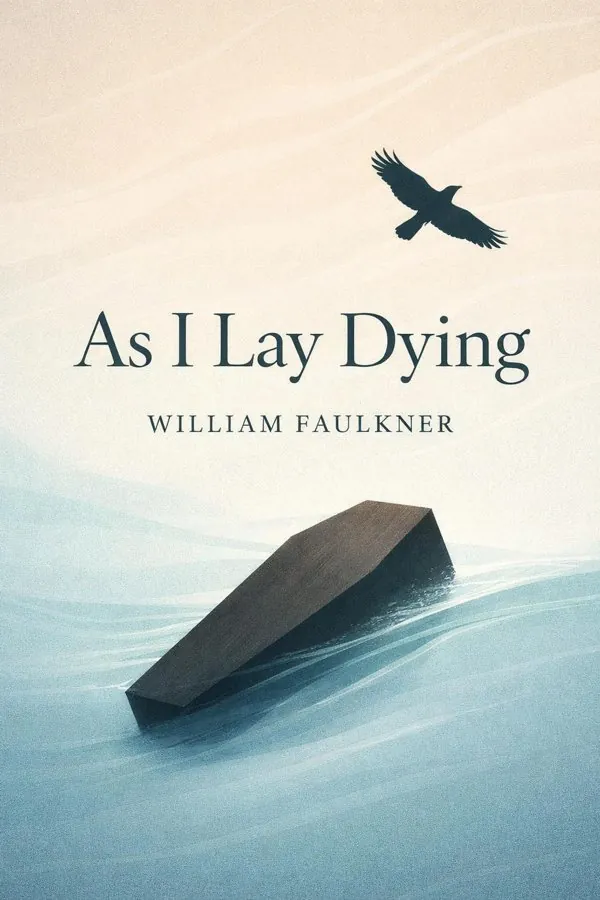
As I Lay Dying: Summary & Key Insights
 10 min5 chaptersAudio available
What Is As I Lay Dying About?
As I Lay Dying by William Faulkner is a classics book spanning 5 pages. Set in the American South, this novel follows the Bundren family as they journey to fulfill their matriarch Addie Bundren’s wish to be buried in her hometown. Told through multiple narrators, the story explores themes of death, identity, and the disintegration of family and faith amid hardship and absurdity.
This FizzRead summary covers all 5 key chapters of As I Lay Dying in approximately 10 minutes, distilling the most important ideas, arguments, and takeaways from William Faulkner's work. Also available as an audio summary and Key Quotes Podcast.
As I Lay Dying
Set in the American South, this novel follows the Bundren family as they journey to fulfill their matriarch Addie Bundren’s wish to be buried in her hometown. Told through multiple narrators, the story explores themes of death, identity, and the disintegration of family and faith amid hardship and absurdity.
Who Should Read As I Lay Dying?
This book is perfect for anyone interested in classics and looking to gain actionable insights in a short read. Whether you're a student, professional, or lifelong learner, the key ideas from As I Lay Dying by William Faulkner will help you think differently.
- ✓Readers who enjoy classics and want practical takeaways
- ✓Professionals looking to apply new ideas to their work and life
- ✓Anyone who wants the core insights of As I Lay Dying in just 10 minutes
Want the full summary?
Get instant access to this book summary and 100K+ more with Fizz Moment.
Get Free SummaryAvailable on App Store • Free to download
Key Chapters
When I conceived Addie Bundren lying on her deathbed, I set her at the heart of a spinning world—the eye of a storm through which each family member’s consciousness would pass. Her death is not merely physical; it shatters the unity that held the Bundrens together. Addie, watching the coffin being built outside her window, experiences her end as a slow unveiling of hypocrisy. Cash’s precise hammer strikes are acts of love expressed through geometry; he defines devotion in angles and balance. Yet the others circle around in anticipation that is both reverent and selfish. Anse clings to the idea of fulfilling his wife’s wish not out of loyalty, but from a desperate hunger for justification and, perhaps, for the rewards waiting at journey’s end—new teeth, new life. Jewel’s impatience burns hotter, his care silent and brutal, born of an illegitimate bond that fills him with shame more than affection.
In these tones I wished to depict how death strips away illusion. Addie’s stillness becomes the mirror in which her family’s true motives reflect. Cash’s craftsmanship converts devotion into practicality; Anse’s piety into narcissism; Dewey Dell’s guilt into quiet panic; Darl’s intellect into detachment. Death becomes the stage upon which meaning is exposed as temporary, language as deceitful, and family as a fragile structure held together only by the necessity of movement. Here begins the journey—their collective pilgrimage toward Jefferson, undertaken in the name of duty but propelled by needs far darker and more individual.
The road to Jefferson serves as crucible. I built it from red clay and swollen river, from heat and dust and the impassivity of the land that watches human struggle with silent indifference. The Bundrens’ progress unfolds not linearly but in fragments, each voice revealing its own universe of motive. Cash’s methodical reason tries to organize chaos, but the countryside resists his precision. When the family reaches the flooded river, nature asserts its superiority: the wagon overturns, mules drown, Cash’s leg breaks, and the coffin—a symbol of both devotion and decay—teeters between rescue and loss. Jewel’s fierce act of saving the coffin, plunging into the current with his mother’s body drifting beside him, embodies the paradox I wanted to capture: love expressed through brutal defiance, heroism born of guilt.
As they travel, the distinctions between loyalty and obsession blur. Darl’s perspective grows sharper and stranger, his awareness a burden rather than a gift. He sees too deeply—the illegitimacy of Jewel’s birth, the futility of the journey—and his insight isolates him. Dewey Dell’s internal monologue shrinks to the turmoil of her own body, trapped between duty and desire. Meanwhile, Anse’s religiosity hardens into self-interest, every setback interpreted as divine trial he must patiently endure, though secretly he counts the benefits waiting at the end. Through their fatigue and hunger, I etched the grotesque poetry of human persistence—the way suffering becomes ritual, and ritual becomes justification for continuing to suffer.
The land itself replaces God; it tests them, absorbs them, and refuses consolation. Each Bundren confronts mortality not abstractly but physically—in mud, in decay, in the shaping of wood and crossing of water. Through their slow progression I tried to evoke the absurdity of faith, how devotion can depend on misunderstanding. For all their toil, the direction remains the same: toward Jefferson, toward the satisfaction of a debt whose moral weight none of them comprehends.
+ 3 more chapters — available in the FizzRead app
All Chapters in As I Lay Dying
About the Author
William Faulkner (1897–1962) was an American novelist and short story writer known for his complex narratives and innovative literary style. A Nobel Prize laureate in Literature (1949), Faulkner is celebrated for his portrayals of the American South, particularly through his fictional Yoknapatawpha County.
Get This Summary in Your Preferred Format
Read or listen to the As I Lay Dying summary by William Faulkner anytime, anywhere. FizzRead offers multiple formats so you can learn on your terms — all free.
Available formats: App · Audio · PDF · EPUB — All included free with FizzRead
Download As I Lay Dying PDF and EPUB Summary
Key Quotes from As I Lay Dying
“When I conceived Addie Bundren lying on her deathbed, I set her at the heart of a spinning world—the eye of a storm through which each family member’s consciousness would pass.”
“The road to Jefferson serves as crucible.”
Frequently Asked Questions about As I Lay Dying
As I Lay Dying by William Faulkner is a classics book that explores key ideas across 5 chapters. Set in the American South, this novel follows the Bundren family as they journey to fulfill their matriarch Addie Bundren’s wish to be buried in her hometown. Told through multiple narrators, the story explores themes of death, identity, and the disintegration of family and faith amid hardship and absurdity.
More by William Faulkner

You Might Also Like






Browse by Category
Ready to read As I Lay Dying?
Get the full summary and 100K+ more books with Fizz Moment.