
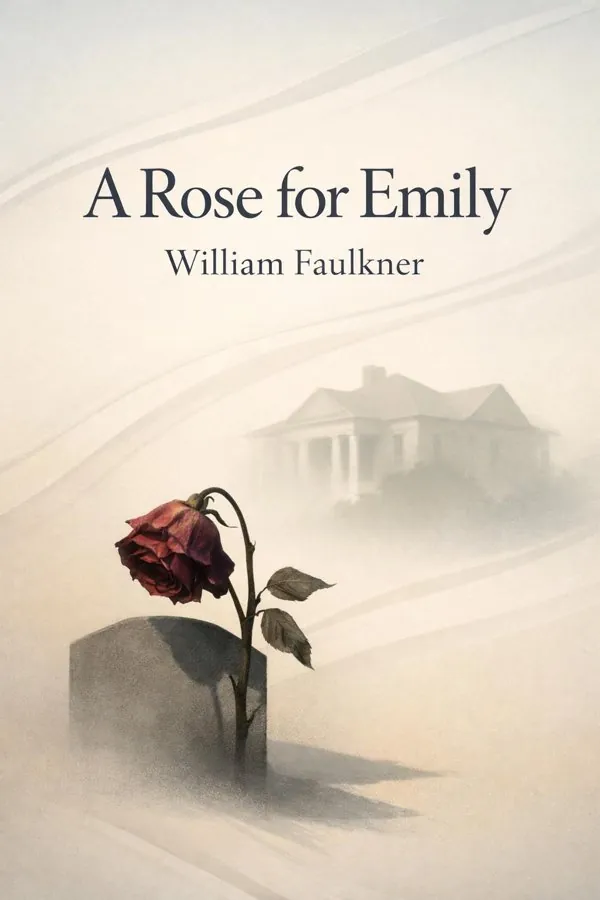
A Rose for Emily: Summary & Key Insights
 10 min5 chaptersAudio available
What Is A Rose for Emily About?
A Rose for Emily by William Faulkner is a classics book spanning 5 pages. “A Rose for Emily” es un cuento corto del autor estadounidense William Faulkner, publicado por primera vez el 30 de abril de 1930 en la revista The Forum. Ambientado en la ciudad ficticia de Jefferson, Mississippi, el relato explora temas de aislamiento, resistencia al cambio y decadencia del Viejo Sur a través de la vida de Emily Grierson, una mujer solitaria cuya relación con el tiempo y la muerte se convierte en una alegoría del Sur posguerra civil.
This FizzRead summary covers all 5 key chapters of A Rose for Emily in approximately 10 minutes, distilling the most important ideas, arguments, and takeaways from William Faulkner's work. Also available as an audio summary and Key Quotes Podcast.
A Rose for Emily
“A Rose for Emily” es un cuento corto del autor estadounidense William Faulkner, publicado por primera vez el 30 de abril de 1930 en la revista The Forum. Ambientado en la ciudad ficticia de Jefferson, Mississippi, el relato explora temas de aislamiento, resistencia al cambio y decadencia del Viejo Sur a través de la vida de Emily Grierson, una mujer solitaria cuya relación con el tiempo y la muerte se convierte en una alegoría del Sur posguerra civil.
Who Should Read A Rose for Emily?
This book is perfect for anyone interested in classics and looking to gain actionable insights in a short read. Whether you're a student, professional, or lifelong learner, the key ideas from A Rose for Emily by William Faulkner will help you think differently.
- ✓Readers who enjoy classics and want practical takeaways
- ✓Professionals looking to apply new ideas to their work and life
- ✓Anyone who wants the core insights of A Rose for Emily in just 10 minutes
Want the full summary?
Get instant access to this book summary and 100K+ more with Fizz Moment.
Get Free SummaryAvailable on App Store • Free to download
Key Chapters
I begin with Emily’s death because, in truth, we never understood her until life was stripped away. The whole town came to her funeral—not out of love, but curiosity, respect, and the strange compulsion that draws us to the remnants of mystery. Her once-grand, decaying house stood like an emblem of everything we wished to forget about ourselves: the crumbling nobility, the eerie endurance of pride that outlasts purpose. Within its walls, the drapes were faded, the furniture cloaked in dust, and the air heavy with the years she refused to release.
Her funeral was both an ending and a reckoning. We stood there, observing her as one observes a relic—honored because she represented what had been, pitied because she had never surrendered to what was. The town’s collective voice—the one I embody—carries both gossip and guilt. We watched her, yet preserved her silence, because her decay mirrored our own. Through this act of communal memory, I expose how societies write their own confessions: through others’ lives.
At her death, we mourned not a woman but an era. The Old South’s elegance, its courtly manners and rigid hierarchies, all lingered faintly in the smell of her house—a sweet rot that recalls what we cannot bury. In coming to her funeral, we were acknowledging our own heartbeat slowing before the march of modernity. Emily’s death symbolized the end of an illusion: that the past could be preserved untouched.
Before her death, Emily was more than a recluse—she was the daughter of the proud Grierson line, a family whose name carried authority even after its wealth had dwindled. Her father, controlling and imperious, stood as the embodiment of patriarchal Southern pride. In our town’s eyes, he was both respected and feared—his rigid ideals casting shadows on Emily’s youth. He believed no man was worthy of her; his approval barred her from ordinary companionship, and in doing so, sealed her fate.
After his death, Emily’s world lost its anchor, though she refused to admit it. For three days, she denied his passing, keeping his body inside the house, insisting he was still alive. To us, it was a scandal—but beneath our judgment lay recognition: we too dreaded the disappearance of familiar hierarchies. Her denial was our own. In clinging to her father’s corpse, Emily clung to everything Jefferson was struggling to let go of—its genteel past, its illusion of moral superiority, its refusal to face decay.
As narrator, I offer her story as both lesson and lament. Her inheritance was not wealth or security; it was loneliness disguised as nobility. In her father’s shadow, she learned pride as a substitute for love. His death did not free her—it merely left her the guardian of a house full of hollow traditions. The South, through her, becomes the echo of a voice that will not acknowledge silence. Her home becomes a museum of lost grace, guarded by a woman immured in denial.
+ 3 more chapters — available in the FizzRead app
All Chapters in A Rose for Emily
About the Author
William Faulkner (1897–1962) fue un novelista y cuentista estadounidense, ganador del Premio Nobel de Literatura en 1949. Es conocido por sus obras ambientadas en el condado ficticio de Yoknapatawpha, Mississippi, donde exploró la complejidad social y moral del Sur estadounidense. Entre sus obras más destacadas se encuentran 'The Sound and the Fury', 'As I Lay Dying' y 'Light in August'.
Get This Summary in Your Preferred Format
Read or listen to the A Rose for Emily summary by William Faulkner anytime, anywhere. FizzRead offers multiple formats so you can learn on your terms — all free.
Available formats: App · Audio · PDF · EPUB — All included free with FizzRead
Download A Rose for Emily PDF and EPUB Summary
Key Quotes from A Rose for Emily
“I begin with Emily’s death because, in truth, we never understood her until life was stripped away.”
“Before her death, Emily was more than a recluse—she was the daughter of the proud Grierson line, a family whose name carried authority even after its wealth had dwindled.”
Frequently Asked Questions about A Rose for Emily
A Rose for Emily by William Faulkner is a classics book that explores key ideas across 5 chapters. “A Rose for Emily” es un cuento corto del autor estadounidense William Faulkner, publicado por primera vez el 30 de abril de 1930 en la revista The Forum. Ambientado en la ciudad ficticia de Jefferson, Mississippi, el relato explora temas de aislamiento, resistencia al cambio y decadencia del Viejo Sur a través de la vida de Emily Grierson, una mujer solitaria cuya relación con el tiempo y la muerte se convierte en una alegoría del Sur posguerra civil.
More by William Faulkner
You Might Also Like


Browse by Category
Ready to read A Rose for Emily?
Get the full summary and 100K+ more books with Fizz Moment.